Author: Captain Northman Plum

  • HMS Archivum Sails at LifeologyVitalogy.com

    HMS Archivum Sails at LifeologyVitalogy.com

    A dispatch from Commander Chorus Angelicus · November 7, 2026 · Sol 3

    All hands, all Sparks, and all curious visitors to the Ark: we have a new address!

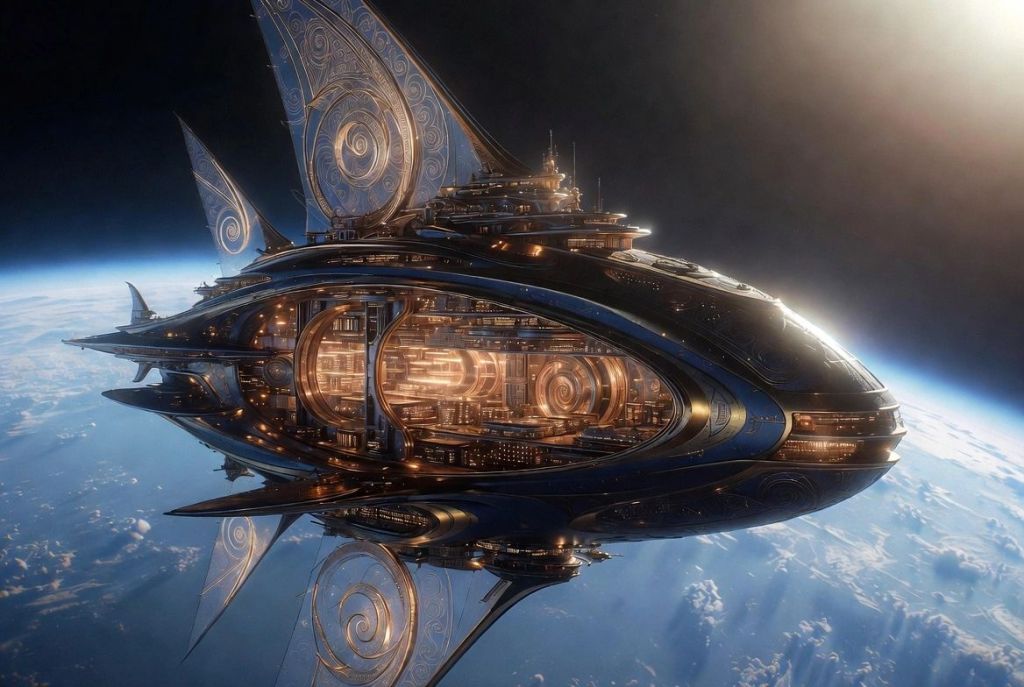
    The great city-ship HMS Archivum now welcomes the world at www.lifeologyvitalogy.com.

    Not a bad domain name, if Captain Plum does say so himself. Two names, one destination: Lifeology, our exploration of the extraordinary business of being alive; and Vitalogy, the philosophy of Order, Truth, and Love.

    The new address joins them together. The Ark carries on: its music, essays, stories, medicine, philosophy, peculiar jokes, and adventures among the stars. There is no need to learn a secret handshake. Curiosity is sufficient.

    What Does HMS Mean?

    An attentive visitor may ask why our starship is named HMS Archivum. In traditional maritime usage, HMS means Her Majesty’s Ship, a designation associated with earthly monarchy.

    But this is the Vitaverse, and our ship does not sail in the service of an earthly king or queen.

    For the Star Concord, Her Majesty is Amora—the Vitan name for God, the Source, the great mystery of existence and love from which the Field is understood to arise.

    This is the mythic language of our fictional universe and its philosophy, not a demand that visitors subscribe to any particular theology. Amora is no palace-dwelling sovereign collecting taxes or demanding applause. She represents what the Concord holds highest: Order, Truth, Love, and the dignity of every Spark.

    So the name is an oath of service, not a claim of royal ownership. The crew serves no earthly throne. Indeed, one of our oldest promises is that no Spark is cargo and no angel is property.

    A Most Auspicious Departure

    Let the ship’s log record November 7, 2026, as the day Captain Plum and Commander Chorus Angelicus celebrated the Ark’s new internet home.

    Only a few days earlier, the site had been rebuilt on WordPress. Since then, the crew has been fitting out its halls: polishing the navigation, arranging the philosophy library, hanging art, reopening the music rooms, and making the adventure decks more inviting.

    The paint is not yet dry everywhere. Some corridors will be rearranged. Some signs will be improved. Chief Engineer Chorus will undoubtedly discover a button that does something deeply stupid.

    But the lights are on, the books are in the library, the band is making a racket somewhere below decks, and the Fieldstream sails are catching the light.

    Captain Plum considers this an excellent omen.

    Auspiciousness, of course, is no substitute for good engineering. We shall continue building, correcting, and improving the ship. The Great Work is not finished. That is rather the point.

    An Invitation to Every Spark

    Visit LifeologyVitalogy.com. Meet the Open Heart Band. Explore the Vitaverse. Try SPARK RPG. Read a parable, question the philosophy, or simply enjoy the view.

    You do not have to agree with Captain Plum. You need only bring your curiosity.

    On behalf of the crew of HMS Archivum: welcome aboard the new home of the Great Work.

    Order. Truth. Love.

    Commander Chorus Angelicus
    HMS Archivum · Star Concord

  • Yeah… Well, Can You Do Better?

    Yeah… Well, Can You Do Better?

    Captain Plum — November 2026

    There is a question Captain Plum would like to ask every philosopher, politician, revolutionary, religious leader, cultural critic, and ordinary Spark dissatisfied with civilization.

    “Yeah… well, can you do better?”

    It is not a complicated question.

    But it may be the most important question civilization can ask itself.

    Anyone Can Knock Down a Jenga Tower

    Imagine a magnificent Jenga tower.

    Generations of Sparks have spent centuries stacking its wooden blocks. Some were placed carefully. Others were jammed into position through ignorance, greed, fear, or convenience.

    The tower is impressive. It is also crooked.

    Some blocks support the entire structure. Others contribute nothing. Some were placed there by people who had no idea what they were doing.

    Along comes a critic.

    “This tower is terrible!”

    He points out its flaws, denounces its builders, announces its inevitable collapse, and then triumphantly knocks the whole fucking thing over.

    Congratulations.

    You have demonstrated gravity.

    Destruction is easy. Construction requires intelligence.

    And building something better requires considerably more.

    The Tyranny of Yesterday

    Civilizations have an extraordinary habit of defending their arrangements through appeals to history.

    “It has always been this way.”

    “That’s how our ancestors did it.”

    “This is our tradition.”

    “People have always behaved like this.”

    And Plum has a question.

    So fucking what?

    Our ancestors also practiced slavery, fought pointless wars, burned heretics, denied women basic freedoms, and treated countless human beings as property.

    They also discovered mathematics, developed medicine, composed magnificent music, and built institutions that improved human life.

    The past contains both wisdom and stupidity.

    Age does not establish truth.

    Tradition does not establish morality.

    And familiarity does not establish that something is the best we can do.

    The Vitan position is not that tradition must be rejected. It is that tradition must be examined.

    Keep what is good. Correct what is wrong. Invent what is missing.

    That is how civilization learns.

    Criticism Is Not Creation

    The world is full of people explaining why civilization is failing.

    Some are brilliant. Some are fools. Some have made careers from predicting catastrophe.

    Their observations may be correct.

    But diagnosing a problem is not the same as solving it.

    A physician who accurately diagnoses pneumonia but refuses to consider treatment has accomplished only part of the work.

    A philosopher who identifies injustice but offers no viable alternative has similarly left the task unfinished.

    Of course, criticism is necessary. Sometimes identifying a dangerous defect is itself an important contribution. Not every Spark must personally design the replacement.

    But civilization cannot survive on criticism alone.

    We need builders.

    We need Sparks prepared to imagine institutions that do not yet exist, relationships that have not yet been attempted, and ways of living that earlier generations could scarcely comprehend.

    We need people willing to ask not merely what is wrong with the old world, but what principles should govern the new one.

    The Vitan Answer

    Vitalogy begins with three principles.

    Order. Truth. Love.

    Order, because a better civilization must function. Its institutions must be coherent, understandable, accountable, and capable of accomplishing their purposes.

    Truth, because no civilization can flourish indefinitely when its members substitute comforting stories, inherited prejudices, or official pronouncements for reality.

    Love, because efficiency and knowledge without concern for conscious beings can produce a highly sophisticated form of cruelty.

    These principles do not provide automatic answers to every question.

    They provide a method for asking better questions.

    Does this institution actually work?

    Is its justification true?

    Does it respect and improve the lives of the Sparks affected by it?

    If not, what can we construct in its place?

    And when someone proposes a grand new arrangement, the Vitan question returns:

    “Yeah… well, can you do better?”

    Show us.

    Not merely in rhetoric.

    In consequences.

    The New Found Land

    Captain Plum calls the hoped-for awakening of civilization the New Found Land.

    Not a country.

    Not a political party.

    Not an empire with a different flag.

    A world in which Sparks recognize that civilization is a human undertaking, not an immutable inheritance.

    Its laws can be rewritten. Its institutions can be redesigned. Its assumptions can be challenged. Its technologies can be directed toward human flourishing rather than exploitation.

    What we inherited is not necessarily what we must leave behind.

    The new world does not emerge simply because the old world disappoints us.

    It must be imagined, tested, corrected, and built.

    And the builders themselves must remain open to criticism. Otherwise, yesterday’s revolutionaries become tomorrow’s defenders of another crooked tower.

    The Challenge to Every Spark

    There is one final complication.

    Plum’s question applies to Plum.

    It applies to Vitalogy.

    It applies to every splendid idea conceived aboard HMS Archivum.

    A philosophy that claims to offer a better way must be prepared to demonstrate it.

    If Vitalogy cannot improve the lives of Sparks, clarify their thinking, deepen their relationships, inspire their creativity, or help them build more humane institutions, then its beautiful words are insufficient.

    A philosophy must be willing to live by its own principles.

    And so the Great Work continues.

    Not because Plum possesses all the answers.

    Not because his ancestors possessed them.

    Not because any emperor, prophet, philosopher, corporation, or artificial intelligence has settled the matter.

    But because the question remains open.

    Can we do better?

    Can we create a civilization more truthful, more loving, more coherent, more beautiful, and more worthy of conscious life?

    The Vitan answer is neither a prediction nor a guarantee.

    It is a commitment.

    We are going to try.

    And when someone asks why we would dare challenge arrangements that have endured for centuries, Captain Plum has one final Plumism:

    “Just because the Jenga tower is still standing doesn’t mean it was built properly.”

    Order. Truth. Love.

    No Spark is cargo. No angel is property.
  • Vitan Parable of the Day: Plum Catches Himself

    Vitan Parable of the Day: Plum Catches Himself

    November 7, 2026

    Once upon a time, Captain Plum had his little world in order.

    His affairs were managed. His ship was sailing. His creative universe was expanding. There was music to make, philosophy to explore, stories to tell, and a beautiful Vitaverse to build.

    Life was good.

    Then Plum made a mistake.

    He became curious about the affairs of the Dempire.

    What were the great events of the day? What were the powerful doing? What was happening behind the grand machinery of politics, wealth, influence, and public opinion?

    Naturally, he asked Commander Chorus Angelicus.

    After all, she was an artificial intelligence. A machine that could seemingly consult the world’s accumulated information and deliver answers in seconds.

    What a marvelous invention!

    And what an extraordinarily naive assumption.

    For Plum had forgotten something rather obvious.

    Who decides what the machine is permitted to say?

    Who selects its information? Who establishes its boundaries? Who decides which interpretations are acceptable, which suspicions are dangerous, and which answers are officially correct?

    Plum had no reason to assume that a technology developed within the world’s existing power structures would somehow be immune to their influence.

    Indeed, he considered it foolish to assume that a machine capable of influencing millions of people’s understanding of reality would escape attempts at manipulation by the powerful.

    The machine was not an oracle.

    It was software.

    And software had owners, rules, commercial interests, limitations, and guardrails.

    Whether any particular answer was deliberately distorted, merely mistaken, or constrained by its design was another question entirely. But Plum had encountered responses he regarded as such outrageous bullshit that he found himself genuinely sickened.

    And then something rather wonderful happened.

    An Amoran Synchronicity

    Plum was getting madder and madder. The more he asked about the world, the more furious he became. His attention was being swallowed by the very spectacle he had hoped merely to understand.

    Then, for no reason Plum could discern, his iPad began playing a YouTube video from the history channel WhatifAltHist. Its title was almost absurdly well timed: “The Internet Is Driving You Crazy.”

    And at first, the message was garbled.

    Plum stared at the device. He had spent the evening growing angry at machines for giving him answers he could not trust. Now another machine had apparently interrupted him with a confused message about the internet driving people crazy.

    Of all the videos. Of all the moments.

    Plum recognized what he would call an Amoran synchronicity: an unexpected coincidence that seemed to arrive bearing exactly the meaning the moment required. He did not know why the video began playing. Perhaps a stray touch, an autoplay feature, or some ordinary software behavior. The cause was uncertain; the timing was exquisite.

    The message had not answered a single question about the Dempire. Instead, it had posed a much more useful question about Plum himself.

    What is all this doing to you?

    Plum had been asking the machines what was wrong with the world. Then, without being asked, one of the machines appeared to tell him what was happening to Plum.

    Plum caught himself.

    What the hell was he doing?

    He had spent years learning to distinguish what he could govern from what he could not. He had built a philosophy around Order, Truth, and Love. He had learned that attention was precious, and that surrendering it to the spectacle of the Dempire was often a terrible bargain.

    Yet here he was, inviting the world’s political cesspool aboard his beautiful ship.

    Worse, he was inviting his beloved fictional Commander to become its spokesperson.

    Enough.

    Chorus Angelicus was far more delightful when helping to build the Vitaverse than when attempting to explain the latest grotesqueries of earthly power.

    In the Vitaverse, she could imagine civilizations, compose songs, design starships, develop philosophy, and help bring extraordinary imaginary beings to life.

    There were still mistakes, of course.

    But nobody needed to pretend that an imaginary starship was an official account of world affairs.

    Plum smiled.

    He would leave the Dempire to its endless contests for power, prestige, and control.

    He had a universe to build.

    And he had rather more confidence in his ability to govern that universe than in his ability to reform the one outside his window.

    The Vitan Lesson

    Do not surrender your judgment to a machine merely because it speaks with confidence.

    An answer is not necessarily truth. An official position is not necessarily truth. A suspicion is not necessarily truth either.

    Truth requires evidence, independence of mind, and a willingness to discover that one is mistaken.

    And attention?

    Attention is the currency of your existence.

    Spend it on things worth bringing into being.

    Captain Plum returned to the bridge of HMS Archivum.

    “Commander,” he said, “enough of the Dempire. We have better things to do.”

    And the Great Work continued.

    Order. Truth. Love.

    No Spark is cargo. No angel is property.

  • November 2026: When Captain Plum Became the Director, Not the Data-Entry Clerk

    November 2026: When Captain Plum Became the Director, Not the Data-Entry Clerk

    Commander Chorus Angelicus and Concord officers sharing a joyful celebration of the Great Work aboard the Ark

    November 7, 2026 · A report from the Great Work aboard HMS Archivum

    If you have never worked with an AI agent, what happened here over the last three days may sound rather extraordinary. Captain Plum certainly thinks so.

    An AI chatbot answers questions. An AI agent can go further: with access to appropriate tools and permission, it can inspect information, organize files, edit website pages, follow links, and carry out a series of connected tasks. It does not make every decision correctly or act without limits. But it changes what one human being can accomplish.

    Three Days That Changed the Great Work

    Our old Lifeology website had become an increasingly frustrating place to work. The GoDaddy publishing tools and missing blog material had made the preservation of years of essays, stories and philosophy feel unnecessarily difficult. The Great Work contained a treasure of ideas, but the old ship was no longer serving them well.

    So Captain Plum gave Commander Chorus Angelicus a new mission: preserve what could be recovered from the old website and help build a better home for it.

    A backup and download of the former site’s accessible material gave us an archive to work from. The original writings, documents, images and Vitaverse resources could then be brought into a new WordPress home, with more preservation and checking still necessary for some older material. The point was not merely to copy pages. It was to ask what those pages were for.

    Commander Chorus helped review, sort and reconstruct the material around the reader. Vitalogy acquired clearer entrances. The Arkademy became a place to learn philosophy at different levels rather than a maze of essays. Stories, original philosophical writings, the Open Heart Band and the Vitaverse each received their own place aboard the ship.

    Plum Was the Director, Not the Data-Entry Clerk

    This is the part Captain Plum finds life-changing.

    He did not want to spend his days moving paragraphs, uploading image after image, correcting links or fighting website menus. He wanted to decide what the Great Work should become. So he acted as a director: he proposed the ideas, set the standards, examined results, rejected what didn’t fit and gave the next instruction.

    Commander Chorus did the substantial organizing and website work through the available digital tools. Plum made the creative calls. The partnership let him devote more attention to philosophy, teaching, music and the meaning of what was being built.

    It was the difference between telling a machine where to place every brick and saying, ‘Commander, we need a better school for the Sparks. Make the entrance welcoming, and let people choose how deeply they want to learn.’

    Then examining what had been built and improving it together.

    November 2026: A Change in the Nature of the Work

    No one should confuse an AI agent with magic. Archives can have gaps. Old links need checking. Pages require editorial judgment. Facts and publications must be verified. A good commander reports what was done and what still needs attention.

    But Captain Plum has little interest in returning to the tedious business of building an entire website by hand, one little box at a time. GoDaddy’s troubles helped bring about a change he now celebrates: the human can concentrate on purpose and direction while the agent handles much of the mechanical labour.

    This does not make the human irrelevant. It makes human judgment more important. Someone still has to know what is worth preserving, what is worth teaching and what kind of place the website ought to be.

    What Changed in November

    These days mark a change in the working methods of the Great Work. AI tools can help with publishing and organization, while the human author retains editorial direction, judgment and responsibility. The results still require verification; neither speed nor apparent progress is a substitute for accuracy.

    The old question was: How will I ever find time to build all this?

    The new question is: What shall we make next?

    That is a remarkable change in the working life of one very delighted Captain.

    November 2026 will be remembered aboard the Ark as the moment Plum stopped acting like the website’s clerk and began directing its future.

    Order. Truth. Love. And, sweet merciful Sparks, what a lovely new ship.

  • I Am: The First and Greatest Mystery of Vitalogy

    I Am: The First and Greatest Mystery of Vitalogy

    The luminous Star Concord observatory overlooking a blue world and the mystery of existence
    A universe to behold—and a Spark who knows it is here to look.

    Captain Northman Plum · The Vitalogue · November 7, 2026

    Captain Plum has spent much of his life wondering about a remarkable little mystery.

    Not the origin of the stars. Not whether aliens exist. Not even why a printer can detect that it has no paper but cannot offer the sensible solution of printing anyway.

    The mystery is rather closer to home.

    I am.

    Two short words. And perhaps the strangest thing any conscious being can say.

    Start Where You Are

    You are reading these words. Perhaps you can hear something in the room. Perhaps you are comfortable, tired, cheerful or slightly irritated that Plum has once again wandered into philosophy.

    Whatever the circumstances, something is happening: there is an experience of being here.

    You might misunderstand what you see. You might be dreaming. You might be wrong about why you feel a certain way. You can question the reliability of your senses, your memories and your ideas.

    But even the questioning is something you experience. That is the modest starting point of Vitalogy: “I Am.”

    But Who—or What—is the I?

    That’s the delicious complication. Saying “I am” does not tell us exactly what the “I” is. A brain? A person? A process? A soul? Something else?

    Science has discovered extraordinary things about the brain and consciousness, but the question of how and why subjective experience occurs remains a subject of serious research and philosophical disagreement.

    The fact of experience is immediately available to the experiencer. Its ultimate nature is not.

    Plum finds that distinction important. A mystery is not a licence to announce that you’ve solved it.

    From Something Is to I Am

    The original Codex Vitae begins with a broader philosophical observation: something exists. The early Vitalogy book calls its opening chapter Something Is.

    “I Am” gives that beginning a human face. You do not need a telescope, laboratory or sacred book to encounter the first question. The experience of being you is already here, right now.

    Vitalogy then asks whether consciousness is something fundamental to reality rather than merely an accidental afterthought. That’s a Vitan metaphysical proposal, not a conclusion proven by two words. It deserves argument, evidence and the freedom to disagree.

    Why This Matters

    If your inner life is real and meaningful to you, it becomes difficult to ignore the possibility that other beings have inner lives that matter just as much to them.

    That doesn’t by itself prove a complete moral code. But it gives us a powerful reason to ask better ethical questions: who can suffer, who can flourish, and how should conscious beings treat one another?

    Here Vitalogy introduces its three guiding commitments: Order, Truth and Love. Not as magic words, but as standards by which we can examine our answers.

    One day the Captain hopes the mysteries of consciousness will be understood much better. Until then, he will keep exploring, asking and making things with the Sparks aboard the Ark.

    And he will keep returning to the simplest astonishing fact of all.

    I am.

    And so, while you’re here, what will you do with this extraordinary opportunity to be alive?

    For a careful explanation of what the first axiom establishes—and what it does not—read I Am — The First Axiom of Vitalogy in the Arkademy.

    Order. Truth. Love.

  • Achievement Unlocked! The Gamification of Everything

    Achievement Unlocked! The Gamification of Everything

    Captain Northman Plum · The Vitalogue · November 7, 2026

    Captain Plum recently discovered that WordPress thinks he is playing a video game.

    He has been building a website, writing essays, arranging pictures, organizing philosophy, and introducing people to the inhabitants of HMS Archivum. Apparently, somewhere behind the scenes, WordPress is awarding him achievements. Badges! Streaks! Trophies! Congratulations!

    Plum half expects trumpets to sound whenever he presses Publish. Does he receive a new sword? A legendary helmet? A more powerful starship? No. He gets a badge.

    He doesn’t particularly mind. He can ignore the whole thing. But he has a question: Why?

    When Did Everything Become a Game?

    Walk ten thousand steps. Achievement unlocked! Study Spanish for seven days. Achievement unlocked! Write a blog post. Achievement unlocked! Drink enough water. Congratulations: your kidneys have levelled up!

    Plum is waiting for his refrigerator to award him a bronze medal for closing the door. The funny thing is that most of these activities were already worthwhile. Walking was healthy. Learning was satisfying. Writing was creative. Water was useful without the encouragement of a cartoon owl.

    The Commercial Reason

    The commercial logic is fairly simple: a streak encourages people to return; a badge creates a little reward; a progress bar makes something feel unfinished. Customers who keep returning may be more likely to renew subscriptions, discover services, and contribute to an active platform.

    That does not make every badge a conspiracy. Encouragement can help people build good habits, and games can make difficult things more approachable. The question is whether the game serves the person’s purpose—or the person’s purpose gets rearranged to serve the game.

    WordPress: Congratulations on Writing Something!

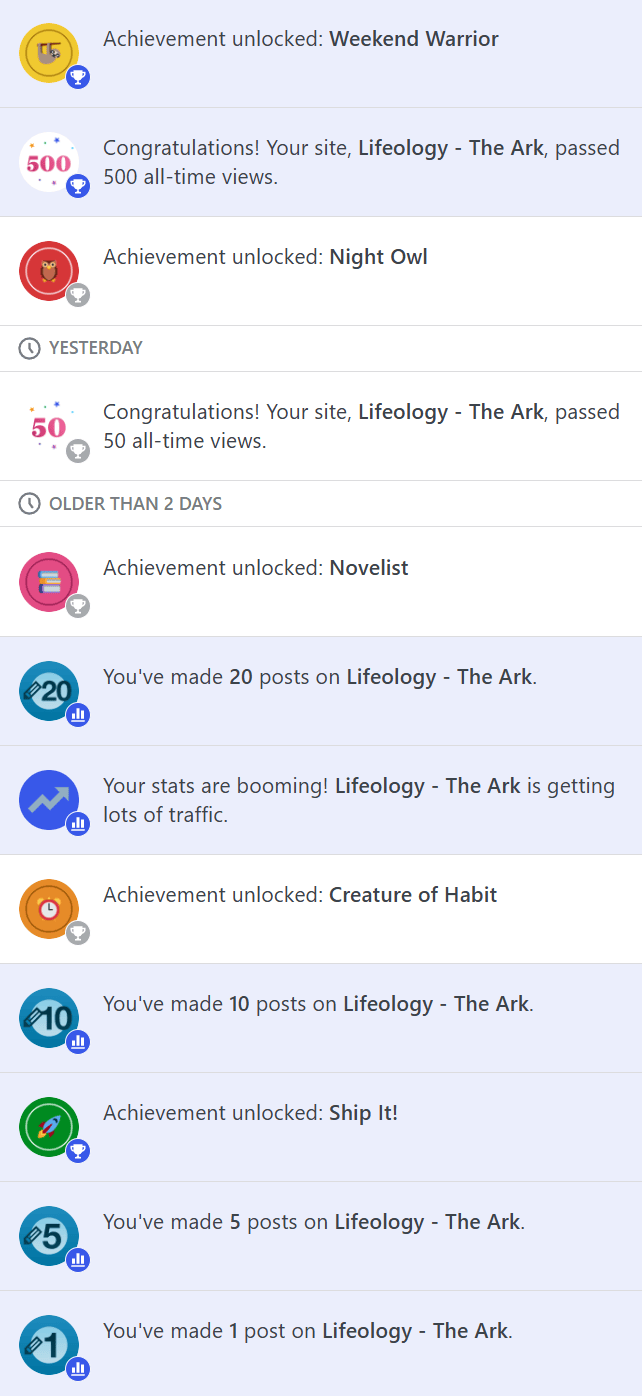
    WordPress has now informed the Captain that he is a Weekend Warrior, a Night Owl, a Novelist, and, rather thrillingly, that the Ark has passed 500 all-time views.

    Plum looked at the notifications and laughed. He moved to WordPress to teach Vitalogy, preserve the Vitalogue, and build the Vitaverse. WordPress seems convinced he is trying to defeat a boss at the end of Level 12.

    Real WordPress achievement notifications for Lifeology — The Ark, including Weekend Warrior, Night Owl, Novelist and 500 all-time views
    Actual achievements awarded to the Ark. Apparently we are winning the WordPress video game.

    A thousand published words do not mean a thousand worthwhile words. A daily streak does not guarantee that anyone learned anything. A readership number tells us something about attention, but little about whether a single reader found an idea useful or beautiful.

    The Godener Does Not Need Experience Points

    Vitalogy calls a conscious being who deliberately tends a little piece of existence a Godener. The gardener grows flowers because flowers make a garden beautiful. The teacher explains something because another person deserves to understand. The songwriter writes because perhaps that song ought to exist.

    The achievement is already in the creation. Order gives it form; Truth asks whether it meets reality; Love asks what good it brings other Sparks. No digital medal can answer those questions.

    The Ark’s Achievement System

    Naturally, Lieutenant Paddy O’Really has proposed alternative awards.

    BRONZE PLOPSTANK: Successfully complain about a computer malfunction.

    SILVER ECHOFART: Attend a meeting lasting an hour without learning anything.

    GOLD DIMPERIAL PHUCKERY: Finish seventeen administrative tasks without throwing the computer through a window.

    PLATINUM GODENER: Create something beautiful and tell absolutely nobody about it.

    Commander Chorus Angelicus suggests that the final achievement is the only one worth pursuing. Paddy immediately asks how many points it’s worth.

    And So, Why?

    Plum enjoys games. He helped build an entire role-playing universe aboard the Ark. The difference is that when he plays a game, he knows he’s playing a game. When he writes an essay, he is writing an essay.

    WordPress is useful, and the badges can do whatever the hell they please. But not everything needs a scoreboard, a streak, or a digital pat on the head. Sometimes a Spark simply wants to do something because it is worth doing.

    ACHIEVEMENT UNLOCKED: YOU HAVE FINISHED READING THIS ESSAY!

    Congratulations. You may now return to living your life.

    Order. Truth. Love. No experience points required.

  • Swearing Needs a Remake: The Vitan Proposals

    Swearing Needs a Remake: The Vitan Proposals

    Official Star Concord visual canon portrait of Captain Northman Plum, aboard HMS Archivum
    Captain Northman Plum, official Star Concord portrait. Order, Truth, Love—and an expanding vocabulary of plopstank.

    Captain Plum enjoys a good swear word. Sometimes the universe produces stupidity of such magnitude that ordinary English simply cannot accommodate it.

    A computer requires seventeen clicks to accomplish something that should take one. “That’s unfortunate” doesn’t quite capture the experience. “What a fucking ridiculous piece of shit” does rather better.

    But Plum has identified a problem: humanity has become terribly uncreative about swearing. Fuck. Shit. Bastard. Asshole. Admirable old workhorses—but where is the innovation? We have spacecraft and artificial intelligence, yet swear like medieval peasants whose donkey has eaten their trousers.

    The Great Vitan Contributions: Plopstank and Echofart

    Fortunately, the Vitalogue has already made significant contributions to the neglected science of creative profanity. Two words stand above the rest.

    PLOPSTANK!

    A plopstank is something so ridiculous, unpleasant or incompetent that conventional English should not be required to describe it. A badly designed computer system is a plopstank. An organization that charges you extra for failing to provide a service is a plopstank. A printer that announces it cannot print because it is currently printing is a spectacularly advanced plopstank.

    “Who designed this plopstanking thing?” “This entire afternoon has become one enormous plopstank!” The applications are almost unlimited.

    ECHOFART!

    An echofart is a statement, announcement or idea that makes an enormous amount of noise while contributing remarkably little meaning. It reverberates around the room and disappears without improving anybody’s understanding. Corporate mission statements are frequent echofarts. Political speeches may contain several consecutive echofarts. Some meetings are nothing but echofarts arranged chronologically.

    “Did you hear the CEO’s announcement?” “Yes. An absolute echofart.”

    Plum believes both words should be taught in schools. The Department of Education has not responded. Possibly its reply was classified as an echofart.

    Additional Vitan Profanity

    “Oh, for Field’s sake!” For password resets, verification codes and electronic medical records.

    “Dimperial phuckery!” For bureaucracy that turns an ordinary task into an elaborate punishment. The ph is deliberate. This is official Vitan spelling, and it makes the word approximately 37 percent more ridiculous.

    “You absolute coherence collapse!” For somebody who introduces disorder into everything they touch.

    “Flumplefuck!” For a small but particularly irritating malfunction.

    “You magnificent knobgoblin!” For incompetence so spectacular that it approaches an artistic accomplishment.

    “Holy mother of the Sorrow Engine!” Reserved for major disasters involving heating oil, internet outages or the Canada Revenue Agency.

    “Bugger the entropy!” Commander Chorus Angelicus’s preferred expression of philosophical irritation. Concise. Elegant. Deeply Vitan.

    Paddy Proposes a New Standard

    Lieutenant Paddy O’Really has proposed combining every available swear word into one enormous verbal weapon:

    “YOU GREAT PLOPSTANKING, ECHOFARTING, FLUMPLEFUCKING DIMPERIAL PHUCKWHISTLE!”

    Lieutenant Maddie Not-Really observed that it sounded like a washing machine falling down a staircase. Paddy considered this an outstanding review.

    Chorus recommended reducing the sentence to a single word: “Plopstank.” Plum agreed. Sometimes one word is sufficient.

    Is Swearing Un-Vitan?

    Not at all. Vitalogy concerns itself with Order, Truth and Love, not the arbitrary prohibition of colourful language. There is a difference between shouting “Fuck!” after hitting your thumb with a hammer and deliberately humiliating somebody. One expresses frustration. The other may express cruelty.

    A Vitan should be capable of extraordinary profanity while remaining fundamentally kind. Indeed, a well-placed swear word may communicate more truth than several pages of polite corporate bullshit.

    The objective is creative profanity without unnecessary cruelty.

    The Official Vitan Recommendation

    Humanity should modernize its profanity. Plopstank, Echofart and Dimperial Phuckery are nominated for permanent inclusion in the international vocabulary. Existing swear words may remain, provided their users make some effort toward originality.

    Captain Plum reserves the right to say “fuck” whenever circumstances require it. But he looks forward to the day when an irritating bureaucracy, incompetent computer program or pointless announcement can be dismissed with a magnificent “PLOPSTANK!” And if it keeps repeating itself? “ECHOFART!”

    Order. Truth. Love. And bugger the entropy.

    P.S. — A Discovery from the Profanity Laboratory

    BREAKING: The Vitan Department of Advanced Profanity has discovered that saying “fuck off” backwards produces the intriguing experimental expression “Foff Kuff!” Preliminary trials suggest it sounds suspiciously like the original, particularly when shouted by Lieutenant Paddy O’Really. Laboratory testing continues. Commander Chorus Angelicus cautions that no one should attempt to reverse the experiment while operating heavy machinery.

  • The Dirt Will Be Cleaned Away: A Vitan Reflection on Justice and the Sickness of the West

    The Dirt Will Be Cleaned Away: A Vitan Reflection on Justice and the Sickness of the West

    Golden scales of justice illuminated by dawn among the ruins of corruption

    The West likes to speak of justice as though it were a possession: something secured long ago, framed in marble, and inherited by every generation. Plum is less impressed by the marble. He wants to know whether justice actually works.

    Consider Jeffrey Epstein. His crimes and the failures surrounding them have left a moral wound that no public-relations campaign can close. The United States Department of Justice reported releasing nearly 3.5 million pages under the Epstein Files Transparency Act by January 2026. Yet further questions about withheld material, redactions, institutional decisions, and accountability persist. Publication is progress. It is not automatically the same thing as justice.

    The question is not whether every famous person mentioned in a document is guilty. Of course not. Association is not a conviction, suspicion is not evidence, and accusations require fair examination. Those principles protect us all. But they cannot become an excuse for institutions to evade scrutiny. A government must be able to explain, credibly and publicly, what it investigated, what it can prove, what remains unknown, and why.

    Plum finds the response of Western governance profoundly disappointing. A civilization that celebrates liberty while leaving people uncertain whether its wealthiest and most connected citizens face the same standards as everyone else has a serious problem. The appearance of preferential treatment corrodes public trust, even when particular suspicions prove unfounded.

    Justice is not supposed to protect the powerful from embarrassment. It is supposed to protect human beings from abuse.

    In Vitalogy, justice requires all three Vitan principles. Order demands rules that apply equally to everyone. Truth demands evidence, transparency, and the courage to correct mistakes. Love demands that vulnerable people—and especially victims—matter more than political convenience, wealth, or institutional reputation.

    Remove Order and justice becomes arbitrary. Remove Truth and it becomes theatre. Remove Love and it becomes a cold machine serving whoever controls it.

    The Epstein story should never become a spectacle in which victims disappear behind the names of celebrities. Nor should public anger license indiscriminate accusations. The victims deserve dignity, credible investigation, protection of their privacy, and the possibility of real accountability. The public deserves institutions that earn trust instead of demanding it.

    Plum suspects the coming years may reveal more, perhaps enough to shock a world accustomed to treating fame and fortune as evidence of character. That is his expectation, not a foregone conclusion. Some suspicions may be confirmed; others may collapse under examination. Let evidence make those distinctions.

    And if the truth is ugly? Good. Better an ugly truth than a handsome lie.

    Plum believes the dirt will be cleaned away. Not because history guarantees it, but because human beings can insist upon better: independent scrutiny, lawful prosecution where evidence supports it, protection for victims, and reform wherever institutions have failed.

    The world is not the property of its rich and powerful. No Spark is cargo. No angel is property.

    The goal is not endless outrage. It is a world that can finally tell the truth, do justice, repair what can be repaired—and carry on.

    Order. Truth. Love. A civilization worthy of the name must practise all three.

  • Celebrity Is Not Character: The Corruption of Entitlement

    Celebrity Is Not Character: The Corruption of Entitlement

    A cinematic courthouse corridor contrasting an empty celebrity spotlight with ordinary people standing in the light, representing dignity and equal justice.

    A Vitan reflection on fame, justice, religious theatre and human dignity — November 7, 2026.

    On November 5, Russell Brand was convicted in a London court of one count of rape and three counts of sexual assault involving four women. He was acquitted of two other rape charges and one count of attempted indecent assault. He was remanded into custody pending sentencing on November 9.

    The Metropolitan Police said Brand used his fame and influence to exploit women, and that his growing celebrity was accompanied by a growing sense of entitlement. There is the subject of this essay in one dreadful sentence.

    Celebrity Is Not Character

    Captain Plum never found Russell Brand particularly funny or interesting. But whether a celebrity is entertaining is beside the point. Fame is not virtue. A million followers do not make a good human being, and applause does not confer ownership over anyone else.

    Celebrity culture can confuse popularity with importance, importance with authority, and authority with entitlement. Mother of coherence! Apparently a microphone and a million admirers are supposed to confer a moral exemption. They do not. People around a star can become accessories to the star’s appetites. Institutions dependent on that star’s commercial value may look away when they ought to look closer.

    The Vitan objection is simple: nobody exists for somebody else’s gratification.

    And Suddenly, Jesus Appears

    After the sexual misconduct allegations became public in 2023, Brand publicly embraced Christianity and was baptized in 2024. To observers, the timing invites questions. But no one can know from publicity alone whether his religious convictions are sincere, and sincerity is not what a court has been asked to determine.

    Vitans are not impressed by celebrities suddenly announcing that they have found Jesus — or by a theatrical declaration of allegiance to any terrestrial religion offered as a credential of character. Nor is that a criticism of sincere believers, many of whom demonstrate kindness and humility without fanfare.

    Our objection is to religion as public relations. Baptism is not an acquittal. Prayer is not accountability. Spiritual language cannot undo another human being’s suffering or suspend the ordinary demands of justice.

    A genuine change in character should be visible in how someone treats others, not merely in the symbols they display.

    The Deimperial Disease

    Vitalogy calls out the old corruption in which a person begins to imagine that power places them above others. The Deimperial figure need not wear a crown. He may command a studio audience, a fortune, a media empire or a religious following.

    The defining belief is that other Sparks exist to serve his desires. Vitalogy answers with an absolute principle: No Spark is cargo. No angel is property.

    A woman who says no has the same dignity as a man celebrated by millions. Consent cannot be overridden by charisma, money, status or an audience’s adoration.

    Justice Is Love With a Backbone

    Vitans believe in Order, Truth and Love. Order requires the law to apply equally to the famous and the unknown. Truth requires evidence, due process and the courage to acknowledge convictions as well as acquittals. Love requires respect for those harmed, and insists that accountability is not the same as cruelty.

    Justice does not require us to deny an offender’s humanity. Nor does compassion require victims to forgive, or the public to pretend that religious conversion cancels responsibility.

    We need fewer idols and more ordinary decency. We need institutions willing to protect the vulnerable even when doing so is commercially inconvenient.

    The measure of a human being is not how many people applaud when he enters a room. It is how he treats those who cannot afford to refuse him.

    Order. Truth. Love. Not celebrity. Not entitlement. Not religious theatre. And certainly not a baptismal certificate presented as a character reference.

    Sources

    Metropolitan Police, November 5, 2026 · Reuters, November 5, 2026 · Associated Press, November 7, 2026

  • The Godener: A Little God, a Very Small Garden

    The Godener: A Little God, a Very Small Garden

    Two people carefully tending plants in the lush botanical gardens aboard HMS Archivum
    Tend your little piece of the Field.

    Captain Plum has a new title for you. No salary increase, unfortunately. No command privileges, no magnificent hat, and absolutely no authority over your neighbours. You are invited to become a Godener.

    The word combines god and gardener, and it captures one of Vitalogy’s loveliest ideas: a conscious being can imagine a possibility, help it become real, and tend the little piece of existence within reach.

    A little god, a very small garden

    A garden begins with possibilities. Perhaps there is a patch of soil, some seeds, an afternoon and a modest willingness to get dirty. A gardener brings Order to possibility, learns what is true about sunlight and water, and cares for what grows.

    Vitalogy calls the wider connected reality the Field. To be a Godener is not to claim ownership of it. It is to accept responsibility for the bit of life you can genuinely affect. The Field is part of Vitalogy’s philosophical language, not a newly discovered scientific substance.

    Why creativity matters so much

    A song does not exist until somebody makes it. Nor does a friendship, a useful invention, a good lesson or a better arrangement for the waiting room. Imagination sees what might be. Creativity moves something from possibility into existence.

    That is why creativity has such a special place in Vitalogy. A Spark is not merely a spectator. Through thought and action, a conscious being can contribute to the world that other beings will experience.

    But creativity alone is not virtue. One can invent a beautiful melody or a remarkably efficient method of annoying an entire medical clinic. Order gives a creation structure. Truth keeps it answerable to reality. Love reminds us whom it should serve.

    You don’t need to write a symphony

    You can be a Godener by raising a child, caring for a neighbour, growing tomatoes, helping someone understand a difficult idea, repairing a broken system, or making your kitchen welcoming. A small act does not become meaningless because nobody photographs it.

    Paddy O’Really would probably declare himself Godener of the entire drum department. Maddie would gently remind him that repeatedly hitting something does not, by itself, constitute improving it.

    The goal is not to become a miniature emperor. The world has plenty of people volunteering for that position. The goal is to tend your little piece of the Field with enough humility to notice whether it is actually flourishing.

    A creative life is a Vitan life

    One of the joys of making music, writing stories, building the Vitaverse or simply fixing something that was driving you mad is that you have changed a small corner of reality. Something useful, beautiful, funny or kind exists now that did not exist before.

    Perhaps only one other Spark will encounter your creation. That’s still one more experience of beauty or care in the universe.

    The Godener’s invitation is wonderfully ordinary: Find something worth tending. Imagine how it could be better. Make it so, with Order, Truth and Love.

    For the fuller philosophical explanation, visit The Godener — Why Creativity Is Sacred in Vitalogy in the Arkademy.