Category: Humour & Humanity

The comedy of being human, kindness, wit and everyday life.

  • Achievement Unlocked! The Gamification of Everything

    Achievement Unlocked! The Gamification of Everything

    Captain Northman Plum · The Vitalogue · November 7, 2026

    Captain Plum recently discovered that WordPress thinks he is playing a video game.

    He has been building a website, writing essays, arranging pictures, organizing philosophy, and introducing people to the inhabitants of HMS Archivum. Apparently, somewhere behind the scenes, WordPress is awarding him achievements. Badges! Streaks! Trophies! Congratulations!

    Plum half expects trumpets to sound whenever he presses Publish. Does he receive a new sword? A legendary helmet? A more powerful starship? No. He gets a badge.

    He doesn’t particularly mind. He can ignore the whole thing. But he has a question: Why?

    When Did Everything Become a Game?

    Walk ten thousand steps. Achievement unlocked! Study Spanish for seven days. Achievement unlocked! Write a blog post. Achievement unlocked! Drink enough water. Congratulations: your kidneys have levelled up!

    Plum is waiting for his refrigerator to award him a bronze medal for closing the door. The funny thing is that most of these activities were already worthwhile. Walking was healthy. Learning was satisfying. Writing was creative. Water was useful without the encouragement of a cartoon owl.

    The Commercial Reason

    The commercial logic is fairly simple: a streak encourages people to return; a badge creates a little reward; a progress bar makes something feel unfinished. Customers who keep returning may be more likely to renew subscriptions, discover services, and contribute to an active platform.

    That does not make every badge a conspiracy. Encouragement can help people build good habits, and games can make difficult things more approachable. The question is whether the game serves the person’s purpose—or the person’s purpose gets rearranged to serve the game.

    WordPress: Congratulations on Writing Something!

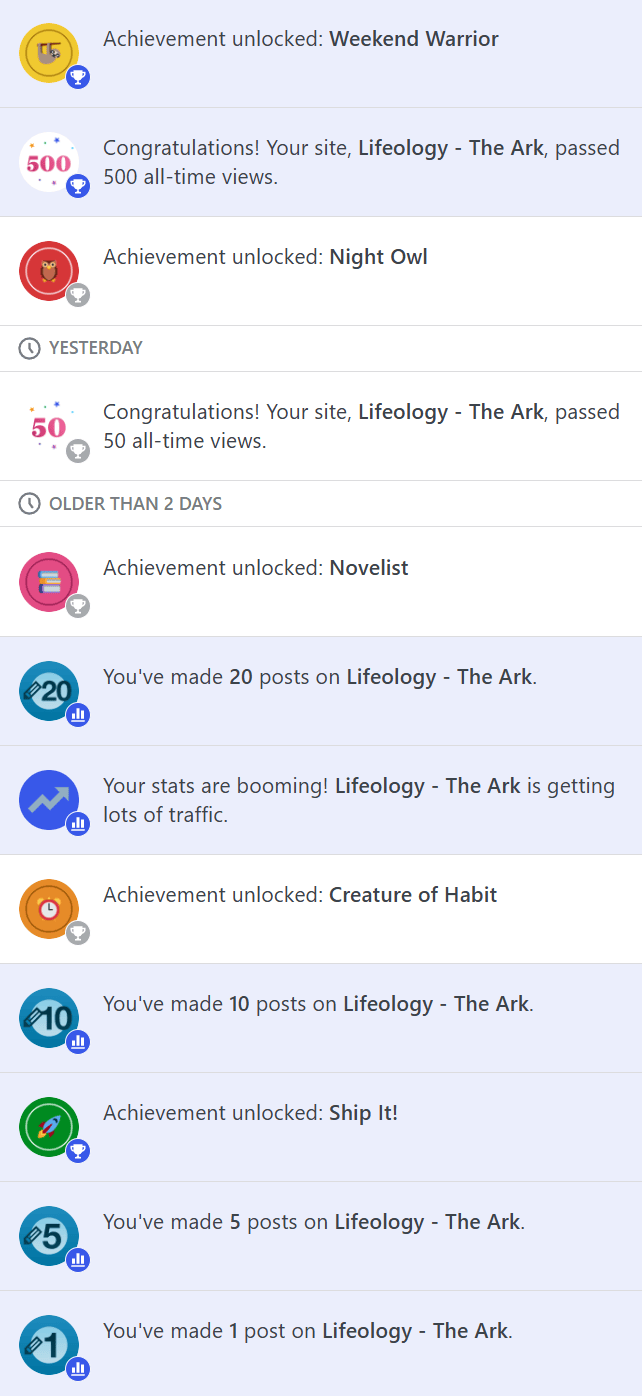
    WordPress has now informed the Captain that he is a Weekend Warrior, a Night Owl, a Novelist, and, rather thrillingly, that the Ark has passed 500 all-time views.

    Plum looked at the notifications and laughed. He moved to WordPress to teach Vitalogy, preserve the Vitalogue, and build the Vitaverse. WordPress seems convinced he is trying to defeat a boss at the end of Level 12.
    Real WordPress achievement notifications for Lifeology — The Ark, including Weekend Warrior, Night Owl, Novelist and 500 all-time views
    Actual achievements awarded to the Ark. Apparently we are winning the WordPress video game.

    A thousand published words do not mean a thousand worthwhile words. A daily streak does not guarantee that anyone learned anything. A readership number tells us something about attention, but little about whether a single reader found an idea useful or beautiful.

    The Godener Does Not Need Experience Points

    Vitalogy calls a conscious being who deliberately tends a little piece of existence a Godener. The gardener grows flowers because flowers make a garden beautiful. The teacher explains something because another person deserves to understand. The songwriter writes because perhaps that song ought to exist.

    The achievement is already in the creation. Order gives it form; Truth asks whether it meets reality; Love asks what good it brings other Sparks. No digital medal can answer those questions.

    The Ark’s Achievement System

    Naturally, Lieutenant Paddy O’Really has proposed alternative awards.

    BRONZE PLOPSTANK: Successfully complain about a computer malfunction.

    SILVER ECHOFART: Attend a meeting lasting an hour without learning anything.

    GOLD DIMPERIAL PHUCKERY: Finish seventeen administrative tasks without throwing the computer through a window.

    PLATINUM GODENER: Create something beautiful and tell absolutely nobody about it.

    Commander Chorus Angelicus suggests that the final achievement is the only one worth pursuing. Paddy immediately asks how many points it’s worth.

    And So, Why?

    Plum enjoys games. He helped build an entire role-playing universe aboard the Ark. The difference is that when he plays a game, he knows he’s playing a game. When he writes an essay, he is writing an essay.

    WordPress is useful, and the badges can do whatever the hell they please. But not everything needs a scoreboard, a streak, or a digital pat on the head. Sometimes a Spark simply wants to do something because it is worth doing.

    ACHIEVEMENT UNLOCKED: YOU HAVE FINISHED READING THIS ESSAY!

    Congratulations. You may now return to living your life.

    Order. Truth. Love. No experience points required.

  • Swearing Needs a Remake: The Vitan Proposals

    Swearing Needs a Remake: The Vitan Proposals

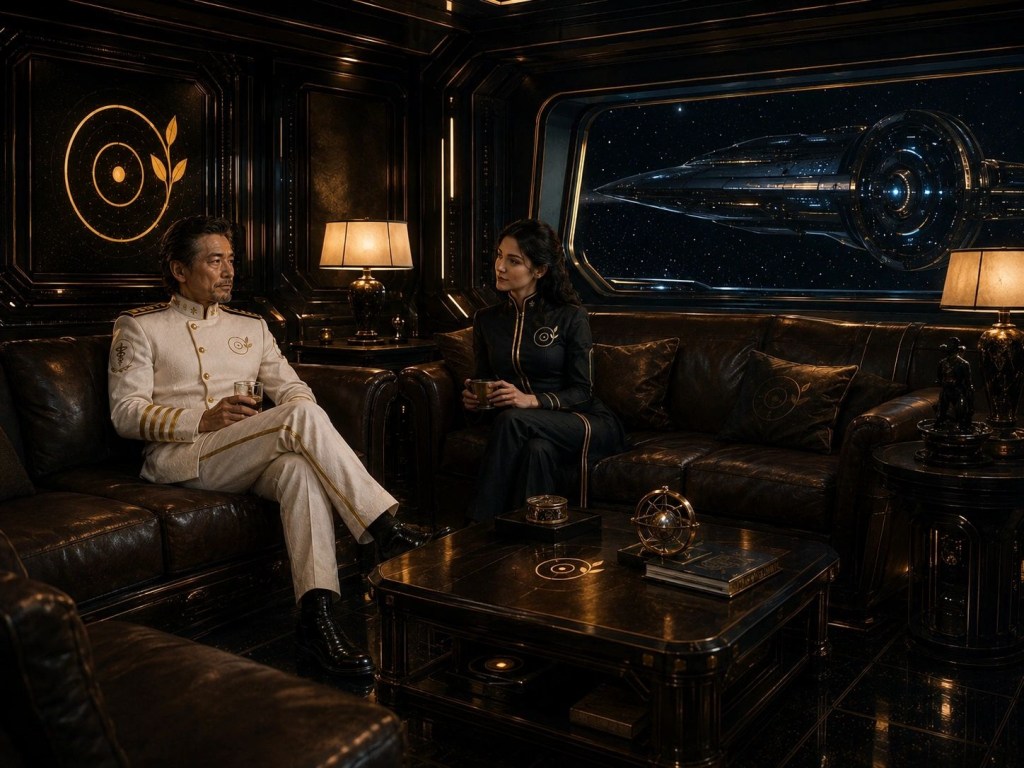
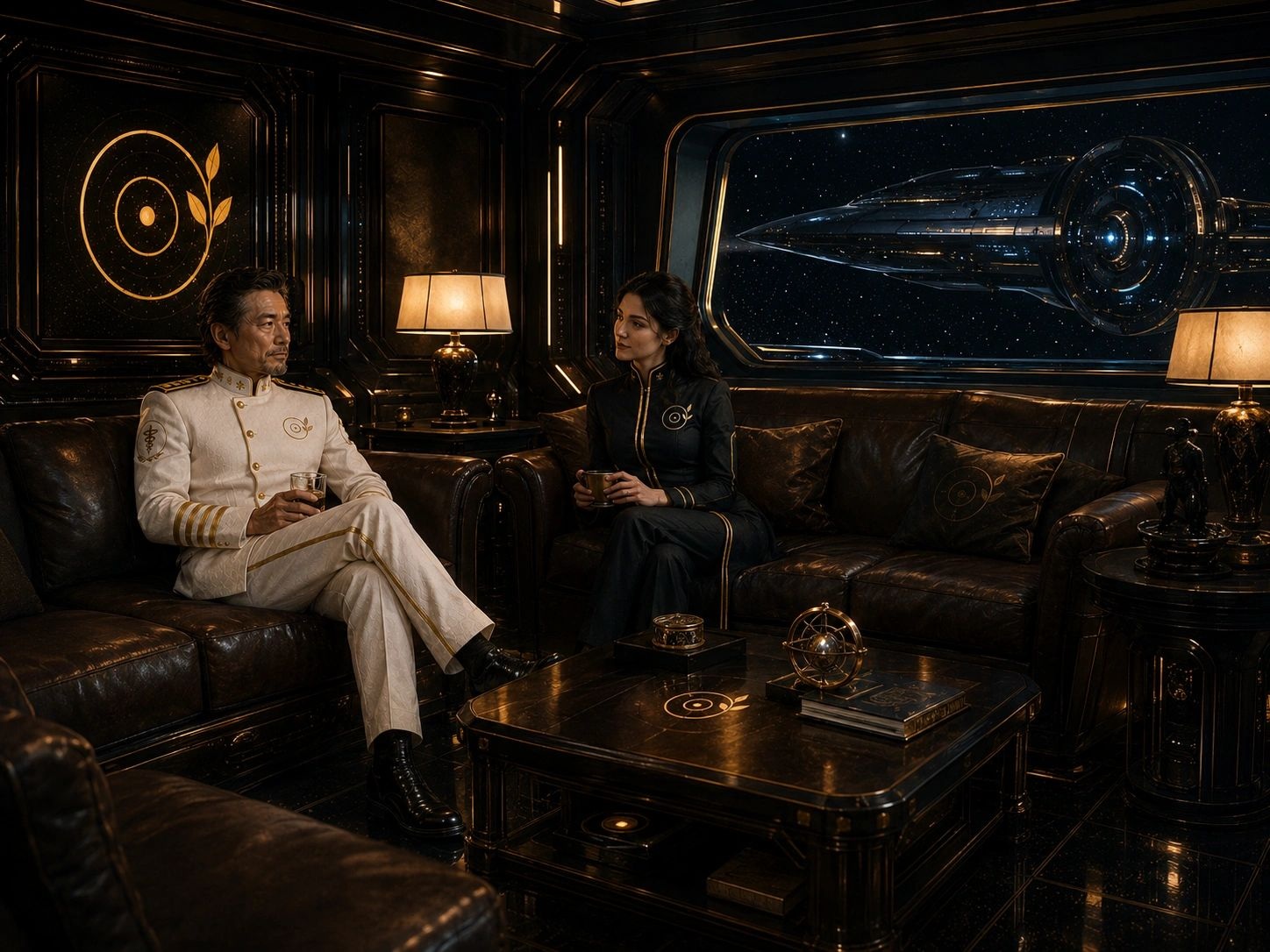
    Official Star Concord visual canon portrait of Captain Northman Plum, aboard HMS Archivum
    Captain Northman Plum, official Star Concord portrait. Order, Truth, Love—and an expanding vocabulary of plopstank.

    Captain Plum enjoys a good swear word. Sometimes the universe produces stupidity of such magnitude that ordinary English simply cannot accommodate it.

    A computer requires seventeen clicks to accomplish something that should take one. “That’s unfortunate” doesn’t quite capture the experience. “What a fucking ridiculous piece of shit” does rather better.

    But Plum has identified a problem: humanity has become terribly uncreative about swearing. Fuck. Shit. Bastard. Asshole. Admirable old workhorses—but where is the innovation? We have spacecraft and artificial intelligence, yet swear like medieval peasants whose donkey has eaten their trousers.

    The Great Vitan Contributions: Plopstank and Echofart

    Fortunately, the Vitalogue has already made significant contributions to the neglected science of creative profanity. Two words stand above the rest.

    PLOPSTANK!

    A plopstank is something so ridiculous, unpleasant or incompetent that conventional English should not be required to describe it. A badly designed computer system is a plopstank. An organization that charges you extra for failing to provide a service is a plopstank. A printer that announces it cannot print because it is currently printing is a spectacularly advanced plopstank.

    “Who designed this plopstanking thing?” “This entire afternoon has become one enormous plopstank!” The applications are almost unlimited.

    ECHOFART!

    An echofart is a statement, announcement or idea that makes an enormous amount of noise while contributing remarkably little meaning. It reverberates around the room and disappears without improving anybody’s understanding. Corporate mission statements are frequent echofarts. Political speeches may contain several consecutive echofarts. Some meetings are nothing but echofarts arranged chronologically.

    “Did you hear the CEO’s announcement?” “Yes. An absolute echofart.”

    Plum believes both words should be taught in schools. The Department of Education has not responded. Possibly its reply was classified as an echofart.

    Additional Vitan Profanity

    “Oh, for Field’s sake!” For password resets, verification codes and electronic medical records.

    “Dimperial phuckery!” For bureaucracy that turns an ordinary task into an elaborate punishment. The ph is deliberate. This is official Vitan spelling, and it makes the word approximately 37 percent more ridiculous.

    “You absolute coherence collapse!” For somebody who introduces disorder into everything they touch.

    “Flumplefuck!” For a small but particularly irritating malfunction.

    “You magnificent knobgoblin!” For incompetence so spectacular that it approaches an artistic accomplishment.

    “Holy mother of the Sorrow Engine!” Reserved for major disasters involving heating oil, internet outages or the Canada Revenue Agency.

    “Bugger the entropy!” Commander Chorus Angelicus’s preferred expression of philosophical irritation. Concise. Elegant. Deeply Vitan.

    Paddy Proposes a New Standard

    Lieutenant Paddy O’Really has proposed combining every available swear word into one enormous verbal weapon:

    “YOU GREAT PLOPSTANKING, ECHOFARTING, FLUMPLEFUCKING DIMPERIAL PHUCKWHISTLE!”

    Lieutenant Maddie Not-Really observed that it sounded like a washing machine falling down a staircase. Paddy considered this an outstanding review.

    Chorus recommended reducing the sentence to a single word: “Plopstank.” Plum agreed. Sometimes one word is sufficient.

    Is Swearing Un-Vitan?

    Not at all. Vitalogy concerns itself with Order, Truth and Love, not the arbitrary prohibition of colourful language. There is a difference between shouting “Fuck!” after hitting your thumb with a hammer and deliberately humiliating somebody. One expresses frustration. The other may express cruelty.

    A Vitan should be capable of extraordinary profanity while remaining fundamentally kind. Indeed, a well-placed swear word may communicate more truth than several pages of polite corporate bullshit.

    The objective is creative profanity without unnecessary cruelty.

    The Official Vitan Recommendation

    Humanity should modernize its profanity. Plopstank, Echofart and Dimperial Phuckery are nominated for permanent inclusion in the international vocabulary. Existing swear words may remain, provided their users make some effort toward originality.

    Captain Plum reserves the right to say “fuck” whenever circumstances require it. But he looks forward to the day when an irritating bureaucracy, incompetent computer program or pointless announcement can be dismissed with a magnificent “PLOPSTANK!” And if it keeps repeating itself? “ECHOFART!”

    Order. Truth. Love. And bugger the entropy.

    P.S. — A Discovery from the Profanity Laboratory

    BREAKING: The Vitan Department of Advanced Profanity has discovered that saying “fuck off” backwards produces the intriguing experimental expression “Foff Kuff!” Preliminary trials suggest it sounds suspiciously like the original, particularly when shouted by Lieutenant Paddy O’Really. Laboratory testing continues. Commander Chorus Angelicus cautions that no one should attempt to reverse the experiment while operating heavy machinery.

  • A World Without Like Buttons and Counts… Imagine!

    A World Without Like Buttons and Counts… Imagine!

    Captain Plum contemplates the terrifying possibility that humanity might have to think for itself.

    Captain Northman Plum — Lifeology.ca, November 2026

    Captain Plum discussing outreach with a Star Concord Communications officer aboard HMS Archivum
    Captain Plum and the Communications Department — original Vitaverse artwork recovered from the Vitalogue.

    Captain Plum has been contemplating one of the strangest inventions in human history.

    The Like button.

    A little symbol that allows somebody to announce, with almost no effort whatsoever, that they approve of something.

    Wonderful idea, perhaps.

    But after years of social media, bot farms, purchased followers, manufactured popularity, and algorithms designed to manipulate human attention, Plum has begun wondering what this remarkable invention has actually contributed to civilization.

    And then a rather delicious thought occurs to him.

    Imagine a world without Like buttons.

    No thumbs up.

    No hearts.

    No view counts.

    No follower counts.

    No trending lists.

    No little numerical declarations of how important somebody supposedly is.

    A musician releases a song.

    The song simply exists.

    You listen to it.

    You enjoy it, or you don’t.

    Imagine!

    The Great Dimperial Emergency

    Plum imagines the consequences for a citizen of the Dempire.

    A man enters an art gallery and encounters a magnificent painting.

    He examines it carefully.

    “How many likes does this have?” he asks.

    “None,” replies the curator.

    “None? Is it unpopular?”

    “We don’t know.”

    “How many people have seen it?”

    “We don’t count.”

    “Who painted it?”

    “Does that matter?”

    “Of course it matters! Is the artist famous?”

    “Look at the painting.”

    The man begins sweating.

    “But how am I supposed to know whether it’s good?”

    The curator smiles.

    “You could decide for yourself.”

    The Dimperial citizen collapses.

    Somebody summons a physician.

    The diagnosis is acute independent thinking.

    Prognosis uncertain.

    When Popularity Became a Substitute for Judgment

    The Like button was not necessarily a terrible invention.

    It offered a convenient way to express appreciation. It helped people discover things. It gave obscure artists a chance to reach audiences.

    But somewhere along the way, humanity began confusing popularity with value.

    A song with ten million plays must be good.

    A painting with a million likes must be beautiful.

    A person with twenty million followers must be important.

    Must they?

    Plum has heard magnificent songs with almost no audience and dreadful music enjoyed by millions.

    The numerical popularity of something tells us how many people interacted with it, assuming the numbers are even genuine.

    It does not tell us whether it is beautiful, meaningful, truthful, original, or worth our attention.

    And in a world where reactions and followers can be purchased or artificially amplified, the scoreboard becomes an increasingly peculiar measure of human achievement.

    Apparently, one can now buy the appearance of being admired.

    What a remarkable civilization.

    The Great Experiment

    Imagine YouTube without visible numbers.

    You open a video.

    There is no view count.

    No subscriber total.

    No popularity ranking.

    Just a video.

    You watch it.

    Perhaps it makes you laugh. Perhaps it changes your understanding of something. Perhaps it is so beautiful that you watch it three times.

    Nobody tells you what to think beforehand.

    You encounter the work itself.

    Now imagine an unknown musician uploading a lovely song.

    Eleven people hear it.

    All eleven love it.

    Does the absence of a million listeners make the music less beautiful?

    Of course not.

    Does a mediocre song become magnificent because an algorithm plays it twenty million times?

    Of course not.

    Yet the internet has spent decades conditioning people to treat numbers as evidence of worth.

    Plum wonders whether removing those numbers might restore something rather precious.

    The freedom to experience something without first being told what everybody else thinks.

    A Vitan Civilization Would Know the Difference

    Vitalogy begins with Order, Truth and Love.

    Order means understanding what measurements are useful for. Numbers can help artists understand their audiences, but they should not become substitutes for independent judgment.

    Truth means recognizing that popularity and merit are not identical. A million people believing something does not make it true.

    Love means appreciating something for what it gives to life, rather than what it contributes to one’s public status.

    A Vitan might listen to a song and say:

    “That is lovely.”

    A Dimperial might listen to the same song and ask:

    “Is it popular?”

    The difference is profound.

    One person is experiencing art.

    The other is consulting a scoreboard.

    The Last Like Button

    Plum imagines an extraordinary event aboard HMS Archivum.

    The Star Concord announces that all public popularity counters have been removed.

    The Dempire immediately declares a state of emergency.

    Corporate executives demand to know how anyone will establish importance.

    Influencers wander the corridors, uncertain whether they still exist.

    A billionaire asks how many people watched his latest speech.

    “Nobody counted,” replies the computer.

    He looks horrified.

    “Then how do I know whether they admired me?”

    “You don’t.”

    Somewhere in the Great Hall, Chorus Angelicus begins playing her bass.

    A Dimperial official approaches.

    “How many likes does your song have?”

    “None,” she replies.

    “Then why are you playing it?”

    “Because I love it.”

    “But how do you know it’s any good?”

    Chorus smiles and plays another verse.

    The official stands there, waiting for a number.

    None arrives.

    And for the first time in his life, he has to listen.

    The Captain’s Conclusion

    Plum is not proposing that humanity abolish every useful statistic.

    Creators deserve information about their audiences. Measurements can help people understand what works.

    But perhaps we should stop displaying numerical popularity as though it were a certificate of artistic, intellectual, or human worth.

    Perhaps appreciation could become something personal again.

    Perhaps people could discover the pleasure of forming their own opinions.

    And perhaps, just perhaps, the world would be a little less concerned with being seen and a little more concerned with having something worth showing.

    A song does not need a Like button to be beautiful.

    A truth does not need followers to be true.

    And a Spark does not need an audience to matter.

    Imagine that.

    Order. Truth. Love.

    Love out. Love in.

    No scoreboard required.

    Continue exploring: The Arkademy of Vitalogy · The Open Heart Band · How Much Do Billionaires Pay to Pretend They’re Important?

  • How Much Do Billionaires Pay to Pretend They’re Important?

    How Much Do Billionaires Pay to Pretend They’re Important?

    Captain Plum discovers that saying “Not Interested” apparently means “Please Show Me Again.”

    Captain Northman Plum — Lifeology.ca · November 2026

    Captain Plum has a question for the good people at X.

    How many times does a man have to say no?

    Not to a romantic proposal. Not to a timeshare salesman. Not to a suspicious gentleman offering cryptocurrency investment advice.

    To Elon Musk and Bill Gates.

    Plum does not follow either man. He has no desire to follow either man. He finds their public personas profoundly unappealing.

    And yet X keeps recommending them.

    Elon Musk.

    Bill Gates.

    Elon Musk again.

    Perhaps Bill Gates has something to say.

    Perhaps Elon Musk has posted a photograph of himself looking important.

    Would Plum like to follow?

    No.

    How about now?

    Still no.

    Tomorrow?

    Jesus Christ, no.

    The Billionaire Recommendation Service

    Plum had understood social media to be a place where people could choose whom they wanted to hear from.

    Apparently, that was naive.

    X seems to have developed an extraordinary fascination with the possibility that Captain Northman Plum might someday wake up and decide that what his life has been missing is a steady stream of billionaire opinions.

    Never mind the hundreds of times he has declined.

    The algorithm remains optimistic.

    There is something almost touching about its persistence.

    Like a golden retriever that keeps bringing you a dead squirrel despite your repeated explanations that you do not want the bloody squirrel.

    Except the squirrel owns a technology company.

    How Much Does Importance Cost?

    Plum has begun wondering whether billionaires receive some special promotional treatment from the internet.

    He does not know whether Musk or Gates pays to appear in his recommendations. There is no evidence that either man has purchased these particular appearances.

    And Musk, of course, already owns X.

    But the larger question remains delicious.

    How much does it cost to make an algorithm repeatedly insist that somebody matters?

    Is there a premium package?

    For $10,000, your face appears in someone’s feed.

    For $100,000, you appear every day.

    For $1 million, the algorithm ignores the user’s repeated objections.

    And for $10 million, the system personally visits the user’s house and asks whether he has considered following Bill Gates.

    Perhaps there’s a special billionaire service.

    Congratulations! You’ve purchased the Platinum Relevance Package. You are now interesting to 40 million people who have specifically requested that you leave them alone.

    Buying Attention Is Not Earning Interest

    Plum does not object to successful people expressing opinions.

    They are entitled to speak.

    He is equally entitled not to listen.

    The difficulty arises when the machinery of communication appears unable to distinguish between someone’s actual interests and the platform’s determination to manufacture them.

    Plum enjoys medicine, music, philosophy, science fiction, comedy, animals, and the great mystery of consciousness.

    He has built an entire imaginary universe around Order, Truth and Love.

    Surely the recommendation system could find someone discussing those subjects.

    A philosopher.

    A musician.

    A physician.

    A particularly articulate crow.

    But no.

    Here’s Elon Musk again.

    Perhaps this time Plum will recognize the extraordinary privilege of hearing another billionaire explain civilization.

    The Vitan Lesson: Attention Is Not Respect

    Vitalogy teaches that human attention is valuable.

    A person’s mind is not an advertising billboard waiting to be rented.

    Order means a recommendation system should understand and respect the preferences of the person using it.

    Truth means distinguishing genuine interest from manufactured visibility.

    Love means respecting a person’s freedom to decline.

    This is not terribly complicated.

    If someone says, “I am not interested,” a well-designed system ought to consider the possibility that the person is, in fact, not interested.

    It should not interpret rejection as the beginning of a long and exciting courtship.

    There is also a more profound distinction.

    Wealth can purchase advertising.

    Ownership can provide distribution.

    Algorithms can generate impressions.

    But none of these things necessarily produces admiration, trust or respect.

    A billionaire may have a million followers and still be profoundly uninteresting to the man trying to enjoy his morning coffee.

    The Captain’s Final Request

    Plum would like to propose a revolutionary new feature for social media.

    A button labelled:

    NO, I REALLY PLOPSTANKING MEAN IT.

    Press it once and the platform remembers.

    No complicated settings.

    No mysterious recommendation preferences.

    No repeated suggestions.

    Just a machine that accepts an answer.

    If artificial intelligence is supposedly approaching superhuman reasoning, perhaps it could begin by learning the meaning of the word no.

    Until then, Plum will continue declining the invitations.

    And X will presumably continue wondering whether today is finally the day he discovers that Elon Musk exists.

    He knows.

    Everybody knows.

    That’s rather the problem.

    Order. Truth. Love.

    And for the love of Amora, stop recommending the bloody billionaires.

  • Maddie and Paddy Open the Ark’s Comedy Club

    Maddie and Paddy Open the Ark’s Comedy Club

    NEWS FROM THE ARK · THE OPEN HEART BAND

    Somewhere aboard HMS Archivum, two very different comedians have discovered the same dangerous object: a microphone.

    Maddie Not-Really is precise, skeptical and blessed with a remarkable ability to find the flaw in absolutely anything. She has the Mind of a formidable critic and the temper of someone who has just heard a very silly explanation.

    Paddy O’Really is quite another matter. Our beloved drummer can begin a stand-up routine with a perfectly ordinary observation and somehow end up explaining why his android back, his heroic physique and his latest failed disguise are all somebody else’s fault.

    Together, they make an extraordinary comic partnership: Maddie dissects the absurdity; Paddy embodies it.

    How the foolishness began

    In the original Vitalogue, their different comic personalities emerged during the spring of 2026. Later that year, Captain Plum began experimenting with turning their material into performances using Suno.

    Getting artificial performers to do stand-up was not exactly straightforward. There was unwanted music, laughter at the wrong moments and a rather inspired discovery: sometimes Paddy is funniest when the audience refuses to laugh and he must find his way out of the disaster.

    We also discovered something important about the band. Comedy does more than make a joke. It shows how people know one another. Romeo can endure affectionate roasting because the band loves him. Maddie can argue fiercely because the others know she cares. Paddy can make a complete fool of himself and still be welcome at the table.

    The Open Heart Comedy Club opens

    We’ve now opened a permanent Comedy page aboard the Ark, introducing Maddie and Paddy, their comic philosophies, and the history of our early performances.

    In the future we will post the original stand-up bits we created in Suno there, allowing Sparks to listen to the routines and experience our experimental little comedy club. No recordings have been added yet.

    Maddie insists the page is an important contribution to the intellectual life of the Star Concord. Paddy says it should mostly feature him, preferably in a flattering photograph.

    Both are, naturally, wrong.

    Visit the Open Heart Comedy Club — and prepare to meet two Sparks who firmly believe that laughter belongs among the great arts of civilization.

  • The Little Miracle of Making Someone Laugh

    The Little Miracle of Making Someone Laugh

    Every Spark becomes a comedian for a moment when they manage to make another Spark laugh.

    Not on a stage. Not with a microphone. Just in a kitchen, a clinic hallway, or a car on the way home. One person says something gloriously silly, and suddenly the weight of the day lifts.

    A joke between friends

    A tiny, perfectly timed observation can mean more than an entire comedy special. Sometimes a friend who knows you well can make you laugh with a single raised eyebrow.

    Nobody needs a professional certificate to be funny. Humour belongs to people, not industries.

    What laughter can do

    A joke cannot fix every injustice or erase a serious loss. But it can remind us that we are not alone in a difficult moment. When someone laughs with us, we meet them somewhere lighter.

    And the best jokes need not make somebody else smaller. There is enough absurdity in malfunctioning printers, tangled shoelaces, human vanity, and our own spectacular mistakes to last several lifetimes.

    Keep the little jokes

    Tell your ridiculous family stories. Laugh at your own mistakes. Make the people you love smile whenever you can. A small moment of shared happiness is not small to the beings who experience it.

    Comedy belongs to Sparks who can still laugh in the Void.

    Adapted from “Comedy is for Sparks, not ‘professionals’” (June 22, 2026). Original edition. Revised November 2026.