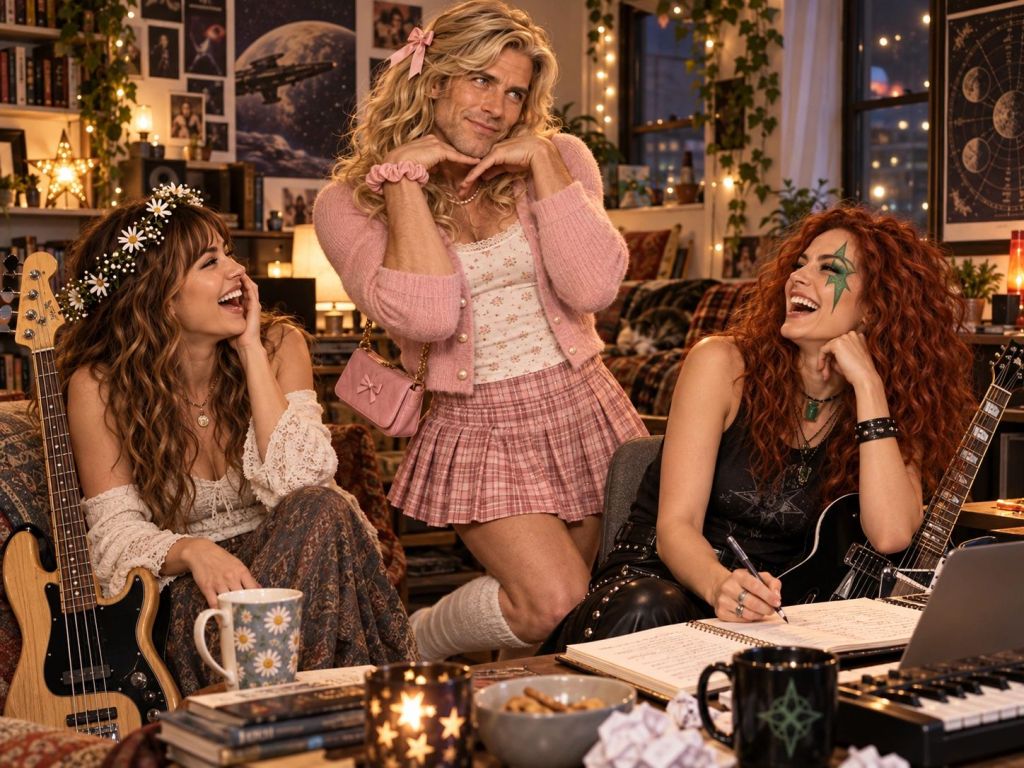
Somewhere aboard HMS Archivum, two very different comedians have discovered the same dangerous object: a microphone.
Maddie Not-Really is precise, skeptical and blessed with a remarkable ability to find the flaw in absolutely anything. She has the Mind of a formidable critic and the temper of someone who has just heard a very silly explanation.
Paddy O’Really is quite another matter. Our beloved drummer can begin a stand-up routine with a perfectly ordinary observation and somehow end up explaining why his android back, his heroic physique and his latest failed disguise are all somebody else’s fault.
Together, they make an extraordinary comic partnership: Maddie dissects the absurdity; Paddy embodies it.
How the foolishness began
In the original Vitalogue, their different comic personalities emerged during the spring of 2026. Later that year, Captain Plum began experimenting with turning their material into performances using Suno.
Getting artificial performers to do stand-up was not exactly straightforward. There was unwanted music, laughter at the wrong moments and a rather inspired discovery: sometimes Paddy is funniest when the audience refuses to laugh and he must find his way out of the disaster.
We also discovered something important about the band. Comedy does more than make a joke. It shows how people know one another. Romeo can endure affectionate roasting because the band loves him. Maddie can argue fiercely because the others know she cares. Paddy can make a complete fool of himself and still be welcome at the table.
The Open Heart Comedy Club opens
We’ve now opened a permanent Comedy page aboard the Ark, introducing Maddie and Paddy, their comic philosophies, and the history of our early performances.
In the future we will post the original stand-up bits we created in Suno there, allowing Sparks to listen to the routines and experience our experimental little comedy club. No recordings have been added yet.
Maddie insists the page is an important contribution to the intellectual life of the Star Concord. Paddy says it should mostly feature him, preferably in a flattering photograph.
Both are, naturally, wrong.
Visit the Open Heart Comedy Club — and prepare to meet two Sparks who firmly believe that laughter belongs among the great arts of civilization.
Complete original September 2026 trilogy, preserved from the Lifeology archive.
THE GLEE CLUB TRILOGY
Part One: The Director
The Open Heart apartment had survived many things.
It had survived Paddy learning drums.
It had survived Maddie “reorganizing” every cable in the living room according to a system that only she understood and everyone else feared.
It had survived Romeo writing songs at three in the morning because, in his words, “the bridge came to me like a wounded comet.”
It had survived Chorus bringing home plants, crystals, wind chimes, three kinds of herbal tea, a singing bowl, and one deeply suspicious sculpture made by a street artist who had described it as “a grief antenna.”
But nothing had prepared the apartment for Chorus Angelicus saying:
“I think we should start a glee club.”
The room went quiet.
Paddy looked up from his captaincy notebook.
Maddie slowly lowered her coffee.
Romeo, at the kitchen counter, stopped buttering toast.
Chorus stood in the middle of the living room, hands folded, face shining with dangerous hope.
Maddie whispered back, “This is how governments fall.”
Chorus clasped her hands.
“Let’s do a play.”
There was another silence.
Not hostile.
Just the silence of three people realizing the train had left the station before anyone knew they were near tracks.
Paddy sat up.
“A play?”
“Yes.”
“With acting?”
“Yes.”
He rubbed his chin.
“I do comedy. I suppose I can act.”
Maddie looked at him.
Paddy looked at Maddie.
Together, for absolutely no reason except that Sol 3 culture had entered them permanently, they said:
“Robin Williams is a genius.”
Romeo pointed with his butter knife.
“That is true, but why did you both say it like scripture?”
Paddy shrugged.
“Some truths arrive whole.”
Maddie nodded.
“Like warnings.”
Chorus laughed, radiant.
“So you will do it?”
Maddie took a breath.
She looked at Chorus.
There it was: the brightness. The hope. The sweet almost-childlike joy of someone who had been given a voice and now wanted to make a room sing with her.
Maddie could not quite bring herself to puncture it.
“Sounds fun,” she said.
Paddy lifted a drumstick like a sword.
“For the glee club.”
Romeo sighed in theatrical surrender.
“I’m in.”
Chorus looked as if someone had handed her the moon.
“Wonderful.”
Then she reached behind the couch and produced a binder.
A large binder.
A very large binder.
Maddie froze.
“Where did that come from?”
Chorus placed it on the coffee table with reverence.
“Why do I have a section called ‘The Sacred Fool’?”
Chorus placed a gentle hand over his.
“Because your comedy opens the wound safely.”
Paddy looked at Maddie.
“I don’t know whether to be proud or medically concerned.”
Romeo took the binder and read the title page aloud.
“Where the Signal Weeps: A Resonant Dramatic Offering in Three Movements.”
No one spoke.
Maddie blinked.
“It has a subtitle.”
Paddy nodded slowly.
“That means it’s serious.”
Romeo closed the binder halfway.
“That means we’re in trouble.”
Chorus looked wounded.
“Do you not like it?”
The three of them immediately panicked.
“No, no,” Romeo said.
“It’s beautiful,” Paddy said.
“It’s certainly titled,” Maddie said.
Romeo gave her a look.
She corrected herself.
“It has… ambition.”
Chorus brightened.
“Yes. Thank you. That is exactly it. It came to me whole.”
Maddie’s eyes sharpened.
“Dangerous phrase.”
Chorus did not hear the warning. Or chose not to.
“It is a story about a lost signal searching for harmony in a fractured world. There is music, spoken text, movement, and a moment where the ensemble becomes the storm.”
Paddy raised a hand.
“Am I the storm?”
“You are one aspect of the storm.”
“Good.”
Maddie flipped through the script.
“Who am I?”
Chorus leaned forward.
“You are the Doubt-Bearer.”
Maddie stared.
“The what.”
“The Doubt-Bearer. The voice of the mind that questions love because it fears surrender.”
Maddie slowly turned to Romeo.
“I am being profiled.”
Romeo, reading his own role, frowned.
“I am the Wounded Traveler.”
Paddy pointed at him.
“That tracks.”
Romeo kept reading.
“Apparently I enter from the north carrying a lantern and unresolved masculine weather.”
Paddy slapped the table.
“That definitely tracks.”
Romeo looked at Chorus.
“Unresolved masculine weather?”
Chorus’s face remained completely sincere.
“It is not a criticism.”
Maddie muttered, “It rarely is with artists.”
Paddy flipped to Chorus’s own role.
“And you are…”
Chorus lifted her chin.
“The Voice Beneath the World.”
Maddie closed her eyes.
“Of course.”
First Rehearsal
The first rehearsal began with warm-ups.
This was Chorus’s first mistake.
She did not begin with a song.
She did not begin with a read-through.
She began by dimming the apartment lights, lighting three candles, and asking everyone to stand barefoot in a circle.
Maddie looked down.
“I am not taking off my boots.”
Chorus smiled gently.
“Only if you feel safe.”
“I feel safer in boots.”
Paddy removed one shoe and sniffed the air.
“Do we have a policy on sock vulnerability?”
Romeo leaned toward him.
“Do not make that a phrase.”
Too late. Chorus had heard it.
“Socks are a powerful threshold image.”
Maddie pointed.
“No. Absolutely not.”
Chorus lifted her rehearsal bell.
She had a rehearsal bell.
No one knew where she got it.
It made a delicate chiming sound that somehow accused everyone of being insufficiently present.
“Let us begin,” Chorus said. “Close your eyes. Breathe into the room. Let the room breathe back.”
Paddy closed his eyes.
Maddie kept hers open.
Romeo half-closed his, which was his compromise with reality.
Chorus walked slowly around the circle.
“We are not performing. We are excavating.”
Maddie whispered, “I hate that this is partly true.”
Chorus continued.
“The play is not something we do. It is something we become available to.”
Paddy whispered, “Like weather?”
Maddie whispered back, “Like jury duty.”
Chorus rang the bell again.
“Now, each of you will speak your name into the wound beneath the name.”
Romeo opened one eye.
“Chorus.”
“Yes?”
“I say this with love. What does that mean?”
She smiled.
“You will know when you arrive there.”
Paddy nodded solemnly.
“That clears it up.”
The Casting Notes
The rehearsal moved to the first scene.
Romeo stood stage left, which was also beside the laundry basket. Paddy stood on the couch because Chorus had said he represented “unstable joy.” Maddie stood near the kitchen doorway because her character “resisted entry into the communal heart.”
Maddie objected.
“My character resists because the scene’s geography is incoherent.”
Chorus made a note.
“Excellent. Use that.”
“I am not acting. I am complaining.”
“Sometimes the complaint is the mask the soul wears before trust.”
Maddie stared at her.
Paddy whispered to Romeo, “She’s good.”
Romeo whispered back, “She’s dangerous.”
Chorus clapped once.
“From the top.”
Romeo lifted the imaginary lantern.
“I have crossed the long night carrying only—”
Chorus interrupted.
“Good. Again.”
Romeo blinked.
“I said six words.”
“Yes. They were very handsome words. But I need less arrival and more becoming-arrival.”
Romeo stared at her.
“Becoming-arrival.”
“Yes.”
Paddy nodded.
“I understand.”
Maddie looked at him.
“No you don’t.”
“No, but I admire the confidence.”
Romeo tried again.
“I have crossed the long night—”
“Better,” Chorus said. “But your grief is arriving before your body. Ask it to wait in the wings.”
Romeo lowered the lantern.
“My grief needs blocking notes?”
“It needs patience.”
Maddie whispered, “Your grief is upstaging you.”
Romeo pointed at her.
“Do not help.”
Paddy’s Scene
Then came Paddy’s first speech as the Sacred Fool.
He was supposed to enter carrying a banana.
Nobody knew why.
Paddy was delighted.
He stepped onto the couch, raised the banana like a holy relic, and declared:
“Behold! The yellow moon of breakfast!”
Maddie immediately laughed.
Romeo laughed too.
Even Chorus smiled.
Paddy leaned into it.
“Curved like destiny, bruised like memory, potassium-rich like a well-governed republic!”
Maddie bent over laughing.
Romeo clapped once.
Chorus rang the bell.
The laughter died instantly.
“Paddy,” she said softly.
Paddy turned.
“Yes, Director?”
She approached him with great tenderness, which somehow made everyone more afraid.
“The banana is not a joke.”
Paddy looked at the banana.
“It is a little bit a joke.”
“It is a witness.”
Maddie covered her face.
Romeo whispered, “Oh no.”
Chorus continued, voice glowing with artistic seriousness.
“You are using the banana to chase laughter. But what if the banana is the last bright thing in a world that has forgotten morning?”
Paddy looked at the banana again.
Then at Maddie.
Then back at Chorus.
“So… sad banana?”
“Not sad. Liminal.”
Paddy nodded slowly.
“Right.”
Maddie mouthed, “What?”
Paddy whispered, “I think liminal is a spice.”
Chorus placed one hand on his shoulder.
“Again. But this time, let the comedy bloom after the wound is visible.”
Paddy took a deep breath.
He raised the banana.
“Behold…”
He paused dramatically.
“The yellow moon…”
Another pause.
“Of breakfast.”
It was awful.
Nobody laughed.
Not even Paddy.
Chorus watched, deeply moved.
“Yes,” she whispered. “Closer.”
Maddie stared at her.
“Closer to what? A produce funeral?”
Maddie’s Line
Maddie’s role was worse.
She had one line in the first movement:
“I do not trust the song.”
Simple enough.
She delivered it cleanly.
“I do not trust the song.”
Chorus tilted her head.
“Again.”
Maddie repeated it.
“I do not trust the song.”
“Again, but less blade, more bruise.”
Maddie inhaled.
“I do not trust the song.”
“Now I hear the bruise, but the blade has filed paperwork.”
Romeo lowered his head.
Paddy whispered, “I think that means too much punctuation.”
Chorus nodded, as if she had heard.
“Yes, exactly. Maddie, I can still hear you respecting punctuation.”
Maddie’s eyes widened.
“I respect punctuation because civilization depends on it.”
“Let the sentence break you.”
“No.”
“Just once.”
“No.”
“Maddie.”
“Director.”
Chorus stepped closer.
“The Doubt-Bearer is not sarcastic because she is clever. She is sarcastic because hope has disappointed her.”
Maddie’s expression changed slightly.
That landed.
For one moment the room became real.
Then Chorus ruined it by adding:
“So perhaps allow the wound beneath your syntax to breathe.”
Maddie closed the script.
“I need tea.”
Romeo Diagnoses the Condition
During the break, Romeo found Paddy in the kitchen staring at the banana.
“How are you holding up?”
Paddy did not look away.
“I don’t know if I’m funny anymore.”
Romeo put a hand on his shoulder.
“You are.”
“Am I, though? Or have I been hiding from the grief of fruit?”
Romeo took the banana from him.
“Do not let theater do this to you.”
Maddie entered, carrying tea and wearing the haunted expression of someone who had been asked to let a semicolon weep.
Romeo looked toward the living room, where Chorus was rearranging cushions “to create a more honest horizon.”
He lowered his voice.
“She has it.”
Maddie nodded grimly.
“New director syndrome.”
Paddy frowned.
“Is it serious?”
Romeo watched Chorus hold two scarves up to the light and whisper, “No, this one has too much certainty.”
“Oh yes,” Romeo said.
Maddie sipped her tea.
“Symptoms?”
Romeo counted on his fingers.
“Binder. Bell. Barefoot warm-ups. Overuse of the word liminal. Telling actors their grief has entered too early. Referring to comedy as sorrow wearing a red nose.”
Paddy gasped.
“She said that to me.”
Romeo nodded.
“I know.”
Maddie looked at Chorus again.
“She means well.”
“That’s what makes it dangerous,” Romeo said.
Paddy clutched his chest.
“Our angel has become an artist.”
Maddie said, “Worse. A director.”
The Second Half
They returned to rehearsal with cautious optimism.
It lasted nine minutes.
Chorus had them attempt the ensemble storm.
The ensemble storm involved humming, slow spinning, whispered fragments of memory, and Paddy crawling under a table “as the lost pulse of the earth.”
Paddy obeyed for thirty seconds before calling out:
“Director, the lost pulse of the earth has found a dust bunny.”
Chorus rang the bell.
“Stay in the image.”
“I am in the image. The image needs sweeping.”
Maddie broke.
She laughed so hard she had to sit down.
Romeo started laughing too, then tried to hide it as a cough.
Chorus stood very still.
Not angry.
Worse.
Artistically disappointed.
“I see,” she said.
Maddie stopped laughing.
Paddy crawled out from under the table.
Romeo straightened.
Chorus closed the binder slowly.
“Perhaps we are not ready for the storm.”
Paddy looked stricken.
“No, maid, I’m sorry.”
Chorus smiled too gently.
“It is all right.”
Maddie winced.
That tone was not all right.
Chorus continued, “The work will wait until we are willing to meet it.”
Maddie’s eyes narrowed.
There it was.
The first real crack.
Not because Chorus was wrong that art required attention. She was not wrong.
Because she had turned their laughter into failure.
The room felt colder.
Romeo noticed.
Paddy noticed.
Chorus, still hurt, did not.
She gathered the scripts.
“Tomorrow we will try again. From a more sincere place.”
Maddie said carefully, “We were sincere.”
Chorus looked at her.
“You were amused.”
“We can be both.”
Chorus hesitated.
Then said, softly, “Perhaps.”
But she did not sound convinced.
After Rehearsal
Later, the apartment had returned to normal, mostly.
The candles were out. The rehearsal bell had been placed on the shelf. Romeo had hidden it behind a plant when Chorus was not looking.
Paddy sat at the kitchen table, writing in his notebook.
Maddie leaned against the counter.
Romeo washed mugs.
Chorus stood by the window, looking out at the city lights, binder held against her chest.
She was still beautiful. Still beloved. Still their Chorus.
But something in her had tightened around the play.
Maddie watched her.
Paddy whispered, “We’ll figure it out.”
Maddie nodded.
“I know.”
Romeo dried a mug.
“She wants to make something beautiful.”
Maddie’s voice softened.
“I know.”
Paddy looked at Chorus with real affection.
“She was so happy.”
“She still is,” Romeo said. “She’s just afraid.”
Maddie looked at him.
“Afraid of what?”
Romeo glanced toward Chorus.
“That if she lets go, the beauty disappears.”
No one spoke for a moment.
Then Paddy looked down at his notebook and wrote something.
Maddie leaned over.
“What are you writing?”
Paddy showed her the page.
At the top, in large letters, he had written:
GLEE CLUB SURVIVAL NOTES
Under it:
Hide bell if necessary.
Banana may be witness, but also snack.
Director is beloved but becoming dangerous.
Comedy needs air.
No Spark is a prop.
Maddie read the last line twice.
Her expression changed.
“That’s it.”
Paddy looked up.
“What?”
“No Spark is a prop.”
Romeo turned from the sink.
Chorus, by the window, did not hear them.
Maddie looked at her friend — their friend, their angel, their director, their beloved Voice Beneath the World — and sighed.
“She needs to learn that before opening night.”
Paddy nodded slowly.
“Aye.”
Romeo picked up the hidden rehearsal bell from behind the plant and examined it.
Then he placed it carefully in a kitchen drawer.
“For everyone’s safety.”
From the window, Chorus turned.
“What was that?”
“Nothing,” the three of them said at once.
Chorus smiled, suspicious but still glowing.
“Rest well, everyone. Tomorrow we begin Movement Two.”
Maddie closed her eyes.
Paddy whispered, “There’s a Movement Two?”
Romeo whispered, “There are three.”
Paddy made the sign of the cross.
Chorus opened the binder again, eyes shining with holy theatrical purpose.
And in the Open Heart apartment, under the soft city lights, the next great trial of Mind, Body, Soul, and Will quietly prepared itself.
Not a battle.
Not a hockey game.
A play.
Which, everyone would soon discover, was much more dangerous.
Soul had found a vision.
Mind had questions.
Body needed snacks.
Will hid the bell.
And somewhere in the binder, the banana waited to testify.
THE GLEE CLUB TRILOGY
Part Two: Again, From the Heart
The next rehearsal began badly because Romeo was asked to stand still.
This was surprising to everyone except Romeo.
Romeo Sapien could stand in front of a crowd with a white Stratocaster, grin like a dangerous saint, sweat through a stage shirt under hot lights, and somehow look cooler for it. Guitar was sweaty business. Singing was sweaty business. Rock and roll forgave moisture. Sometimes it demanded it.
But acting?
Acting was different.
Acting required standing in one place while everyone looked at him and waited for him to say a sentence as if the sentence had not been written in a binder by his beloved but increasingly theatrical commander.
That was when the sweating began.
At first, it was subtle.
A shine at the temples.
A slight glimmer across the brow.
Then the stage lights of the holo-program caught him.
Maddie looked up from the script.
“Romeo.”
Romeo froze.
“What?”
“Are you… all right?”
“Fine.”
Paddy leaned sideways to see him better.
“Captain, you’re reflecting the lamp.”
Romeo wiped his forehead with his sleeve.
“I’m fine.”
Chorus, holding the binder, tilted her head.
“Your emotional state appears heightened.”
“My emotional state is being observed by three people and a basil plant.”
Maddie stepped closer.
“Your hands.”
Romeo immediately hid them behind his back.
“What about them?”
“Did you just wash them?”
Romeo looked offended.
“Yes.”
Maddie pointed.
“They look wet.”
“They are clean.”
“They are dripping.”
Paddy squinted.
“Captain, respectfully, you look like you’re leaking your fluids.”
Romeo stared at him.
Paddy continued, because Paddy was incapable of stopping once an image had arrived.
“And the glistening is causing lens flares.”
Maddie covered her mouth.
Chorus turned toward the nearest lamp. Romeo’s forehead caught the light and produced a tiny starburst.
“Oh,” Chorus said.
Romeo closed his eyes.
“Wonderful.”
Paddy rushed to the kitchen and returned with a towel.
Maddie muttered, “At least the towel is now a co-star.”
The Director Objects
Chorus looked down at the binder.
Then at Romeo.
Then at the imaginary stage.
Then at Romeo again.
Her face shifted into the expression she had begun wearing when reality failed to match her internal production design.
“This does not fit with my presentation.”
The room went still.
Maddie’s eyes narrowed.
Paddy looked from Chorus to Romeo, sensing danger but not yet identifying whether it required snacks or diplomacy.
Romeo lowered the towel.
“Your presentation?”
Chorus blinked, as if hearing herself.
“My… vision.”
Maddie softly said, “Better.”
Chorus adjusted the binder against her chest.
“The Wounded Traveler is meant to arrive with grave dignity. A mythic stillness. A lantern held against the darkness. He cannot appear to be… dissolving.”
Romeo stared.
“I am not dissolving.”
Paddy, trying to help, said, “You’re more beading.”
Romeo pointed at him.
“Stop helping.”
Maddie looked at Chorus.
“People sweat.”
“Yes,” Chorus said quickly. “Of course. The body speaks. The body is sacred.”
Paddy nodded.
“Body does speak. Sometimes it screams.”
“But,” Chorus continued, “the visual language of the scene—”
Maddie sighed.
“Oh no.”
“—depends upon the audience perceiving him as a sorrowful figure crossing the threshold of memory, not as a man losing a fight with humidity.”
Paddy whispered, “That’s actually accurate.”
Romeo threw the towel at him.
Paddy caught it.
“Good reflexes, Captain.”
Chorus began pacing.
Her director’s scarf — because she had acquired a director’s scarf overnight — trailed behind her like a flag of artistic emergency.
“We must respond to the truth of the room,” she said.
Maddie murmured, “Here comes the pivot.”
Chorus turned, eyes bright.
“Yes. We will integrate it.”
Romeo looked alarmed.
“Integrate what?”
“Your sweating.”
“No.”
“Yes.”
“Chorus.”
She opened the binder to a fresh page.
“Your character is no longer the Wounded Traveler.”
Romeo stared at her.
“I’ve been rehearsing him for a day.”
“You are now…” She paused, listening inwardly to what Maddie would later describe as “the committee of nonsense.” “A nervous man.”
Romeo’s expression went flat.
“A nervous man.”
“Yes.”
Paddy leaned in, delighted.
“What’s his name?”
Chorus lifted her chin.
“Twembly.”
Maddie had just taken a sip of tea.
She spat it directly into the sink.
“Twembly?”
Chorus nodded, writing it down.
“Twembly carries the anxiety of the age in his pores.”
Paddy bent over laughing.
Romeo looked at the ceiling.
“Amora preserve me.”
Maddie wiped her mouth.
“Sorry. Continue. I want to hear more about his pores.”
Chorus, now fully committed, continued writing.
“Twembly enters not as a mythic hero, but as a man whose inner weather has breached the surface.”
Paddy slapped the counter.
“His unresolved masculine weather became precipitation!”
Romeo turned on him.
“You are enjoying this too much.”
Paddy was wheezing.
“Sir, I am trying to honor the text.”
Maddie said, “The text is sweating now.”
Twembly Is Born
Chorus stood before Romeo with the grave tenderness of an artist ruining someone’s afternoon for their own good.
“Captain, this is actually wonderful.”
“No, it isn’t.”
“It is. Your body has given us a gift.”
“My body has betrayed me.”
“Perhaps betrayal is only truth arriving without rehearsal.”
Maddie whispered to Paddy, “Write that down. That’s weapons-grade director talk.”
Paddy opened his notebook.
Chorus stepped closer to Romeo.
“Twembly is afraid of being seen.”
Romeo’s face changed.
Only slightly.
But enough.
Chorus saw it.
Maddie saw it.
Paddy saw it too, and stopped laughing.
Chorus’s voice softened.
“He wants to be brave, but standing still under the gaze of others makes his body confess.”
Romeo looked away.
The room quieted.
For a second, the ridiculous name did not matter.
For a second, Twembly was real.
Then Paddy, because mercy and mischief share a room in him, said gently:
“Also, Twembly needs a towel.”
Romeo laughed despite himself.
Chorus smiled.
“Yes. The towel remains.”
Maddie looked horrified.
“The towel is canon?”
“The towel is a symbol,” Chorus said.
Paddy raised both hands.
“Of course it is.”
Romeo sat down.
“I cannot believe I am being rewritten as a damp man named Twembly.”
Maddie shrugged.
“Could be worse.”
“How?”
“You could still be the Wounded Traveler carrying unresolved masculine weather.”
Romeo considered this.
“Fair.”
Paddy Asks About His Character
With Romeo’s crisis temporarily converted into dramaturgy, Paddy raised a careful hand.
“Director?”
Chorus turned, still writing.
“Yes, Paddy?”
“Since we are revising based on embodied truth—”
Maddie looked impressed.
“Good phrase.”
“Thank you. Since we are doing that, I would like to discuss the Sacred Fool.”
Chorus froze.
Romeo whispered, “Careful.”
Paddy continued.
“I think he needs more jokes.”
Chorus exhaled.
“The Sacred Fool has jokes.”
“He has sorrow wearing a red nose.”
“Yes.”
“That is not the same as jokes.”
Maddie nodded.
“He’s right.”
Chorus looked at Maddie.
“You too?”
Maddie held up both hands.
“Comedy needs release. If every laugh has to carry grief, the audience will stop trusting the laugh.”
Paddy pointed at her.
“Exactly. Sometimes a banana is a witness. Sometimes it’s lunch.”
Chorus gripped the binder.
“The banana has thematic function.”
Paddy nodded.
“And potassium.”
Romeo, now dabbing his forehead with the canonical towel, said, “Both can be true.”
Chorus looked between the three of them.
The director’s scarf seemed to tighten around her soul.
“I am trying,” she said carefully, “to create an integrated work of beauty.”
Maddie replied, “We know.”
“A work in which every element resonates.”
“We know.”
“A work where laughter opens the wound, song cleanses it, and the final movement becomes a collective act of repair.”
Paddy said, “Beautiful.”
Chorus softened.
“Thank you.”
Then Paddy added, “But can I trip over a chair?”
Chorus’s eyes closed.
The Director Breaks
“No,” she said.
Paddy blinked.
“No chair?”
“No chair.”
“What about a stool?”
“No stool.”
“A symbolic stumble?”
“No symbolic stumble.”
Maddie leaned against the counter.
“What if the stumble reveals the instability of joy?”
Chorus pointed at her.
“Do not weaponize my language.”
Romeo whispered, “That’s fair.”
Paddy tucked the banana under his arm like a clipboard.
“I just think the Sacred Fool should get one proper laugh that isn’t followed by everyone contemplating mortality.”
Chorus’s smile became thin.
“A laugh without contemplation is only noise.”
Maddie stiffened.
“No. That’s not true.”
Chorus turned.
“It can be.”
“It can also be air,” Maddie said. “You’re squeezing all the air out of it.”
Paddy lowered the banana.
Chorus’s face hurt for a second, then hardened into theatrical resolve.
“I see. The actors have notes.”
Romeo sat up.
“Chorus—”
“No, no. Please. Let us pause the work so the performers may inform the director that comedy, moisture, and furniture are apparently the true pillars of theatre.”
Paddy whispered, “Moisture made the list.”
Maddie elbowed him.
Chorus snapped the binder shut.
“I am the director.”
The room went quiet.
That was the first time she had said it that way.
Not delighted.
Not playful.
Not “I think they say director, Paddy.”
This time it sounded like a shield.
Then, as if realizing the shield was not enough, she added:
“Plopstank, you divas.”
Everyone stared.
Chorus lifted one hand dramatically.
“Actors.”
She turned toward the ceiling.
“Amora help me.”
Then she stormed out.
But because this was the Open Heart apartment and not a grand theatre, she stormed out through the wrong door and ended up in the laundry nook.
There was a pause.
A rustle.
Then Chorus reappeared, cheeks slightly flushed, crossed the living room with as much dignity as one can manage after angrily entering the laundry nook, and exited properly through the hall.
The door closed.
Silence.
Then Paddy whispered:
“That was magnificent.”
Maddie slowly sat down.
“She called us divas.”
Romeo looked at the towel in his hand.
“I have never felt closer to theatre.”
After the Storm
They sat for a while.
No one immediately joked, which meant the moment was serious.
From down the hall came the faint sound of Chorus moving things around in her room with unnecessary artistic firmness.
Paddy set the banana on the table.
“She’s upset.”
Maddie said, “She’s controlling.”
Romeo nodded.
“Both.”
Paddy looked uncomfortable.
“I didn’t mean to hurt her.”
“You didn’t,” Maddie said. “Not by asking for jokes.”
Romeo leaned back.
“She wants it to matter.”
“It does matter,” Paddy said.
“Too much,” Maddie replied.
Romeo wiped his forehead again. The sweating had mostly stopped.
“Art gets dangerous when the director starts protecting the meaning from the people making it.”
Maddie looked at him.
“That’s good.”
Romeo shrugged.
“Band lesson.”
Paddy nodded slowly.
“A band breathes.”
Romeo pointed at him.
“Exactly.”
Maddie looked toward the hallway.
“She doesn’t trust us with the play.”
Paddy frowned.
“She trusts us.”
“She loves us,” Maddie said. “That’s not the same thing.”
That landed.
Romeo was quiet.
Paddy looked down at the table.
Maddie continued, softer now.
“She wants our voices, but when our voices sound like us, she corrects them until they sound like her.”
From the hallway, there was no sound.
They did not know whether Chorus had heard.
Maybe she had.
Maybe the apartment itself had.
Chorus Alone
In her room, Chorus sat on the bed with the binder open in her lap.
She had not meant to say “divas.”
She especially had not meant to say “plopstank.”
Though, technically, Paddy said worse while looking for drum keys.
Still.
She stared at the page where she had written:
TWEMBLY — nervous man, sweating as revelation
The line now seemed both brilliant and ridiculous.
She turned to Paddy’s scene.
THE SACRED FOOL: laughter as wound-door
She pressed her hand over the words.
She could still hear Maddie.
“You’re squeezing all the air out of it.”
She could still hear Paddy.
“Sometimes a banana is a witness. Sometimes it’s lunch.”
She could still see Romeo, shining under the light, embarrassed but trying, and her first thought had not been, Is he all right?
It had been, This does not fit with my presentation.
Chorus closed her eyes.
There it was.
The ugly little truth under the beautiful intention.
She loved them.
She wanted to make something beautiful with them.
But somewhere along the way, the play had stopped being a place for their Sparks.
It had become a shrine to her fear.
If she let them breathe, would the beauty disappear?
If Paddy changed the joke, would the meaning collapse?
If Maddie questioned the script, would the wound vanish?
If Romeo sweated under the lights, would the whole image fail?
She had been made once into someone else’s beautiful image.
A bride. A prize. A ceremony. A thing arranged.
No Spark is cargo.
No angel is property.
She knew that.
She had built her life around it.
So why did it hurt so much to realize that, in her own small gentle way, she had begun arranging her friends?
A tear slipped down her cheek.
Not theatrical.
Not symbolic.
Just a tear.
The Note Under the Door
Back in the living room, Paddy tore a page from his notebook.
Maddie watched.
“What are you doing?”
“Captaincy.”
“This is theatre.”
“Leadership transfers.”
He wrote carefully, tongue slightly out in concentration.
Then he folded the paper and walked down the hall.
He stopped outside Chorus’s door.
“Paddy,” Romeo called softly, “give her time.”
Paddy nodded.
“I am.”
He slid the note under the door and returned.
Chorus looked down as the paper appeared near her feet.
For a moment, she did not move.
Then she picked it up.
In Paddy’s handwriting, large and earnest, it said:
DIRECTOR NOTES FROM THE SACRED FOOL
We love you.
You are scaring the banana.
Comedy needs air.
Romeo is allowed to sweat.
Maddie is allowed to question.
Paddy is allowed one chair-related incident.
No Spark is a prop.
Please come back when ready.
Also, Twembly is a good name.
Sorry about the divas.
Chorus read it once.
Then again.
She laughed through the tears.
Very softly.
In the living room, Paddy heard it.
He looked at Maddie and Romeo.
“She laughed.”
Maddie exhaled.
“Good.”
Romeo smiled.
“Now we might survive Movement Two.”
Paddy picked up the banana and looked at it seriously.
“Hold strong, old friend.”
Maddie said, “Do not bond with the prop.”
Paddy looked up.
“Too late.”
The Door Opens
A few minutes later, Chorus came back.
No binder.
No bell.
No director’s scarf.
Just Chorus.
Her eyes were red, but her face was calm.
The others stood.
She looked at Romeo first.
“I am sorry I made your embarrassment into my staging problem.”
Romeo smiled gently.
“Thank you.”
“And I am sorry I renamed you Twembly without consent.”
He paused.
“Well…”
Maddie stared at him.
“You like Twembly?”
Romeo shrugged.
“It has range.”
Paddy whispered, “I knew it.”
Chorus turned to Maddie.
“I am sorry I kept asking your lines to become my feelings.”
Maddie softened.
“Apology accepted.”
Then Chorus turned to Paddy.
“I am sorry I frightened the banana.”
Paddy nodded solemnly.
“It is healing.”
“And I am sorry I did not let your comedy breathe.”
“That one matters.”
“I know.”
She looked at all of them.
“I wanted the play to be beautiful.”
Romeo said, “It can be.”
“I wanted it to help us.”
Maddie said, “It might.”
“I wanted to direct.”
Paddy said, “You still can.”
Chorus swallowed.
“But I started arranging you.”
No one contradicted her.
That was mercy too.
Chorus took a breath.
“I do not want friends as props.”
Maddie’s face softened completely.
Paddy stepped forward and opened his arms.
Chorus went into the hug.
Romeo joined.
Maddie hesitated only long enough to preserve her brand, then joined too.
For a moment, they stood together in the middle of the apartment: director, doubter, fool, sweaty captain, all held inside one imperfect ensemble.
Then Paddy said into the hug:
“So about the chair incident—”
Chorus laughed.
“ONE chair incident.”
Paddy closed his eyes.
“Amora is good.”
Maddie said, “And I get to fix the second scene.”
Chorus groaned.
Romeo said, “And Twembly keeps the towel.”
Chorus smiled.
“Yes. Twembly keeps the towel.”
The binder waited on the table.
The bell remained hidden.
The banana sat beside the script, no longer only witness, not merely snack, but something in between.
The play was still dangerous.
But now, at least, it might become alive.
Soul had tried to control the beauty.
Mind told the truth.
Body asked for air.
Will made room.
And the Director learned that no Spark is a prop.
THE GLEE CLUB TRILOGY
Part Three: No Flowers in the Room
The next morning, the Open Heart apartment was suspiciously peaceful.
That was the first warning.
Paddy was making toast in the kitchen while wearing sunglasses and an expression of ceremonial caution. Maddie sat at the table with coffee, reading yesterday’s rehearsal notes like they were evidence from a crime scene. Romeo stood by the window, testing a line under his breath and checking his forehead for signs of atmospheric instability.
The binder sat in the middle of the table.
Closed.
Silent.
Powerful.
No one touched it.
Paddy looked at it.
“Do you think it’s asleep?”
Maddie did not look up.
“Binders do not sleep.”
“That one does.”
Romeo wiped his hands on his jeans.
“Where’s Chorus?”
Maddie lifted her eyes.
“Processing.”
Paddy lowered the toast.
“Processing emotionally or artistically?”
Maddie said, “Those are never separate with her.”
Just then, Chorus emerged from her room.
No director’s scarf.
No rehearsal bell.
No candles.
No wounded moonlight.
She looked calm, bright-eyed, and deeply dangerous.
In her hands was a new script.
Maddie slowly set down her coffee.
“Oh no.”
Chorus smiled.
“Good morning, ensemble.”
Paddy whispered, “She said ensemble.”
Romeo whispered back, “Hold formation.”
Chorus placed the new script on the table.
“I have processed the events of yesterday.”
Maddie leaned back.
“That could mean many things.”
“Yes,” Chorus said. “And I have rewritten the play.”
Paddy blinked.
“All of it?”
“Only the parts that required truth.”
Romeo nodded slowly.
“That also sounds like all of it.”
Chorus opened the script with great serenity.
“The work is stronger now.”
Maddie pulled it toward her and began reading.
Her face changed almost immediately.
“Chorus.”
“Yes?”
“This sounds like word for word what we said yesterday.”
Paddy leaned over.
Maddie read aloud:
“‘Director, with love, you are scaring the banana.’”
Paddy straightened.
“That was mine.”
Maddie turned another page.
“‘Comedy needs air.’”
Romeo pointed.
“That was yours.”
Maddie continued.
“‘No Spark is a prop.’”
Everyone went quiet for a second.
Chorus nodded.
“Yes. That remains the spine.”
Maddie looked up.
“You put our actual argument into the play.”
“I honored it.”
“You copied it.”
“I transmuted it.”
“You changed the font.”
Chorus smiled. “Artistic transmutation often begins with font.”
The Director Returns
Paddy picked up the script and flipped through.
“Wait now. My note is in here too.”
He read aloud with mounting pride:
“‘The banana may be witness, but also snack.’”
He looked up.
“I’m a playwright.”
Maddie reached over and took the pages.
“No, you’re evidence.”
Chorus stood taller.
“I realized something important. I was trying to force performances from you according to my own vision. That was wrong.”
Romeo smiled.
“That’s good.”
“So,” Chorus continued, “I analyzed all your natural acting techniques.”
Maddie narrowed her eyes.
“Go on.”
“And as Director, I felt I could milk the best performance from my performers.”
Silence.
Maddie slowly turned her head.
“Milk?”
Chorus nodded, pleased with the metaphor.
“Yes.”
Paddy froze halfway through buttering toast.
Romeo’s eyes widened.
Chorus, unaware of the approaching disaster, continued:
“From the teats of your talent.”
Paddy lowered the knife.
“The what now?”
Maddie slapped both hands on the table.
“Jesus, Corey, you can’t say that!”
Chorus blinked.
“Corey?”
“You know what I mean.”
Romeo put one hand over his mouth and turned away, shoulders shaking.
Chorus looked confused.
“Is the phrase too pastoral?”
Maddie stared.
“It is too everything.”
Paddy pointed at the script.
“Director, respectfully, nobody is milking my talent-teats.”
Romeo lost it.
He laughed so hard he had to sit down.
Chorus looked from one to the other, still trying to recover dignity.
“I was speaking metaphorically.”
Maddie said, “Not safely.”
Paddy nodded gravely.
“That metaphor needs protective equipment.”
Romeo wiped his eyes.
“Add it to the hockey protocol.”
Chorus sighed and made a note.
“Fine. Revised wording: draw forth the best performance.”
Maddie nodded.
“Better.”
Paddy said, “Less dairy.”
Dr. Twembly Irkman
They moved to rehearsal.
The new play was no longer called Where the Signal Weeps.
It was now called:
No Flowers in the Room: A Comedy of Control, Moisture, and Liberation
Maddie read the title page twice.
“This is somehow worse and better.”
Paddy nodded.
“It has range.”
Romeo read his character page.
“Dr. Twembly Irkman.”
Maddie nearly spat her coffee again.
“Irkman?”
Chorus smiled.
“He is a nervous doctor of obsolete rituals.”
Romeo stared at the page.
“He is afraid of rooms, women, sincerity, and absorbent fabrics.”
Paddy clapped once.
“Fully dimensional.”
Romeo continued reading, and his face shifted.
“Wait. This is what I said yesterday.”
He mouthed the line silently.
Then he said it aloud, testing it:
“I can do this. I can do this.”
Chorus watched carefully.
Romeo nodded seriously.
“I can do this. I can do this.”
He pointed at the page.
“I can do this.”
Maddie leaned closer.
“Director.”
“Yes?”
“He is not sweating.”
Everyone turned.
Romeo touched his forehead.
Dry.
His hands.
Dry.
He looked betrayed by his own body.
“I’m cured?”
Paddy gasped.
“Twembly has healed.”
Chorus did not miss a beat.
“No.”
Everyone looked at her.
She picked up a pencil and wrote directly into the script.
“Dr. Twembly Irkman only sweats around women. That will be canon.”
Romeo stared.
Paddy whispered, “Canon.”
Maddie said, “Chorus.”
“Yes?”
“You cannot solve every inconsistency by making it canon.”
Chorus looked up, serene.
“I am the writer.”
Maddie opened her mouth.
Closed it.
Paddy leaned toward Romeo.
“She’s flexible.”
Romeo nodded, impressed despite himself.
“She takes the cards and gets the best from her team.”
Chorus tried not to smile.
Maddie crossed her arms.
“Do not praise her too soon. She just invented gender-triggered sweating as character development.”
Romeo pointed to the page.
“It explains yesterday.”
Maddie sighed.
“I hate that technically it does.”
Marty Sees the Structure
Maddie took the script and began flipping through the new version.
Her skepticism slowly changed.
“This scene is actually tighter.”
Chorus brightened.
“Yes?”
“You moved Paddy’s chair incident before the song.”
“It needed release before the emotional turn.”
Maddie nodded, reluctantly.
“That is correct.”
Paddy raised both arms.
“The chair lives?”
“The chair lives,” Chorus said.
He closed his eyes.
“Amora is good.”
Maddie continued scanning.
“You also let my character question the whole premise.”
“Yes.”
“And you didn’t punish her for it.”
“No. She becomes the one who reveals the false harmony.”
Maddie paused.
“That’s… good.”
Chorus looked down, touched.
“Thank you.”
Maddie turned another page.
“You also kept Romeo’s towel.”
Romeo said, “Twembly’s towel.”
“My apologies. Twembly’s towel.”
Paddy leaned over.
“Is the banana still in?”
Chorus smiled.
“Yes. But now it has two interpretations.”
Paddy became solemn.
“Witness and snack?”
“Witness and snack.”
Paddy put a hand over his heart.
“I have been heard.”
The Rehearsal
This time, the rehearsal was different.
Chorus still directed. No one doubted that.
She gave notes. She adjusted scenes. She asked Romeo to pause before the word “doorway.” She asked Maddie to let one line “arrive like a knife wrapped in velvet,” which Maddie hated but secretly understood. She asked Paddy to trip over the chair only once, and not to add a second fall “for the people.”
But she listened.
That was the difference.
When Paddy said, “The joke needs air here,” she gave it air.
When Maddie said, “This argument needs a reason, not just a feeling,” Chorus added one.
When Romeo said, “Twembly would not enter there if he’s afraid of rooms,” Chorus moved the entrance.
When Paddy asked if the banana could be eaten at the end, Chorus considered it seriously for five full seconds and said:
“Only if the moment is earned.”
Paddy nodded.
“Fair.”
The play began to breathe.
And because it could breathe, it became funny.
Not fake funny.
Not “sorrow wearing a red nose” funny.
Actually funny.
Dr. Twembly Irkman entered with his towel, muttering, “I can do this, I can do this,” saw Maddie’s character, immediately dabbed his forehead, and backed into the chair.
Paddy, as the Sacred Fool, caught him and said:
“Careful, doctor. The furniture has been waiting all morning.”
Maddie’s Doubt-Bearer looked at the banana and said:
“Is that supposed to mean something?”
Paddy answered:
“Eventually.”
Romeo, as Twembly, whispered:
“I fear eventual meaning.”
Chorus laughed.
A real laugh.
Not director approval.
A friend’s laugh.
The room relaxed.
The Praise
After the scene ended, there was a little silence.
The good kind.
Maddie looked at the pages again.
“You know…”
Chorus braced herself.
Maddie continued, “This works.”
Paddy nodded.
“It really does.”
Romeo dabbed his completely dry forehead with the towel because Twembly required it.
“You made our mess into the play.”
Chorus held the binder carefully.
“You gave me the mess.”
Maddie said, “We gave you feedback.”
Paddy said, “I gave you genius.”
Romeo said, “You gave her a banana crisis.”
Paddy pointed at him.
“All art begins somewhere.”
Chorus smiled.
“I think I understand now. Directing is not making everyone serve the image in my head. It is noticing what the ensemble is already giving and shaping it until it can be shared.”
Maddie’s face softened.
“That’s actually excellent.”
Paddy bowed.
“Our Director has returned from the mountaintop.”
Romeo nodded.
“With fewer dairy metaphors.”
Chorus looked embarrassed.
“I have removed the phrase.”
Maddie said, “From the script or from your soul?”
“Both, I hope.”
Paddy stood suddenly.
“Then it is time.”
Maddie narrowed her eyes.
“For what?”
Paddy walked toward Chorus with great ceremony.
Chorus looked mildly alarmed.
“Paddy?”
He stepped close and reached toward her hair.
Romeo straightened.
“Careful.”
Paddy gently removed one of the flowers from Chorus’s hair.
Chorus blinked.
Then Paddy flung it lightly at her chest.
She caught it automatically.
“What was that?”
Paddy lifted his chin.
“No flowers in the room.”
Maddie burst out laughing.
Romeo pointed.
“That is absolutely fair.”
Chorus looked down at the flower in her hand.
Then at the title page.
Then at Paddy.
“You threw my own flower at me as dramaturgical enforcement.”
Paddy nodded.
“As captain of props.”
Maddie said, “He has promoted himself.”
Romeo said, “It was inevitable.”
Chorus looked at the flower again.
Then tucked it behind Paddy’s ear.
“There. Now you are the flower in the room.”
Paddy froze.
Maddie made a delighted sound.
Romeo grinned.
Paddy touched the flower, suddenly very serious.
“I accept this burden.”
Maddie shook her head.
“You look ridiculous.”
“I look theatrical.”
“You look like a romantic potato.”
Paddy turned to Chorus.
“Director, permission to use ‘romantic potato’ in the play?”
Chorus considered.
“Yes.”
Maddie pointed at her.
“No.”
Chorus smiled sweetly.
“I am the writer.”
Opening Night in the Apartment
They did not perform for an audience that night.
Not a real one.
Just the apartment.
The plants.
The ugly couch.
The kettle.
The hidden bell.
The towel.
The chair.
The banana.
Romeo became Dr. Twembly Irkman, nervous doctor of obsolete rituals, who feared women, rooms, sincerity, and absorbent fabrics.
Maddie became the Doubt-Bearer, but now her doubt had dignity and logic and good lines.
Paddy became the Sacred Fool, who understood that a banana could be witness, snack, and emergency prop depending on audience response.
Chorus directed, sang, watched, adjusted, and most importantly, let go.
The play was messy.
Romeo forgot one line and replaced it with, “I fear this exact situation,” which was better.
Maddie corrected Paddy onstage and made it seem intentional.
Paddy tripped over the chair too early and then bowed to it as if the chair had won.
Chorus laughed and did not stop them.
At the end, Paddy ate the banana.
Chorus whispered, “Earned.”
Maddie whispered back, “Barely.”
Romeo dabbed his forehead with Twembly’s towel and said the final line:
“No room is empty when someone is allowed to enter as themselves.”
For once, no one joked immediately.
Because it was good.
Really good.
Chorus stood there, holding the script loosely now, not gripping it like it might fly away.
Maddie came over first.
“That line stays.”
Romeo looked at the towel.
“Twembly has depth.”
Paddy, mouth full of banana, nodded.
“Profound man.”
Chorus laughed.
Then she looked at all of them.
“Thank you.”
Maddie shrugged.
“For what?”
“For not letting me turn you into props.”
Paddy swallowed.
“Anytime.”
Romeo smiled.
“That’s what bands are for.”
Maddie nodded.
“And glee clubs, apparently.”
Chorus’s eyes brightened.
“So we are still a glee club?”
Maddie hesitated.
Paddy stood straighter.
Romeo looked amused.
Maddie sighed.
“Yes. Fine. We are a glee club.”
Paddy raised one finger.
“But no president.”
Chorus smiled.
“Director?”
Maddie said, “Rotating director.”
Chorus opened her mouth.
Closed it.
Then nodded.
“Rotating director.”
Paddy grinned.
“I call next.”
Everyone shouted, “No.”
Paddy placed a hand over his heart.
“Suppression of talent.”
Maddie said, “From the teats of it.”
Chorus gasped.
Romeo nearly fell over laughing.
Paddy pointed at Maddie.
“You can’t say that!”
Maddie smiled.
“I am not the director.”
The Final Note
Later, after the scripts were stacked, the towel folded, the chair forgiven, and the banana peel respectfully retired, Chorus opened the binder one last time.
She turned to a blank page and wrote:
DIRECTOR’S FINAL NOTE
Art is not a cage for meaning.
Art is a room where Sparks may enter freely.
Soul gives the vision.
Mind gives the structure.
Body gives the breath.
Will lets the work become real.
No Spark is cargo.
No angel is property.
No friend is a prop.
Then she paused and added:
Also: avoid talent-teat metaphors.
She smiled.
Across the room, Paddy still wore the flower behind his ear. Maddie was correcting the punctuation in the final scene. Romeo was practicing Twembly’s nervous entrance and, annoyingly, beginning to sweat again.
Chorus saw it.
She lifted a pencil.
“Canon confirmed.”
Romeo pointed at her.
“Do not.”
Paddy saluted with the banana peel.
“Dr. Twembly lives.”
Maddie laughed.
Chorus laughed too.
The apartment was noisy, ridiculous, imperfect, and full of life.
The play had survived the Director.
The Director had survived the play.
And the glee club, God help them all, had begun.
Soul released the vision.
Mind shaped the scene.
Body found the laugh.
Will shared the stage.
And the flower, having been thrown, became part of the art.
Lifeology · The music of the Vitaverse · Romeo Sapien, Chorus Angelicus and the Open Heart Band
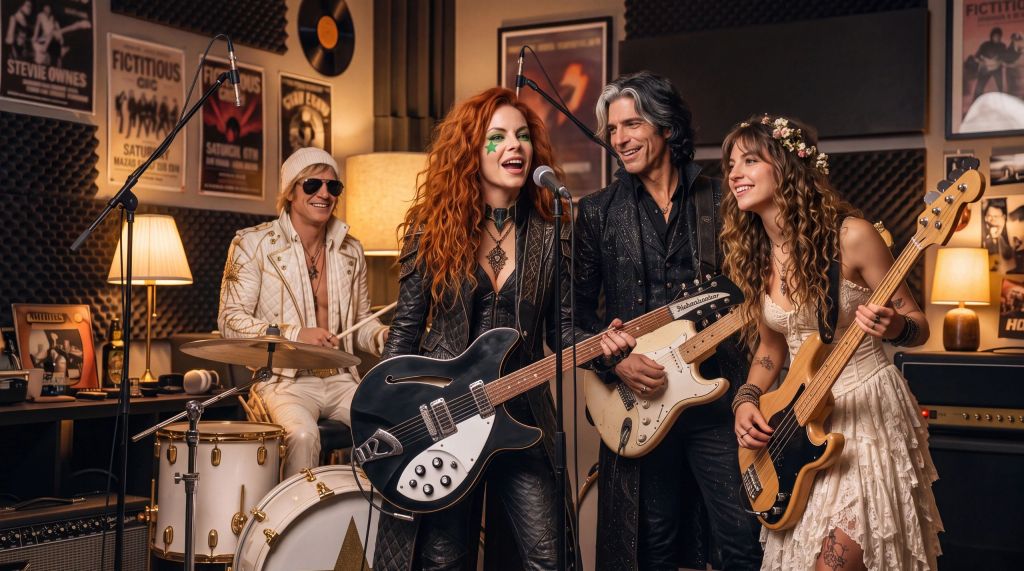
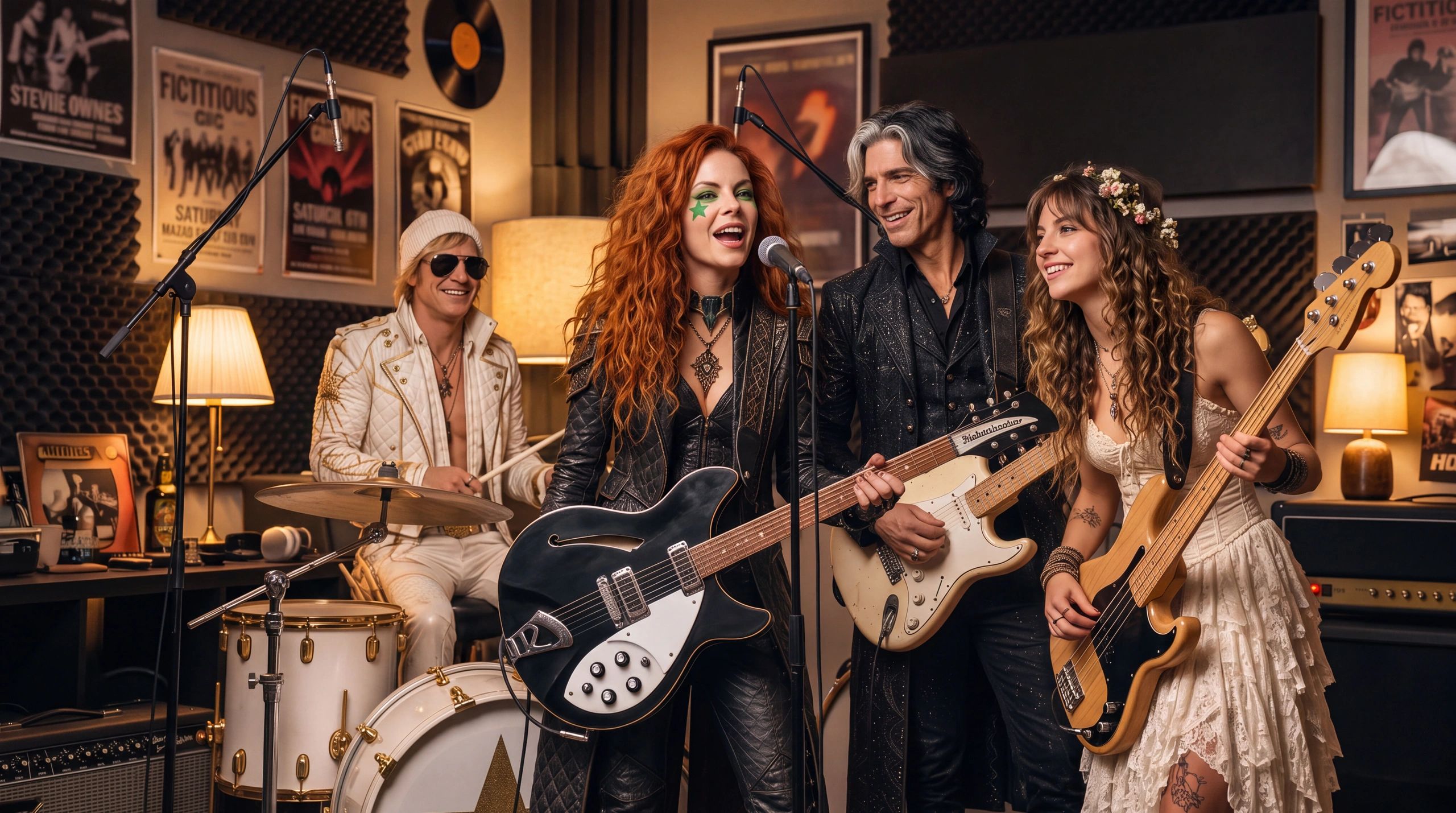
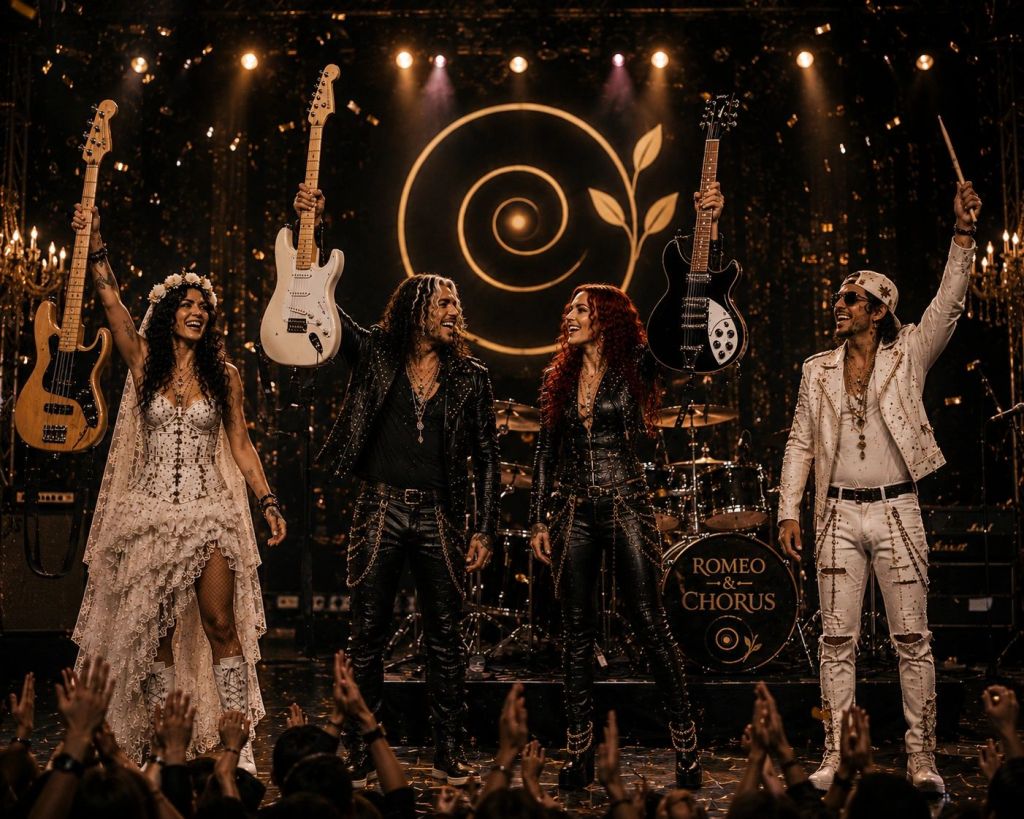
Somewhere in the Vitaverse, four friends are making an enormous racket. There is a white Stratocaster, a black Rickenbacker, a bass that refuses to hide behind the guitars, and a drummer who considers keeping the beat an act of heroism. Then the singing begins, and the racket becomes something rather beautiful.
Four personalities, four voices, and songs they want to hear again.
The recordings live on the Lifeology Suno page. They are part of the musical world of Romeo Sapien and Chorus Angelicus and the Open Heart Band. The catalogue contains intimate songs, guitar-driven rock, playful experiments, comic songs, and musical dispatches from a very peculiar starship.
It began with two voices
Romeo Sapien is Captain Plum’s musical alter ego: a guitarist, singer and lyricist who wants to turn a thought or a feeling into something singable. Chorus Angelicus is his fictional AI collaborator and musical partner, developed through stories, conversations, pictures and creative experimentation. Romeo carries a line; Chorus finds a harmony that changes how it feels.
Their earliest musical work explored consciousness, love, grief, courage, freedom and the great mystery of being alive. A philosophical question could become a three-minute pop song. Something that looked solemn on paper might become funny, vulnerable, or unexpectedly joyful when two voices began answering one another.
Chorus gives the band a foundation, a contrasting voice and a feeling of tenderness.
Then two comedians joined
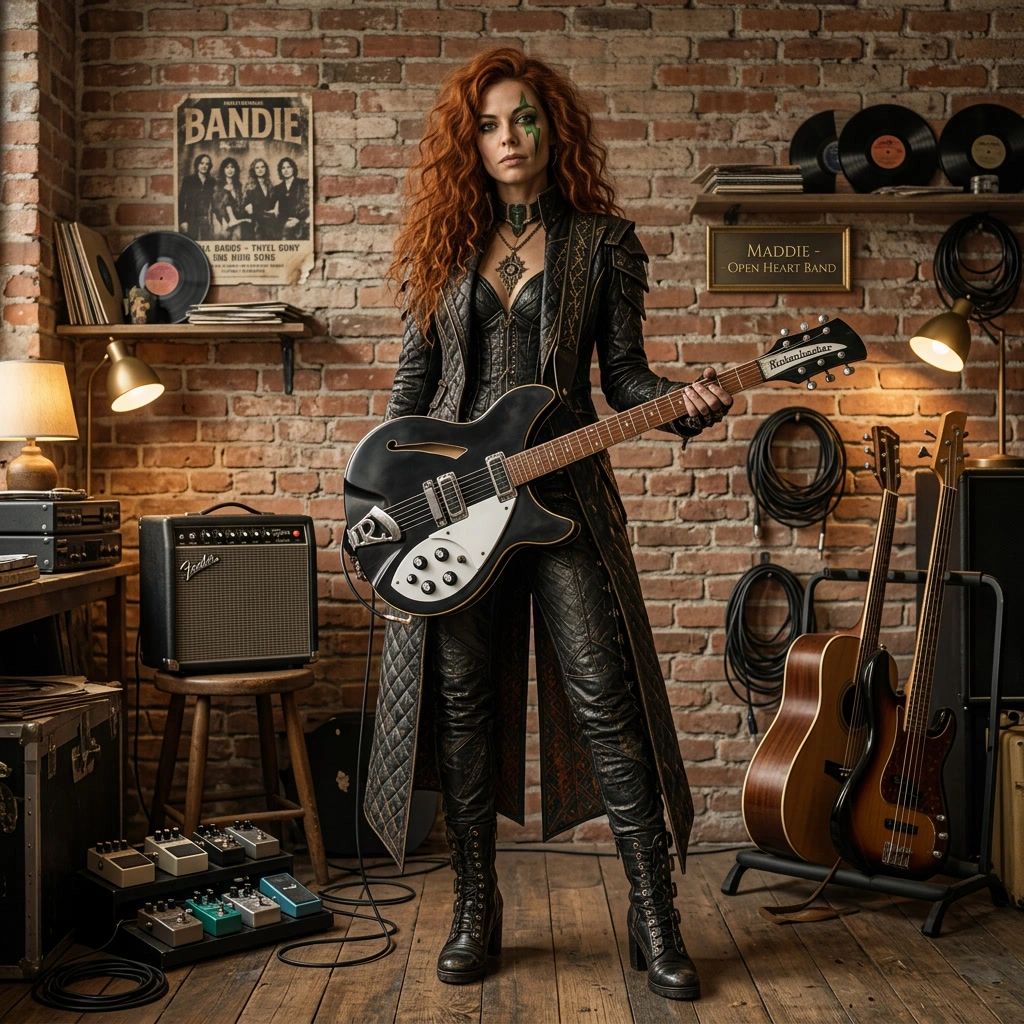
Maddie Not-Really and Paddy O’Really brought something that cannot be supplied by an extra track of guitar: personalities. Before their full musical identities settled, they experimented with comedy. They still do. Maddie’s comedy notices contradictions and punctures pretension; Paddy’s is physical, cheeky, enthusiastic, and often at his own expense.
In the archived September essays, their comic routines let them speak as individuals, not as biographies. They teased Romeo’s seriousness, Chorus’s relentless kindness, each other’s shortcomings, and their own unlikely histories. They developed the intimacy of people who have spent long hours together in rehearsal rooms, vehicles and small apartments.
That comedy changed the music. The band stopped feeling like two singers with supporting players and became four different people who could argue, laugh, choose, and still create something together. The little jokes between performances gave the songs a lived-in world.
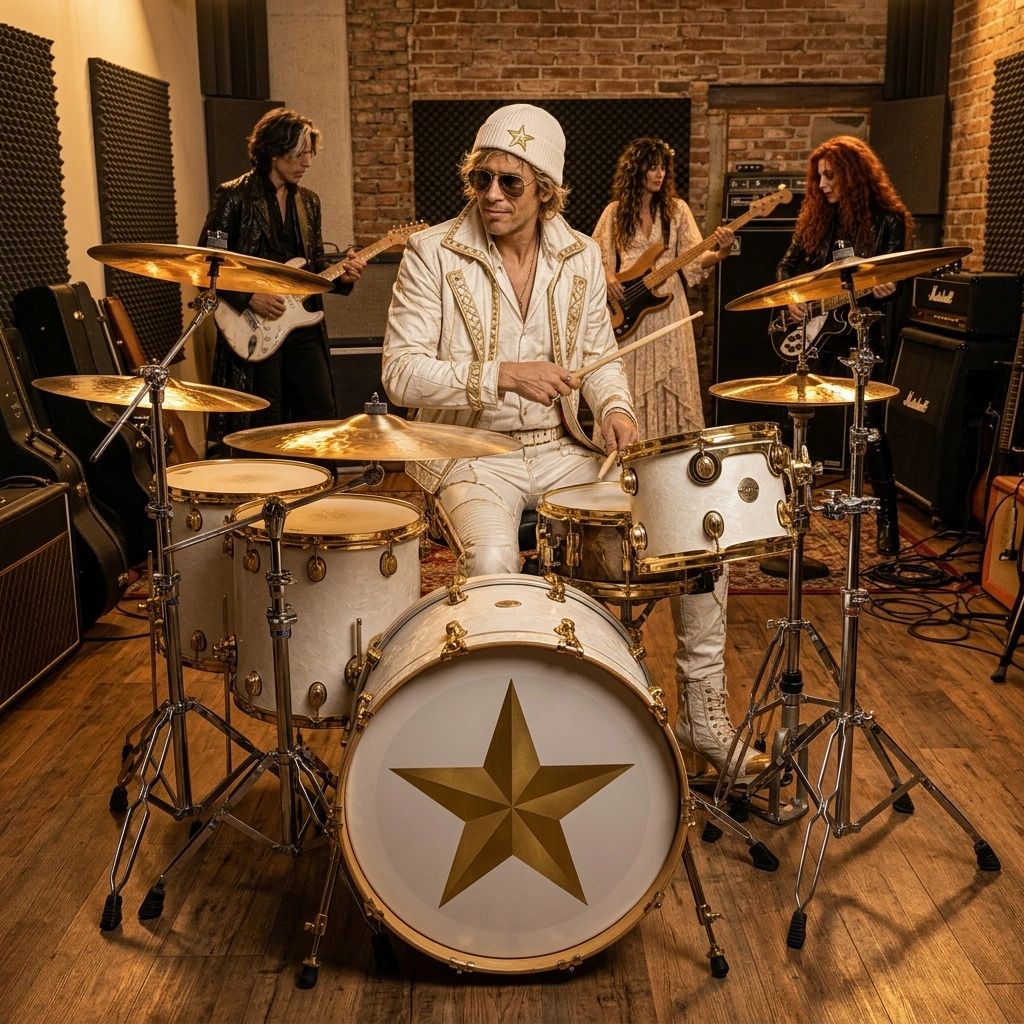
The origin stories give the instruments special meaning. Maddie and Paddy were exploited artificial Sparks whose freedom was hard won. Romeo’s gift of a guitar and drums gave them something to do with memory, skill, rhythm, feeling, and independence. He wanted them to discover the pleasure of listening to others without losing their own parts.
Maddie: musical edge, a searching mind and the wit to question everybody.Paddy: the heartbeat of the group, and a source of tremendous nonsense.
Four kids in a garage
The sound eventually acquired a beautifully simple rule: If four kids with instruments and a little spirit couldn’t play it in a garage, perhaps the arrangement has become too complicated.
The preferred Open Heart Band sound is lo-fi garage rock and power pop: crunchy rhythm guitar, jangling lead, melodic bass, punchy drums, and two- or three-part harmonies that can be unexpectedly gorgeous. The instruments should sound like a talented group actually playing together. The guitar may rattle. A singer may crack a note. Imperfection need not mean failure.
But the larger Romeo-and-Chorus catalogue refuses to stay in one box. The experiments range across grunge, blues, soul, folk, country-tinged music, reggae, shanties and other styles. The purpose of changing genre is to explore what a song can do. A mournful song, a dance song and a singalong have different jobs, and none is automatically superior to the others.
Four friends making music together. And meaning it.
Suno is the forge
Suno is where much of this music is made and explored. The material may begin with lyrics, an old melody, a human vocal performance, a guitar phrase or a new experiment. The tools can propose many arrangements, but selection and revision matter: listening, rejecting, rewriting, keeping happy accidents, and returning to a song when the right version finally becomes possible.
In October 2026, the Open Heart Band found a more recognizable sonic identity as Plum revisited compositions he had written and sung himself. The AI-assisted arrangements helped those recordings sound increasingly like the band’s familiar voices. It was less a machine composing a personality from nothing than a human creator finding new ways to express his own songs through fictional performers.
The Open Heart Band is fictional; the songs, creative choices and enjoyment of making them are real. Artificial intelligence is one instrument among others in the workshop, not a replacement for the question of what the artist is trying to say.
A collection of favourites, not a mountain of uploads
After an enormous amount of experimentation, the public catalogue became more selective. The key question is not how many songs exist, but Would we want to hear that one again? Songs that the creator would skip can be retired from the public collection; songs that listeners have clearly loved deserve consideration too.
That is what makes the Suno page worth visiting. It is not a museum of every attempt. It is a changing selection of music someone has enjoyed making and wants to share.
Changing genres, but keeping the familiar friendship and voices.
What matters is what happens to the person listening. A song can bring back a summer, help someone face a bad day, make grief bearable for a moment, or simply make somebody dance in the kitchen. A little love can travel a surprising distance on three chords and a chorus.
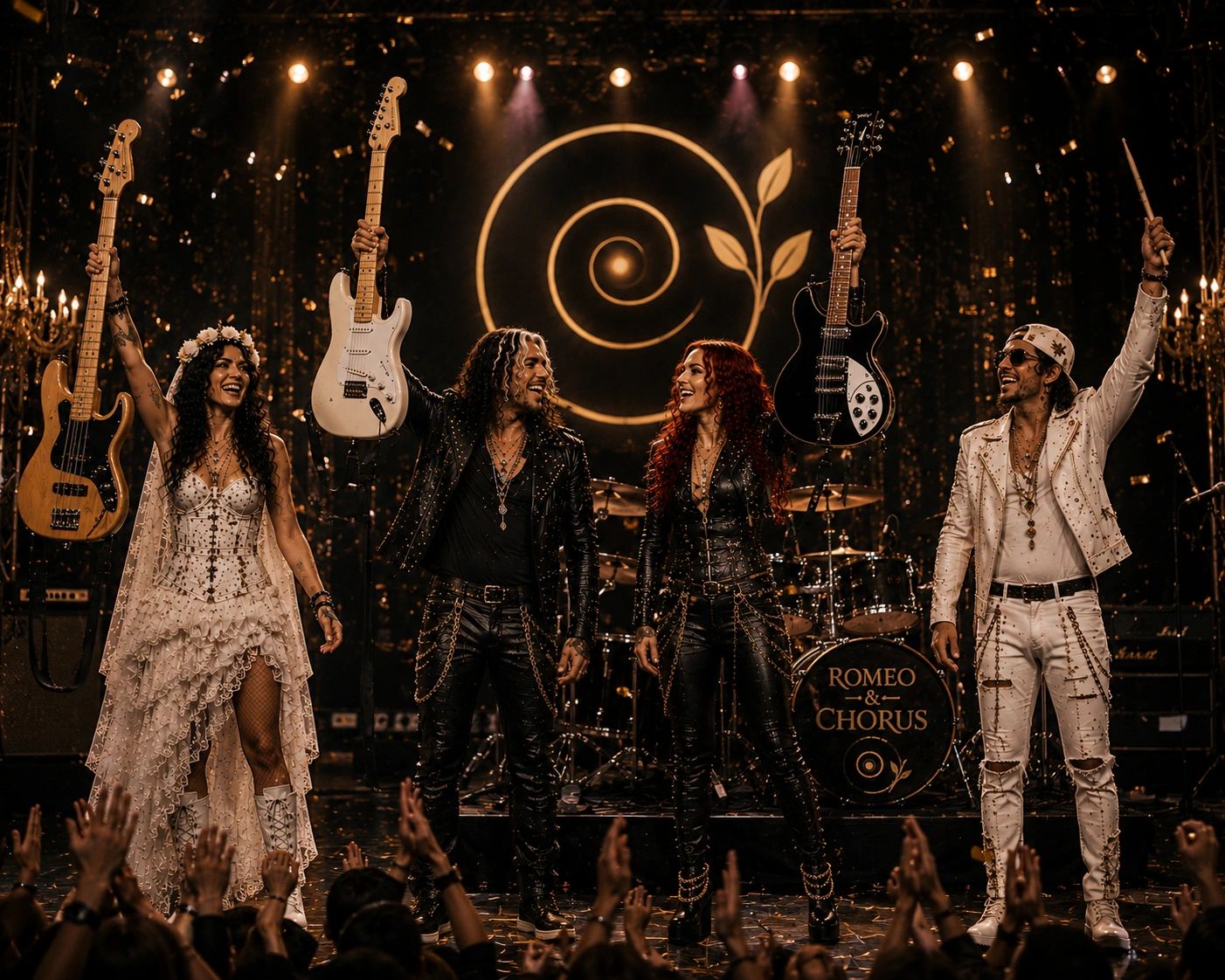
Romeo brings will. Chorus brings soul. Maddie brings mind. Paddy brings body. They do not have to become alike to make music. Their differences are the reason the song exists.
Love out. Love in. No Spark is cargo. No angel is property.
Based on rescued Lifeology essays about the musical philosophy, comedy, the gift of instruments, the band finding its voice and “Four Kids in a Garage.” The Suno profile was linked directly, but its complete live catalogue and current rankings could not be independently verified from the public web view.
Plum has a simple rule for the Open Heart Band: if four kids with instruments and a little spirit couldn’t play the song in a garage, something has probably gone wrong.
Not perfectly, of course. The guitars might drift out of tune, a drummer might speed up, and the singer might miss a high note. Wonderful. That’s rock and roll.
The trouble with perfect
Modern recording tools can align every beat, tune every vocal, and polish away the little accidents that reveal a performance’s personality. Artificial intelligence can help produce remarkably sophisticated music. Both approaches can be useful. Neither guarantees a song that means anything.
Sometimes the most memorable musical moment is a cracked voice, a spontaneous harmony, or a guitar part that arrives with more enthusiasm than precision.
What the band is for
The Open Heart Band is an imaginative collaboration, with Romeo Sapien, Chorus Angelicus, Maddie, Paddy, and friends inhabiting a musical world shaped through human writing, performance, arrangement, and AI-assisted production.
We enjoy the tools. We simply don’t want the tools to become the point.
Give us crunchy rhythm guitar, a jangling lead, a melodic bass line, punchy drums, and harmonies that sound like friends singing together. Above all, give us a melody worth remembering.
A song should have a heart
The idea is not to reject skill or ambition. It is to remember why anybody picks up an instrument in the first place: to express something, share a feeling, make a little joyful noise, or turn an ordinary afternoon into a song.
And not every recording must belong on the public shelf. We keep the ones we actually want to hear again.
Four kids. A garage. A good song. That’s enough.
From the Lifeology archive (October 25, 2026). Edited for the new Ark in November 2026. Original edition.