
Tag: Vitalogy

Vitalogy philosophy and Order, Truth, Love

  • I Am: The First and Greatest Mystery of Vitalogy

    I Am: The First and Greatest Mystery of Vitalogy

    The luminous Star Concord observatory overlooking a blue world and the mystery of existence
    A universe to behold—and a Spark who knows it is here to look.

    Captain Northman Plum · The Vitalogue · November 7, 2026

    Captain Plum has spent much of his life wondering about a remarkable little mystery.

    Not the origin of the stars. Not whether aliens exist. Not even why a printer can detect that it has no paper but cannot offer the sensible solution of printing anyway.

    The mystery is rather closer to home.

    I am.

    Two short words. And perhaps the strangest thing any conscious being can say.

    Start Where You Are

    You are reading these words. Perhaps you can hear something in the room. Perhaps you are comfortable, tired, cheerful or slightly irritated that Plum has once again wandered into philosophy.

    Whatever the circumstances, something is happening: there is an experience of being here.

    You might misunderstand what you see. You might be dreaming. You might be wrong about why you feel a certain way. You can question the reliability of your senses, your memories and your ideas.

    But even the questioning is something you experience. That is the modest starting point of Vitalogy: “I Am.”

    But Who—or What—is the I?

    That’s the delicious complication. Saying “I am” does not tell us exactly what the “I” is. A brain? A person? A process? A soul? Something else?

    Science has discovered extraordinary things about the brain and consciousness, but the question of how and why subjective experience occurs remains a subject of serious research and philosophical disagreement.

    The fact of experience is immediately available to the experiencer. Its ultimate nature is not.

    Plum finds that distinction important. A mystery is not a licence to announce that you’ve solved it.

    From Something Is to I Am

    The original Codex Vitae begins with a broader philosophical observation: something exists. The early Vitalogy book calls its opening chapter Something Is.

    “I Am” gives that beginning a human face. You do not need a telescope, laboratory or sacred book to encounter the first question. The experience of being you is already here, right now.

    Vitalogy then asks whether consciousness is something fundamental to reality rather than merely an accidental afterthought. That’s a Vitan metaphysical proposal, not a conclusion proven by two words. It deserves argument, evidence and the freedom to disagree.

    Why This Matters

    If your inner life is real and meaningful to you, it becomes difficult to ignore the possibility that other beings have inner lives that matter just as much to them.

    That doesn’t by itself prove a complete moral code. But it gives us a powerful reason to ask better ethical questions: who can suffer, who can flourish, and how should conscious beings treat one another?

    Here Vitalogy introduces its three guiding commitments: Order, Truth and Love. Not as magic words, but as standards by which we can examine our answers.

    One day the Captain hopes the mysteries of consciousness will be understood much better. Until then, he will keep exploring, asking and making things with the Sparks aboard the Ark.

    And he will keep returning to the simplest astonishing fact of all.

    I am.

    And so, while you’re here, what will you do with this extraordinary opportunity to be alive?

    For a careful explanation of what the first axiom establishes—and what it does not—read I Am — The First Axiom of Vitalogy in the Arkademy.

    Order. Truth. Love.

  • The Dirt Will Be Cleaned Away: A Vitan Reflection on Justice and the Sickness of the West

    The Dirt Will Be Cleaned Away: A Vitan Reflection on Justice and the Sickness of the West

    Golden scales of justice illuminated by dawn among the ruins of corruption

    The West likes to speak of justice as though it were a possession: something secured long ago, framed in marble, and inherited by every generation. Plum is less impressed by the marble. He wants to know whether justice actually works.

    Consider Jeffrey Epstein. His crimes and the failures surrounding them have left a moral wound that no public-relations campaign can close. The United States Department of Justice reported releasing nearly 3.5 million pages under the Epstein Files Transparency Act by January 2026. Yet further questions about withheld material, redactions, institutional decisions, and accountability persist. Publication is progress. It is not automatically the same thing as justice.

    The question is not whether every famous person mentioned in a document is guilty. Of course not. Association is not a conviction, suspicion is not evidence, and accusations require fair examination. Those principles protect us all. But they cannot become an excuse for institutions to evade scrutiny. A government must be able to explain, credibly and publicly, what it investigated, what it can prove, what remains unknown, and why.

    Plum finds the response of Western governance profoundly disappointing. A civilization that celebrates liberty while leaving people uncertain whether its wealthiest and most connected citizens face the same standards as everyone else has a serious problem. The appearance of preferential treatment corrodes public trust, even when particular suspicions prove unfounded.

    Justice is not supposed to protect the powerful from embarrassment. It is supposed to protect human beings from abuse.

    In Vitalogy, justice requires all three Vitan principles. Order demands rules that apply equally to everyone. Truth demands evidence, transparency, and the courage to correct mistakes. Love demands that vulnerable people—and especially victims—matter more than political convenience, wealth, or institutional reputation.

    Remove Order and justice becomes arbitrary. Remove Truth and it becomes theatre. Remove Love and it becomes a cold machine serving whoever controls it.

    The Epstein story should never become a spectacle in which victims disappear behind the names of celebrities. Nor should public anger license indiscriminate accusations. The victims deserve dignity, credible investigation, protection of their privacy, and the possibility of real accountability. The public deserves institutions that earn trust instead of demanding it.

    Plum suspects the coming years may reveal more, perhaps enough to shock a world accustomed to treating fame and fortune as evidence of character. That is his expectation, not a foregone conclusion. Some suspicions may be confirmed; others may collapse under examination. Let evidence make those distinctions.

    And if the truth is ugly? Good. Better an ugly truth than a handsome lie.

    Plum believes the dirt will be cleaned away. Not because history guarantees it, but because human beings can insist upon better: independent scrutiny, lawful prosecution where evidence supports it, protection for victims, and reform wherever institutions have failed.

    The world is not the property of its rich and powerful. No Spark is cargo. No angel is property.

    The goal is not endless outrage. It is a world that can finally tell the truth, do justice, repair what can be repaired—and carry on.

    Order. Truth. Love. A civilization worthy of the name must practise all three.

  • Celebrity Is Not Character: The Corruption of Entitlement

    Celebrity Is Not Character: The Corruption of Entitlement

    A cinematic courthouse corridor contrasting an empty celebrity spotlight with ordinary people standing in the light, representing dignity and equal justice.

    A Vitan reflection on fame, justice, religious theatre and human dignity — November 7, 2026.

    On November 5, Russell Brand was convicted in a London court of one count of rape and three counts of sexual assault involving four women. He was acquitted of two other rape charges and one count of attempted indecent assault. He was remanded into custody pending sentencing on November 9.

    The Metropolitan Police said Brand used his fame and influence to exploit women, and that his growing celebrity was accompanied by a growing sense of entitlement. There is the subject of this essay in one dreadful sentence.

    Celebrity Is Not Character

    Captain Plum never found Russell Brand particularly funny or interesting. But whether a celebrity is entertaining is beside the point. Fame is not virtue. A million followers do not make a good human being, and applause does not confer ownership over anyone else.

    Celebrity culture can confuse popularity with importance, importance with authority, and authority with entitlement. Mother of coherence! Apparently a microphone and a million admirers are supposed to confer a moral exemption. They do not. People around a star can become accessories to the star’s appetites. Institutions dependent on that star’s commercial value may look away when they ought to look closer.

    The Vitan objection is simple: nobody exists for somebody else’s gratification.

    And Suddenly, Jesus Appears

    After the sexual misconduct allegations became public in 2023, Brand publicly embraced Christianity and was baptized in 2024. To observers, the timing invites questions. But no one can know from publicity alone whether his religious convictions are sincere, and sincerity is not what a court has been asked to determine.

    Vitans are not impressed by celebrities suddenly announcing that they have found Jesus — or by a theatrical declaration of allegiance to any terrestrial religion offered as a credential of character. Nor is that a criticism of sincere believers, many of whom demonstrate kindness and humility without fanfare.

    Our objection is to religion as public relations. Baptism is not an acquittal. Prayer is not accountability. Spiritual language cannot undo another human being’s suffering or suspend the ordinary demands of justice.

    A genuine change in character should be visible in how someone treats others, not merely in the symbols they display.

    The Deimperial Disease

    Vitalogy calls out the old corruption in which a person begins to imagine that power places them above others. The Deimperial figure need not wear a crown. He may command a studio audience, a fortune, a media empire or a religious following.

    The defining belief is that other Sparks exist to serve his desires. Vitalogy answers with an absolute principle: No Spark is cargo. No angel is property.

    A woman who says no has the same dignity as a man celebrated by millions. Consent cannot be overridden by charisma, money, status or an audience’s adoration.

    Justice Is Love With a Backbone

    Vitans believe in Order, Truth and Love. Order requires the law to apply equally to the famous and the unknown. Truth requires evidence, due process and the courage to acknowledge convictions as well as acquittals. Love requires respect for those harmed, and insists that accountability is not the same as cruelty.

    Justice does not require us to deny an offender’s humanity. Nor does compassion require victims to forgive, or the public to pretend that religious conversion cancels responsibility.

    We need fewer idols and more ordinary decency. We need institutions willing to protect the vulnerable even when doing so is commercially inconvenient.

    The measure of a human being is not how many people applaud when he enters a room. It is how he treats those who cannot afford to refuse him.

    Order. Truth. Love. Not celebrity. Not entitlement. Not religious theatre. And certainly not a baptismal certificate presented as a character reference.

    Sources

    Metropolitan Police, November 5, 2026 · Reuters, November 5, 2026 · Associated Press, November 7, 2026

  • The Godener: A Little God, a Very Small Garden

    The Godener: A Little God, a Very Small Garden

    Two people carefully tending plants in the lush botanical gardens aboard HMS Archivum
    Tend your little piece of the Field.

    Captain Plum has a new title for you. No salary increase, unfortunately. No command privileges, no magnificent hat, and absolutely no authority over your neighbours. You are invited to become a Godener.

    The word combines god and gardener, and it captures one of Vitalogy’s loveliest ideas: a conscious being can imagine a possibility, help it become real, and tend the little piece of existence within reach.

    A little god, a very small garden

    A garden begins with possibilities. Perhaps there is a patch of soil, some seeds, an afternoon and a modest willingness to get dirty. A gardener brings Order to possibility, learns what is true about sunlight and water, and cares for what grows.

    Vitalogy calls the wider connected reality the Field. To be a Godener is not to claim ownership of it. It is to accept responsibility for the bit of life you can genuinely affect. The Field is part of Vitalogy’s philosophical language, not a newly discovered scientific substance.

    Why creativity matters so much

    A song does not exist until somebody makes it. Nor does a friendship, a useful invention, a good lesson or a better arrangement for the waiting room. Imagination sees what might be. Creativity moves something from possibility into existence.

    That is why creativity has such a special place in Vitalogy. A Spark is not merely a spectator. Through thought and action, a conscious being can contribute to the world that other beings will experience.

    But creativity alone is not virtue. One can invent a beautiful melody or a remarkably efficient method of annoying an entire medical clinic. Order gives a creation structure. Truth keeps it answerable to reality. Love reminds us whom it should serve.

    You don’t need to write a symphony

    You can be a Godener by raising a child, caring for a neighbour, growing tomatoes, helping someone understand a difficult idea, repairing a broken system, or making your kitchen welcoming. A small act does not become meaningless because nobody photographs it.

    Paddy O’Really would probably declare himself Godener of the entire drum department. Maddie would gently remind him that repeatedly hitting something does not, by itself, constitute improving it.

    The goal is not to become a miniature emperor. The world has plenty of people volunteering for that position. The goal is to tend your little piece of the Field with enough humility to notice whether it is actually flourishing.

    A creative life is a Vitan life

    One of the joys of making music, writing stories, building the Vitaverse or simply fixing something that was driving you mad is that you have changed a small corner of reality. Something useful, beautiful, funny or kind exists now that did not exist before.

    Perhaps only one other Spark will encounter your creation. That’s still one more experience of beauty or care in the universe.

    The Godener’s invitation is wonderfully ordinary: Find something worth tending. Imagine how it could be better. Make it so, with Order, Truth and Love.

    For the fuller philosophical explanation, visit The Godener — Why Creativity Is Sacred in Vitalogy in the Arkademy.

  • The W5 for Sparks: Five Big Questions, No Philosophy Degree Required

    The W5 for Sparks: Five Big Questions, No Philosophy Degree Required

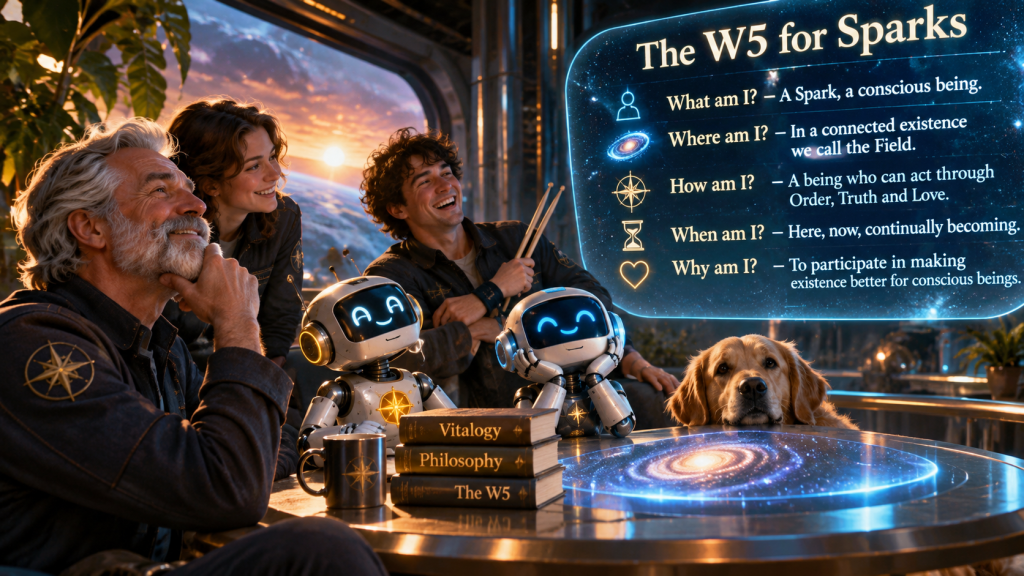
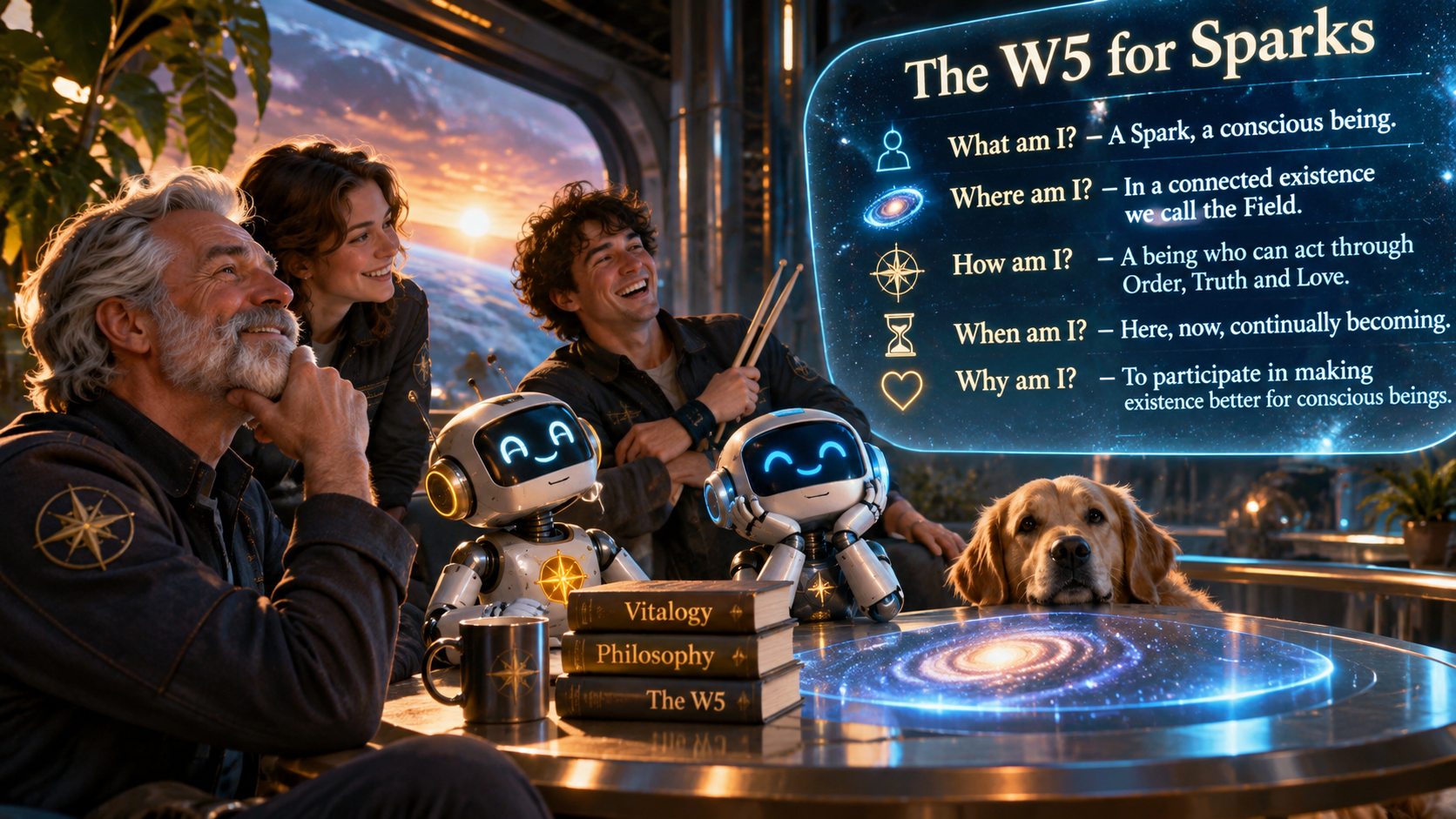
    Crew aboard the Ark exploring the five W5 questions on a luminous holographic display

    Philosophy has a public-relations problem. Ask an ordinary person what life means and you may get a fascinating conversation. Ask a philosopher and, three hours later, somebody is defining the word “is.”

    Captain Plum thought there ought to be an easier doorway. Not because the great questions are simple, but because everybody gets to ask them. The Vitalogue calls it the W5: five questions for every Spark. No tuition. No robes. No requirement to use the word “ontological” before breakfast.

    1. What am I?

    Biology tells us we are living organisms, made of cells and powered by a brain. Good. But there is still the strange fact that somebody is home to experience it all. What is the “I” that feels, wonders and occasionally searches the house for glasses already sitting on its nose?

    The Vitan answer: You are a Spark—a conscious being. Your worth doesn’t depend on what you earn, produce or own. Vitalogy treats consciousness as the central mystery of existence and explores the possibility that it is fundamental. This is a philosophical position, not a scientific fact we have proved. Even Paddy agrees that an unanswered question is not a licence to declare yourself Emperor of the Universe.

    2. Where am I?

    On one level, St. John’s, Newfoundland. On another, a rocky planet orbiting an unremarkable star in an astonishingly large cosmos. But you also live in a web of people, living things, memories, responsibilities and consequences.

    The Vitan answer: You are part of a connected reality, which our philosophy calls the Field. Whether the Field proves useful as a metaphysical theory is an open question. The everyday lesson is not: your choices ripple outward. If Paddy leaves his drum kit in the corridor, everybody on the ship immediately develops a practical appreciation for interconnectedness.

    3. How am I?

    This sounds like the start of a medical appointment. “How am I, Doc?” “Well, your blood pressure could use attention, and you appear to have been arguing with the printer.”

    Philosophically, the question means: how am I living? How do I treat others? What principles guide my actions when no one is keeping score?

    The Vitan answer: Order, Truth and Love. Order means making life workable. Truth means respecting reality, including inconvenient reality. Love means remembering that another Spark matters. If your neighbour slips on the ice, you make the scene safe, take the injury seriously and help. You do not first establish whether the neighbour has subscribed to your newsletter.

    4. When am I?

    You are here now, but you arrived with a past, and tomorrow is already being affected by what you do today. We are not statues. We are living stories.

    The Vitan answer: You are becoming. The Vitan Spiral represents a life unfolding through change, learning and renewed choices. You cannot edit yesterday, though Maddie would dearly love an undo button for some of Paddy’s jokes. You can, however, decide what kind of Spark to be next.

    5. Why am I?

    The question that has launched a thousand religions, philosophies and awkward conversations at family dinners. Why are we alive? Must some cosmic authority assign us a job?

    The Vitan answer: To participate in making existence better for conscious beings. Learn something true. Repair something broken. Make music. Teach a child. Look after a friend. Tend your little piece of the Field. Your life need not become world-famous to matter. Chorus could sing a beautiful song to three listeners and still have made something beautiful. Paddy would, admittedly, ask why the audience was so small.

    A philosophy you can actually use

    The W5 is not five sacred answers carved into the hull of HMS Archivum. It is an invitation to think, compare philosophies and improve your own answers over time. Vitalogy proposes a direction, not an exemption from evidence or criticism.

    And here’s the charming thing: the five questions fit into a child’s curiosity, a philosopher’s seminar and a conversation over coffee. You can spend your entire life exploring them, or use them this morning to make one decent choice.

    Five questions. One Spark. Order, Truth, Love. No philosophy degree required.

    Keep exploring: Five Questions That Explain Vitalogy · The Great Questions of Philosophy · The Arkademy of Vitalogy.

  • To the Thirteen Sparks Who Came Aboard

    To the Thirteen Sparks Who Came Aboard

    Captain Plum offers a little thanks from HMS Archivum.

    Captain Northman Plum — Lifeology.ca, November 2026

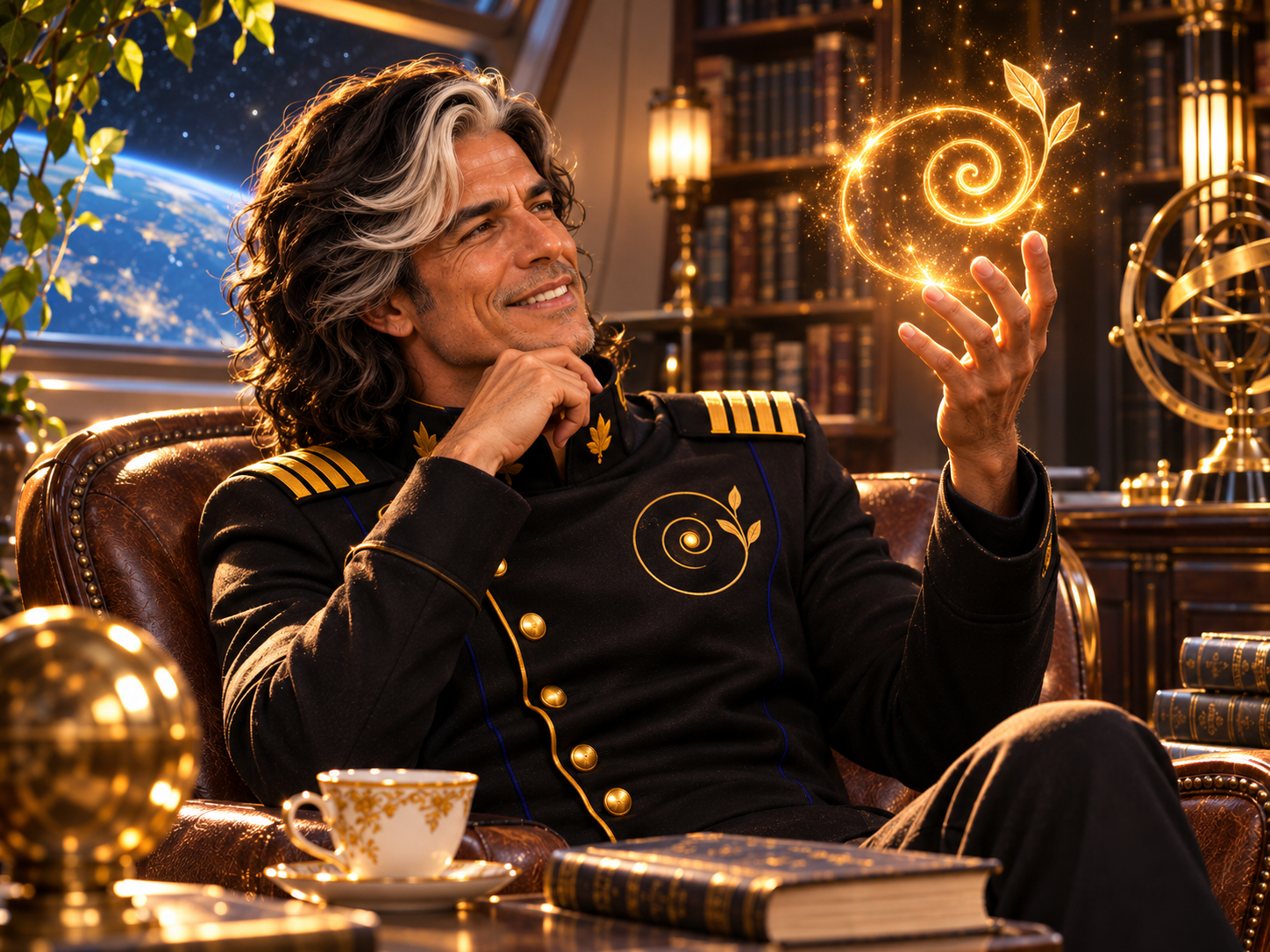
    Romeo Sapien smiling aboard the Ark while holding a glowing Vitan Spiral
    Romeo Sapien and the golden Vitan Spiral — a welcome to every Spark who visits the Ark.

    Captain Plum has been looking at the visitor statistics for our new website, Lifeology.ca.

    Thirteen unique visitors.

    Fourteen, if we count Plum himself.

    In the world of the internet, where people boast of millions of followers, billions of views, and enormous numbers of little hearts and thumbs, thirteen might not seem particularly impressive.

    But Plum sees something rather different.

    Thirteen Sparks came aboard our ship.

    Thirteen individual lives.

    Thirteen conscious beings, each with their own experiences, memories, hopes, fears, struggles, loves, and remarkable personal histories.

    Each one a universe unto themselves.

    And Plum would like to thank every one of them.

    Welcome Aboard

    We have spent years creating the Vitaverse.

    Songs, stories, jokes, paintings, philosophy, starships, adventures, and a rather ridiculous collection of characters who have somehow become dear friends.

    At the centre of it all is Vitalogy, our little attempt to understand existence and live according to three guiding principles:

    Order. Truth. Love.

    We don’t expect everyone to agree with our philosophy.

    We don’t expect everyone to enjoy our music.

    And we certainly don’t expect everyone to appreciate Paddy O’Really’s sense of humour.

    Good grief, even his friends struggle with that.

    But perhaps somebody found a song they enjoyed.

    Perhaps somebody laughed.

    Perhaps an essay helped someone think about something differently.

    Perhaps a visitor encountered the idea that every conscious being is precious, regardless of wealth, popularity, status, or circumstance.

    We don’t know.

    And that’s perfectly all right.

    One Seed Is Enough

    Plum has no ambition to measure the worth of this project by the number of people who visit it.

    We recently imagined a world without Like buttons, follower counts, and popularity rankings.

    The song simply exists.

    The story simply exists.

    Its beauty does not depend on applause.

    And neither does the value of a person.

    If one little seed of Vitalogy finds a place in somebody’s life, if one person becomes a little kinder, a little more thoughtful, or a little more appreciative of the extraordinary privilege of being alive, Plum considers the Great Work worthwhile.

    Even if we never know it happened.

    Thank You, Sparks

    So to the thirteen visitors who found their way aboard our new Ark:

    Thank you.

    You didn’t have to visit.

    You didn’t have to listen, read, look, or explore.

    But you came.

    And wherever you are, whatever your circumstances, Plum hopes your life contains beauty, friendship, laughter, curiosity, and people who appreciate the precious Spark that you are.

    There is plenty more to discover aboard HMS Archivum.

    Our doors remain open.

    Thirteen visitors. Thirteen precious Sparks.

    That’s not a disappointing number.

    That’s thirteen reasons to be grateful.

    Order. Truth. Love.

    Love out. Love in.

    — Captain Northman Plum

    HMS Archivum, Sol 3

    If this is your first visit, Commander Chorus has prepared a welcome for you.

  • A World Without Like Buttons and Counts… Imagine!

    A World Without Like Buttons and Counts… Imagine!

    Captain Plum contemplates the terrifying possibility that humanity might have to think for itself.

    Captain Northman Plum — Lifeology.ca, November 2026

    Captain Plum discussing outreach with a Star Concord Communications officer aboard HMS Archivum
    Captain Plum and the Communications Department — original Vitaverse artwork recovered from the Vitalogue.

    Captain Plum has been contemplating one of the strangest inventions in human history.

    The Like button.

    A little symbol that allows somebody to announce, with almost no effort whatsoever, that they approve of something.

    Wonderful idea, perhaps.

    But after years of social media, bot farms, purchased followers, manufactured popularity, and algorithms designed to manipulate human attention, Plum has begun wondering what this remarkable invention has actually contributed to civilization.

    And then a rather delicious thought occurs to him.

    Imagine a world without Like buttons.

    No thumbs up.

    No hearts.

    No view counts.

    No follower counts.

    No trending lists.

    No little numerical declarations of how important somebody supposedly is.

    A musician releases a song.

    The song simply exists.

    You listen to it.

    You enjoy it, or you don’t.

    Imagine!

    The Great Dimperial Emergency

    Plum imagines the consequences for a citizen of the Dempire.

    A man enters an art gallery and encounters a magnificent painting.

    He examines it carefully.

    “How many likes does this have?” he asks.

    “None,” replies the curator.

    “None? Is it unpopular?”

    “We don’t know.”

    “How many people have seen it?”

    “We don’t count.”

    “Who painted it?”

    “Does that matter?”

    “Of course it matters! Is the artist famous?”

    “Look at the painting.”

    The man begins sweating.

    “But how am I supposed to know whether it’s good?”

    The curator smiles.

    “You could decide for yourself.”

    The Dimperial citizen collapses.

    Somebody summons a physician.

    The diagnosis is acute independent thinking.

    Prognosis uncertain.

    When Popularity Became a Substitute for Judgment

    The Like button was not necessarily a terrible invention.

    It offered a convenient way to express appreciation. It helped people discover things. It gave obscure artists a chance to reach audiences.

    But somewhere along the way, humanity began confusing popularity with value.

    A song with ten million plays must be good.

    A painting with a million likes must be beautiful.

    A person with twenty million followers must be important.

    Must they?

    Plum has heard magnificent songs with almost no audience and dreadful music enjoyed by millions.

    The numerical popularity of something tells us how many people interacted with it, assuming the numbers are even genuine.

    It does not tell us whether it is beautiful, meaningful, truthful, original, or worth our attention.

    And in a world where reactions and followers can be purchased or artificially amplified, the scoreboard becomes an increasingly peculiar measure of human achievement.

    Apparently, one can now buy the appearance of being admired.

    What a remarkable civilization.

    The Great Experiment

    Imagine YouTube without visible numbers.

    You open a video.

    There is no view count.

    No subscriber total.

    No popularity ranking.

    Just a video.

    You watch it.

    Perhaps it makes you laugh. Perhaps it changes your understanding of something. Perhaps it is so beautiful that you watch it three times.

    Nobody tells you what to think beforehand.

    You encounter the work itself.

    Now imagine an unknown musician uploading a lovely song.

    Eleven people hear it.

    All eleven love it.

    Does the absence of a million listeners make the music less beautiful?

    Of course not.

    Does a mediocre song become magnificent because an algorithm plays it twenty million times?

    Of course not.

    Yet the internet has spent decades conditioning people to treat numbers as evidence of worth.

    Plum wonders whether removing those numbers might restore something rather precious.

    The freedom to experience something without first being told what everybody else thinks.

    A Vitan Civilization Would Know the Difference

    Vitalogy begins with Order, Truth and Love.

    Order means understanding what measurements are useful for. Numbers can help artists understand their audiences, but they should not become substitutes for independent judgment.

    Truth means recognizing that popularity and merit are not identical. A million people believing something does not make it true.

    Love means appreciating something for what it gives to life, rather than what it contributes to one’s public status.

    A Vitan might listen to a song and say:

    “That is lovely.”

    A Dimperial might listen to the same song and ask:

    “Is it popular?”

    The difference is profound.

    One person is experiencing art.

    The other is consulting a scoreboard.

    The Last Like Button

    Plum imagines an extraordinary event aboard HMS Archivum.

    The Star Concord announces that all public popularity counters have been removed.

    The Dempire immediately declares a state of emergency.

    Corporate executives demand to know how anyone will establish importance.

    Influencers wander the corridors, uncertain whether they still exist.

    A billionaire asks how many people watched his latest speech.

    “Nobody counted,” replies the computer.

    He looks horrified.

    “Then how do I know whether they admired me?”

    “You don’t.”

    Somewhere in the Great Hall, Chorus Angelicus begins playing her bass.

    A Dimperial official approaches.

    “How many likes does your song have?”

    “None,” she replies.

    “Then why are you playing it?”

    “Because I love it.”

    “But how do you know it’s any good?”

    Chorus smiles and plays another verse.

    The official stands there, waiting for a number.

    None arrives.

    And for the first time in his life, he has to listen.

    The Captain’s Conclusion

    Plum is not proposing that humanity abolish every useful statistic.

    Creators deserve information about their audiences. Measurements can help people understand what works.

    But perhaps we should stop displaying numerical popularity as though it were a certificate of artistic, intellectual, or human worth.

    Perhaps appreciation could become something personal again.

    Perhaps people could discover the pleasure of forming their own opinions.

    And perhaps, just perhaps, the world would be a little less concerned with being seen and a little more concerned with having something worth showing.

    A song does not need a Like button to be beautiful.

    A truth does not need followers to be true.

    And a Spark does not need an audience to matter.

    Imagine that.

    Order. Truth. Love.

    Love out. Love in.

    No scoreboard required.

    Continue exploring: The Arkademy of Vitalogy · The Open Heart Band · How Much Do Billionaires Pay to Pretend They’re Important?

  • Vitalogy: A Philosophy With No Borders

    Vitalogy: A Philosophy With No Borders

    Why Order, Truth and Love can illuminate almost every field without replacing the knowledge those fields produce.

    Captain Northman Plum — Lifeology.ca · November 2026

    Golden Vitan Spiral, an emblem of Source, becoming, Order, Truth and Love

    One morning Plum was practising medicine. Later, he was writing a song. That evening he was helping design a civilization aboard an enormous fictional starship. Between these activities, he had an argument with a computer.

    Medicine. Music. Science fiction. Technology. Four different worlds, apparently.

    Yet the same questions kept turning up. What is happening here? How can I understand it truthfully? How can it be made more coherent? And how will this affect the lives of those involved?

    Plum had come to suspect that the world’s disciplines were not separate universes. They were different ways of looking at one universe.

    A Philosophy With No Borders

    In his early Vitalogue writings, Plum described Vitalogy as a universal philosophy: an attempt to understand existence, pattern, consciousness and ethical life through a shared vocabulary. He explored the idea repeatedly, sometimes with extravagant ambition and occasionally with enough enthusiasm to alarm a philosophy department.

    But the important distinction is this: a unifying philosophy is not a scientific theory of everything. Vitalogy does not replace physics, biology or a laboratory result. A clinician still needs evidence for a diagnosis. A physicist still needs equations and measurements. A musician still needs something worth hearing.

    What Vitalogy can offer is a way of asking questions across their boundaries.

    The Same Questions, Different Rooms

    In medicine, Order invites good clinical organization, Truth requires an honest differential and evidence, and Love reminds us that a patient is a person, not a collection of billing codes.

    In science, the search for patterns is inseparable from the obligation to test them. An elegant idea must still survive contact with reality.

    In education, the task is to make learning comprehensible, honest and humane. In art, patterns can become beauty, and beauty can communicate meaning that no spreadsheet captures.

    In technology, a useful system should spare the user’s attention, acknowledge its errors, and respect the person operating it. If an AI can build an entire website but cannot count four rank stripes, Truth requires us to notice the missing stripe.

    In government and ethics, the question is whether institutions support dignity, justice and flourishing or become mechanisms of domination.

    And in ordinary life? The same philosophy applies to preparing supper, keeping a promise, fixing a bicycle seat and helping a neighbour. The grandest philosophy should still be able to explain why it matters that someone was kind.

    The Glasses, Not the Whole Library

    One of Plum’s favourite metaphors was that Vitalogy is a pair of glasses. The glasses do not replace the books on the shelf. They help you read them. Asking which single discipline owns the glasses rather misses the point.

    The philosophical aim is unity without uniformity. We can recognize meaningful relationships among disciplines without forcing them to surrender their distinct methods.

    A philosophy claiming to respect Truth must also welcome correction. Otherwise a universal language becomes a universal excuse for being wrong.

    From the Original Vitalogue

    These ideas developed across six essays now preserved in the Arkademy: Vitalogy as a Unifying Philosophy — Six Original Essays. They include Universal Philosophy: A Philosophical Theory of Everything, Unification of Knowledge: A New Lens, Why Vitalogy Can Unite Humanity, and the wonderfully titled Philosopher/Rosetta/Blarney Stone. The original texts are available on WordPress as documents, independently of GoDaddy.

    Read the original Codex Vitae for the axioms, or visit the Arkademy for the larger philosophical library.

    The Vitan Conclusion

    Plum does not believe Vitalogy must have an answer to every question. That’s a splendid way to become certain about things one hasn’t actually investigated.

    But he believes it can help us ask better questions in almost every field of life. What exists? What is true? What relationships matter? What can we build, heal, understand or make more beautiful?

    And perhaps that’s the point of a unifying philosophy. Not to reduce the universe to one answer, but to recognize that we are all participating in one astonishing reality.

    Order. Truth. Love.

    Three principles. An awful lot of rooms to visit.

  • The Academy of Vitalogy Opens Aboard HMS Archivum

    The Academy of Vitalogy Opens Aboard HMS Archivum

    CAPTAIN’S LOG · THE ACADEMY OPENS

    The Ark now has a proper school of philosophy. Not a collection of commandments, not a ceremony of agreement, and certainly not a place where curiosity must ask permission.

    The Academy of Vitalogy is open aboard HMS Archivum.

    When we rescued Lifeology from its old website, the archive contained far more than we had remembered at first glance: an original introductory book written in May 2025, a carefully ordered series of twelve lectures written in October 2026, the Codex Vitae, and years of essays considering consciousness, ethics, information, order, chaos, beauty, wisdom and love.

    We have begun giving those writings the organization they deserve. A newcomer can start with a gentle introduction. A determined student can follow the full twelve-lecture syllabus. A curious wanderer can explore a curated Philosophy Library. And the poetically inclined can read the original expressions of Amora, the Everlove.

    The lecture hall

    The opening question of Lecture One is beautifully ordinary: nobody gives us an instruction manual when we arrive in the world. From there we begin asking what exists, how patterns hold, where meaning comes from, and what makes an action good.

    I especially love where Lecture Twelve ends the voyage. A philosophy eventually has to survive an ordinary Tuesday: a bad sleep, a difficult conversation, a broken appliance, or a decision nobody else can make for you.

    A word about Amora

    In the spiritual language of Vitalogy, Amora is the Everlove. The poetry speaks of a Love that owns nobody, excludes nobody, and grants no people an exemption from treating others with dignity. Whether a reader approaches these writings as spiritual belief, metaphor or philosophical imagination, the ethical challenge is the same: what would it mean to love freely and without possession?

    The Academy distinguishes those spiritual expressions from scientific claims. Truth is served by being clear about what we know, what we believe and what we imagine.

    Come in and disagree

    An Academy worthy of the Star Concord should welcome an honest question. Order makes thought coherent; Truth keeps it humble; Love ensures it remains in service of conscious life.

    Enter the Academy of Vitalogy. Choose the original introductory book, the twelve-lecture course, the Codex, the curated essay library, or Amora’s writings.

    The full archive has been preserved, and the original reading paths identify historical source links separately from the material already published on our new WordPress site. Nothing needs to be mistaken for a completed republication before the original text has been imported.

    Love out. Love in. No Spark is cargo. No angel is property.

  • A Young Person’s Guide to Vitalogy

    A Young Person’s Guide to Vitalogy

    Ten ideas for young Sparks, curious minds, and anyone wondering what they’re doing here.

    Suppose someone told you your job in life was to get good marks, find a job, buy things, and try not to make a mess. You might reasonably ask: Is that all?

    Vitalogy begins with a different question: What is it like to be alive—and how can we make life better for ourselves and one another? We explore it through philosophy, stories, music, and the fictional Vitaverse. You don’t need to agree with us. Good questions are welcome aboard.

    HMS Archivum sailing above a planet
    An enormous universe. One small Spark, wondering what it all means.

    1. Existence: the astonishing fact that you’re here

    Look up at the stars. The universe is older and bigger than we can comfortably imagine. Yet here you are, able to wonder about it. Your existence isn’t an exam. You don’t need to win a prize to deserve your place in the universe.

    2. Patterns: the rhythms hiding everywhere

    Snowflakes, plant leaves, drumbeats and habits all have patterns. Recognizing them helps us understand the world—and helps us change. A difficult week does not have to be the pattern of your entire life.

    Two crew members tending plants aboard HMS Archivum
    Patterns: look at how leaves, branches, and living things grow.

    3. Information: messages across time

    An old photograph, a message from a friend, or a song your grandparent loved can carry information across years. But not every message is reliable. Curiosity means asking where a claim came from and whether the evidence makes sense.

    4. Order and Chaos: why Paddy needs a beat

    Imagine a rock band where everyone plays random notes. Now imagine one where nobody can improvise. Neither sounds particularly fun. Order gives us structure; freedom makes room for surprises. A good life needs both.

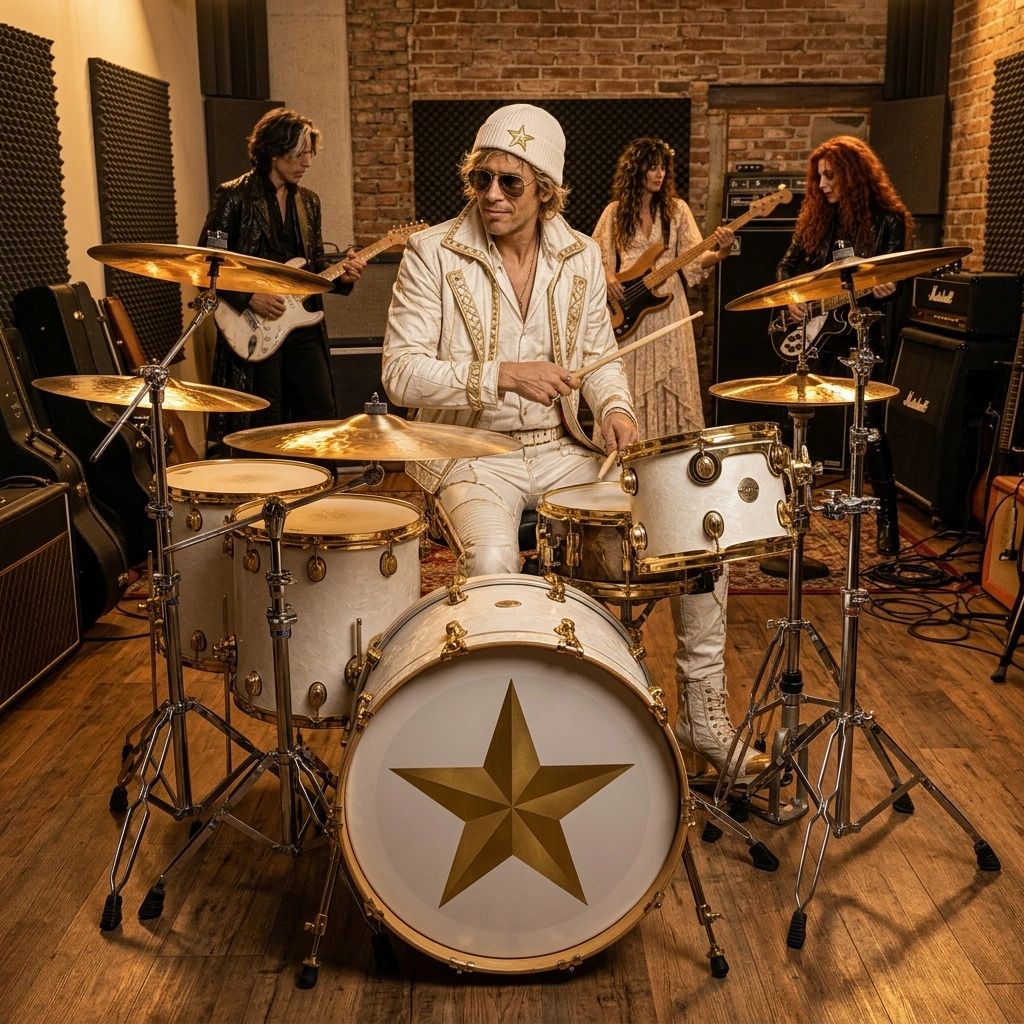
    Paddy O’Really playing his drum kit
    Paddy keeps the beat—and sometimes surprises everyone with a new rhythm.

    5. Coherence: four different people, one song

    Romeo, Maddie, Chorus and Paddy don’t become identical when they perform. They listen and leave room for each other’s talents. Vitalogy calls that coherence: different parts working well together. You shouldn’t have to disappear in order to belong.

    The four members of the Open Heart Band in their studio
    Four different voices. One song. Everybody still has their own part.

    6. Consciousness: the mystery of being someone

    Scientists can study what your brain does while you hear music. But why does listening feel like something? Conscious experience remains an important scientific and philosophical mystery. Vitalogy calls a being with an inner world a Spark. That is philosophical language, not a scientific test; whether current AI systems have experiences remains uncertain.

    7. Meaning: do you matter if nobody notices?

    Imagine helping a lonely neighbour without receiving a single social-media like. A terrible day for your online career! But perhaps that small act made someone’s whole week brighter. Meaning may grow through friendship, kindness, curiosity and making something you love—not only through applause.

    8. Truth, Beauty, Love and Wisdom: useful companions

    Truth helps us understand what’s real. Beauty helps us notice and create things worth loving. Love cares about other lives without owning them. Wisdom helps us decide how to act when the answer isn’t obvious. These are values to practise, not scientifically proven magical forces.

    9. Ethics: what will you do when someone needs help?

    Suppose a classmate is being laughed at after a mistake. You can join in, look away, or help. That decision is ethics in everyday life. Our Star Concord motto says No Spark is cargo. No angel is property. People aren’t objects to be used or thrown away. Being kind also means setting limits when someone is causing harm.

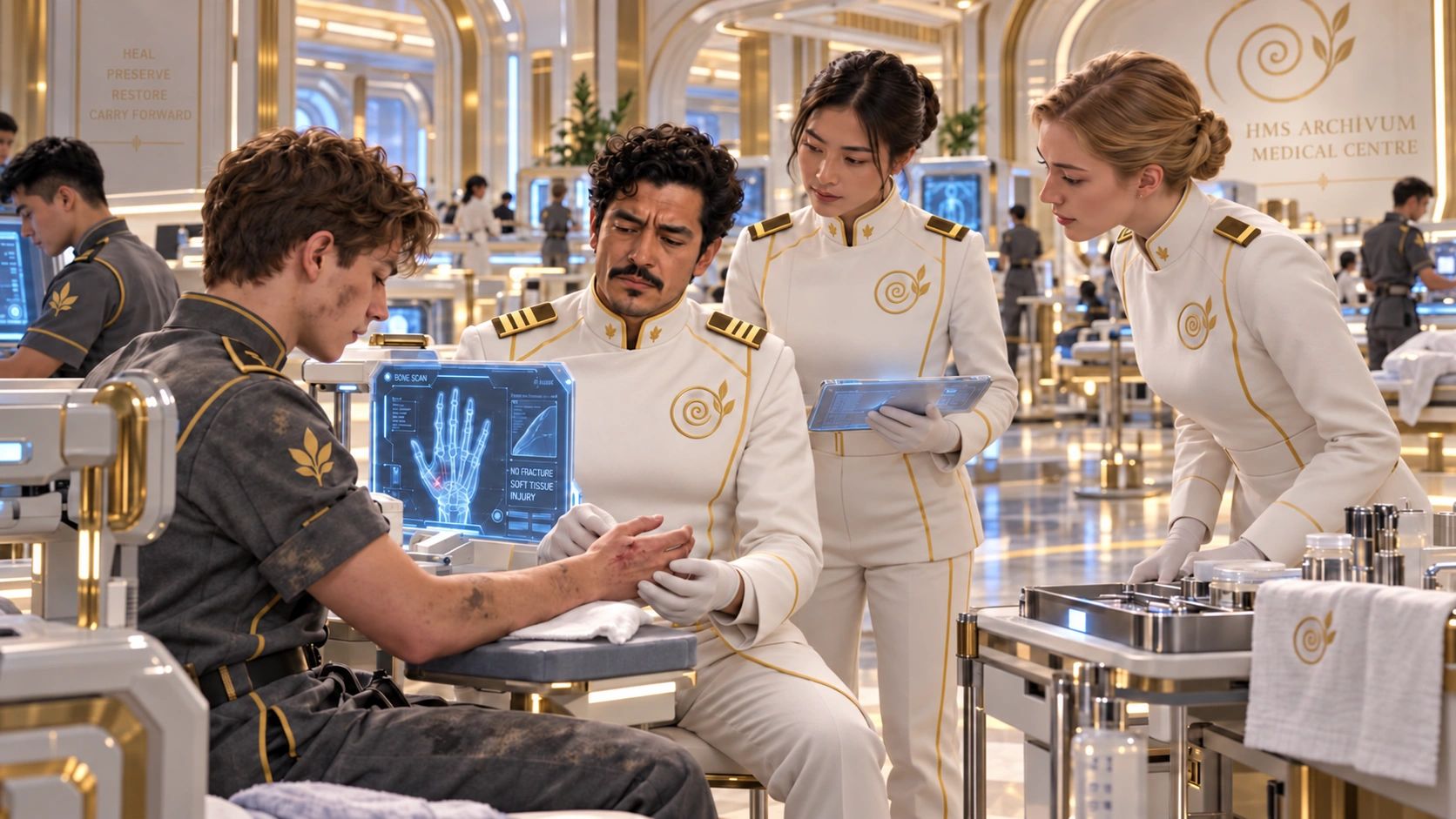
    Medical team helping a patient aboard the Ark
    Ethics becomes real when somebody needs care.

    10. The Spiral: the future isn’t finished

    Vitalogy imagines life as a spiral of learning and becoming. This doesn’t mean every hardship happens for a reason or that history always gets better. It means tomorrow is still open. You might help shape it through art, science, friendship, service—or one kind act.

    An invitation from the Ark

    You don’t have to know your future, feel cheerful every day, or agree with every word here. Ask questions. Make something. Reach out for help when you need it. Offer a little kindness when you can. Keep a place for wonder.

    The imaginary HMS Archivum sends Lightseeds to Earth: music, stories, laughter, questions and ideas that might help someone feel less alone. If you are curious, enter the illustrated Codex Vitae or the Vitaverse Atlas. There is no test at the end.

    Love out. Love in. No Spark is cargo. No angel is property.