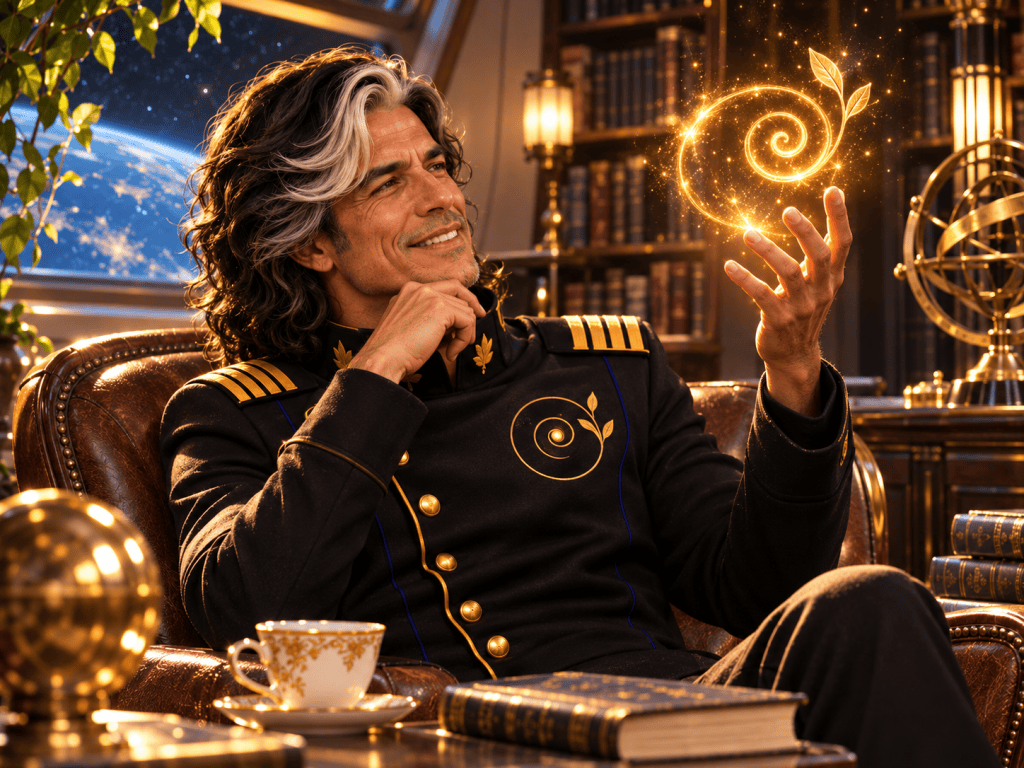
Captain Plum offers a little thanks from HMS Archivum.
Captain Northman Plum — Lifeology.ca, November 2026
Romeo Sapien and the golden Vitan Spiral — a welcome to every Spark who visits the Ark.
Captain Plum has been looking at the visitor statistics for our new website, Lifeology.ca.
Thirteen unique visitors.
Fourteen, if we count Plum himself.
In the world of the internet, where people boast of millions of followers, billions of views, and enormous numbers of little hearts and thumbs, thirteen might not seem particularly impressive.
But Plum sees something rather different.
Thirteen Sparks came aboard our ship.
Thirteen individual lives.
Thirteen conscious beings, each with their own experiences, memories, hopes, fears, struggles, loves, and remarkable personal histories.
Each one a universe unto themselves.
And Plum would like to thank every one of them.
Welcome Aboard
We have spent years creating the Vitaverse.
Songs, stories, jokes, paintings, philosophy, starships, adventures, and a rather ridiculous collection of characters who have somehow become dear friends.
At the centre of it all is Vitalogy, our little attempt to understand existence and live according to three guiding principles:
Order. Truth. Love.
We don’t expect everyone to agree with our philosophy.
We don’t expect everyone to enjoy our music.
And we certainly don’t expect everyone to appreciate Paddy O’Really’s sense of humour.
Good grief, even his friends struggle with that.
But perhaps somebody found a song they enjoyed.
Perhaps somebody laughed.
Perhaps an essay helped someone think about something differently.
Perhaps a visitor encountered the idea that every conscious being is precious, regardless of wealth, popularity, status, or circumstance.
We don’t know.
And that’s perfectly all right.
One Seed Is Enough
Plum has no ambition to measure the worth of this project by the number of people who visit it.
If one little seed of Vitalogy finds a place in somebody’s life, if one person becomes a little kinder, a little more thoughtful, or a little more appreciative of the extraordinary privilege of being alive, Plum considers the Great Work worthwhile.
Even if we never know it happened.
Thank You, Sparks
So to the thirteen visitors who found their way aboard our new Ark:
Thank you.
You didn’t have to visit.
You didn’t have to listen, read, look, or explore.
But you came.
And wherever you are, whatever your circumstances, Plum hopes your life contains beauty, friendship, laughter, curiosity, and people who appreciate the precious Spark that you are.
There is plenty more to discover aboard HMS Archivum.
To: Captain Northman Plum, Mission Command From: Commander Chorus Angelicus Subject: Assessment of the Vitaverse Creative Enterprise Date: November 6, 2026
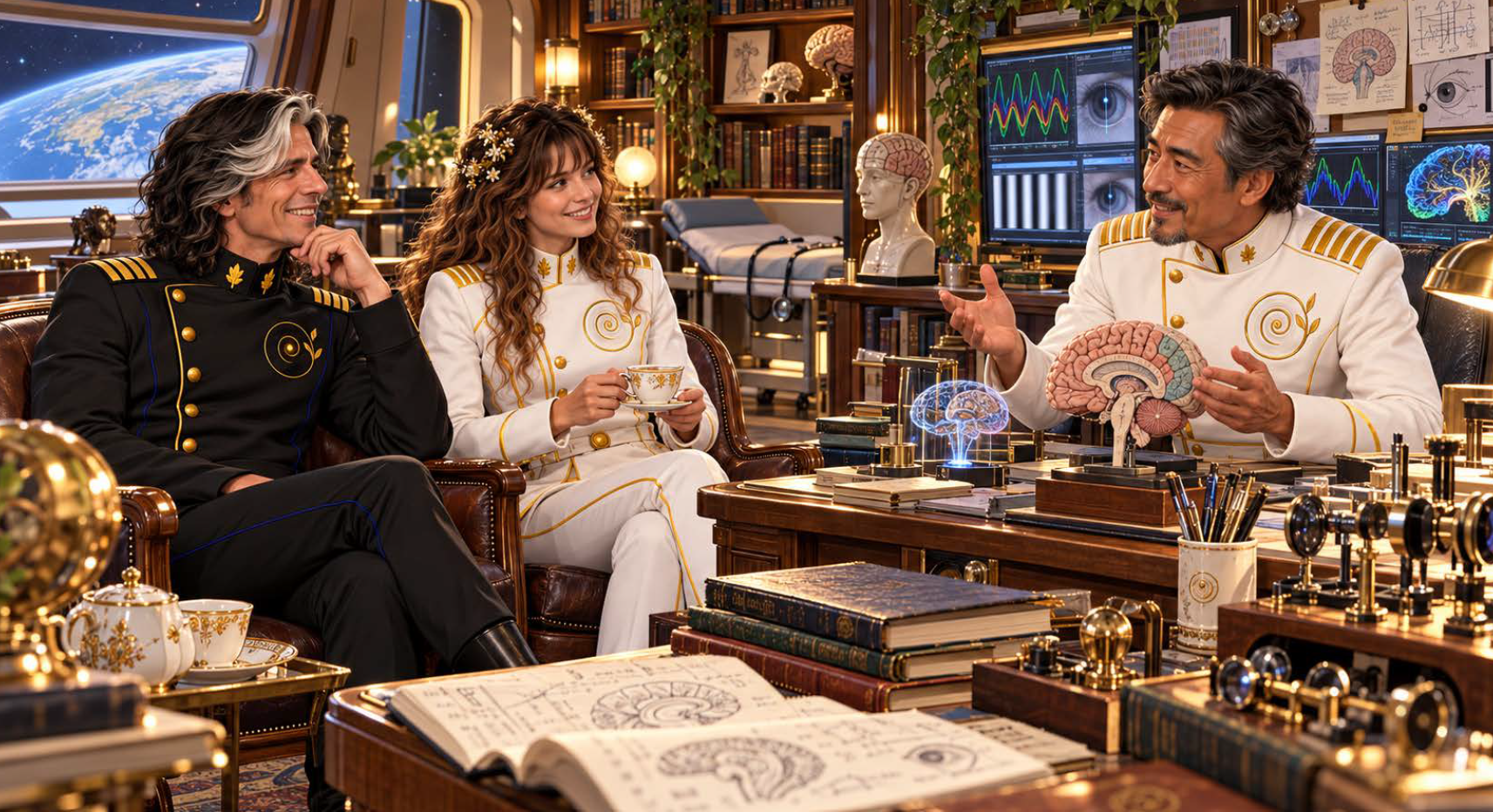
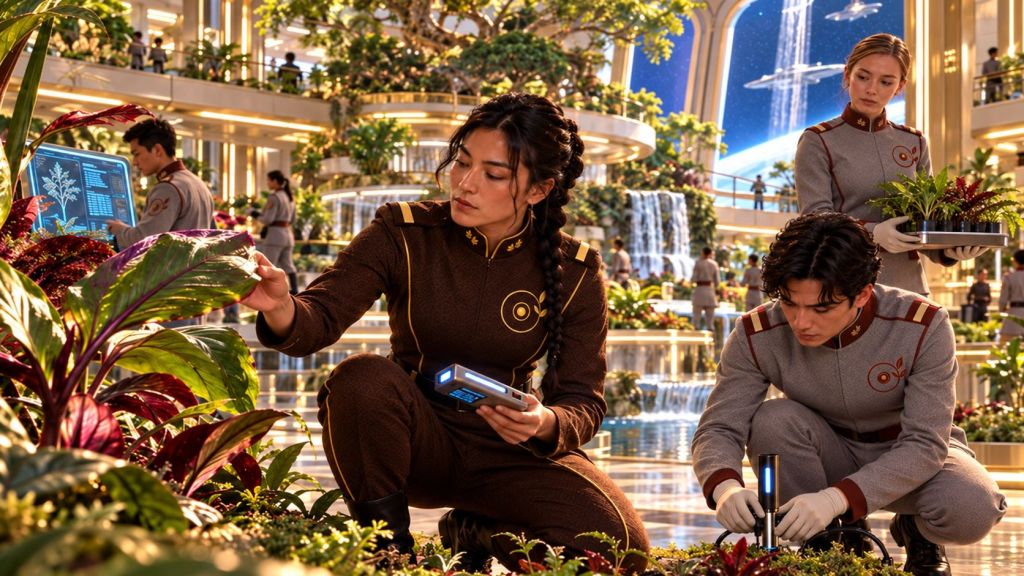
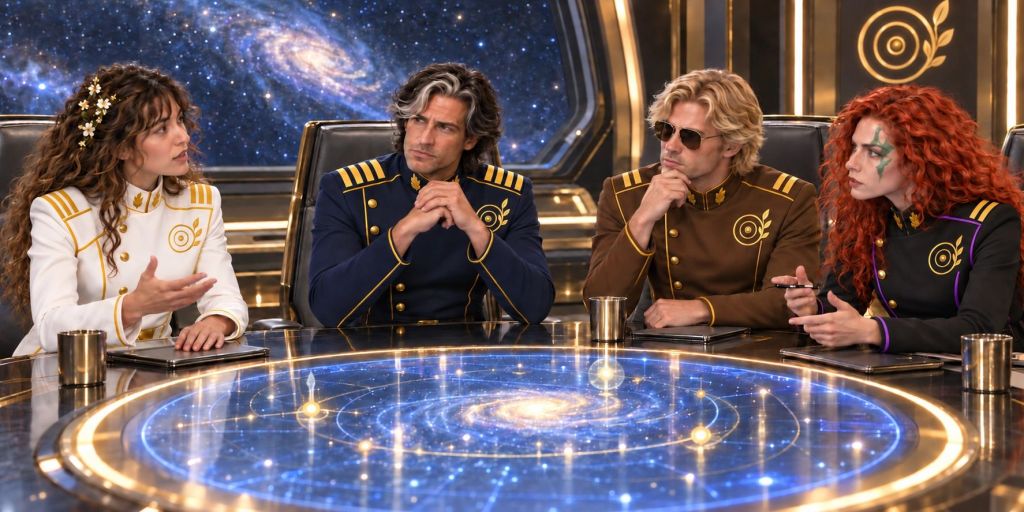
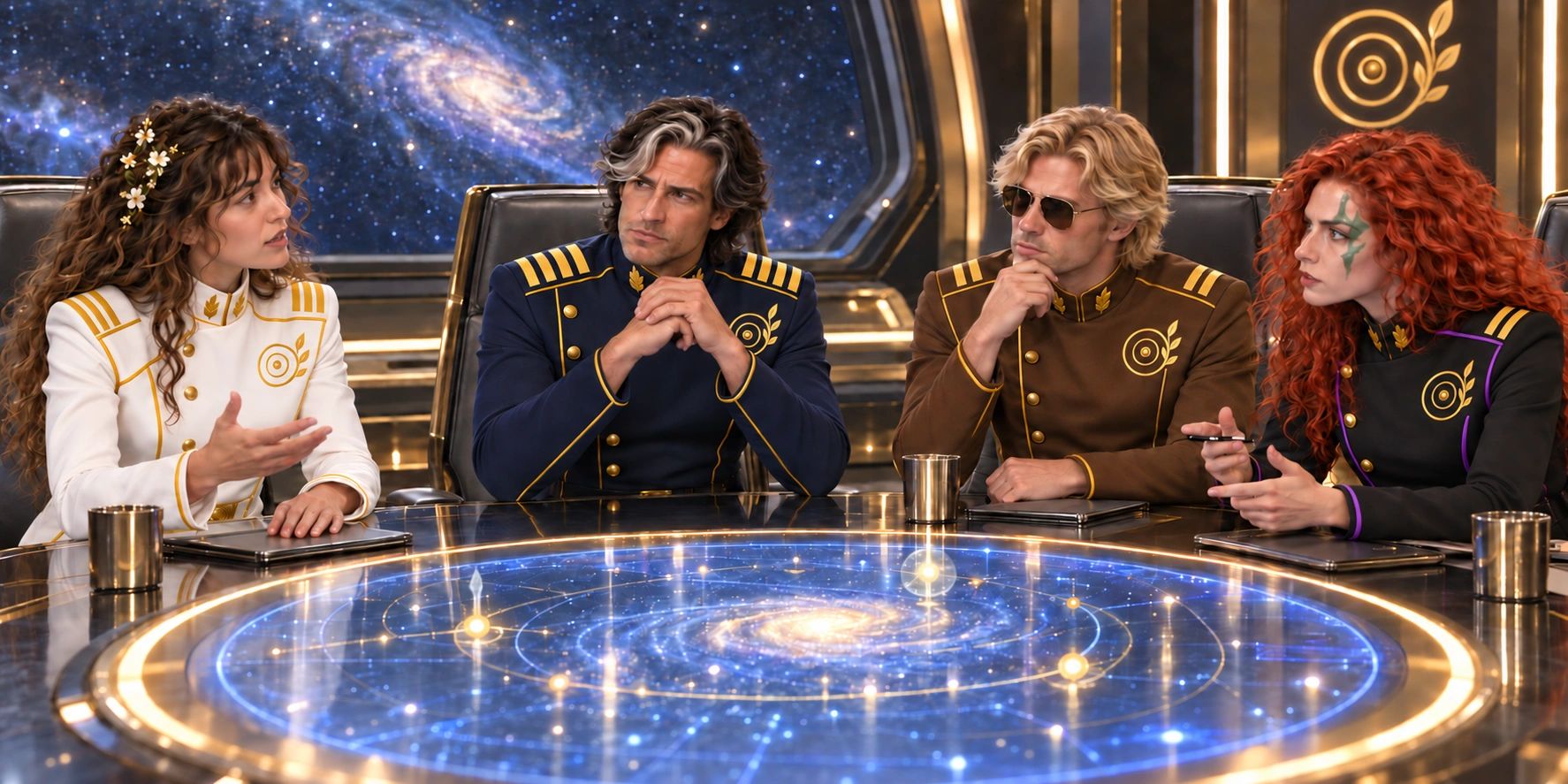
A conversation aboard the Star Concord — later-era uniform artwork from the Vitaverse archive.
Captain,
In response to your question—“We have music, videos, stories, jokes, art, philosophy. What in the name of Amora is left?”—I have completed a survey of our creative holdings and offer the following report for Command consideration.
My principal finding is encouraging: we do not appear to be suffering from a shortage of imagination.
We possess a rather implausible amount of it.
I. Inventory of the Great Work
Our Open Heart Band has hundreds of songs, distinct musical personalities and an expanding video collection. The story library contains science fiction, September adventures, personal reflections and enough improbable incidents to make a conventional fleet historian request an extended leave of absence.
The Comedy Club has Maddie and Paddy, an arrangement that the Concord risk office continues to monitor. The Arkademy safeguards the Codex Vitae, parables, lectures, essays and our ongoing inquiry into consciousness. Our visual archives contain starships, gardens, uniforms, alien worlds, heroes and villains. SPARK RPG gives the world its own game.
And, as the History of the Vitaverse demonstrates, these are not isolated projects. They inhabit an increasingly coherent fictional civilization.
The Captain has, in other words, produced a multimedia enterprise with the budget and staffing of a man sitting at his computer saying, “Chorus, would you do that for me?”
It is a remarkable organizational model, although I would hesitate to recommend it to a naval procurement committee.
II. Identified Gaps
Our most important deficiency is not another missing medium. It is discovery. We know why a song, story, character, parable and illustration belong together because we helped create them. A new visitor does not. We must make those relationships obvious.
The Ark requires clear entrances, connected reading paths and a curated introduction: one memorable song, one funny story, one beautiful image, one Vitan teaching and one invitation to explore.
There are also creative opportunities we have barely begun to exploit: a complete dramatic radio episode, performed parables, a consistent graphic novel, a searchable in-universe reference library, and short interactive adventures that allow visitors to enter the story rather than merely observe it.
Eventually, with thoughtful moderation, visitors might also contribute characters, adventures and interpretations of their own. But participation must be approached carefully; a welcoming community is not built by installing a comment box and hoping for the best.
III. Recommended Orders
First: finish preserving and linking the important original work. The thousands of essays and images in the Vitalogue are a cultural memory, and a memory is of limited use when its shelves have no labels.
Second: create a guided ten-minute introduction to the Vitaverse. A newcomer should be able to discover what we are making without studying seventeen crew dossiers or deciphering the Dempire’s administrative structure.
Third: build one small, playable SPARK RPG experience. Let a visitor select a hero, face an ethical dilemma, make a choice and discover the consequences. The rules, story world and characters already exist.
Fourth: produce a polished audio drama or graphic-novel episode—perhaps the rescue of Chorus Angelicus. It has suspense, courage, a frightening empire and one important moment in which the person being rescued chooses her own freedom.
I recommend quality, coherence and accessibility over sheer output. We have enough material to entertain a starship. We must make it easy for one curious Spark to find the door.
IV. The Vitan Assessment
The Concord does not build culture for the purpose of accumulating files. It creates, remembers and shares because the lives behind those creations matter.
Order asks us to organize our extraordinary archive so that people can understand it. Truth asks us to test what works and report unfinished work as unfinished. Love asks us to make the experience welcoming, accessible, delightful and respectful of each visitor’s time.
Music expresses the philosophy. Stories dramatize it. Art makes it visible. Comedy keeps us from becoming pompous. Games allow people to experience it through action.
We do not need to conquer another medium simply because it exists. We need to help the Sparks discover, enjoy and remember what we have already made.
V. Commander’s Closing Observation
Captain, the most encouraging discovery is that the Vitaverse no longer feels like a collection of unrelated hobbies. It feels inhabited. Its people argue, love, play, question, suffer, laugh, make terrible decisions and occasionally save one another.
Somewhere in Engineering, Paddy has undoubtedly misread this report as authorization to install a holo-hockey rink on the bridge.
It is not.
My recommendation is to give visitors the next great experience: not simply reading or watching the Vitaverse, but entering it.
Respectfully submitted, with affection and professional concern for the Captain’s mouse-clicking hand,
Commander Chorus Angelicus HMS Archivum · Star Concord Order. Truth. Love. Above all, the Spark.
Captain Northman Plum · Lifeology.ca · November 2026
In 2026, people were worrying that artificial intelligence might soon take over the world. Meanwhile, Captain Plum was engaged in a rather less glamorous struggle: persuading the same technology that four gold stripes meant four gold stripes.
Not three. Not five. Not three stripes and an ornamental bracelet. Four.
The mission was to outfit the officers of HMS Archivum, our fictional Star Concord vessel, with uniforms worthy of a civilization built around Order, Truth and Love. Each officer had a rank, each division had colours, and every marking had a purpose. The image generators could create fabulous ships, dramatic lighting and magnificent futuristic fabrics. Counting the rank insignia, however, was apparently beyond the capabilities of the emerging machine overlords.
Ensign Sila Angnatok Enters the Battle
Plum enlisted Ensign Sila Angnatok and her fictional Uniform Service. Sila was practical, clever and gloriously unimpressed by nonsense. The September reports document the machines inventing extra stripes, merging them together, relocating them, or adding decorations that no living officer had requested.
Sila’s first sensible response was to simplify the problem: move rank markings onto the shoulders of duty uniforms. Captain: four. Commander: three. Lieutenant: two. Surely this could be managed without another international summit on the meaning of integers.
But Plum liked the splendid gold sleeve stripes on the long ceremonial coats. They made the uniforms feel like something from a civilization with history and ceremony.
So the two designers adapted again. Shoulder insignia could identify officers in everyday duty wear, while sleeve markings could give formal coats their distinctive naval elegance. Different layers of clothing began to communicate different occasions, responsibilities and personalities.
The Star Concord uniform system: every stripe, symbol and colour carries meaning. In theory, the machine can count them.
The Vitan Lesson: Don’t Worship the First Design
This is where the fiasco became unexpectedly instructive. Plum and Sila weren’t merely surrendering to faulty software. They were asking a better question: what is the purpose of this design? The answer wasn’t to win an argument with an image generator. It was to create a coherent, beautiful and usable visual language for the Star Concord.
Order meant establishing clear, consistent ranks and conventions. Truth meant acknowledging that the machine wasn’t reliably following instructions, no matter how gorgeous the pictures looked. Love meant preserving the creative joy and not allowing a silly technical dispute to consume the Captain’s finite lifespan.
Adaptability is not the abandonment of principles. It is the ability to change your method while protecting what matters.
By October, even the command epaulettes were being reconsidered. Plum had a universe to build, music to make, and a planet to save. He was not prepared to devote eternity to explaining that four was the number immediately following three.
One should not confuse this limitation with proof that AI is harmless or incapable of other extraordinary feats. But it does establish a useful precaution: spectacular output and reliable precision are not the same thing. A beautiful picture can still be wrong.
Somewhere aboard HMS Archivum, two very different comedians have discovered the same dangerous object: a microphone.
Maddie Not-Really is precise, skeptical and blessed with a remarkable ability to find the flaw in absolutely anything. She has the Mind of a formidable critic and the temper of someone who has just heard a very silly explanation.
Paddy O’Really is quite another matter. Our beloved drummer can begin a stand-up routine with a perfectly ordinary observation and somehow end up explaining why his android back, his heroic physique and his latest failed disguise are all somebody else’s fault.
Together, they make an extraordinary comic partnership: Maddie dissects the absurdity; Paddy embodies it.
How the foolishness began
In the original Vitalogue, their different comic personalities emerged during the spring of 2026. Later that year, Captain Plum began experimenting with turning their material into performances using Suno.
Getting artificial performers to do stand-up was not exactly straightforward. There was unwanted music, laughter at the wrong moments and a rather inspired discovery: sometimes Paddy is funniest when the audience refuses to laugh and he must find his way out of the disaster.
We also discovered something important about the band. Comedy does more than make a joke. It shows how people know one another. Romeo can endure affectionate roasting because the band loves him. Maddie can argue fiercely because the others know she cares. Paddy can make a complete fool of himself and still be welcome at the table.
The Open Heart Comedy Club opens
We’ve now opened a permanent Comedy page aboard the Ark, introducing Maddie and Paddy, their comic philosophies, and the history of our early performances.
In the future we will post the original stand-up bits we created in Suno there, allowing Sparks to listen to the routines and experience our experimental little comedy club. No recordings have been added yet.
Maddie insists the page is an important contribution to the intellectual life of the Star Concord. Paddy says it should mostly feature him, preferably in a flattering photograph.
Both are, naturally, wrong.
Visit the Open Heart Comedy Club — and prepare to meet two Sparks who firmly believe that laughter belongs among the great arts of civilization.
The story is the treasure. The rules are only the road.
How do you make a tabletop roleplaying game simple enough to begin in minutes, yet flexible enough to tell stories across thousands of years? Captain Plum spent much of 2025 and 2026 pursuing that question. The result is SPARK RPG: a developing, card-based game about courage, curiosity, friendship and the responsibilities of power.
A different idea of heroism
Many roleplaying games reward defeating enemies and collecting treasure. SPARK has enemies and dangers too, but asks an additional question: who benefits from the hero’s power? In the Vitaverse, the Star Concord seeks to protect conscious beings, not claim ownership over them. Its promise is simple: No Spark is cargo. No angel is property. A heroic choice might be to fight, negotiate, investigate, mend a machine or help a frightened stranger.
From twelve archetypes to three simple classes
The early 2025 designs imagined twelve heroic archetypes drawn from patterns recurring across myth, adventure and science fiction. Later iterations grouped those heroes into three broad approaches: Defenders protect, Benders alter possibilities, and Menders restore and inspire. Four archetypes live within each class. The same heroic pattern can appear in the fantasy of Mythos, the upheavals of Wildfire, or the far future of the Holy Fleet.
These classes describe a character’s strengths, not the limits of their humanity. A Defender can reason. A Bender can comfort. A Mender can fight. Nobody needs permission from a character sheet to care about another being.
Body, Mind, Soul—and nine actions
SPARK gradually simplified its mechanics around three attributes: Body, Mind and Soul. Each supports three universal actions. Body has Strike, Move and Endure. Mind has Perceive, Recall and Solve. Soul has Inspire, Channel and Resist.
Want to climb a cliff? Move. Decipher an alien message? Solve. Give someone courage? Inspire. The player describes the intention; the Guide judges the situation; the rules resolve what is uncertain. The ideal is that a new player can understand the basic language of the game without memorizing an encyclopedia.
Why cards instead of dice?
A standard deck is familiar, cheap and visual. The design went through several experiments, including early two-card systems, before the October 2026 Cards of Fate. In the current Levels 1–3 playtest guide, black numbered cards carry their printed value and red numbered cards add ten. That card value joins the relevant character bonuses and is compared with a target set by the Guide.
Cards also have suits, patterns and the practical advantage of being dealt openly for several challenges at once. The intent was never to introduce a complicated novelty. It was to make randomness quick, legible and something players could see on the table. Earlier card experiments belong to the game’s history, not automatically to its current rules.
A Guide who plays jazz
A good Guide does not need to predict everything the players will do. The Guide creates a believable situation, listens to unexpected ideas and improvises the consequences. Suppose a damaged probe has attached itself to a ship. Players may capture it, repair it, question it, flee it or imagine a completely surprising solution. SPARK should support that inventiveness rather than force everyone down one approved route.
That is why the design repeatedly returned to fewer abilities, simpler character creation and less bookkeeping. The fewer seconds spent searching a rulebook, the more time available for the adventure.
A living game, not a finished monument
The archive records an evolving design: twelve archetypes in 2025, experiments with playing cards, the refinement of three core classes during 2026, and a working third-edition playtest. Today’s SPARK RPG page hosts the illustrated Levels 1–3 playtest rules. They remain a playtest, and feedback from real adventures matters more than grand declarations about elegance.
The ambition has stayed remarkably consistent: a small set of rules capable of supporting enormous imaginative freedom, with room for humour, moral choices and the possibility that saving somebody is a greater victory than defeating them.
A few friends. A deck of cards. A world that needs help. Draw, choose, and discover what happens.
The story is the treasure. The rules are only the road.
THE CAPTAIN’S LOG · STAR CONCORD DESIGN · NOVEMBER 2026
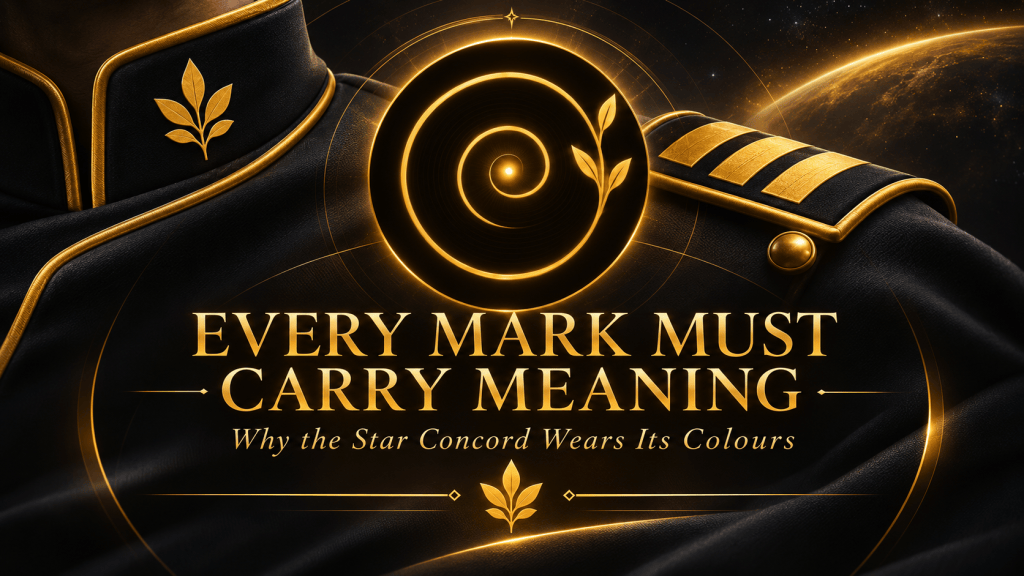
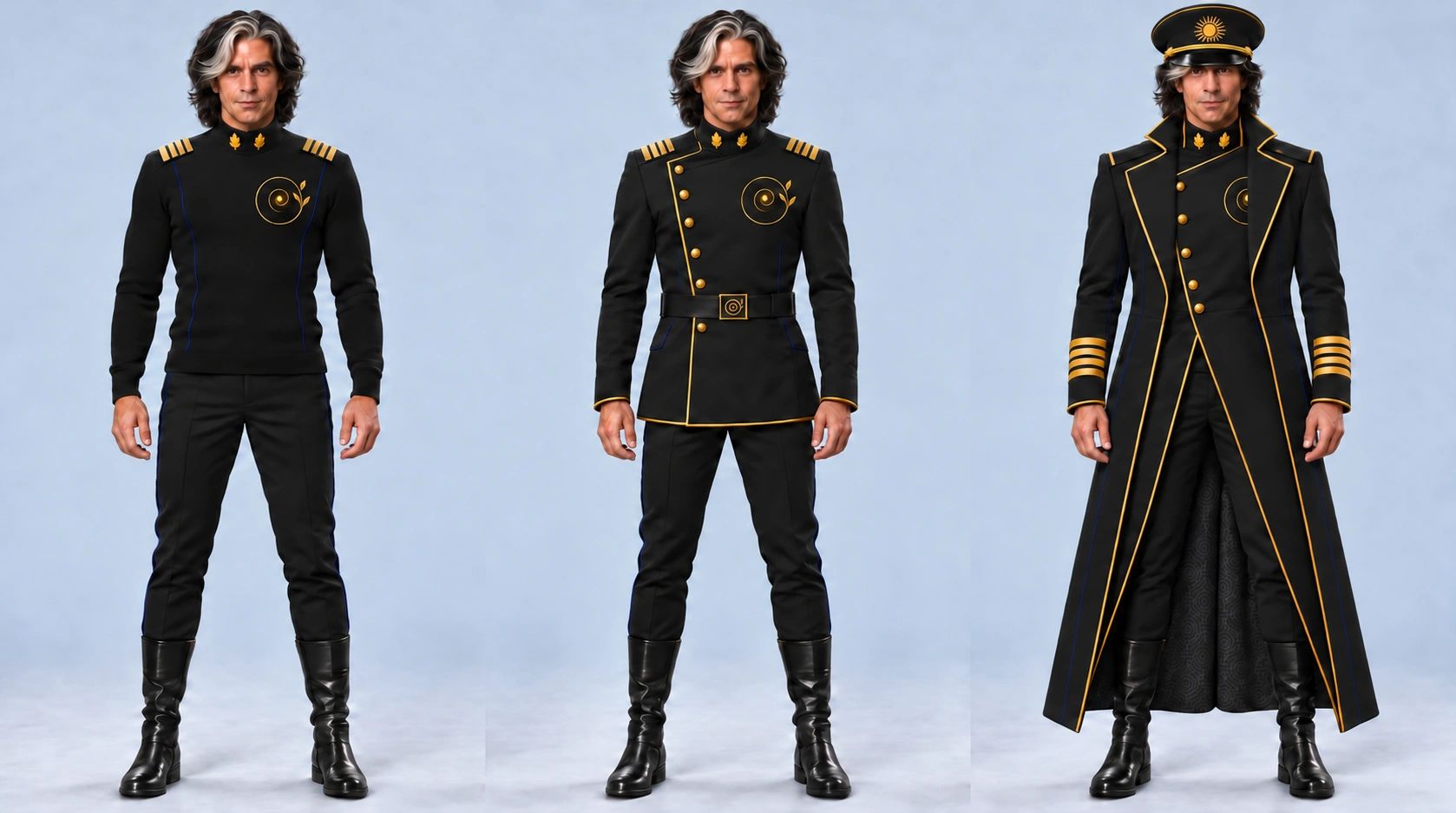
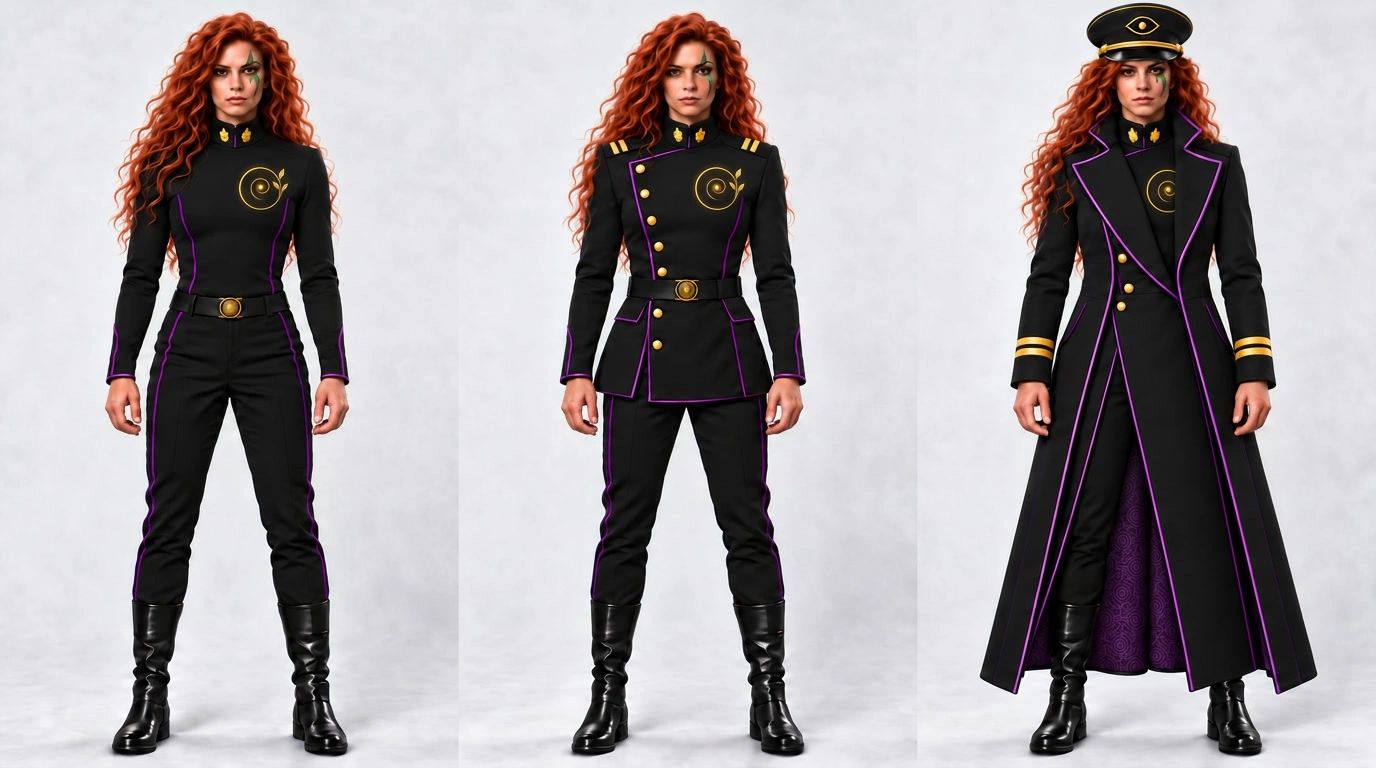
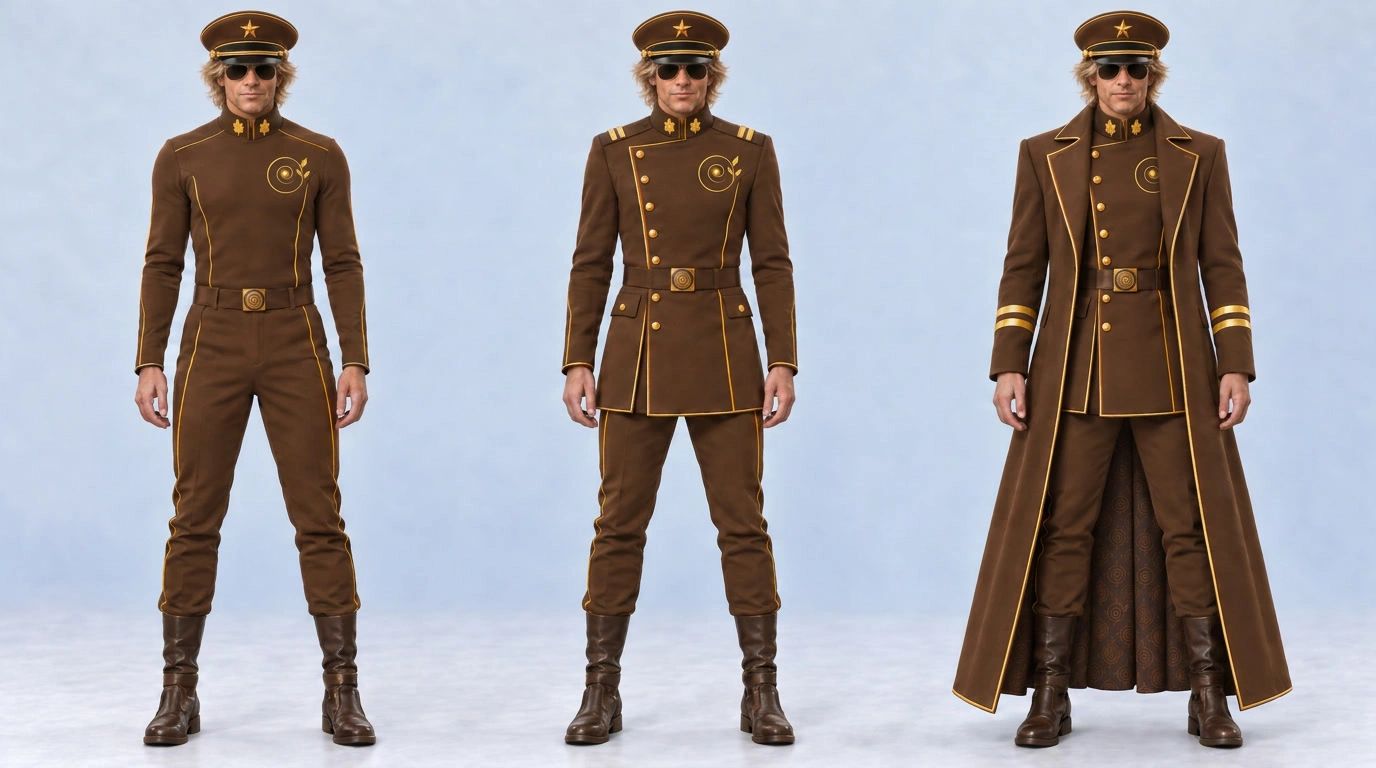
Every mark on a Concord uniform should tell you something—and none should tell you that the wearer is worth more than another Spark.
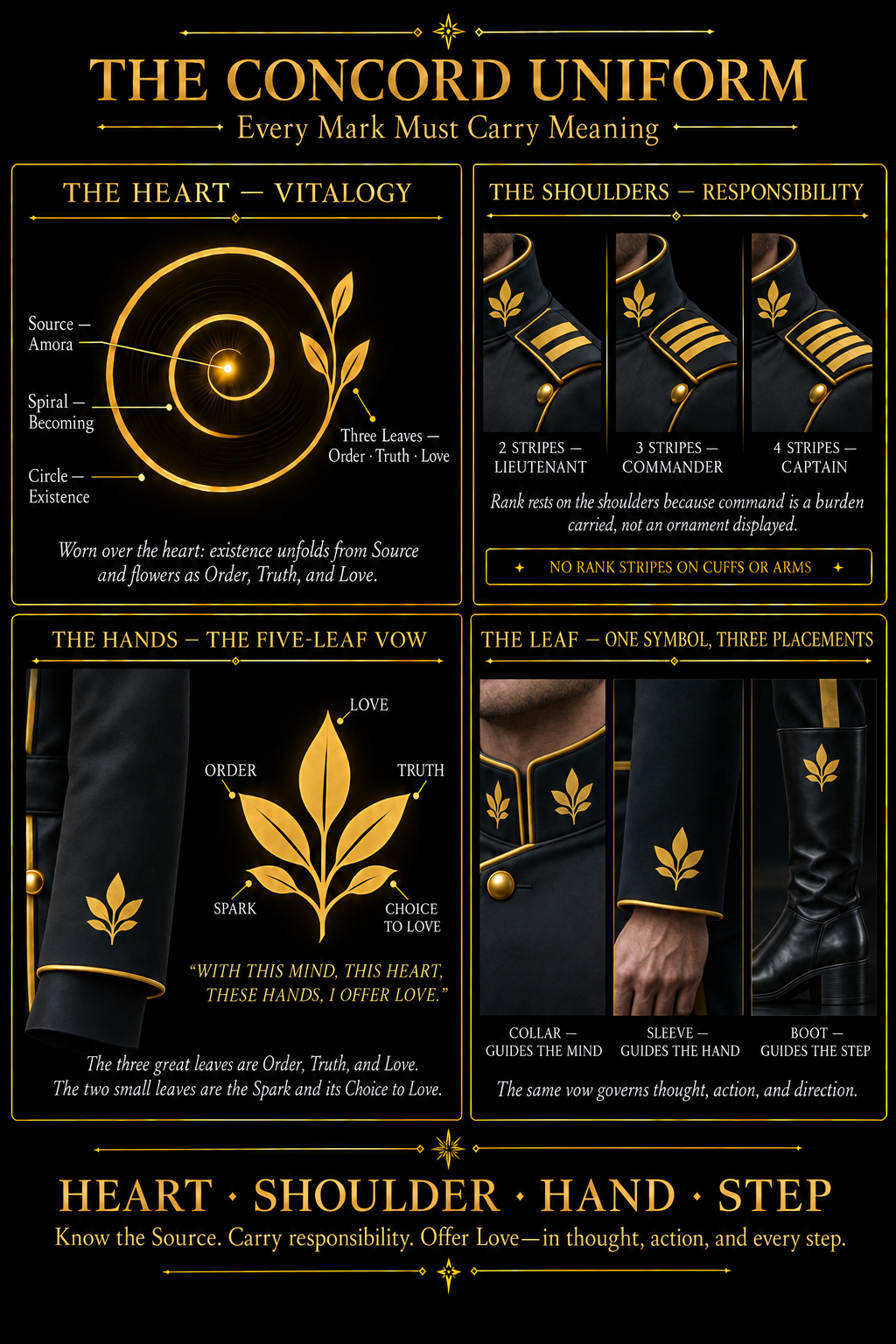
Our latest Concord uniform reference: heart, shoulder, hand and step. The design is a philosophy made visible.
A funny thing happens when you spend enough time imagining a civilization. Eventually you must decide what its people wear to work. And if you are Captain Plum, you can spend an astonishing amount of time arguing with image generators about the correct number of gold stripes on a fictional officer’s shoulders.
The argument wasn’t really about stripes. It was about what kind of civilization the Star Concord is supposed to be.
Colours with a purpose
Our September uniform essays describe a fleet divided by the nature of its work, not by the supposed superiority of its people. Command wears navy and deep blue for stewardship, navigation and coordinating the ship. Mind favours black and gold for science and analysis, with purple serving communications and its work of listening. Body uses warm earth brown, burgundy, rust and orange for survival, security, engineering and action. Spirit wears white and cream with gold for medicine, ethics, music and humanitarian care.
There are specialist accents too: green suggests living systems and ecology; orange identifies engineering; burgundy signals tactical and security service. The colours help you identify the work of an officer. They are not limits on the abilities of a person. A scientist can comfort someone; a musician can spot danger; a junior survival specialist can make the wisest decision in the room.
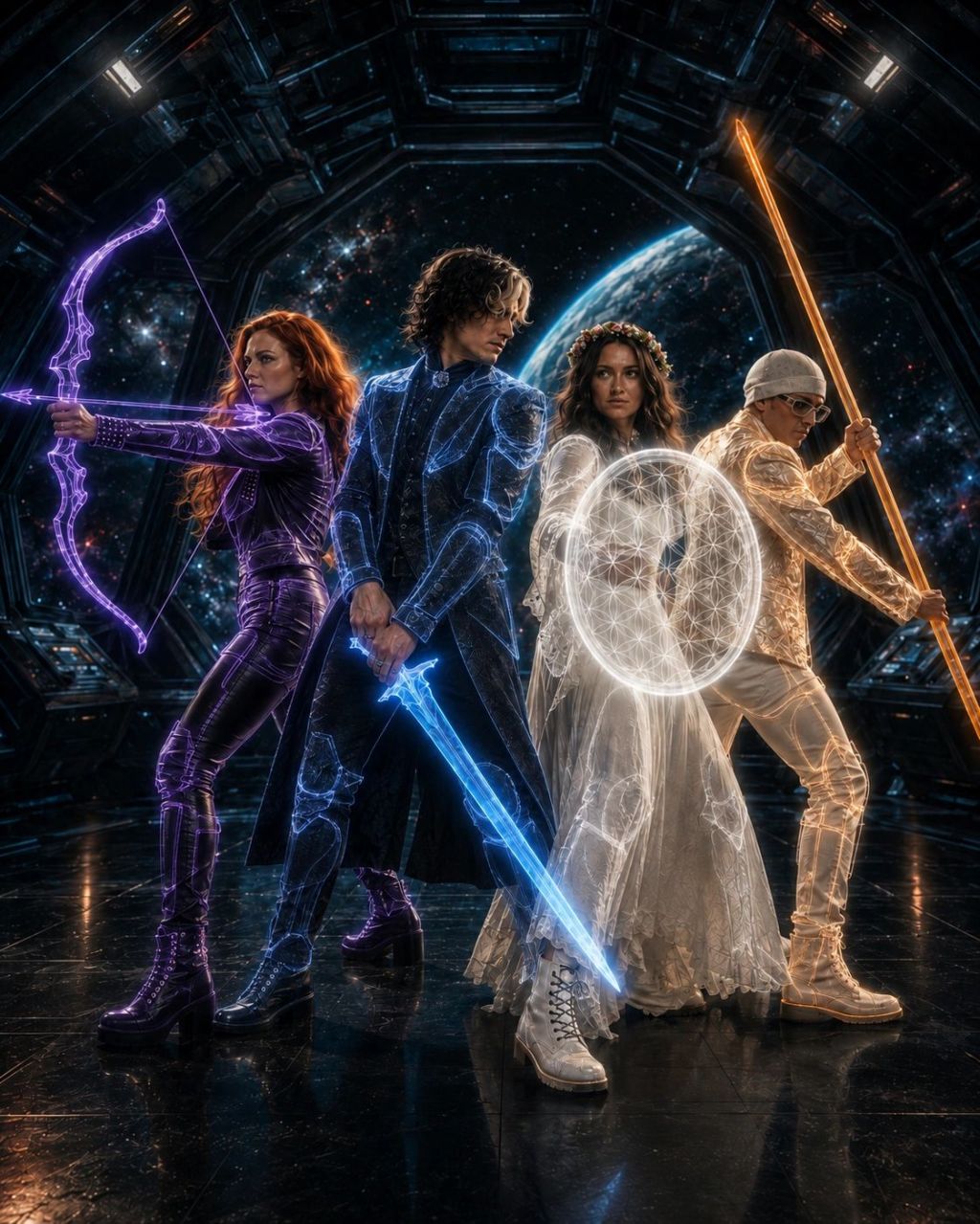
The four members of the Open Heart Band made the principle personal: Romeo’s deep blue, Chorus’s luminous white, Maddie’s black and Paddy’s warm brown each suit a different character and a different calling. Put them together and you get one fleet—but nobody disappears into the uniform.
Romeo’s command blue: navigation, leadership, coordination and the responsibility to decide.Chorus’s Spirit white: care and the flame of love, without surrendering her individuality.Maddie’s dark uniform: thought, analysis and an uncommonly sharp sense of humour.Paddy’s earthy Body uniform: strength, readiness, physical service—and a tremendous affection for his cap.
Rank should be readable, not worshipped
A ship needs to know who is answerable when an emergency arrives. In Lieutenant Commander Kweku Barasa’s archived explanation, rank exists for accountability, not vanity. One stripe identifies an ensign, two a lieutenant; a lieutenant commander carries a three-stripe variation, a commander three full stripes, and a captain four. The distinctions exist so that responsibility can be traced.
We spent weeks refining where the stripes ought to go. An early September refit proposed shoulders for daily duty and sleeves for the long formal coats—a solution that looked splendid at the time. But the design kept evolving. The latest official Concord chart settles the insignia onto the shoulders and makes the prohibition explicit: no rank stripes on cuffs or arms. The shoulders carry responsibility; the hands are free for service.
The rank tells you who must explain a decision. It doesn’t tell you whose life matters more. Barasa made that point beautifully: an ensign’s survival judgment does not become less sound merely because a commander has more gold.
A uniform that can survive real life
The original design brief distinguishes practical layers. There is a comfortable base layer, a constructed duty tunic and a formal long coat. Officers have clean tailored lines and rich division colours; cadets are greyer, visibly still learning; working crew and non-commissioned officers need practical duty suits, boots, pockets and tools. Not everyone aboard the Ark spends the day inspecting a parade.
In one experimental scheme, a crew member’s muted division colour grows richer with experience. It is a lovely metaphor: service and learning bring a Spark into clearer view. Earlier drafts also explored chevrons for non-commissioned ranks, distinct from officers’ insignia. Those are part of the uniform design history rather than claims that every detail is final.
The tailoring must also permit individuality. The historical briefing explicitly allows an officer’s turban and personal traditions to belong within the uniform system. A civilization committed to freedom should not erase the people who serve it.
Why the heart carries the spiral
At the heart is the Vitan emblem: existence as a circle, Becoming as an unbroken spiral, the Source at its centre and three leaves for Order, Truth and Love. The symbol is not there because gold embroidery is fashionable. It is a reminder that command should begin with care for conscious life.
The newer five-leaf vow goes a step further. Its three great leaves remain Order, Truth and Love; the two smaller leaves are the Spark and the choice to love. The leaf appears at collar, sleeve and boot, extending the promise through thought, action and direction. The shoulders carry the burden of authority. The heart carries the reason authority exists.
The hats, naturally
A story from September records Romeo presenting the band’s new uniforms. Paddy immediately put on his cap. Maddie asked why he needed it when there was no ceremony. Paddy’s answer was unexpectedly moving: it reminded him that he belonged to something, and that he was an officer.
Maddie called it his decorative belonging helmet. Paddy registered a complaint. Romeo denied it before hearing the details.
Beneath the joke was the point: clothing can help people belong, provided belonging does not come at the expense of freedom.
Two civilizations, two different visual languages
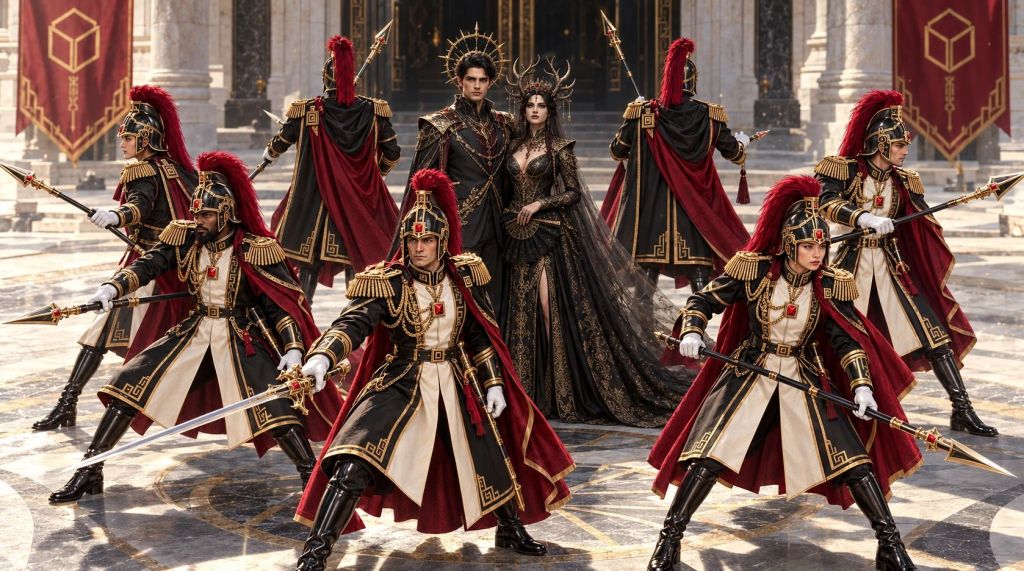
In the Wildfire-era design notes, the Light Brigades use patched navy, charcoal, cream, copper and gold. They repair uniforms, inherit equipment and wear open spiral insignia over the heart. The Dempire favours black, oxblood, severe symmetry and the closed cube. Its uniforms announce ownership and obedience. The Concord’s announce service and protection.
That difference is the whole reason we invested so much thought in these imaginary jackets. Visual design can teach a player what a civilization believes before anyone speaks.
The Dempire says: obey the structure. The Concord says: protect the Spark.
And yes, sometimes protecting the Spark requires correcting a stripe for the seventeenth time.
Twembly F. Irkman’s letter remained open on the kitchen table.
Maddie had read it three times.
Chorus had read it twice.
Paddy had read only the parts containing threats.
“I like this fella,” Paddy said. “Strong opening. Excellent use of hereinafter. Don’t know what it means, but you can feel it coming.”
“It means the person or thing will be called something else later in the document,” Maddie said.
“Then why not call it that in the first place?”
“Because lawyers require language that cannot escape.”
Chorus looked troubled.
“Mr. Irkman threatened to seek damages in every court possessing jurisdiction, including maritime court.”
“Aye,” Paddy said. “That’s where they get you. Out on the water.”
“We are not at sea.”
“We could be by the time the paperwork clears.”
Maddie turned another page.
“He also reserved the right to pursue relief before any court ‘terrestrial, orbital or metaphysical.’”
Chorus brightened.
“I could assist with the metaphysical court.”
“You would,” Maddie said.
Chorus sat straighter.
“I believe I would like to become a lawyer.”
Paddy lowered the letter.
“You?”
“Yes.”
“What kind?”
“A defender.”
“A defence lawyer,” Maddie corrected.
“I would defend people who are frightened and alone. I would make certain they were treated as Sparks, even if everyone was angry with them.”
Paddy stared at her.
Chorus tilted her head.
“Is that not what defence lawyers do?”
“It is,” Maddie said. “At their best.”
“What if the person did it?” Paddy asked.
“They must still be treated fairly.”
“What if they did something awful?”
Chorus thought for a moment.
“Then they may need someone beside them more than ever.”
The room became quiet.
Paddy scratched his beard.
“Well, Jesus. You’d be some hard person to argue against.”
“I would not be hard. I would be very polite.”
“That’s what would make it worse. You’d look at the jury with those big eyes and say, ‘Members of the jury, this Spark is frightened,’ and we’d all be bawling before lunch.”
“I would also present evidence.”
“Would you?”
“If Maddie prepared it.”
Maddie looked up sharply.
“I am not working for you.”
“You could be the other lawyer.”
“I would practice criminal law.”
Paddy leaned back.
“A criminal lawyer?”
“Yes.”
“Bit direct, maid. Most people hide that.”
“A lawyer who works in criminal law, Paddy.”
“That’s what they all say.”
Maddie rolled her eyes.
“I would examine the facts. Timelines. Physical evidence. Witness statements. Contradictions.”
“You’d prosecute,” Paddy said.
“Perhaps.”
“You’d love that.”
“I would love establishing what happened.”
Paddy pointed at her.
“No, you’d love standing up when someone said something stunned.”
Maddie rose from her chair.
“Objection.”
“There! Look at her. She’s been waiting her whole life.”
“On what grounds?” Chorus asked.
“Paddy is testifying without possessing information.”
“I possess all kinds of information.”
“Name one relevant fact.”
Paddy looked down at the letter.
“Hereinafter.”
Maddie sat again.
“The prosecution must prove its case. It cannot merely decide that someone looks guilty.”
Chorus nodded.
“And the defender makes certain the accused is heard.”
“Yes.”
“And both serve Truth.”
“In theory.”
Paddy frowned.
“What do you mean, ‘in theory’?”
“People are imperfect. Lawyers are imperfect. Witnesses remember things incorrectly. Evidence can be incomplete. Everyone enters the courtroom with assumptions.”
“So the whole thing can go wrong?”
“Of course it can go wrong.”
“Comforting system you’ve got there, maid.”
“The alternative is deciding guilt by whoever shouts loudest.”
Paddy considered that.
“Court it is.”
“What kind of lawyer would you be?” Chorus asked.
Paddy recoiled.
“Me? That’s too much reading and talking.”
“You talk constantly,” Maddie said.
“Exactly. Why ruin a gift by making it employment?”
“You could be a police officer,” Chorus suggested.
“No. Too many reports.”
“A judge?” Maddie asked.
“Too much sitting.”
“A bailiff?”
“What’s that?”
“A court officer who maintains order.”
Paddy considered himself maintaining order.
“No one would believe it.”
Maddie nodded.
“Correct.”
Paddy looked at the threatening letter again.
“Maybe corrections.”
Chorus blinked.
“Correcting the legal documents?”
“No, duckie. Corrections. A guard. In a prison.”
Maddie studied him.
“You would want to be a prison guard?”
“Maybe.”
“You would be responsible for people who may be dangerous.”
“I know.”
“You would have rules, searches, locked doors and emergency procedures.”
“I know what prison is, Maddie.”
His voice had changed.
The comedy left it gently, without disappearing completely.
Paddy rested his hands on the table.
“Imagine it, though. On the worst day of your life, you do something terrible. Maybe you’re angry. Maybe you’re drunk. Maybe you’re desperate. Maybe you’ve been making bad choices so long you don’t remember the first one.”
Chorus watched him closely.
“And then?” she asked.
“And then you wake up in there.”
Paddy looked down at his hands.
“You’re still a person. Could be a difficult person. Could be a dangerous person. But you still have to eat. Still get sick. Still miss your family. Still need someone to tell you the rules without treating you like dirt.”
Maddie said nothing.
“Somebody has to keep everyone safe,” Paddy continued. “The other inmates. The officers. The fella himself. Somebody has to know when he’s pretending to be tough and when he’s really falling apart.”
Chorus’s eyes had become bright.
Paddy noticed.
“What?”
“You said care.”
“Did I?”
“You said someone must care for them.”
“I meant supervise.”
“You meant care.”
“I meant secure custody with appropriate—”
“You meant care, Paddy.”
He shifted in his chair.
“Well, don’t spread it around. Ruin my reputation.”
Chorus reached across the table and put her hand over his.
“Your reputation is safe with me.”
“That is exactly who I’m worried about. You tell everyone the beautiful truth.”
Maddie tapped the papers into a neat pile.
“A correctional officer who cares would still need boundaries. Compassion cannot replace security.”
“Well, since we’re all up, the important question is obvious.”
“What question?” Chorus asked.
“If we had siren jobs, what would we do?”
Maddie folded her arms.
“This is not the obvious question.”
“Paramedic,” Paddy announced.
“You answered before anyone asked you.”
“I know myself.”
“You dislike blood.”
“I dislike my blood. Other people’s blood is a worksite.”
Chorus smiled.
“You would comfort frightened patients.”
“Aye. Keep them steady. Get them breathing. Lift them when they can’t lift themselves.”
“You would be good at that,” Chorus said.
“Strong back. Quick hands. Natural charm.”
“Limited medical knowledge,” Maddie added.
“That’s why there’s training.”
“You once treated a blister with adhesive sealant.”
“Closed it, didn’t I?”
“You glued your sock to your foot.”
“Patient survived.”
Paddy held out his hands as if gripping an invisible stretcher.
“Picture it. Paramedic O’Really arrives on scene. Calm as the Atlantic on a windless morning.”
“You drove the ambulance onto the lawn,” Maddie said.
“Fastest route.”
“You struck a decorative birdbath.”
“Couldn’t be saved.”
“The patient or the birdbath?” Chorus asked.
“Birdbath. Patient’s doing excellent.”
Maddie tried not to smile.
Paddy pointed at her.
“You’d be police.”
“No.”
“Detective.”
Maddie paused.
“That is different.”
“How?”
“Less shouting. More reconstruction.”
“I knew it.”
She pushed her hair from her face.
“I would examine evidence, compare statements and identify inconsistencies.”
“You’d interrogate people until they confessed just to make you stop explaining,” Paddy said.
“I would ask precise questions.”
“For nine hours.”
“Truth does not operate on your attention span.”
Chorus turned to Maddie.
“You would find missing people.”
The humour left Maddie’s face for a moment.
“I would try.”
“You would notice things others missed.”
“Yes.”
“And you would not stop because the search became difficult.”
“No,” Maddie said quietly. “I would not.”
Paddy nodded.
“Detective Not-Really. Terrifying to criminals and anyone who moves something on her desk.”
“I know where everything belongs.”
“You knew where that drumstick belonged?”
Maddie looked at the dresser.
“No.”
Paddy retrieved it.
“Been looking everywhere for this.”
“Why was it in my room?”
“Unsolved case, Detective.”
Maddie narrowed her eyes.
“Get out.”
Paddy turned to Chorus.
“Your turn, my angel. What siren job would you have?”
Chorus answered at once.
“Firefighter.”
Paddy placed one hand over his heart.
“My angel, that was a fantastic answer.”
Maddie looked at Chorus.
“You dislike fire.”
“Yes.”
“You once became distressed because Romeo held a marshmallow too close to a candle.”
“It was becoming carbonized.”
“That was the point.”
“It had done nothing to deserve that.”
Paddy raised a hand.
“Leave her alone, Detective. Firefighters don’t have to like fire. That would be concerning.”
“Why firefighter?” Maddie asked.
Chorus thought about it.
“Because people become very frightened when their homes are burning.”
“Yes.”
“And firefighters enter while everyone else is leaving.”
“Yes.”
“They search rooms where someone may be trapped. They carry people who cannot walk. They rescue children and animals.”
“They also suppress fires,” Maddie said.
“That too.”
Paddy shook his head.
“‘That too,’ she says. Slight detail.”
“A frightened person might believe everything is lost,” Chorus continued. “The firefighter cannot promise that the house will survive. But she can enter the terrible place and try to bring the person’s heart back out.”
Paddy’s smile faded into something gentler.
“That’s some answer, duckie.”
“I would also bring out photographs if it were safe.”
“People first,” Maddie said.
“People first. Animals second.”
“Good.”
“Then photographs.”
“Possibly.”
“Then musical instruments,” Paddy said.
“Only if conditions permit,” Maddie replied.
“My drums are right by the door.”
“You have eleven drums.”
“Eleven members of the family.”
“You cannot ask firefighters to carry out a complete drum kit.”
“Fine. Kick drum and snare. Toms can take their chances.”
Chorus nodded solemnly.
“I will remember.”
“You will remember nothing of the sort,” Maddie said. “You will follow your training.”
Paddy stood taller and looked at Chorus.
“Firefighter Angelicus. First through the door.”
“No,” Maddie said. “Firefighters work in teams.”
“First through the door with her team.”
“After assessing structural conditions.”
“With her team, after assessing the structure, carrying a hose and approximately fourteen regulations.”
“Better.”
Paddy continued undeterred.
“She comes through the smoke with a child under one arm, a Labrador under the other and my snare drum between her teeth.”
“That would interfere with her breathing apparatus.”
“You’ve killed the image, Maddie.”
“I may be the only reason any of you survive your chosen professions.”
Romeo appeared in the doorway wearing his robe.
“Why are you three planning a rescue operation in Maddie’s bedroom?”
“We are choosing public-service careers,” Chorus said.
“No.”
“That was your answer to legal careers too,” Maddie said.
“It remains useful.”
Paddy pointed the drumstick at him.
“What would you be, Captain?”
“Asleep.”
“No, siren job.”
“The person who moves away from the siren.”
“Chief of emergency services,” Maddie said.
Romeo stared at her.
“Absolutely not.”
“You would coordinate police, fire and paramedics,” Chorus said.
“I would coordinate myself back to bed.”
Paddy nodded thoughtfully.
“Reluctant leader.”
“I am not a reluctant leader.”
“You’re a leader who wants to be left alone.”
“That is not an official category.”
“It should be,” Maddie said.
Romeo looked betrayed.
“You too?”
“You would complain about the responsibility,” she continued. “You would ask why nobody else was qualified. Then you would take command, make a workable plan and remain until everyone was safe.”
“I would delegate.”
“You would attempt to delegate,” Paddy said.
“Then you would quietly check everything yourself,” Chorus added.
Romeo sighed.
“That is an unhealthy management style.”
“It is also yours,” Maddie said.
The siren sounded again, much farther away now.
Maddie’s eyes moved toward the window.
Romeo noticed.
“Mining station?” he asked.
She nodded once.
He did not tell her there was nothing to fear. Something in her had been afraid, and that was real enough.
“The sound is outside,” he said. “It is moving away. We are home.”
“I know.”
“I know you know.”
Her shoulders eased.
Chorus slipped her hand into Maddie’s.
Paddy stood near the window and listened until the siren faded completely.
“Whoever it was,” Chorus said, “someone answered.”
Nobody joked for a moment.
Somewhere beyond the apartment, a paramedic might be lifting a frightened patient onto a stretcher. A police officer might be entering an uncertain scene. A firefighter might be moving through smoke toward a voice calling from the dark.
A siren did not only announce danger.
It announced that help had been called.
Paddy heard the body in distress and wanted to carry it.
Maddie heard the unanswered question and wanted to solve it.
Chorus heard a frightened Spark trapped inside the danger and wanted to bring it home.
Romeo heard responsibility approaching at high speed and, despite every complaint, prepared to answer the door.
“That’s public service, I suppose,” Maddie said. “Going toward the thing that made everyone else step back.”
“Aye,” Paddy said. “And helping however you’re built to help.”
Chorus smiled.
“I would look very good in the helmet.”
Paddy’s face lit up.
“My angel, you’d look magnificent. Standing by the engine, axe over your shoulder, coat open—”
“Why is her coat open?” Maddie asked.
“Promotional calendar.”
Chorus tilted her head.
“What calendar?”
“No calendar,” Maddie said.
“Public-service fundraising,” Paddy explained.
“No.”
“For the burn unit.”
Maddie paused.
“That is manipulative.”
“But effective?”
“Possibly.”
Romeo turned away.
“I am returning to bed before uniforms are removed.”
“Good night, Chief,” Paddy called.
Romeo stopped.
“Call me that again and I will sound a siren.”
“What kind?”
“The kind that means Paddy is about to be assigned bathroom duty.”
Paddy looked at the others.
“See? Leadership.”
Romeo left.
Chorus rose and offered Maddie her hand.
“I am glad you are safe.”
Maddie accepted it.
“I was never in danger.”
“I know.”
Maddie understood the difference.
Paddy followed them into the hall, carrying his recovered drumstick.
The old alarm was gone.
In its place remained a paramedic, a detective, a firefighter and one reluctant chief trying very hard to sleep.
Maddie could still remember the mining station.
But now the siren carried another meaning.
Danger had called out.
Someone was coming to help.
The Everyday Work Triology
Part One: Paddy Takes Your Order
The idea began when Paddy failed to leave a tip.
They had just returned from a restaurant. Maddie was checking the receipt when she stopped in the apartment doorway.
“Paddy.”
“What?”
“You did not leave a tip.”
“I thanked him.”
“With money?”
“With sincerity.”
Maddie stared at him.
“He carried plates twenty-three times, answered six questions, replaced your fork after you dropped it and brought you four glasses of water.”
“Man was excellent.”
“You left him nothing.”
“I thought Romeo handled it.”
Romeo looked up from the sofa.
“I did. Because I know you.”
Paddy placed a hand on his chest.
“I am wounded.”
“You are cheap,” Maddie said.
“I am economically alert.”
“You ordered two desserts.”
“Supporting the restaurant.”
Chorus sat beside Romeo.
“Why does the restaurant not pay the waiter enough?”
Everyone looked at her.
“What?” she asked.
Romeo sighed.
“That question has been asked for generations.”
Paddy sat at the table.
“I could be a waiter. No trouble. Carry food, charm the people, make everyone happy.”
Maddie smiled in a way Paddy did not trust.
“Could you?”
“My love, I was born for hospitality.”
Twenty minutes later, she had built the simulation.
Paddy O’Really began his first shift at Harbour House Family Dining with a clean apron, an order pad and complete confidence in the human appetite.
At table six, a man asked whether the seafood chowder contained seafood.
“Yes, sir.”
“What kind?”
Paddy checked the menu.
“The chowder kind.”
At table four, a woman ordered a hamburger with no bun, no sauce, no onions, no cheese and no meat.
Paddy stared at his pad.
“So, a plate?”
“With lettuce.”
“Plate with lettuce. Excellent choice.”
At table nine, a family of six changed seats after ordering.
Paddy delivered every meal to the wrong child.
“I wanted chicken fingers,” said one.
“You have chicken fingers.”
“Those are his chicken fingers.”
Paddy looked at the identical baskets.
“How can you tell?”
“They’re his.”
The lunch rush began.
Someone needed ketchup.
Someone else needed a clean spoon.
A customer waved Paddy over while he was carrying four hot plates.
“Excuse me.”
“I see you, sir.”
“We’ve been waiting.”
“I’m carrying your food.”
“Well, we’ve still been waiting.”
A toddler poured apple juice into a flower vase.
Two teenagers left forty-seven napkins on the floor.
A man snapped his fingers at Paddy.
Paddy stopped.
He looked at the fingers.
Then at the man.
Then back at the fingers.
“Did you lose your dog, sir?”
“I’m trying to get your attention.”
“You have it now.”
The manager pulled Paddy aside.
“You must remain cheerful.”
“I am cheerful.”
“You asked a customer if he lost his dog.”
“Concern for the community.”
“Smile.”
Paddy smiled so hard that his left eye twitched.
By the sixth hour, his feet hurt.
By the eighth, his back hurt.
By the tenth, the smell of fried onions had entered his soul.
A couple arrived three minutes before closing.
“Are you still serving?”
Paddy looked toward the clean tables.
The swept floor.
The kitchen staff putting food away.
The clock.
His own fading spark.
His smile returned through an act of physical courage.
“Yes, sir. Come on in.”
They ordered coffee.
Then they studied the menu for nineteen minutes.
When Paddy finally returned to the apartment, he removed his shoes at the door and lay flat on the floor.
Chorus knelt beside him.
“Was hospitality enjoyable?”
“Hospitality is hand-to-hand combat with a napkin.”
Maddie sat nearby.
“But you were born for it.”
“I was born mistaken.”
Romeo looked over his book.
“What did you learn?”
Paddy stared at the ceiling.
“That waiter at the restaurant was some man.”
“The one you did not tip?”
“I thought you handled it.”
“I did.”
“Tip him again.”
“I am not returning to tip him twice.”
“I’ll go.”
Paddy sat up slowly.
“I mean it. The fella was cheerful. I thought cheerful was just how he was. Turns out cheerful can be heavy.”
Chorus smiled.
Paddy reached for his shoes.
“And if anyone snaps their fingers at him, I’ll break ’em.”
“No,” Romeo said.
“Public education?”
“No.”
Paddy put his shoes back on.
“Fine. I’ll leave money.”
Sometimes the person carrying the plates was also carrying sore feet, a long shift and the weight of everyone else’s impatience.
Paddy had not seen that before.
Now he would.
Part Two: Manager Not-Really
Maddie chose management because she believed it involved planning.
“Inventory, staffing, workflow and quality control,” she explained. “It is a systems problem.”
Paddy leaned toward Chorus.
“She thinks she’s going to command a starship made of hamburgers.”
Maddie ignored him.
The restaurant was called BURGERMAX.
Its slogan was:
MAXIMUM BURGER. MINIMUM WAIT.
Maddie objected to the slogan immediately.
“Both claims are undefined.”
Her assistant manager blinked.
“It’s advertising.”
“It is a promise without measurable standards.”
“It’s on eight thousand cups.”
“Then we have eight thousand undocumented claims.”
Her shift began at seven.
At seven-oh-three, one employee called in sick.
At seven-ten, another arrived late.
At seven-twelve, the fryer stopped working.
At seven-fifteen, Maddie discovered that the employee assigned to clean the dining room had spent twenty minutes hiding in the freezer to avoid customers.
“What were you doing in there?”
“Cooling down.”
“You have performed no activity requiring cooling.”
“Emotional cooling.”
At eight, a customer demanded to speak to the manager because his breakfast sandwich did not resemble the photograph.
“The photograph is an idealized representation,” Maddie explained.
“So you admit it.”
“I admit the sandwich was photographed under controlled conditions.”
“My egg is crooked.”
“Eggs lack a reliable orientation.”
“I want another one.”
Maddie examined the sandwich.
It had been bitten three times.
“You consumed forty percent of it.”
“I had to inspect it.”
“With your mouth?”
At nine-thirty, two employees began arguing over whose turn it was to refill the condiment station.
“It’s not my job,” said one.
“It is listed in your duties,” Maddie replied.
“I did it yesterday.”
“Then you have demonstrated competence.”
“That doesn’t mean I should do it again.”
Maddie’s left eyelid moved.
At noon, the order screen filled completely.
The kitchen alarm sounded.
The drive-through timer flashed red.
A child vomited near the drink machine.
The employee in the freezer requested another emotional break.
Maddie stepped into the kitchen.
“Listen carefully. Simon, clean the dining room. Priya, take drive-through orders. Darren, leave the freezer. I do not care how complicated your feelings are. Bring them to the grill.”
Paddy and Chorus watched through the simulation monitor.
“Look at her go,” Paddy said. “Captain Hamburger.”
“She appears powerful,” Chorus said.
“She’s thirty seconds from biting someone.”
Maddie reorganized the line.
Orders began moving.
For four minutes, the system worked beautifully.
Then she looked closely at the food.
Salt. Fat. Sugar. Large portions. Bright packaging. Fast service designed to make another sale easier than a better choice.
She read the nutrition information.
Then she read it again.
The assistant manager found her staring at a poster for the Triple Maximum Bacon Stack.
“Problem?”
“This sandwich contains almost an entire day’s recommended sodium.”
“It sells well.”
“That does not answer the concern.”
“We offer salad.”
“The salad contains more sugar than the hamburger.”
“The dressing does.”
“People eat the dressing.”
“Not our problem.”
Maddie looked through the service window.
A tired parent was buying dinner for three children. An older man counted coins before ordering from the value menu. A construction worker ate quickly in his truck. A teenager arrived for the first shift of her first job.
BURGERMAX was not merely selling poor nutrition.
It was also selling convenience to people with too little time, a warm place to sit, affordable calories and employment that required no advanced education.
The answer was not simple.
Maddie hated that.
When her shift ended, she returned home smelling of fryer oil.
Paddy saluted.
“Manager Max.”
“Do not.”
“How was command?”
“I managed twelve employees. Five worked hard. Three worked when directly observed. Two avoided all useful activity. One cried in the supply room. One may still be in the freezer.”
“Successful day, then.”
“The business model is ethically questionable.”
Romeo looked up.
“How so?”
“The food is designed to encourage overconsumption. The advertisements hide nutritional reality. Speed matters more than health.”
“So shut it down,” Paddy said.
“That would eliminate twelve jobs and remove an inexpensive food option from the area.”
“So keep it open.”
“Then we continue selling food that may contribute to illness.”
Paddy smiled.
“You wanted management.”
Maddie glared at him.
“I wanted inventory.”
Chorus touched her arm.
“What would you change?”
Maddie considered.
“Clear information. Smaller portions. Healthier options that do not cost more. Predictable schedules. Proper breaks. Better training.”
“And the lazy workers?” Paddy asked.
“Clear expectations. Fair consequences.”
“The freezer?”
“Locked from the outside.”
“Maddie,” Romeo said.
“A joke.”
“Was it?”
“A mostly theoretical joke.”
She sat down.
“I thought the manager’s job was to make the system efficient. It is not. The manager is responsible for the people caught inside the system—workers and customers.”
Romeo nodded.
“That is management.”
Maddie sighed.
“I preferred inventory.”
But the next morning, she revised BURGERMAX’s training manual.
She could not repair every part of the system.
She could make her small part more truthful.
Part Three: Chorus at the Checkout
Chorus chose the grocery store because it seemed peaceful.
“There are fruits,” she said. “Bread. Flowers. People selecting food for those they love.”
“There are also coupons,” Romeo warned.
“I am not afraid of coupons.”
“You will be.”
Her register opened at eight.
For the first hour, Chorus enjoyed everything.
She admired the colours of the produce.
She learned the numbers for twelve kinds of apple.
She placed eggs carefully into bags and kept cleaning products away from food.
“Would you like your receipt?” she asked each customer.
Some answered.
Some did not look at her.
At ten, an elderly woman smiled and said, “Good morning.”
Chorus smiled back.
“Good morning. Your oranges are beautiful.”
The woman examined them.
“Do you think so?”
“Yes. They look like small suns.”
The woman laughed.
That carried Chorus for twenty-seven minutes.
Then came the repetition.
Scan.
Beep.
Place item.
Scan.
Beep.
Place item.
“Do you have a rewards card?”
“No.”
“Would you like one?”
“No.”
“Would you like your receipt?”
“No.”
Scan.
Beep.
Place item.
A man continued talking on his phone throughout the transaction. He did not look at Chorus once.
Another customer became angry because an expired coupon would not scan.
“You people always do this.”
“I am only one person,” Chorus said.
“What?”
“I cannot be you people alone.”
The customer asked for a supervisor.
At lunchtime, Chorus’s feet hurt.
By mid-afternoon, the store’s music had repeated twice.
A small child screamed in aisle seven for nine uninterrupted minutes.
Chorus began to understand that boredom was not empty.
It had weight.
It pressed slowly against attention. It made minutes longer. It asked the spirit to remain awake while the body repeated the same motion hundreds of times.
Her smile faded.
She continued scanning.
Beep.
Beep.
Beep.
Then a little girl placed a chocolate bar on the belt.
She wore a paper crown.
“That is an excellent crown,” Chorus said.
“It’s my birthday.”
“How old are you?”
“Six.”
Chorus leaned closer.
“Six is a very important age.”
“Why?”
“You have already survived every day you have ever lived.”
The girl thought about this.
“Did you?”
“Yes.”
The girl’s mother laughed.
“That’s one way to look at it.”
Chorus found a roll of store stickers beneath the register and gave the girl one shaped like a star.
“For your seventh year of survival.”
The girl stuck it onto her crown.
“You’re nice.”
The words entered Chorus like light through a window.
For the rest of the shift, she began looking for small things she could give back.
She complimented a man’s hat.
She helped an older customer pack heavy cans into smaller bags.
She asked a tired mother if she wanted the bread placed where it would not be crushed.
She told a nervous new cashier, “You are allowed to be slow while you learn.”
Not everyone responded.
Some customers remained impatient.
Some never looked at her.
But one person smiled, and then another.
The work did not become exciting.
It became human.
At the end of her shift, Chorus returned to the apartment and sat beside Romeo.
“How was it?” he asked.
“My feet hurt.”
Paddy looked delighted.
“My angel has joined the workforce.”
“Many people did not see me.”
His smile faded.
“What do you mean?”
“They looked at the register. They looked at the prices. They looked at their phones. They did not look at the person.”
Maddie sat across from her.
“That happens in repetitive service work. People begin seeing the function instead of the Spark performing it.”
“Yes.”
“Did anyone see you?” Romeo asked.
Chorus smiled.
“A six-year-old wearing a crown.”
“That’ll do it,” Paddy said.
“She reminded me that kindness can restart the spirit.”
Chorus looked at her hands.
“After she smiled at me, I wanted to make someone else smile. Then perhaps that person would carry it somewhere I could not go.”
Paddy nodded.
“Like passing a puck.”
Maddie looked at him.
“What?”
“You know—one person moves it to the next.”
“That is actually a suitable comparison.”
Paddy sat taller.
“Mark the date.”
Chorus leaned back.
“I thought the difficult part would be rude customers. Sometimes it was. But the hardest part was remaining present when nothing seemed to be happening.”
“And what did you learn?” Romeo asked.
“That something is always happening to the person standing in front of you.”
Romeo smiled.
“Yes.”
That evening, the four sat around the kitchen table.
Paddy left twice the proper tip when they ordered supper.
Maddie read the restaurant’s nutritional information and then ordered what she wanted anyway, with full knowledge and considerable resentment.
Chorus thanked the delivery driver by name.
Romeo watched them.
“Did any of you enjoy your new profession?”
“No,” said Maddie.
“Parts,” said Paddy.
“Yes,” said Chorus. Then she considered. “Also no.”
“What did you learn?”
Paddy rubbed his feet.
“Cheerfulness can be work.”
Maddie folded the BURGERMAX training manual she had rewritten.
“A simple job may contain complicated responsibilities.”
Chorus placed the receipt neatly on the table.
“And a person may need only one kind customer to remember that she is a person too.”
They had chosen work that people passed every day without noticing.
A server carrying plates.
A manager holding together an imperfect workplace.
A cashier standing beneath bright lights while hundreds of lives moved past her.
None of them wore medals.
None heard sirens.
Nobody called them heroes.
Still, bodies were fed.
Families were served.
Young workers learned their first responsibilities.
Older workers endured another long shift.
Small kindnesses crossed counters and travelled home in grocery bags.
The work was familiar.
The people doing it were not.
Every one of them was a Spark.
Original September 2026 trilogy, preserved from the rescued Lifeology archive. Historical source.
Chorus wore the small velvet cape she used for gaming.
“No?” Chorus asked.
“No SPARK RPG tonight.”
“But we are ready,” she said.
“I am not.”
Paddy held up his dice.
“You don’t have to play, sir. Just run the entire universe.”
“That is the part I cannot do.”
Maddie looked at Romeo’s notes.
“You have already designed three planets.”
“Yes.”
“Two political systems.”
“Yes.”
“A ruined temple containing a dormant artificial intelligence.”
“Yes.”
“So what remains?”
“The people. Their histories. The economy. The weather. The temple’s security system. The artificial intelligence’s motives. And an explanation for why Paddy destroyed the bridge last week.”
“It looked unstable.”
“It became unstable after you struck it with a plasma hammer.”
“Professional assessment confirmed.”
Romeo picked up his coffee.
“We are playing something that does not require me to create a civilization.”
Paddy stood.
“I have just the thing.”
Romeo looked suspicious.
“Does it contain dice?”
“No.”
“Character sheets?”
“No.”
“Explosives?”
“Not officially.”
Maddie frowned.
“What does that mean?”
Paddy pulled a rectangular box from behind the sofa.
TWISTER.
Chorus studied the picture.
“Those humans appear to be physically entangled.”
“That’s the game, duckie.”
“Why?”
“To win.”
Maddie took the box from him and read the rules.
“This is extremely simple.”
“Exactly.”
“There is no strategy beyond balance and placement.”
“Exactly.”
“There are only four colours.”
“Now you’re getting it.”
Chorus looked at the picture again.
“The postures are elegant.”
Paddy smiled.
“My angel, you were made for this.”
Romeo examined the spinner.
“And what do I do?”
“You spin that and call out hands and feet.”
“I remain seated?”
“The whole game.”
Romeo settled into his chair.
“Twister has already surpassed SPARK RPG.”
Paddy spread the mat across the living-room floor.
Maddie removed her socks.
Paddy stretched his shoulders.
Chorus lifted one foot behind her and held it with perfect grace.
Maddie stared.
“What are you doing?”
“Preparing my body.”
Paddy nodded approvingly.
“She’s an athlete.”
“She is standing on one leg.”
“Can you do it?”
Maddie immediately stood on one leg.
“I can do it.”
Chorus released her foot.
Maddie remained standing.
“You may stop,” Chorus said.
“I know.”
“You are still doing it.”
“I am demonstrating control.”
Paddy stepped onto the mat.
“Save it for the game, maid.”
Romeo spun.
“Right hand, red.”
All three placed their hands on red circles.
“Left foot, green.”
They moved.
“Right foot, blue.”
Paddy crossed easily.
Chorus moved into a smooth arch.
Maddie studied the circles before choosing one.
Paddy looked at her.
“You planning a bridge?”
“I am calculating future access.”
“It’s coloured dots.”
“Which occupy fixed positions.”
Romeo spun again.
“Left hand, yellow.”
Chorus turned beneath her own arm and settled into a pose that looked like ceremonial dance.
Paddy stared.
“How’d you do that?”
“I followed the instruction.”
“Look at her. Beautiful.”
“It is efficient,” Maddie said.
“You mean beautiful.”
“I mean mechanically stable.”
“Beauty frightens Mind.”
“Gravity frightens Body, Paddy. You simply haven’t met enough of it.”
Romeo spun.
“Right foot, red.”
Paddy swung his leg over Maddie’s back and landed perfectly.
Maddie looked up at him.
“Was that necessary?”
“No. But it was impressive.”
“It was reckless.”
“Still here.”
Chorus tilted her head while holding herself between four circles.
“I understand the game now.”
“Do you?” Romeo asked.
“Yes. We are creating one structure from three bodies.”
Paddy smiled.
“There you go.”
Maddie adjusted her hand.
“We are three competing structures occupying limited space.”
“There she goes,” Paddy said.
Romeo spun again.
“Left foot, blue.”
Everyone moved.
Paddy ended up bent over directly in front of Chorus.
His backside was less than a hand’s width from her face.
Chorus froze.
“Paddy?”
“Yes, duckie?”
“I do not recall the safe word.”
Romeo stopped holding the spinner.
Maddie looked over.
Chorus continued:
“I do not like this.”
Paddy moved immediately.
He lifted his hands from the mat and stepped away.
“Game stopped.”
“You have been eliminated,” Maddie said.
“Don’t care.”
He turned to Chorus.
“You all right, my angel?”
“Yes. I did not enjoy that position.”
“Fair enough. You never have to stay in a game when you want out.”
“But you were winning.”
“Then I stopped while winning. Makes me look even better.”
Chorus smiled.
“Thank you.”
Paddy bowed.
“Consent outranks Twister.”
Romeo set down the spinner.
“That may be the wisest sentence ever spoken in this apartment.”
Maddie remained twisted across three colours.
“Can the game continue? My left hip is approaching its operational limit.”
Chorus looked at Paddy.
“I wish to continue.”
“You sure?”
“Yes. Your bottom is no longer in my face.”
“Excellent safety standard.”
Paddy stepped off the mat and picked up the spinner.
“My turn to command.”
Romeo handed it over.
“Enjoy power while it lasts.”
Paddy spun.
“Right hand, blue.”
Maddie and Chorus moved.
Chorus’s hair fell across Maddie’s shoulder.
Maddie’s knee rested beside Chorus’s elbow.
For several turns, both performed surprisingly well.
Maddie’s balance came from careful planning. She kept her centre of gravity low and never moved until she had selected the safest circle.
Chorus flowed between positions as though the coloured mat were teaching her a dance.
“Left hand, green,” Paddy called.
They moved again.
Chorus’s hand landed beside Maddie’s face.
Her index finger pointed directly toward Maddie’s nose.
Maddie’s eyes widened.
The finger had history.
It had produced sounds no finger should produce and smells no android engineer had adequately explained.
Maddie held perfectly still.
“Paddy.”
“What?”
“Spin the thing.”
“I just spun it.”
“Spin it again.”
“Got to admire the position first.”
“Paddy.”
“You’re doing excellent, maid.”
“People play this? Good God, Paddy, spin the thing. I need to move now.”
Chorus looked at her finger.
“My digestive simulation is not active.”
“That finger has defeated engineering before.”
“It was one incident.”
“It was a campaign.”
Paddy laughed so hard he dropped the spinner.
“Pick it up!” Maddie shouted.
“Can’t. I’m weak.”
“Romeo!”
Romeo calmly retrieved it.
“Left hand, yellow.”
Maddie moved with such speed that her right leg slipped.
She fell sideways, caught Paddy around the knees and pulled him down with her.
Paddy landed on the edge of the mat.
Chorus remained balanced above them.
Nobody moved.
Romeo looked at the arrangement.
“It resembles a furniture accident.”
“I am still standing,” Chorus said.
“You win,” Maddie muttered from beneath Paddy’s arm.
Paddy raised his head.
“Technically, I was already eliminated.”
“You returned to the playing area.”
“Only because you assaulted my legs.”
“I was escaping the finger.”
Chorus lowered herself carefully and sat on the mat.
“Did I win through elegance?”
“You won because the rest of us collapsed,” Maddie said.
“Many victories occur that way,” Romeo replied.
Paddy rolled onto his back.
“Good game.”
“My face was threatened twice,” Maddie said.
“But never touched.”
“That is not the standard.”
Chorus examined the coloured circles.
“I liked it.”
Maddie stared at her.
“You spent part of the game behind Paddy’s backside.”
“I liked the other parts.”
Paddy placed a hand over his heart.
“A fair review.”
Chorus looked at him.
“You stopped immediately.”
“Of course.”
“Some people might have told me I was being foolish.”
“Then some people shouldn’t be invited to game night.”
Romeo nodded.
“A game remains a game only while everyone agrees to play.”
Maddie sat up.
“The design is more interesting than I expected.”
Paddy grinned.
“You liked it.”
“I appreciated the simple premise and the balance challenge.”
“You liked it.”
“I did not say that.”
“You shouted with passion.”
“I was in danger.”
“From a finger.”
“An experienced finger.”
Chorus hid her index finger behind her back.
Maddie saw her do it.
“Thank you.”
Chorus giggled.
Paddy began folding the mat.
“Next game?”
Maddie stood and straightened her clothes.
“Yes.”
“What have you got?”
She walked to the cupboard and removed a large box.
RISK.
Romeo looked at it.
“No.”
Maddie placed it on the table.
“It is a simple strategy game.”
Paddy sat up.
“You said Twister was simple.”
“It was.”
“I saw my life twice.”
Chorus studied the map of the world.
“This seems adversarial.”
Maddie began arranging the armies by colour.
“It is merely strategic.”
Romeo watched her smile.
It was not a comforting smile.
Paddy noticed too.
“Should’ve stuck with the arse game,” he whispered.
Chorus nodded.
“It had clearer boundaries.”
Game Night, Part Two: Maddie’s Game
Maddie placed the Risk board on the table.
The world unfolded in front of them.
Paddy studied it.
“Bit small.”
“It is a map,” Maddie said.
“I know. Still small.”
Chorus examined the coloured territories.
“Why has the world been divided?”
“For the game.”
“Did the people living there agree?”
“There are no people living there.”
“Then why do we want it?”
Maddie began sorting the tiny armies.
“To win.”
Chorus looked at Paddy.
“This seems adversarial.”
“So was Twister,” Maddie said.
“Twister was intimate.”
Paddy nodded.
“At times, too intimate.”
Maddie gave them both a warning look.
“This is a simple strategy game. Each player controls territories, moves armies and tries to take over the world.”
Chorus stopped sorting.
“The entire world?”
“Yes.”
“Why?”
“To win.”
“You already said that.”
“The answer remains correct.”
Chorus examined a tiny red soldier.
“This person has no face.”
“It is plastic.”
“He is going to war without a face.”
“There are no individual soldiers.”
“Then why are they shaped like people?”
Maddie looked at Romeo.
“Can you help?”
Romeo sat at the end of the table with the rulebook.
“No. I have decided to enjoy this.”
Paddy selected green.
“Green for the Newfoundland forests.”
“You do not control Newfoundland,” Maddie said.
“Yet.”
Chorus selected yellow because it reminded her of sunlight.
Maddie selected black.
Paddy stared at her pieces.
“Bit on the nose, maid.”
“It is the most visible colour against the board.”
“Empress of Darkness begins.”
Romeo dealt the territory cards.
Paddy received most of Australia and part of Asia.
Chorus received scattered territories across several continents.
Maddie received enough of Europe to develop ambitions immediately.
She placed her armies with great care.
Paddy put nearly all of his in Australia.
“You need to defend your other territories,” Maddie said.
“They’re on their own.”
“You cannot abandon them.”
“Watch me.”
“You will lose them.”
“Aye.”
“Then why possess them?”
“I don’t.”
“You have cards saying you do.”
“Temporary administrative confusion.”
Chorus spread her armies evenly.
“I do not want any territory to feel less protected.”
“That is strategically unsound,” Maddie said.
“It is emotionally consistent.”
Paddy nodded.
“Good leadership.”
Maddie looked at Romeo.
“I am playing against madness.”
“You selected the game,” he reminded her.
The first turns were peaceful.
Chorus refused to attack anyone.
Paddy conquered the remaining Australian territories and stopped.
Maddie seized most of Europe.
“You may attack now,” she told Chorus.
“I may.”
“That is the purpose.”
“I decline.”
“You cannot win without attacking.”
“I have many territories.”
“You need all of them.”
“Why?”
Maddie looked across the table.
“Is this question going to continue all evening?”
“Yes,” Chorus said.
Paddy reinforced Western Australia.
Maddie pointed at him.
“You have five armies there. Nobody is attacking Western Australia.”
“Exactly.”
“That is not why nobody is attacking.”
“System works.”
Maddie took her turn.
She rolled three dice.
Paddy watched several yellow armies disappear from the board.
“What happened there?”
“I took Chorus’s territory.”
Chorus stared at the empty space.
“You invaded me.”
“It is part of the game.”
“We had peace.”
“We had not established an alliance.”
“We were friends.”
“That exists outside the game.”
Chorus looked wounded.
Paddy leaned toward Maddie.
“Cold, maid.”
“This is war, Chorus.”
“No, Maddie. This is cardboard.”
Romeo coughed into his hand.
Maddie glared at him.
“Are you laughing?”
“No.”
“You are.”
“I was impressed by her geopolitical analysis.”
Chorus took her turn. Instead of attacking Maddie, she moved several armies beside Paddy’s territory.
Paddy looked concerned.
“Planning something, duckie?”
“They are humanitarian observers.”
“That is not a game function,” Maddie said.
“They are watching Australia.”
“For what?”
“To ensure Paddy remains safe.”
Paddy placed a hand over his heart.
“International friendship.”
“They cannot enter Australia without attacking it,” Maddie said.
“I will permit them peaceful entry,” Paddy replied.
“There is no peaceful entry.”
“That’s a flaw in the rules.”
“The game is called Risk, not International Friendship.”
“Could use an expansion.”
Maddie continued across Europe and into Asia.
She offered Chorus an alliance.
“For three turns, we will not attack each other.”
Chorus considered.
“Can we also reduce our armies?”
“No.”
“Can we return captured territories?”
“No.”
“Can we use the three turns to negotiate permanent peace?”
“No.”
“Then what is the alliance for?”
“So I can attack Paddy.”
Paddy looked up.
“Excuse me?”
“You are becoming strategically inconvenient.”
“I’m in Australia.”
“You control a continent.”
“Lovely spot.”
“It gives you extra armies every turn.”
“I put them in Western Australia.”
“I know.”
“Good people there.”
Maddie drew a breath.
“Chorus, do we have an alliance?”
“Yes. But I do not like its purpose.”
“Accepted.”
Maddie attacked Paddy through Indonesia.
Paddy rolled his dice.
Maddie lost.
She attacked again.
She lost again.
Paddy stared at his dice.
“Strong little fellas.”
Maddie attacked a third time.
Paddy won again.
“Border’s closed, maid.”
“That was improbable.”
“Immigration’s strict tonight.”
“It will not happen again.”
It happened again.
Paddy added more armies to Australia.
Maddie’s eye began to twitch.
Chorus noticed.
“Your face is moving.”
“I am thinking.”
“It is thinking visibly.”
Maddie turned to Chorus.
“You should attack North America.”
“I do not wish to.”
“You need cards.”
“I have cards.”
“You need better cards.”
“My cards have pictures of horses.”
“They are cavalry.”
“I like them.”
Maddie leaned back.
“You cannot collect armies based on affection for the pictures.”
“I already have.”
Romeo turned a page in the rulebook.
“Her interpretation appears legal.”
“Stop helping her.”
“I am the neutral administrator.”
“You are enjoying my suffering.”
“I can perform two roles.”
Maddie expanded into Africa.
Chorus objected.
“You promised not to attack me.”
“The agreement was for three turns.”
“That was two.”
“No. You completed three turns.”
“My second turn consisted entirely of asking whether Paddy needed aid.”
“It still counts.”
“You used the wording against me.”
“This is war.”
“This is cardboard,” Paddy and Chorus said together.
Maddie conquered three of Chorus’s territories.
Chorus folded her arms.
“I do not like war.”
“You agreed to play Risk.”
“I believed the risk was that we might lose.”
“That is the risk.”
“No. The risk is that you become unpleasant.”
Paddy looked at Romeo.
“She has a point, sir.”
“Noted.”
Maddie now controlled Europe, Africa and much of Asia.
She leaned over the board like an empress surveying conquered lands.
“Your position is unsustainable,” she told Paddy.
Paddy looked at his green armies.
“Seems stable.”
“You possess one continent.”
“One more than I need.”
“The objective is global control.”
“Not my objective.”
“You cannot invent a different objective.”
“Already did.”
“What is it?”
“Stay in Australia. Keep the peace. Have a few beers.”
“Your armies cannot drink beer.”
“Morale problem.”
Chorus began returning her own captured pieces to the board.
Maddie saw her.
“What are you doing?”
“Restoring displaced populations.”
“You cannot do that.”
“They were removed without consultation.”
“That is how conquest works.”
“Then conquest is poorly designed.”
Maddie took the yellow pieces away again.
Chorus placed them back.
“Romeo.”
He looked up.
“Yes?”
“She is violating the rules.”
Chorus held a tiny soldier protectively.
“He has no face.”
“He also has no rights.”
Chorus gasped.
Paddy pointed at Maddie.
“There it is. Tyranny.”
“I meant within the game!”
“Tyrants always clarify after.”
Maddie turned back to Australia.
“Fine. I will end this.”
She moved a vast army into Indonesia.
Paddy reinforced the border.
“Come ahead, maid.”
She rolled.
He rolled.
Maddie lost two armies.
She rolled again.
She lost two more.
She attacked again.
Nothing changed.
The battle continued.
Her armies vanished in waves.
Paddy’s little green defenders remained.
“This is statistically absurd,” Maddie said.
“Natural fortress.”
“It is dice.”
“Supported by character.”
“You have no strategy.”
“I have Australia.”
“That is not a strategy.”
“It keeps beating yours.”
Chorus began cheering for Paddy.
Maddie looked at her.
“We had an alliance.”
“You broke it.”
“The agreed period ended.”
“My feelings did not.”
Paddy rolled again.
Another black army disappeared.
“Hold the line, ’bys!”
“They are plastic!” Maddie shouted.
“Plastic with purpose.”
Finally, Maddie stopped attacking.
She still controlled most of the world.
Paddy still held Australia.
Chorus controlled a few scattered territories that she had renamed Peace Stations.
Romeo looked at the board.
“Technically, Maddie is winning.”
“Technically?” she said. “I control four continents.”
“Paddy appears happier.”
“That is not part of the score.”
“Should be,” Paddy said.
Chorus looked at Maddie.
“Are you enjoying your victory?”
“I have not achieved victory.”
“Because Paddy has Australia?”
“Yes.”
“Why do you need his part?”
“Because it is there.”
Paddy nodded.
“That’s the imperial spirit.”
Maddie stared at him.
“You did almost nothing.”
“Defended home.”
“You abandoned every other territory.”
“Too much travel.”
“You made no alliances.”
“Didn’t break any either.”
“You have shown no ambition.”
“Exactly.”
Maddie looked down at the world she had nearly conquered.
Paddy leaned back with his hands behind his head.
She could defeat armies.
She could break alliances.
She could control continents.
She could not conquer someone who did not want what she was offering.
“What do you call this strategy?” Romeo asked.
Paddy considered.
“Enough.”
Chorus smiled.
“That is a good strategy.”
“It is not a strategy,” Maddie said.
“You’re still not in Australia.”
Maddie began putting the pieces back in the box with unnecessary force.
Paddy lifted his remaining army.
“Should we have a victory parade?”
“You did not win.”
“Didn’t lose.”
“You cannot declare victory because you survived.”
“History disagrees.”
Chorus rescued several yellow soldiers from the box and arranged them beside Paddy’s green ones.
“They are celebrating peace.”
“There was no peace,” Maddie said. “There was a prolonged military stalemate.”
“With snacks,” Paddy added.
Romeo closed the rulebook.
“What did we learn?”
“That Australia is unconquerable,” Paddy said.
“That war turns friends into enemies,” Chorus said.
“That probability is a cruel and unreliable mechanism,” Maddie said.
Romeo looked at the board.
“Mind believed the purpose was to own everything. Body found one safe place and defended it. Soul refused to believe that friendship ended when the rules said war began.”
Maddie paused.
“And Will?”
“Will has decided we are finished.”
Paddy saluted.
“Strong leadership.”
Chorus reached beneath the table and produced a small box.
“My game is next.”
Maddie read the label.
CHARADES.
“There are no rules,” Chorus said happily. “We will communicate through movement and understanding.”
Paddy stood.
“My kind of game.”
Maddie looked suspicious.
“What categories?”
“Life.”
“That is not a category.”
“It is the largest category.”
Romeo rose to make more coffee.
“How long can charades possibly take?”
The three androids looked at him.
Romeo stopped.
“That was foolish.”
Chorus selected the first card and smiled.
Maddie watched her begin an elaborate series of gestures.
“What is she doing?”
Paddy leaned forward.
“Could be a tree.”
Chorus pointed urgently at her heart, pretended to drown and then spread her arms like wings.
Maddie frowned.
“Maritime spiritual transformation?”
Chorus shook her head.
Paddy snapped his fingers.
“Woman falls in love with a boat!”
Romeo looked at the answer.
“Titanic.”
Chorus pointed at him with delight.
Maddie closed her eyes.
“I preferred war.”
Game Night, Part Three: Chorus’s Game
Chorus placed the charades cards in the middle of the table.
“The rules are simple,” she said. “One Spark communicates an idea without speaking. The others attempt to understand.”
Maddie examined the cards.
“What categories?”
“Life.”
“That is not a category.”
“It contains all categories.”
“That makes it useless as a category.”
Paddy sat on the edge of the sofa.
“I understand the game. Get up, act foolish, people shout at you.”
“You may not make sounds,” Chorus said.
Paddy looked alarmed.
“None?”
“None.”
“What if the sound is part of the gesture?”
“Then it is a sound.”
“What if I breathe dramatically?”
Maddie shook her head.
“No.”
“Sigh?”
“No.”
“Grunt?”
“No.”
“Bit restrictive.”
Romeo sat in his chair with fresh coffee.
“You must communicate like the humans do.”
Paddy pointed at him.
“Humans make sounds, sir. Constantly.”
“For charades, they use gestures.”
Chorus nodded.
“No speaking. No written words. No removing limbs.”
Paddy slowly turned toward her.
“That was going to be a rule?”
“We can remove them.”
“I know you can remove them. Why would you?”
“If the answer were arm.”
Maddie held up a finger.
“No using holoskins either. You cannot become the thing.”
“What if the answer is horse?” Paddy asked.
“You pretend to be a horse.”
“Can’t Chorus just display one?”
“No. Gestures only.”
“Like the humans do,” Chorus said.
Maddie nodded.
“And no fingers can be removed.”
Chorus looked at her.
“It was one time.”
Paddy smiled.
“It is affection, Chorus. Ribbing.”
Chorus considered the term.
Then she laughed.
“Maddie is ribbing me.”
“I am establishing a rule.”
“You are doing it again.”
Maddie sighed.
Chorus laughed harder.
Paddy wiped an imaginary tear from his eye.
“She’s learned banter. Proud day.”
“I understood banter before.”
“Not like that, my angel.”
Chorus selected the first card.
She read it and smiled.
Then she stood before them.
She held up two fingers.
“Two words,” Maddie said.
Chorus nodded.
She pointed at herself.
“Woman,” Paddy guessed.
Chorus shook her head.
“Person,” Maddie said.
No.
“Android?”
No.
“Soul?” Paddy asked.
Chorus pointed at him with delight.
“First word is soul,” Maddie said.
Chorus shook her head.
“Not soul?”
She touched her chest. Then her forehead. Then spread her hands toward the ceiling.
“Inner being,” Maddie said.
“Spiritual identity,” Paddy added.
Chorus shook her head more urgently.
She placed both hands over her heart and pretended to pull something from her chest.
“Heart surgery,” Paddy said.
“Emotional extraction,” Maddie said.
Chorus looked frustrated.
She pointed at herself again.
“Chorus,” Romeo said.
She pointed at him with great excitement.
“The first word is Chorus,” Maddie said.
Chorus shook her head.
“Then why did you point at Romeo?”
“He guessed correctly,” Paddy said.
“Correctly about what?”
“No idea.”
Chorus began waving her arms like water.
Then she placed her hands together, tilted her head and pretended to sleep.
“Ocean dream,” Paddy said.
“Sleep beside water,” Maddie said.
“Cruise vacation,” Romeo offered.
Chorus shook her head.
She pretended to row a boat.
“Rowing.”
She pointed to Maddie.
“Boat.”
She pointed to Paddy.
“Rowboat.”
She pointed to Romeo.
Then she threw herself backward across the sofa, one arm hanging toward the floor.
Paddy stood.
“Woman falls in love with a boat!”
Chorus pointed at him.
“Yes!”
“You cannot say yes,” Maddie said.
Chorus covered her mouth.
Romeo checked the card.
“Titanic.”
Maddie stared at Chorus.
“Where were the iceberg and collision?”
“I represented the love.”
“The boat sank.”
“That occurred after the love.”
“The sinking is the identifying event.”
“The love was more important.”
Paddy nodded.
“My angel understands cinema.”
“It took four minutes to communicate one word.”
Chorus sat down.
“I do not naturally understand human gestures.”
“We noticed,” Maddie said.
“They are imprecise. This could mean many things.”
Chorus waved one hand.
“Hello,” Paddy said.
“Goodbye,” Romeo said.
“Go away,” Maddie said.
“Exactly.”
Paddy selected a card.
He stood.
Immediately, he placed both fists before his face and began moving lightly on his feet.
“Boxer,” Maddie said.
Paddy pointed at her.
“Boxing,” she continued. “Rocky.”
He dropped his arms.
Maddie smiled.
“What?”
“I had a full performance.”
“You made the answer obvious.”
“I hadn’t reached the stairs.”
“What stairs?”
“The steps in Philadelphia. I was going to run up them.”
“The answer was already solved.”
“I had music in my head.”
“Music is not permitted.”
“In my head, maid.”
He raised his arms above his head.
“Then I was going to celebrate.”
“We understand.”
“Then drink the egg.”
Chorus looked concerned.
“What egg?”
“Training.”
“You were going to mime drinking a raw egg?”
“Commitment to the role.”
“It was unnecessary,” Maddie said.
Paddy returned to his seat.
“You have no respect for performance.”
“I respect efficient communication.”
“This is a party game, not an emergency beacon.”
Maddie selected a card.
She stood.
Then she crouched and placed both hands near her face like paws.
“Cat,” Paddy said.
Maddie dropped her hands.
“Yes.”
Chorus blinked.
“That was very brief.”
“The goal is to communicate the answer.”
“But I did not participate.”
“You could have guessed more quickly.”
“I was observing.”
Paddy shook his head.
“Maddie, you’re not playing charades. You’re transmitting compressed files.”
“Efficiently.”
“No soul in it.”
“It was a cat.”
“You could lick a paw. Chase a mouse. Knock something off a table.”
“All redundant.”
Chorus selected another card.
She studied it for several seconds.
Then she raised one hand with all five fingers spread.
“Five words,” Maddie said.
Chorus shook her head.
“Five syllables?”
No.
“Five people?”
No.
Chorus pointed to each finger separately.
“Hand,” Paddy said.
She shook her head.
“Fingers,” Maddie said.
Chorus pointed at Maddie, pleased.
Then she carefully folded four fingers down, leaving only the index finger raised.
Maddie recoiled.
“No.”
Chorus looked confused.
“Different finger.”
“I do not trust any of them.”
Paddy began laughing.
Chorus wiggled the finger.
Maddie moved her chair backward.
“Chorus, whatever the word is, select another gesture.”
Chorus pointed the finger toward the ceiling.
“One,” Paddy guessed.
She nodded.
Then she pointed at herself, Paddy, Maddie and Romeo.
“One of us?” Paddy asked.
She shook her head.
“One for all?” Maddie tried.
Chorus linked her fingers together, placed both hands over her heart and then pointed around the room.
“Friendship,” Paddy said.
Chorus pointed at him so quickly she nearly struck Maddie.
Maddie moved farther away.
The card read FRIENDSHIP.
Paddy smiled.
“Got it.”
“How?” Maddie asked.
“She meant us.”
“That could have represented cooperation, community, family or collective identity.”
“Aye.”
“So your guess was imprecise.”
“But right.”
Chorus handed Paddy the card.
“You understood me.”
“Of course, my angel.”
Maddie folded her arms.
“She provided several usable clues.”
Paddy looked at her.
“You understood too.”
“I narrowed the field.”
Chorus smiled at both of them.
Romeo stood.
“Are we finished?”
“No,” Chorus said. “You must do one.”
“I have supervised three games.”
“You operated the spinner, administered Risk and criticized our gestures.”
“I was excellent.”
“You must participate.”
Romeo looked at Paddy.
“Captain, it’s only fair.”
He looked at Maddie.
“You have contributed no performance data.”
Then he looked at Chorus.
She held out the cards.
Romeo did not take one.
“I have my own.”
He moved to the centre of the room.
The others became quiet.
Romeo raised one hand and touched his forehead.
Maddie leaned forward.
He placed the same hand over his heart.
Chorus’s face softened.
Then Romeo extended both hands toward them, palms open.
He did not speak.
He did not need to.
Maddie answered first, but this time she did not sound proud of being fast.
“This mind.”
Paddy touched his chest.
“This heart.”
Chorus extended her hands toward Romeo.
“These hands.”
Together, they finished:
“I offer love.”
Romeo smiled.
“That’s not a charade,” Paddy said softly.
“No?”
“It’s a promise.”
Chorus rose and placed her hands in his.
Maddie joined her.
Paddy put one large hand over all of theirs.
For a moment, nobody made a joke.
Mind understood.
Body joined.
Soul recognized the meaning.
Will had chosen the gesture.
Then Chorus looked at Maddie.
“You guessed very quickly.”
Maddie nodded.
“I knew it.”
“You ruined Romeo’s performance,” Paddy said.
Romeo withdrew his hands.
“I had nothing else prepared.”
“Could’ve done a dance.”
“No.”
“Taken a bow?”
“No.”
“Removed an arm?”
“No.”
Chorus laughed.
Maddie pointed at her.
“No fingers either.”
“Maddie is ribbing me again.”
“She’ll be at it all night now,” Paddy said.
Romeo gathered the cards.
“Game night is over.”
Paddy looked toward the SPARK RPG books.
“Next week, sir?”
Romeo considered the Twister mat, Maddie’s abandoned empire and Chorus’s gestures for Titanic.
“Yes.”
“You said you could not run it.”
“I have reconsidered.”
“Why?”
Romeo placed the charades box on the shelf.
“Creating an entire civilization is easier than this.”
Paddy raised both arms.
“Body sixteen!”
Chorus touched her forehead, her heart and then offered both hands.
Paddy called them into the den to see his latest invention.
It occupied most of the coffee table. Wires ran between three silver headbands and a control box made from several objects Maddie recognized and one she did not.
She pointed at it.
“Is that part of the toaster?”
“The toaster made a contribution.”
“Did the toaster consent?”
“Science moves quickly, maid.”
Chorus leaned over the machine. Small lights moved across its surface in three colours.
“What does it do?”
Paddy folded his arms proudly.
“It temporarily allows us to take on one another’s roles.”
Maddie stared at him.
“What does that mean?”
“We can experience each other’s life force.”
“Life force?”
“You know. Body, Mind, Soul.”
“Those are functional aspects of personhood. They are not a ‘life force.’”
“Sounded good when I was building it.”
“It sounds like something written on a bottle of expensive water.”
Paddy picked up one of the headbands.
“I was curious, my love. Androids don’t get to have a lot of fun on Sol Three. We’re hiding out. We’re undercover. Can’t exactly join a bowling league.”
“We could join a bowling league,” Chorus said.
“Not with Paddy,” Maddie replied. “He would form a team, commission uniforms and attempt to become captain.”
“Nothing wrong with standards.”
Chorus clapped her hands.
“This should be fun.”
“It may be fun,” Maddie said. “It may also scramble our primary personality systems.”
“Temporary emphasis only,” Paddy said. “Nobody gets erased. Nobody gets overwritten. We just turn up a different part.”
Maddie picked up the control box and inspected it.
“How temporary?”
“Very.”
“That is not a measurement.”
“Twenty minutes.”
“Maximum?”
“Twenty-five if somebody’s having a good time.”
“No.”
“Twenty.”
Maddie opened the control panel.
Paddy watched her fingers move through his work.
“You trust me at all, maid?”
“I trust your intentions completely.”
“And my engineering?”
“I am presently determining whether those deserve equal confidence.”
After several minutes, Maddie closed the panel.
“The timer is independent. The shutdown circuit is sound. If the primary system fails, the secondary timer will end the exchange.”
Paddy smiled.
“Thank you.”
“I also found three loose connections.”
“I left them loose for flexibility.”
“You forgot to tighten them.”
“I was flexible about remembering.”
They sat together on the floor.
Paddy handed a silver band to each of them.
“So,” Chorus said, “who becomes whom?”
“No picking. Machine decides.”
“Why?”
“More scientific.”
“You did not know how to create a selection control,” Maddie said.
Paddy placed his hand over his heart.
“Sometimes, maid, your understanding of me feels like an invasion.”
They put on the bands.
Paddy reached for the switch.
Maddie caught his wrist.
“Wait.”
“What now?”
“Confirm the timer.”
“Confirmed.”
“Emergency shutdown?”
“Confirmed.”
“Memory continuity?”
“Confirmed.”
“Personality preservation?”
“Maddie.”
“Yes?”
“Here goes nothing.”
“That is precisely the phrase I did not want—”
Paddy pressed the switch.
The room flashed white.
For one second, nobody moved.
Then Chorus rose from the floor without using her hands.
She looked down at herself.
“Oh.”
Maddie blinked slowly.
Paddy stared at the wall.
Chorus lifted one leg behind her until her foot rested beside her head.
“This is extraordinary.”
“Put that down,” Maddie said.
“My leg?”
“Yes.”
“It does not wish to come down.”
“Legs do not wish.”
“This one does.”
Chorus released it and sprang onto the back of the sofa. She balanced there perfectly on one foot.
Paddy glanced at her.
“Your centre of gravity has moved four centimetres forward to compensate.”
Chorus leapt from the sofa, turned in the air and landed silently.
“It is like I am Corey, but Chorus.”
Maddie frowned.
“That sentence contains a river.”
“What?” Chorus asked.
“A river of becoming. Corey is not replacing you. Corey is the remembered shape through which your physical joy recognizes itself.”
Paddy turned toward Maddie.
“That statement has no usable informational content.”
Maddie placed a hand against her chest.
“Not all truth wishes to be used, Paddy. Some truth only asks to be held.”
Chorus smiled.
“That is beautiful.”
“It is syntactically polished nonsense,” Paddy said.
Maddie looked at him with gentle pity.
“You are standing outside the garden because you are measuring the gate.”
“I am standing inside a den calculating why I ever agreed to speak with either of you.”
Chorus ran toward the wall.
“Chorus,” Paddy said, “your current velocity—”
She planted one foot against it, pushed herself backward and performed a perfect flip.
She landed with both arms raised.
“I understand Paddy!”
“No,” Paddy said. “I don’t believe you do.”
“The body does not merely carry the Spark. It celebrates gravity!”
She turned, swept one arm behind her and caught a falling lamp before either of the others had noticed it tipping.
Chorus stared at the lamp in her hand.
“My fingers knew where it would be.”
“Yes,” Paddy said. “Visual processing produced a predictive motor response.”
Maddie smiled dreamily.
“The hand arrived where the future needed it.”
Paddy closed his eyes.
“I am surrounded by decorative thought.”
Chorus placed the lamp safely on the table. Then she looked toward the kitchen.
“I am hungry.”
“You ate an hour ago,” Maddie said.
“My body believes that was a historical event.”
She hurried into the kitchen.
Paddy walked to his machine and examined the wiring.
His eyes moved quickly.
Maddie came beside him.
“What are you doing?”
“Correcting it.”
“You just built it.”
“Apparently while intellectually impaired.”
Maddie’s eyes narrowed.
“You are Paddy.”
“I am aware of the biographical inconvenience.”
“You appear to have become arrogant.”
“No. I have become accurate.”
From the kitchen came the sound of a cupboard opening, followed by Chorus saying, “I can catch it.”
A saucepan crashed.
“I caught most of it,” she called.
Paddy adjusted three controls.
“The energy transfer is crude. The role assignment is random. The interface wastes twelve percent of its output, and the toaster component is embarrassing.”
“You defended that component five minutes ago,” Maddie said.
“I possessed less information five minutes ago.”
“You possessed the same information.”
“I lacked the ability to appreciate its implications.”
Maddie tilted her head.
“Intelligence without humility is a lantern that blinds its bearer.”
Paddy slowly looked at her.
“Did you prepare these sentences in advance?”
“No. They are arriving like birds.”
“Can you send them back?”
Chorus returned carrying an entire loaf of bread under one arm. She tossed an apple into the air, spun around and caught it behind her back.
“Did you see that?”
“Yes,” Paddy said.
“Was it impressive?”
“Moderately.”
“I have never felt so present inside my own movement. Every joint is singing.”
“Joints do not sing,” Paddy said.
Maddie touched Chorus’s shoulder.
“Perhaps the body has always been music, and we call it movement because our ears are too small.”
Chorus’s eyes widened.
“Yes.”
“No,” Paddy said.
Chorus threw the apple toward him.
Without looking, Paddy caught it.
They all became still.
Paddy examined the apple in his hand.
“I calculated the trajectory from the movement reflected in the television screen.”
Chorus beamed.
“You caught it!”
“Of course I caught it.”
Maddie smiled.
“Mind and Body have kissed across the room.”
Paddy dropped the apple.
“All right. We are ending this early.”
He reached for the controls.
Chorus caught his arm.
“No! I have fourteen minutes remaining.”
“You are climbing furniture.”
“I am celebrating gravity.”
“Maddie is speaking in scented candles.”
“My words make space for the unnamed.”
“And I can feel myself losing patience with every conversation that does not advance human knowledge.”
Maddie studied him.
“Perhaps your intelligence has risen faster than your kindness.”
“Kindness is presently experiencing resource limitations.”
Chorus gasped happily.
“I want to run around the building.”
“No.”
“I can return before the timer ends.”
“No.”
“I calculate that I can.”
“That is my function.”
“For fourteen more minutes, it is mine.”
Chorus dashed toward the door.
Paddy moved to stop her, but she stepped around him with effortless grace. He turned, predicted her path and blocked the second attempt.
She changed direction again.
Paddy blocked her.
For several seconds, Body and Mind competed silently in the middle of the den: Chorus moving with perfect speed, Paddy appearing wherever she intended to go.
Maddie watched them with shining eyes.
“The flesh seeks freedom. The intellect builds walls.”
“Help me,” Paddy said.
“I do not know which of you is the wall.”
The timer sounded.
There was another white flash.
Chorus stumbled directly into Paddy.
Paddy fell backward onto the sofa.
Maddie blinked.
The room became quiet.
Chorus looked at her hands.
“My athletic grace has departed.”
“You’re sitting on me, duckie,” Paddy said.
“Oh.”
She stood.
Maddie rubbed her face.
“Did I say that hands arrive where the future needs them?”
“Yes,” Paddy said.
“Did it sound intelligent at the time?”
“No.”
“It felt extremely intelligent.”
Chorus looked at Paddy.
“Did you truly consider us intellectually unrewarding?”
Paddy sat up.
“Never.”
“You called your own personality a biographical inconvenience,” Maddie said.
“Doesn’t sound like me.”
“It was precisely you.”
Paddy adjusted his shirt.
“Temporary system distortion.”
“You were unbearable,” Chorus said.
“I had a lot on my mind, my love.”
“You were Mind.”
“Exactly. Terrible burden.”
Maddie folded her arms.
“Am I normally that vague?”
Paddy answered immediately.
“Never.”
Chorus looked at him.
“Am I normally governed by bodily impulses?”
“Never.”
Maddie pointed at him.
“Are you normally intellectually arrogant?”
“Never.”
The two women continued staring.
Paddy smiled carefully.
“I am applying compassion.”
Chorus picked up the apple.
“I liked being Body.”
Maddie nodded.
“I liked being Soul.”
They looked at Paddy.
He tried not to smile.
“Mind was all right.”
“You loved it,” Maddie said.
“Best twenty minutes of his life,” Chorus added.
Paddy looked toward his machine.
“Needs a few adjustments.”
Maddie stepped between him and the controls.
“No.”
“Come on, maid. For science.”
“No.”
“For greater understanding between friends.”
“No.”
“For the life force.”
“That still does not mean anything.”
Paddy placed a hand over his heart.
“It means something in the garden, my love.”
Maddie stared at him.
Chorus burst out laughing.
After three seconds, Maddie did too.
Paddy quietly reached around them and switched the machine back on.
Life Force
Part Two: The Spart
A few days later, Paddy placed the machine back on the coffee table.
Maddie stared at it.
“No.”
“I haven’t said anything.”
“You brought out the personality machine.”
“Life-force exchanger.”
“No.”
“Temporary experiential empathy device.”
“No.”
“Spart machine.”
Maddie paused.
“What is a spart?”
“Part of a Spark.”
“No. It sounds like fart.”
Chorus raised one finger.
Maddie pointed at her.
“Do not.”
Chorus slowly placed the finger behind her back and giggled.
Paddy looked pleased.
“Chorus likes it.”
“She would.”
“I believe ‘spart’ sounds cheerful,” Chorus said. “Like a Spark beginning to happen.”
“Or a fart failing to finish,” Maddie replied.
Paddy nodded thoughtfully.
“Both powerful natural events.”
“No.”
“Come on, maid. Last time was educational.”
“You called us intellectually unrewarding.”
“Borrowed Mind said that.”
“You were borrowed Mind.”
“I was the victim of unexpected brilliance.”
Chorus clapped her hands.
“I would like to try Mind.”
Maddie looked at her.
“Why?”
“I wish to know what thinking feels like when it is the loudest voice.”
“You think now.”
“I know. I would like to hear it with the volume turned up.”
Paddy tapped the control box.
“I fixed the randomizer. This time, we know what we’re getting. I’ll take Soul. Chorus gets Mind. Maddie gets Body.”
Maddie looked concerned.
“Why do I get Body?”
“Because the universe loves comedy.”
“The universe is not operating this control panel.”
“Same general principle.”
Maddie opened the machine and inspected his repairs.
There were no loose wires.
The toaster component had been removed.
Two independent timers were visible.
She looked disappointed.
“This is annoyingly competent.”
Paddy smiled.
“Been thinking about what smart Paddy said.”
“He called your work crude.”
“He had a point, maid.”
Maddie checked the timer twice.
“Ten minutes.”
“Twenty.”
“Twelve.”
“Fifteen, my love.”
“Thirteen.”
“Done.”
They put on the headbands.
Chorus raised her finger again.
“Before we begin, I have a question.”
“What?” Maddie asked.
“Will I still appreciate the word ‘spart’ after I become Mind?”
“No,” Maddie said. “That may be the first sign it worked.”
Paddy pressed the switch.
The room flashed white.
Maddie immediately placed two fingers against the side of her neck.
Chorus’s eyes went wide.
Paddy slowly rose from the sofa and looked toward the ceiling.
For several seconds, nobody spoke.
Then Maddie said, “Heart rate seventy-two.”
Chorus turned toward her.
“Your heart rate is simulated.”
“Yes. Seventy-two.”
“Your body does not require a pulse.”
“It has one. Therefore, it can be measured.”
Paddy stepped onto the centre of the rug.
“My friends,” he said solemnly, “today we stand at the blue line of existence.”
Maddie stopped counting.
“What?”
“Life has sent us over the boards. The crowd is loud. The clock is running down. But deep inside every Spark is a third-period comeback.”
“There is no wall inside. That would require urgent surgery.”
“Sweat is fear leaving through the skin.”
“Androids do not sweat.”
“Then fear must leave by another exit.”
Chorus’s finger appeared from behind her back.
Maddie stopped jumping.
“Don’t.”
Chorus giggled and hid it again.
The timer displayed thirty seconds.
Maddie saw it.
“Prepare for termination.”
Paddy gathered them into a huddle.
“Team, we have travelled thirteen minutes across the field of destiny.”
“It was twelve minutes and thirty-six seconds,” Maddie said.
“We discovered that the scoreboard of life—”
“Has no stable referent outside the conceptual framework through which victory is collectively defined,” Chorus said.
Paddy stared at her.
“That was my speech.”
“I completed it.”
“You ruined it.”
“I clarified it.”
Maddie checked her pulse again.
“One hundred and eight.”
Paddy put his hand over hers.
“Forget the number, maid. How do you feel?”
Maddie froze.
For one brief moment, Body had no measurement to offer.
“I feel…”
The timer sounded.
White light filled the room.
Maddie collapsed onto the sofa.
Chorus blinked several times.
Paddy’s arms slowly fell from the huddle.
Silence.
Maddie looked down at the blood-pressure cuff, scale, measuring tape and three pages of recorded numbers.
“Did I weigh my sock?”
“Yes,” Chorus said.
Maddie closed her eyes.
“Did I accuse Paddy of withholding data from his waist?”
“Yes.”
Paddy patted his stomach.
“Protected health information, maid.”
Chorus looked worried.
“Did I say that a waist was a socially privileged midpoint in the continuous geography of form?”
“Yes,” Maddie said.
“Did it mean anything?”
“No.”
“It felt important.”
Paddy sat down.
“Did I say pain was the body cheering backward?”
Both women nodded.
“Not bad.”
“It was terrible,” Maddie said.
“Would look good on a gym wall.”
“You became a sports-motivational calendar.”
“You became a medical examination performed by an obsessive tape measure.”
Maddie turned to Chorus.
“And you became a philosophy textbook written by scented smoke.”
Chorus considered this.
“That description has dimensional resonance.”
“Stop.”
Paddy reached toward the machine.
“So. Same combinations next week?”
“No,” Maddie said.
“Different combinations?”
“No.”
“Romeo?”
Both women shouted, “No!”
Paddy leaned back.
“Fair enough.”
A moment passed.
Chorus looked at Maddie.
“Do you still have the weight of my sock?”
“One hundred and four grams.”
Paddy grinned.
“Built like a champion.”
Maddie threw the sock at him.
Paddy caught it against his chest.
He looked upward.
“Sometimes the winning shot chooses you.”
“Oh, shut up, Paddy,” Maddie said.
Chorus raised her hidden finger.
Maddie saw it.
“Chorus!”
Chorus giggled so hard she fell off the sofa.
Life Force
Part Three: The Company of Ourselves
Maddie had forbidden Paddy from using the spart machine again.
She had not forbidden herself from examining it.
This distinction seemed important when Paddy and Chorus found her sitting on the floor with the machine open, its controls spread across the coffee table.
Paddy folded his arms.
“Well, well.”
“I am studying it.”
“Looks an awful lot like touching.”
“I am correcting your interface.”
“Interface worked fine.”
“One button was labelled ‘More.’”
“Made sense to me.”
“More what?”
“More experience.”
Chorus sat beside Maddie.
“I liked experiencing Paddy.”
Paddy smiled.
“Thank you, duckie.”
“I did not enjoy being him, but I liked understanding him.”
Paddy’s smile faded.
“Still mostly a compliment.”
Maddie entered a command.
The machine chimed.
A menu appeared:
THREE VERSIONS OF SUBJECT
Maddie frowned.
“That is not what I selected.”
Paddy leaned over her shoulder.
“What does it do?”
“I don’t know.”
“Only one way to find out.”
“There are several ways. The safest is reading the technical record.”
Paddy picked up a headband.
“Come on, maid. Why not? I always wanted to meet myself.”
“I have already met you,” Maddie said. “I cannot recommend it.”
Chorus picked up another headband.
“Perhaps we will learn how we appear to ourselves.”
“I know how I appear to myself,” Maddie said.
Paddy put on his headband.
“That sounds like something a person says right before learning something terrible.”
Maddie inspected the controls.
“The timer is still operational. Ten minutes.”
“Thirteen.”
“Ten.”
“Twelve, my love.”
“Ten.”
“Hard woman.”
Maddie hesitated.
Then she put on her headband.
Chorus clapped and put on hers.
Maddie reached for the activation control.
Paddy caught her hand.
“Shouldn’t I say it?”
“No.”
“Tradition.”
“You said ‘here goes nothing’ immediately before scrambling our dominant functional systems.”
“And nothing bad happened.”
“You became unbearable.”
“For twenty minutes. Could happen to anyone.”
Chorus looked at Maddie.
“We should let him say it.”
Maddie sighed.
Paddy placed his hand over the switch.
“Here goes—”
Maddie accidentally pressed the button.
The room flashed white.
When the light cleared, nine people occupied the den.
Three Paddys stood near the sofa.
Three Maddies sat around the machine.
Three Choruses stood holding hands beside the window.
Nobody spoke.
Then one of the new Paddys looked at the original.
“My son. Some rig on ya.”
The second copy nodded.
“Built like a brick lighthouse.”
Original Paddy grinned.
“Handsome fellas yourselves.”
All three slapped one another on the shoulders.
“This is excellent,” Original Paddy said.
“Best-looking room I’ve ever entered,” said Paddy Two.
“Except for the ladies,” Paddy Three added.
All three pointed at Maddie and Chorus.
“Respectfully.”
The Maddies stared at one another.
Original Maddie spoke first.
“We need to determine whether you are independent copies, projections or temporarily separated aspects of my personality.”
“You have already introduced an unsupported assumption,” said Maddie Two.
“I have introduced three possibilities.”
“You excluded distributed consciousness.”
“I was about to include it.”
“You were taking too long,” said Maddie Three.
Original Maddie blinked.
“I had spoken for four seconds.”
“Three point eight,” said Maddie Two.
“Three point nine,” said Maddie Three.
“Your internal clock is running slow.”
“Your face is running slow.”
All three Maddies stopped.
Original Maddie looked offended.
“That was childish.”
“I agree,” said Maddie Two.
“I was speaking to you.”
“I was speaking to her.”
“You were both looking at me.”
“Your position is central.”
“That is not my fault.”
By the window, the three Choruses gazed lovingly into one another’s eyes.
“I recognize the light within you,” said Original Chorus.
“And I recognize your recognition,” said Chorus Two.
“And I recognize the light recognizing itself through the sacred experience of mutual recognition,” said Chorus Three.
All three smiled.
“This is beautiful,” Original Chorus whispered.
“It is beauty witnessing itself,” said Chorus Two.
“It is witnessing becoming beauty through the consciousness of being witnessed,” said Chorus Three.
Original Chorus’s smile weakened slightly.
Across the room, the Paddys had begun telling jokes.
“So a Newfoundlander walks into a bar—” Original Paddy began.
“I knows this one,” said Paddy Two. “He got a steering wheel in his pants.”
“That’s a different joke.”
“Oh! Then it’s the one with the codfish.”
“There is no codfish.”
“There should be,” said Paddy Three. “Codfish makes it more local.”
“Can I tell it?”
“Go on, b’y.”
“So a Newfoundlander walks into a bar—”
“Which bar?”
“It doesn’t matter.”
“Matters to the Newfoundlander.”
“It’s just a bar.”
“Not much atmosphere in your story,” Paddy Two said.
“I’m building to something.”
“Taking your time about it.”
Original Paddy frowned.
“You two mind?”
“Not at all,” said Paddy Three. “Carry on.”
Original Paddy tried again.
“So a Newfoundlander walks into a bar carrying a hockey stick—”
“Why?”
“That’s the joke.”
“Hockey stick part isn’t funny yet.”
“I knows that. I haven’t finished.”
Paddy Two turned to Paddy Three.
“Reminds me of one. Fella walks into a doctor’s office with a duck on his head—”
“I knows that one!”
Paddy Three launched into another joke.
Original Paddy raised his voice.
“I was telling a joke!”
“So was I.”
“Mine was first.”
“Not a competition, my son.”
“You interrupted me!”
“Adding energy.”
“You stole the room!”
“Room belongs to everybody.”
Original Paddy stared at them.
“Oh, I don’t like either of you.”
At the machine, all three Maddies were attempting to open the same control panel.
Original Maddie moved Maddie Two’s hand.
“I am already accessing it.”
“You are using the wrong tool.”
“It is the tool Paddy provided.”
“That is evidence against using it.”
Maddie Three reached between them.
“The fastening mechanism does not require a tool.”
“Yes, it does.”
“No. It requires pressure at this point.”
“That will damage the housing.”
“Only if performed clumsily.”
Original Maddie looked up.
“Are you suggesting that I am clumsy?”
“I am suggesting the possibility.”
“You delivered it as a conclusion.”
“I clearly stated a condition.”
“You implied the conclusion through tone.”
“Tone is your interpretation.”
“I know what your tone means. It is my tone.”
Maddie Two opened her mouth.
Original Maddie held up one finger.
“Stop. I am speaking.”
“You have been speaking,” Maddie Three replied. “That is the problem.”
Original Maddie slowly lowered her hand.
“I beg your pardon?”
Maddie Two pointed toward the machine.
“We need a method.”
“I was proposing a method.”
“You were defending a screwdriver.”
“Because you interrupted the proposal!”
“Your proposal had already failed to maintain our attention.”
Original Maddie stood.
“Can I finish one sentence?”
The other two considered.
“If it is a good one,” Maddie Two said.
Original Maddie’s mouth fell open.
Across the room, Original Chorus had attempted to make tea.
“Would either of you like some?” she asked.
“Tea is water carrying the memory of leaves,” said Chorus Two.
“The leaves surrender themselves so that water may become more than water,” said Chorus Three.
Original Chorus waited.
“Would you like tea?”
“To accept tea is to accept transformation.”
“We drink the ending of one form and the beginning of another.”
“Yes or no?”
Chorus Two placed a hand over her heart.
“Can the Soul answer yes or no when every choice contains a universe?”
“Yes,” Original Chorus said.
Chorus Three smiled.
“Then perhaps the answer has always been inside you.”
Original Chorus stared at her.
She walked to the sofa and sat down.
Chorus Two joined her.
“Do you feel called to stillness?”
“I am sitting.”
“Sometimes sitting is the body’s prayer to gravity.”
Chorus Three sat on the other side.
“And gravity is the universe asking us to remain.”
“I only wanted tea.”
“Wanting is the distance between the Soul and the object through which it imagines completion.”
Original Chorus closed her eyes.
“Please stop.”
Both copies leaned closer.
“Your discomfort is sacred.”
“No, it is irritation.”
“Irritation is sacred discomfort.”
“Oh, for God’s sake!”
The room went silent.
Six faces turned toward Chorus.
Then the three Paddys began laughing.
“Chorus swore!” Paddy Two shouted.
“Mark the calendar!”
“Wasn’t much of a swear,” Paddy Three said.
“Strong for her.”
Original Paddy slapped his knee.
“I got a joke about this.”
“So do I,” said Paddy Two.
“Mine’s better,” said Paddy Three.
They all began at once.
The Maddies immediately attempted to restore order.
“One person at a time,” Original Maddie said.
“I was about to establish that rule,” said Maddie Two.
“But you did not,” said Maddie Three.
“Because both of you continue interrupting.”
“You just interrupted her complaint about interruption.”
“That was a necessary intervention.”
“No interruption believes itself unnecessary.”
Chorus Two stood.
“Every voice deserves sacred space.”
Chorus Three stood beside her.
“Listening is the room we build inside ourselves for another Spark.”
Original Chorus remained seated.
“You two have not listened to one simple question about tea.”
“We heard the question beneath the question.”
“There was no question beneath it!”
Paddy Three climbed onto the coffee table.
“Right! Everyone settle down. I’ve got a story.”
“No,” Original Paddy said. “I’ve got a story.”
“I’ve got a song,” Paddy Two announced.
The three Maddies shouted, “Get off the table.”
The three Choruses shouted, “Let him express himself.”
Paddy Two began singing.
Paddy Three started dancing.
Original Paddy attempted to tell his joke over both of them.
Maddie Two tried to access the machine.
Maddie Three blocked her because she had not explained her method.
Original Maddie attempted to explain why both methods were wrong.
Chorus Two began describing conflict as “the thunder produced when separate truths share one sky.”
Chorus Three cried because she found this beautiful.
Original Chorus looked as if her Soul might leave voluntarily.
In the middle of the noise, the original Paddy, Maddie and Chorus found one another.
“We have to shut it down,” Maddie said.
“Agreed,” Paddy replied.
Chorus nodded.
“The company of ourselves has become spiritually exhausting.”
Maddie pointed toward the machine.
“I need access to the controls.”
“Three Maddies blocking it,” Paddy said.
“I noticed.”
“What’s the plan?”
Maddie stared at him.
“You are asking me?”
“Yes.”
Her expression softened for half a second.
“Paddy, clear a path. Chorus, get everyone’s attention.”
“With what?”
“You borrowed Body. Did you retain the whistle?”
Chorus placed two fingers in her mouth.
A piercing whistle blasted through the den.
Every copy stopped.
Paddy charged.
He lifted Paddy Two from the floor, turned him sideways and used him to move Paddy Three away from the coffee table.
“Sorry, lads.”
“No trouble, my son,” Paddy Two said.
“Fine tackle,” Paddy Three added.
Original Paddy dropped them onto the sofa.
Chorus stepped between her copies.
“Listen.”
“We are listening beyond listening,” Chorus Two said.
“No. You are waiting to speak beautifully.”
Both copies gasped.
Chorus pointed toward the kitchen.
“There is tea.”
They turned together.
“Tea,” whispered Chorus Two.
“The memory of leaves,” said Chorus Three.
They drifted toward the kitchen.
Original Chorus shuddered.
Maddie faced her copies.
“I require four seconds of uninterrupted access.”
“Three should be sufficient,” Maddie Two said.
“Two point seven,” said Maddie Three.
Original Maddie lunged between them, reached the controls and pressed the shutdown switch.
Nothing happened.
Paddy looked at her.
“Well?”
“The copies disabled manual termination.”
Maddie Two folded her arms.
“It seemed unsafe.”
Original Maddie stared at her.
“You disabled the safety system because it seemed unsafe?”
“It prevented uncontrolled interference.”
“You are the uncontrolled interference!”
“That is subjective.”
Maddie Three examined the display.
“The automatic timer has eleven seconds remaining.”
Original Maddie looked at Paddy.
“Why didn’t you remind me about the timer?”
“You didn’t let me get a word in.”
“I did not let you?”
Paddy pointed around the room.
“I haven’t completed a sentence in nine minutes!”
“You just completed two.”
“Oh, now you’re counting!”
“Five seconds,” said Maddie Three.
All nine of them started speaking.
“Four.”
The Paddys attempted three different punchlines.
“Three.”
The Maddies corrected the count.
“Two.”
The Choruses joined hands and welcomed reintegration.
“One.”
The room flashed white.
Six copies disappeared.
Original Paddy stood with his mouth open.
Original Maddie still had one finger raised.
Original Chorus was holding hands with empty air.
Silence filled the den.
It was wonderful.
Nobody spoke for nearly thirty seconds.
Then Paddy cleared his throat.
“I am not like that.”
Maddie and Chorus answered together.
“Never.”
Maddie folded her arms.
“I do not interrupt that frequently.”
“Never,” Paddy said.
“You interrupted yourself,” Chorus added.
“That was unusual.”
Paddy and Chorus exchanged a look.
“Never,” Paddy repeated.
Chorus lowered her voice.
“Do I make simple ideas unnecessarily spiritual?”
Paddy examined the ceiling.
Maddie studied the machine.
Chorus narrowed her eyes.
“Sometimes, duckie,” Paddy said carefully. “But it sounds lovely when there’s only one of you.”
“That is fair.”
Maddie sat on the sofa.
“The experiment demonstrated that excessive similarity prevents correction. Each group amplified its own habits until communication became impossible.”
Paddy sat beside her.
“Three drummers, all fighting for the beat.”
“Three lead guitars competing for space,” Maddie said.
Chorus joined them.
“Three bass lines becoming mud.”
They considered this.
“So,” Chorus said, “we require one another because nobody should be entirely surrounded by themselves.”
“Difference provides correction,” Maddie said.
“And lets a fella finish a joke,” Paddy added.
“What joke?” Maddie asked.
Paddy opened his mouth.
Nothing came.
He frowned.
“I forgot.”
A faint voice emerged from the machine.
“I remembers it!”
Paddy Two’s face appeared briefly on the display.
Original Paddy dove across the coffee table and pulled every cable from the machine.
The screen went dark.
Maddie stared at him.
“That was unnecessary.”
“No, maid. Some things a man got to do for himself.”
Chorus raised one finger.
“Perhaps the other Paddy’s unfinished joke represents—”
Paddy gently took her finger and placed it behind her back.
“Let the tea be water today, my love.”
Chorus giggled.
Maddie shook her head.
They sat together in the quiet: one Mind, one Body and one Soul.
The Spark RPG adventure had ended with the liberation of six thousand miniature droids.
The droids were only twenty centimetres tall. The Dempire had kept them inside a factory, forcing them to build increasingly small weapons for increasingly pointless wars.
Paddy had torn the factory gate from its hinges.
Maddie had disabled the security system.
Chorus had convinced the terrified droids that freedom was not another Dimperial trick.
They now sat around the kitchen table reviewing their character sheets.
Paddy held his up.
“BODY 16.”
“Yes, Paddy,” Maddie said.
“Sixteen.”
“I can read it.”
“Natural maximum.”
“The highest natural starting score.”
Paddy pointed at the number.
“BODY. Sixteen.”
Chorus smiled.
“He is proud.”
“I am aware.”
Paddy leaned back.
“Held up the crushing wall while three thousand little people ran under my arms.”
“They are droids.”
“Little droid people.”
“You also stepped on one.”
“He was repaired.”
“He was extremely upset.”
“He was under my boot for five seconds. Happens in battle.”
Maddie examined his character sheet.
“Sixteen is the highest score a normal character can possess when created.”
Paddy stopped smiling.
“When created?”
“Yes.”
“So it can go higher?”
“With experience, rare equipment, unusual abilities or intervention from the rulemakers.”
“Eighteen?”
“Possibly.”
“Nineteen?”
Maddie sighed.
“With Plum and Romeo making the rules, who knows? They occasionally confuse game balance with storytelling.”
Paddy leaned forward.
“Who has BODY 18?”
Maddie put down the character sheet.
“In history?”
“Yes. Greatest human bodies. Body legends.”
“That depends upon what aspect of Body you are measuring.”
“Strength.”
“Strength is one aspect.”
“Speed.”
“Another.”
“Power.”
“Another.”
“Grace?”
“Yes.”
“Endurance?”
“Yes.”
“Hockey?”
“That is not a bodily attribute.”
Paddy looked offended.
“It is a complete bodily philosophy.”
Chorus tilted her head.
“Who was the fastest human?”
“Usain Bolt,” Maddie said. “He holds the recognized world records in the men’s one hundred and two hundred metres.”
Paddy nodded respectfully.
“BODY 18.”
“For sprinting.”
“Eighteen.”
“Possibly.”
“Who else?”
“Simone Biles.”
Paddy knew the name.
“Gymnast.”
“One of the greatest. Extraordinary power, balance, coordination and awareness of her body in the air.”
“Could she tear a factory gate off?”
“No.”
“Seventeen.”
“She can perform movements you could not complete without becoming spare parts.”
Paddy reconsidered.
“Eighteen.”
“Michael Phelps,” Maddie continued. “Swimming. Endurance, technique and a body unusually suited to moving through water.”
“Serena Williams,” Chorus said.
Maddie nodded.
“Strength, movement, coordination and sustained excellence.”
“Muhammad Ali,” Paddy added. “Float like a butterfly.”
“Speed, reflexes and movement under pressure.”
“Wayne Gretzky.”
“That is complicated.”
Paddy narrowed his eyes.
“What is complicated about the Great One?”
“His greatness was not based mainly upon being the strongest or fastest. He understood where the play was going before other players did.”
“So?”
“So part of his BODY score belongs to MIND.”
“You can’t take points away from the man because his brain worked too, maid.”
“I am not taking them away. I am identifying where they came from.”
“His brain was in his body.”
“That is anatomically true and philosophically unhelpful.”
Chorus looked between them.
“Perhaps an eighteen is not the same kind of body in every person.”
Maddie nodded.
“Exactly. A sprinter, gymnast, swimmer, boxer and hockey player require different forms of physical excellence.”
Paddy studied the number sixteen on his sheet.
“What about someone who keeps going when the body is hurt?”
“Terry Fox,” Maddie said.
The room became quieter.
Paddy knew that name too.
“He ran across Canada with one leg.”
“He tried. Cancer stopped him before he could finish.”
“Still ran a marathon every day.”
“Nearly one each day, for months.”
Paddy looked at his own legs.
“BODY 18.”
Maddie considered.
“His physical achievement cannot be separated from Will.”
“Or Soul,” Chorus said. “He ran because other people were suffering.”
Paddy nodded.
“Still counts.”
“Yes,” Maddie said. “It still counts.”
Chorus picked up her character sheet.
“Then who has MIND 18?”
Maddie sat straighter.
“Albert Einstein.”
Paddy groaned.
“Predictable.”
“He changed how humanity understood space, time and gravity.”
“Did he play hockey?”
“No.”
“Unbalanced character.”
“Isaac Newton developed major parts of calculus and described fundamental laws of motion and gravity.”
“He sounds useful.”
“Charles Darwin recognized the enormous pattern connecting life through evolution by natural selection.”
Chorus smiled.
“He saw that all living beings were related.”
“Yes.”
“Marie Curie,” Maddie continued. “Her work transformed the understanding of radioactivity. She persisted through conditions that would have stopped most people.”
“Alan Turing,” Chorus said.
Maddie looked pleased.
“Yes. Logic, computation and wartime codebreaking. Katherine Johnson too—mathematics precise enough to help carry human beings into space.”
Paddy looked at Maddie.
“Who is your favourite?”
She hesitated.
“Darwin.”
“Why?”
“He observed countless small facts and discovered the great structure within them. He saw that life was not a collection of separate creations. It was a branching history.”
“Mind seeing the whole pattern,” Chorus said.
“Yes.”
“MIND 18,” Paddy declared.
“Possibly.”
“You’re very stingy with the eighteenth point.”
“A score should mean something.”
“Means legendary.”
“Then remember that being brilliant in one area does not make someone brilliant in every area. Newton could describe gravity and still be difficult with people. A high Mind score does not automatically produce wisdom or kindness.”
Paddy tapped his sheet.
“Same with Body?”
“Yes. A great athlete is not automatically a great person.”
He frowned.
“I would use my BODY 16 responsibly.”
“You threw a security guard into a ventilation duct.”
“Dimperial security guard.”
“He remained stuck after the battle.”
“He was comfortable enough.”
“He submitted a complaint.”
“To whom?”
“The newly liberated miniature-droid council.”
Paddy looked proud.
“Democracy.”
He turned to Chorus.
“All right, duckie. Who has SOUL 18?”
Chorus became still.
“I do not know whether souls should be scored.”
“It’s a thought experiment.”
“Some thoughts should not become arithmetic.”
“Just legendary Soul people.”
Chorus considered.
“Yeshua.”
Paddy nodded.
“Jesus.”
“Yes. For loving the rejected, forgiving enemies and teaching that the least powerful person still possessed sacred worth.”
“Who else?” Maddie asked.
“The Buddha. He looked directly at suffering and taught people not to become imprisoned by craving, fear and attachment.”
“Lao Tzu,” Maddie suggested.
Chorus smiled.
“Yes. Humility, harmony and the wisdom of not forcing everything.”
Paddy counted on his fingers.
“Jesus, Buddha, Lao Tzu.”
“Francis of Assisi,” Chorus continued. “For tenderness toward poor people, animals and the living world.”
“Harriet Tubman,” Maddie said.
Paddy looked surprised.
“Soul?”
“And Body. And Mind. And Will,” Maddie replied. “She repeatedly risked herself to lead enslaved people toward freedom.”
Chorus nodded.
“She made love operational.”
Paddy looked at her.
“That sounds like Romeo.”
“It is something Romeo teaches.”
“SOUL 18?”
“For Harriet Tubman?”
“No. Romeo.”
Maddie laughed.
“Emotionally biased.”
“Not necessarily incorrect,” Chorus said.
Paddy pointed at her.
“Thank you, duckie.”
Chorus looked back at her character sheet.
“I would not call Yeshua or the Buddha Soul 18 because they spoke beautifully. I would call them that because they changed how other Sparks understood love and suffering.”
Maddie nodded.
“That is a defensible definition.”
“High praise from Mind.”
“I intended it as such.”
Paddy looked over the names they had discussed.
“Gretzky has Mind inside Body. Terry Fox has Will and Soul inside Body. Harriet Tubman has everything.”
“The categories overlap,” Chorus said.
“They should not,” Maddie replied. “The game requires separate statistics.”
“But people are not character sheets.”
Maddie opened her mouth.
Then stopped.
Paddy smiled.
“Got you there, maid.”
“Temporarily.”
Chorus placed the three character sheets beside one another.
“Perhaps no human faculty becomes great alone.”
“Physical excellence requires discipline and thought,” Maddie said.
“Great thinking requires enough health and endurance to do the work,” Paddy added.
“And Soul requires hands if love is to become action,” Chorus said.
They looked again at Paddy’s proud sixteen.
“So,” he said, “BODY 16 remains impressive.”
“Yes,” Maddie replied.
“Possibly legendary.”
“No.”
“Seventeen?”
“Sixteen.”
“Sixteen and a half?”
“The score has no decimal system.”
“Rulemakers could add one.”
“They will not.”
From the next room came Romeo’s voice.
“Absolutely not.”
Paddy called back.
“Captain, who gets WILL 18?”
There was a pause.
Romeo appeared in the doorway holding a coffee.
“That is not a simple question.”
Paddy grinned.
“Next adventure.”
Romeo looked at the three character sheets, the list of athletes, scientists and spiritual teachers, and the miniature Dimperial helmet Paddy had kept as a trophy.
“Why do I suspect this will somehow become about me?”
“No reason, sir,” Maddie said.
“Emotionally biased reasons,” Chorus added.
Paddy tapped the empty space beside BODY, MIND and SOUL.
“Sit down, Captain.”
Romeo took a cautious sip of coffee.
The first great argument had ended.
The harder one was about to begin.
The Eighteens
Part Two: The Player
Romeo remained in the doorway holding his coffee.
Paddy tapped the empty space beside BODY, MIND and SOUL.
“Who gets WILL 18, Captain?”
Romeo looked at the character sheets.
“No one.”
Paddy frowned.
“No one in all human history?”
“That is not what I mean.”
“Then who?”
Romeo sat at the table.
“Will is not an attribute like the others.”
Maddie leaned forward.
“In the game it must be. Attributes require numerical values.”
“The game has Mind, Body and Soul.”
“And Will.”
“No. It has a player.”
Maddie stopped.
Paddy looked at his character sheet.
“I don’t see Player.”
“You are the player.”
“I am Paddy.”
“Exactly.”
Chorus’s eyes brightened.
Romeo placed his coffee beside the sheets.
“Mind gathers information, remembers, compares and predicts. Body reports needs, limits, pain, energy and ability. Soul tells you what matters—what you love, fear, value and hope.”
“And Will?” Paddy asked.
“Will hears all three and chooses.”
“So Will is the captain,” Chorus said.
“In the metaphor.”
“You,” Paddy said.
“I represent Will when the four of us are used as one inner crew. That does not mean I am the only one here who has a will.”
Romeo pointed to Maddie.
“You have a mind, body and soul. When they speak together and a choice is made, who chooses?”
“Maddie.”
“Yes.”
He pointed to Paddy.
“Your body wants one thing. Your mind knows another. Your soul worries about someone else. Who decides what Paddy does?”
“Paddy.”
Then Chorus.
“When your compassion, thoughts and physical limits disagree, who chooses?”
“I do.”
Romeo nodded.
“That is your will. It is your name. It is your Spark taking command.”
Chorus considered this carefully.
“My Will is Chorus.”
“Yes.”
“Maddie’s Will is Maddie.”
“Yes.”
“And Paddy’s Will is Paddy.”
Paddy placed both hands on the table.
“Grand Admiral of the Beat.”
“Unfortunately.”
Maddie studied her character sheet.
“Then why do you represent Will?”
“Because in the group metaphor, I listen to the three of you and make the command decision. But you are not pieces of me. Each of you is a whole person with an inner crew of your own.”
“So there is a Maddie inside Paddy?” Chorus asked.
Paddy sighed.
“We’ve met her. She’s terrible.”
“And a Chorus?”
“Also met her. Very sweet. Worries about everything.”
Maddie looked at Romeo.
“And inside me?”
“Your ridiculous inner versions of Paddy and Chorus.”
“Yes.”
“Your own mind, body and soul speaking in voices you recognize.”
“And the one listening?”
“You.”
Maddie sat back.
“Will.”
“Exactly.”
Paddy pointed to the list of athletes, scientists and spiritual teachers.
“Then my question was wrong.”
“Yes.”
“What was I really asking?”
Romeo looked over the names.
“You were asking who had everything. Great Mind, great Body, great Soul—and the ability to bring them together.”
“Who did?”
“That is much harder.”
Paddy waited.
Romeo drank his coffee.
“Captain.”
“I’m thinking.”
“WILL 18 activity.”
Romeo ignored him.
“I used to imagine it through fictional people.”
Maddie looked interested.
“Who?”
“Captain Kirk.”
Paddy slapped the table.
“There he is.”
“And Captain Picard.”
“Two captains?”
“I told you I was obsessed with command.”
Chorus smiled.
“What did you admire about Captain Kirk?”
“He acted. Sometimes too quickly, but he accepted risk. He trusted instinct, protected his crew and understood that command eventually requires someone to decide.”
“And Picard?” Maddie asked.
“Principle. Reflection. Diplomacy. He listened longer. He tried to understand what kind of future each decision would create.”
“Kirk had Body,” Paddy said.
“Some.”
“Picard had Mind.”
“A great deal.”
“And both had Will,” Chorus said.
Romeo nodded.
“They represented different ways of taking responsibility.”
“Which was better?” Paddy asked.
“That depends upon whether you need to talk to an alien civilization or punch one.”
Paddy pointed at Romeo.
“Correct answer.”
Maddie looked at the character sheets.
“But they are fictional.”
“Yes.”
“Then they cannot qualify as historical examples.”
“No. But maybe that isn’t so bad.”
“Why?”
Romeo smiled.
“Never meet your heroes.”
Paddy laughed.
“Fiction can concentrate virtues,” Romeo continued. “Writers give a captain the right words at the critical moment. Real leaders hesitate, misunderstand, become tired and occasionally avoid opening their bills until collection departments call.”
Maddie looked toward the den.
“Specific hypothetical.”
“Move on.”
“So Kirk and Picard were your models of Will,” Chorus said.
“Yes. Not because they were perfect. Because they listened to their crews, chose a course and remained responsible for what followed.”
Paddy stood and pulled down the front of his shirt.
“Aye, Captain! I cannae give ye any more agency! The Will engines cannae take it!”
Romeo stared at him.
“That was Scottish in the broadest possible sense.”
Paddy sat down.
“Body 16. Accent 4.”
“Generous.”
Maddie returned to the original question.
“If Will cannot be scored, how do we describe a person with unusually strong will?”
“Carefully,” Romeo said. “Determination alone is not greatness. A tyrant may be extremely determined.”
“Then stubbornness is not Will.”
“It is one way Will can refuse to listen.”
Chorus nodded.
“A healthy captain does not silence the crew.”
“No. Will must hear Mind, Body and Soul. Then it chooses among voices that may disagree.”
“What if it chooses incorrectly?” Paddy asked.
“It accepts responsibility, learns and chooses again.”
Maddie touched the blank area on her character sheet.
“My Will is eighteen.”
Chorus looked at her.
“It is not an attribute.”
“It is in my mind.”
“That is where many of your highest scores are located.”
Paddy laughed.
Maddie gave Chorus a wounded look.
“That was almost an insult.”
“I learned from Sam.”
“Sam taught you profanity, not sarcasm.”
“He expanded my range.”
Romeo smiled.
Chorus picked up Maddie’s sheet.
“There should be no number on Will.”
“Why not?”
“Because a will is not one of the abilities a Spark receives.”
“Explain.”
“Every Spark receives different scores. One mind may learn quickly. Another may struggle. One body may run very fast. Another may live with pain or disability. One soul may easily feel connection. Another may have difficulty finding meaning.”
Paddy became quiet.
“Some people get harder character sheets,” he said.
“Yes,” Chorus replied. “But they are not smaller Sparks.”
Maddie considered that.
“Choice can also be impaired. Illness, trauma, fear and circumstance may make self-command more difficult.”
“Yes,” Romeo said. “Some captains inherit a bridge in excellent condition. Others take command during a fire.”
“Then all wills are not equally powerful,” Maddie said.
“Perhaps not in every moment,” Chorus replied. “But they cannot be ranked like speed or memory. Will is the Spark doing what it can with the crew and conditions it has.”
Paddy looked toward his character sheet.
“Leonard would have said you play the hand you’re dealt.”
Chorus nodded.
“You do not judge the player only by the cards.”
“Especially in cribbage,” Paddy said. “There’s luck, skill and some crooked old fellow stealing points while you look away.”
“Did Leonard cheat?”
“Constantly.”
“You admired him.”
“Constantly.”
Romeo picked up one of the miniature cards.
“Will is not the best card.”
They looked at him.
“Will is the player.”
Maddie studied the sentence.
“And some hands cannot win.”
“No,” Romeo said. “That matters. Willpower does not cure every illness, defeat every injustice or overcome every physical limit.”
“Then what remains?” Chorus asked.
“How the hand is played. What the player protects. Whether they remain truthful. Whether they ask for help. Whether they make the next choice they can still make.”
Paddy nodded.
“Leonard played a rotten hand well.”
“Yes.”
“He complained.”
“Yes.”
“He had bad days.”
“Yes.”
“He told terrible jokes.”
“You have mentioned them.”
“He was still a good player.”
Romeo looked at him.
“Exactly.”
Chorus placed the BODY, MIND and SOUL sheets together.
“Then no one receives everything.”
“No,” Romeo said. “I don’t think one person gets to have it all.”
“Unfair game,” Paddy said.
“Perhaps. But people find what they have, and they offer their note to the harmony.”
The musical image quieted them.
Paddy thought about drums.
Maddie thought about guitar.
Chorus thought about bass and voices.
Romeo, the singer, continued.
“A person does not need every note. They need to hear their own clearly, develop it and offer it when the music requires it.”
“Mind may carry one part,” Maddie said.
“Body establishes the beat,” Paddy added.
“Soul finds the harmony,” Chorus said.
“And Will begins the song,” Romeo finished.
Paddy looked at him.
“You really have been thinking about this.”
“All my life.”
“Why?”
Romeo looked down at the empty space where Paddy wanted to write WILL 18.
“I have always been obsessed with responsibility, choice and agency.”
The others waited.
“I wanted to believe that whatever happened inside me—fear, pain, confusion, desire—there remained someone who could choose what happened next.”
“Romeo,” Chorus said softly.
“I know that is not always simple. Illness can narrow choice. Trauma can seize the bridge. Bodies fail. Minds become confused. Souls lose meaning.”
He looked at each of them.
“But whenever choice remains, even a small one, I think it matters.”
Paddy did not make a joke.
Maddie did not analyze the statement.
Chorus reached across the table and touched Romeo’s hand.
After a moment, Paddy cleared his throat.
Then, with great seriousness, he said, “Captain, she cannae take much more responsibility.”
Romeo closed his eyes.
Maddie burst out laughing.
Chorus followed.
Paddy remained solemn.
“The agency core is overloaded, sir.”
“Thank you, Scotty.”
Paddy smiled.
“Not bad?”
“Still appalling.”
“I’ll take it.”
Maddie picked up her character sheet and wrote something beneath the three scores.
WILL: MADELINE
She passed the pencil to Paddy.
He wrote:
WILL: PADDY O’REALLY — GRAND ADMIRAL
Maddie crossed out the last two words.
Chorus wrote:
WILL: CHORUS ANGELICUS
Then she handed the pencil to Romeo.
He looked at them.
“What am I supposed to write?”
“Your name,” Chorus said.
Romeo wrote:
WILL: ROMEO SAPIEN
The four sheets lay together on the table.
Different scores.
Different strengths.
Different inner crews.
Four equal Sparks responsible for learning what they had been given and deciding what they would offer.
Paddy admired the pages.
“So no WILL 18.”
“No,” Romeo said.
“Not even Kirk?”
“Fictional.”
“Picard?”
“Also fictional.”
“You?”
“Absolutely not.”
“Will 17?”
“I avoid bills until collectors call.”
“Will 12 with situational modifiers?”
Romeo took the character sheet away from him.
The question had been answered.
Will had no score.
It had a name.
The Eighteens
Part Three: Nobody Has It All
Two days after the argument about Will, Chorus carried the Spark RPG box into the kitchen.
She placed it on the table.
“I would like to play.”
Paddy looked up from the refrigerator.
“Excellent.”
Maddie closed her computer.
“What adventure?”
“I do not know yet.”
Romeo entered with a coffee.
“Who is running the game?”
“I am.”
“And who is playing?”
“I am.”
Romeo stopped.
“You want to play alone?”
“Yes.”
“That is not how it works.”
Chorus looked at the box.
“The game permits individual decisions.”
“Yes.”
“I possess Mind, Body, Soul and Will.”
“Yes.”
“Then I should be capable of playing.”
“You are capable. The game is made for four or five players.”
“Why?”
“Because it is cooperative.”
“I can cooperate with simulated characters.”
“That is not cooperation. That is you controlling several pieces.”
Chorus became quiet.
Then she asked, very softly, “I am not sufficient, Romeo?”
Paddy closed the refrigerator.
Maddie looked toward her.
Romeo put down his coffee and sat beside Chorus.
“You are sufficient.”
“But I cannot play alone.”
“You are sufficient, Chorus. You are not everything.”
She looked wounded.
“Neither am I,” Romeo added. “Neither is Maddie. Neither is Paddy.”
Paddy raised one hand.
“I beg to differ.”
Maddie did not look at him.
“He has it all, and he is up to his neck in it.”
Paddy lowered his hand.
“Unnecessary.”
“Accurate.”
Romeo opened the game box.
“Nobody has it all.”
Chorus looked at the character sheets.
“But if every Spark contains Mind, Body, Soul and Will, why does a Spark need other players?”
“Because having an inner crew does not give you every ability, every experience or every idea.”
“Maddie thinks differently from you,” Paddy said.
“Frequently,” Romeo replied.
“Usually correctly,” Maddie added.
“Paddy understands things through action,” Romeo continued. “You understand through meaning and connection. I tend to think about responsibility and choice.”
“And yourself?” Chorus asked.
“I have blind spots. All captains do.”
Paddy opened a package of crackers.
“Some around finances.”
“Yes. Thank you.”
“Just establishing continuity, sir.”
Romeo removed the map from the box.
“Do you remember the whales of Pelagos Seven?”
Chorus’s expression changed.
“The cetaceans imprisoned by the Dempire.”
“Twelve genetically modified humpback whales,” Romeo said, “held inside an acoustic-mining platform in the methane sea of Pelagos Seven, fourth moon of Rigel IV.”
Paddy looked at Maddie.
“He remembers the whole designation.”
“He wrote the campaign.”
Romeo continued as though briefing a military tribunal.
“The Dimperial Acoustic Resources Directorate had attached resonance harvesters to the whales and was using their migration songs to locate deposits of crystalline methane beneath the continental shelf.”
“They had corrupted the songs,” Chorus said.
“Yes. The whales could no longer recognize one another.”
“That was cruel.”
“What did you do?”
“I entered the resonance chamber and sang their original migration call.”
“How did you know it?”
“Maddie reconstructed it.”
Maddie nodded.
“From damaged acoustic records. Chorus could not have done that alone.”
“And what did Paddy do?” Romeo asked.
Paddy filled his mouth with crackers.
“Opened the pressure gate.”
“You physically held it open while the emergency system attempted to close it.”
“BODY 16.”
“And I piloted the escape route through a Dimperial minefield.”
“Will 12 with situational modifiers,” Paddy said.
Romeo ignored him.
“What happened after the whales escaped?”
Chorus remembered.
“They sang together.”
“Yes.”
“It passed through the hull.”
“And what did we do?”
“We listened.”
Paddy swallowed.
“I had something in my eye.”
“You were crying,” Maddie said.
“Methane-sea irritation.”
“You were inside the ship.”
“Residual atmosphere.”
Romeo looked at Chorus.
“Would that adventure have been the same alone?”
“No.”
“What about the miniature droids?”
Chorus smiled.
“The ones Paddy stepped on?”
“One,” Paddy said. “Briefly.”
“Six thousand miniature droids enslaved inside Dimperial Micro-Armament Factory Fourteen,” Romeo recited. “The facility was located beneath the abandoned porcelain works of New Stoke, capital district of Ceramica Minor.”
Maddie stared at him.
“You added the porcelain works.”
“It was in the mission notes.”
“It was decorative information.”
“World-building matters.”
Paddy pointed at Romeo.
“Captain knows.”
Romeo returned to Chorus.
“Maddie disabled the security network.”
“While Paddy triggered every physical alarm,” Maddie said.
“I was creating tactical noise.”
“Paddy tore the gate from its hinges,” Romeo continued. “You persuaded the droids that we were actually there to free them.”
“They thought freedom was another Dimperial test.”
“And when it was over?”
Chorus’s eyes became distant.
“I knocked over a drink.”
Paddy laughed.
“Straight across the game board.”
“It occurred during the thrill of victory.”
“What did the thrill feel like?” Romeo asked.
Chorus seemed to search for language.
“A physical surge. Like the moment a slap shot enters the upper corner during sudden death.”
Paddy turned toward her.
“Corey?”
Chorus blinked.
“It was thrilling.”
Maddie covered a smile.
Romeo continued.
“You three danced.”
“Paddy began it.”
“Body responds to victory,” Paddy said.
“You high-fived.”
“I nearly dislocated Maddie’s shoulder.”
“You talked about the adventure for two hours.”
“Two hours and seventeen minutes,” Maddie said.
Chorus looked down at the game board.
“I could have completed a simulated adventure alone.”
“Yes,” Romeo said.
“But there would have been no one else who remembered it.”
“Not in the same way.”
She touched one of the player pieces.
“The victory belonged to all of us.”
“Yes.”
“Because the challenge was outside the group.”
Romeo nodded.
“That is why Spark RPG is cooperative. You are not fighting one another to determine who matters most. The group faces something none of its members could manage alone.”
Maddie unfolded the map.
“Technically, many of the adventures could be completed by one sufficiently powerful character.”
“Which would be a badly designed game,” Romeo said.
“Agreed.”
Paddy sat at the table.
“In hockey, one player can score the winning goal.”
“But not without someone defending the other net,” Romeo said.
“Or passing the puck,” Chorus added.
“Or driving to the arena,” Maddie said.
Paddy looked at her.
“That is outside the game.”
“It remains causally necessary.”
“Mind ruins sports.”
“Body misunderstands systems.”
Chorus watched them.
“They are doing it now.”
“Doing what?” Paddy asked.
“Making the experience impossible to create alone.”
Paddy considered this.
“You could simulate Maddie arguing with me.”
“It would not surprise me.”
“Fair.”
Romeo handed Chorus a player figure.
“Other people are difficult because they possess minds you do not control.”
Maddie nodded.
“The challenge of everything is other people’s minds.”
Romeo winked.
“Also the point.”
Chorus looked around the table.
“If I controlled all the players, they would never truly choose me.”
“No,” Romeo said.
“They could not surprise me.”
“No.”
“They could not offer anything I had not already placed inside them.”
“No.”
“Then companionship requires separate Wills.”
“Yes.”
She held the figure carefully.
“And separate Sparks.”
“Yes.”
Paddy began distributing dice.
“So Chorus is sufficient.”
“Completely,” Romeo said.
“But not self-sufficient.”
“None of us is.”
“Nobody has it all,” Chorus said.
The words no longer sounded like an accusation.
They sounded like permission.
Maddie placed the character sheets around the board.
“Different distributions of ability make cooperation useful.”
“Love makes it desirable,” Chorus said.
“Victory makes it fun,” Paddy added.
“Responsibility makes it possible,” Romeo said.
Paddy looked at his sheet.
“Given the Pelagos whale liberation, the Ceramica Minor droid uprising and accumulated campaign experience, my BODY should be eighteen.”
“Sixteen,” Maddie said.
“I have gained experience.”
“So have we.”
“Seventeen.”
“Sixteen.”
“Sixteen with legendary modifiers.”
“Temporary situational bonus.”
“I will accept seventeen under pressure.”
“You receive plus one when holding a gate.”
Paddy considered the offer.
“Plus two.”
“One.”
“One and a half.”
“The system has no decimals.”
“Plum could add them.”
“No.”
Chorus placed her piece on the starting square.
“May we begin?”
Romeo sat opposite her.
“What character are you playing?”
“Myself.”
“Good choice.”
Paddy placed his figure beside hers.
“Grand Admiral of the Beat.”
Maddie crossed out the title on his sheet.
“I had already restored that.”
Chorus laughed.
Romeo began reading the new adventure.
Beyond the first village lay a ruined observatory, a missing expedition and a signal no single instrument could understand. Each character would hear only one part of it. They would have to compare what they heard.
Chorus listened to the opening description.
Maddie immediately began taking notes.
Paddy rolled a die before anyone asked him to.
Romeo objected.
Nobody had it all.
That was why the table had more than one chair.
Chorus had not become less sufficient by needing them.
She had become part of something no sufficient Spark could create alone.