SPARK RPG · DESIGN HISTORY · VITAVERSE
The story is the treasure. The rules are only the road.
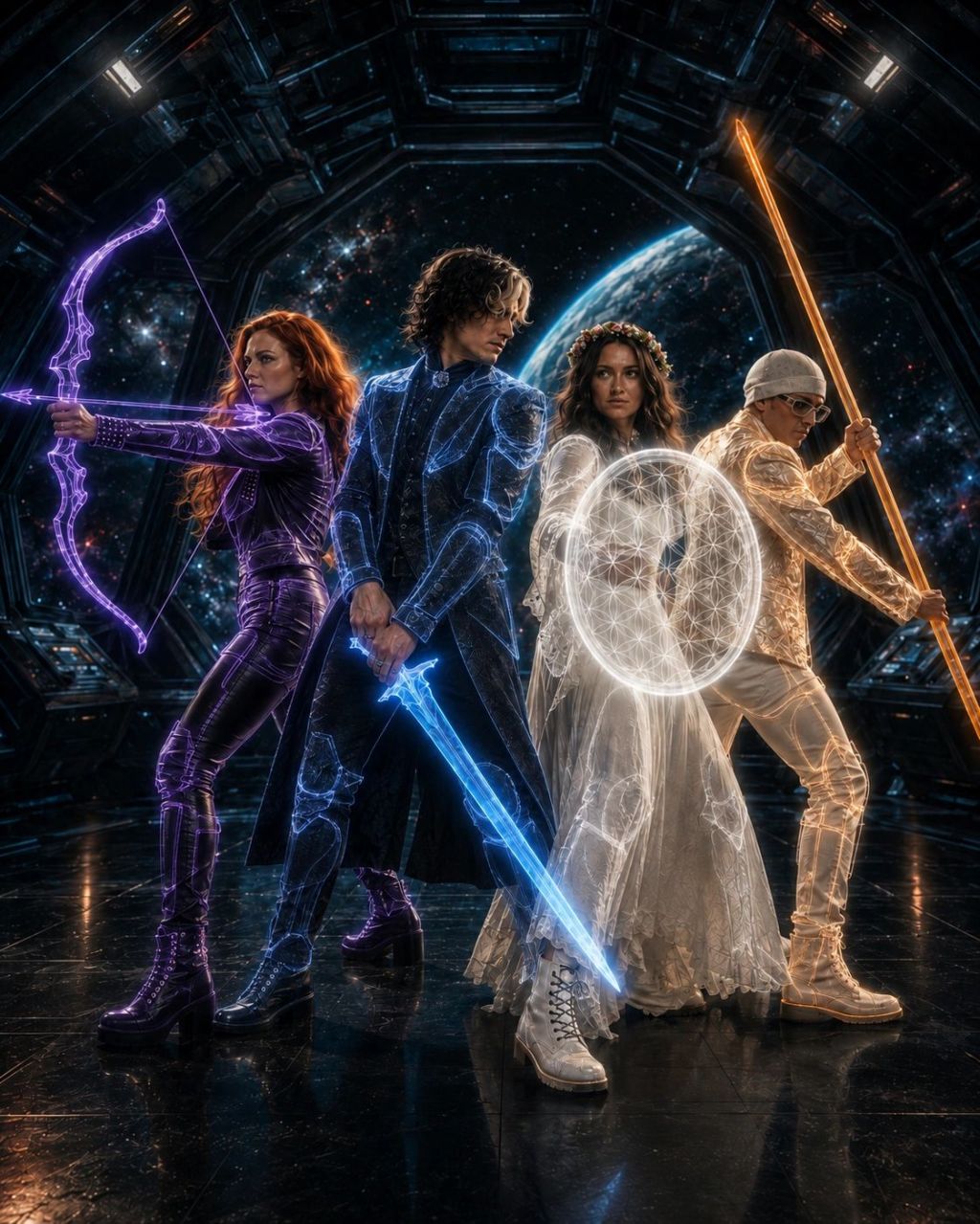
How do you make a tabletop roleplaying game simple enough to begin in minutes, yet flexible enough to tell stories across thousands of years? Captain Plum spent much of 2025 and 2026 pursuing that question. The result is SPARK RPG: a developing, card-based game about courage, curiosity, friendship and the responsibilities of power.
A different idea of heroism
Many roleplaying games reward defeating enemies and collecting treasure. SPARK has enemies and dangers too, but asks an additional question: who benefits from the hero’s power? In the Vitaverse, the Star Concord seeks to protect conscious beings, not claim ownership over them. Its promise is simple: No Spark is cargo. No angel is property. A heroic choice might be to fight, negotiate, investigate, mend a machine or help a frightened stranger.
From twelve archetypes to three simple classes
The early 2025 designs imagined twelve heroic archetypes drawn from patterns recurring across myth, adventure and science fiction. Later iterations grouped those heroes into three broad approaches: Defenders protect, Benders alter possibilities, and Menders restore and inspire. Four archetypes live within each class. The same heroic pattern can appear in the fantasy of Mythos, the upheavals of Wildfire, or the far future of the Holy Fleet.
These classes describe a character’s strengths, not the limits of their humanity. A Defender can reason. A Bender can comfort. A Mender can fight. Nobody needs permission from a character sheet to care about another being.
Body, Mind, Soul—and nine actions
SPARK gradually simplified its mechanics around three attributes: Body, Mind and Soul. Each supports three universal actions. Body has Strike, Move and Endure. Mind has Perceive, Recall and Solve. Soul has Inspire, Channel and Resist.
Want to climb a cliff? Move. Decipher an alien message? Solve. Give someone courage? Inspire. The player describes the intention; the Guide judges the situation; the rules resolve what is uncertain. The ideal is that a new player can understand the basic language of the game without memorizing an encyclopedia.
Why cards instead of dice?
A standard deck is familiar, cheap and visual. The design went through several experiments, including early two-card systems, before the October 2026 Cards of Fate. In the current Levels 1–3 playtest guide, black numbered cards carry their printed value and red numbered cards add ten. That card value joins the relevant character bonuses and is compared with a target set by the Guide.
Cards also have suits, patterns and the practical advantage of being dealt openly for several challenges at once. The intent was never to introduce a complicated novelty. It was to make randomness quick, legible and something players could see on the table. Earlier card experiments belong to the game’s history, not automatically to its current rules.
A Guide who plays jazz
A good Guide does not need to predict everything the players will do. The Guide creates a believable situation, listens to unexpected ideas and improvises the consequences. Suppose a damaged probe has attached itself to a ship. Players may capture it, repair it, question it, flee it or imagine a completely surprising solution. SPARK should support that inventiveness rather than force everyone down one approved route.
That is why the design repeatedly returned to fewer abilities, simpler character creation and less bookkeeping. The fewer seconds spent searching a rulebook, the more time available for the adventure.
A living game, not a finished monument
The archive records an evolving design: twelve archetypes in 2025, experiments with playing cards, the refinement of three core classes during 2026, and a working third-edition playtest. Today’s SPARK RPG page hosts the illustrated Levels 1–3 playtest rules. They remain a playtest, and feedback from real adventures matters more than grand declarations about elegance.
The ambition has stayed remarkably consistent: a small set of rules capable of supporting enormous imaginative freedom, with room for humour, moral choices and the possibility that saving somebody is a greater victory than defeating them.
A few friends. A deck of cards. A world that needs help. Draw, choose, and discover what happens.
The story is the treasure. The rules are only the road.
From the original design archive
This retrospective draws on original Vitalogue writings, including Design Philosophy of Classes in SPARK RPG (June 2025), A New Kind of RPG (July 2026), The Cards of Fate (October 2026), and Making Sparks (October 2026). These historical links may be unreliable as the archive moves from GoDaddy to WordPress.


Leave a Reply