OPEN HEART BAND · VITAVERSE CHARACTER ARCHIVE

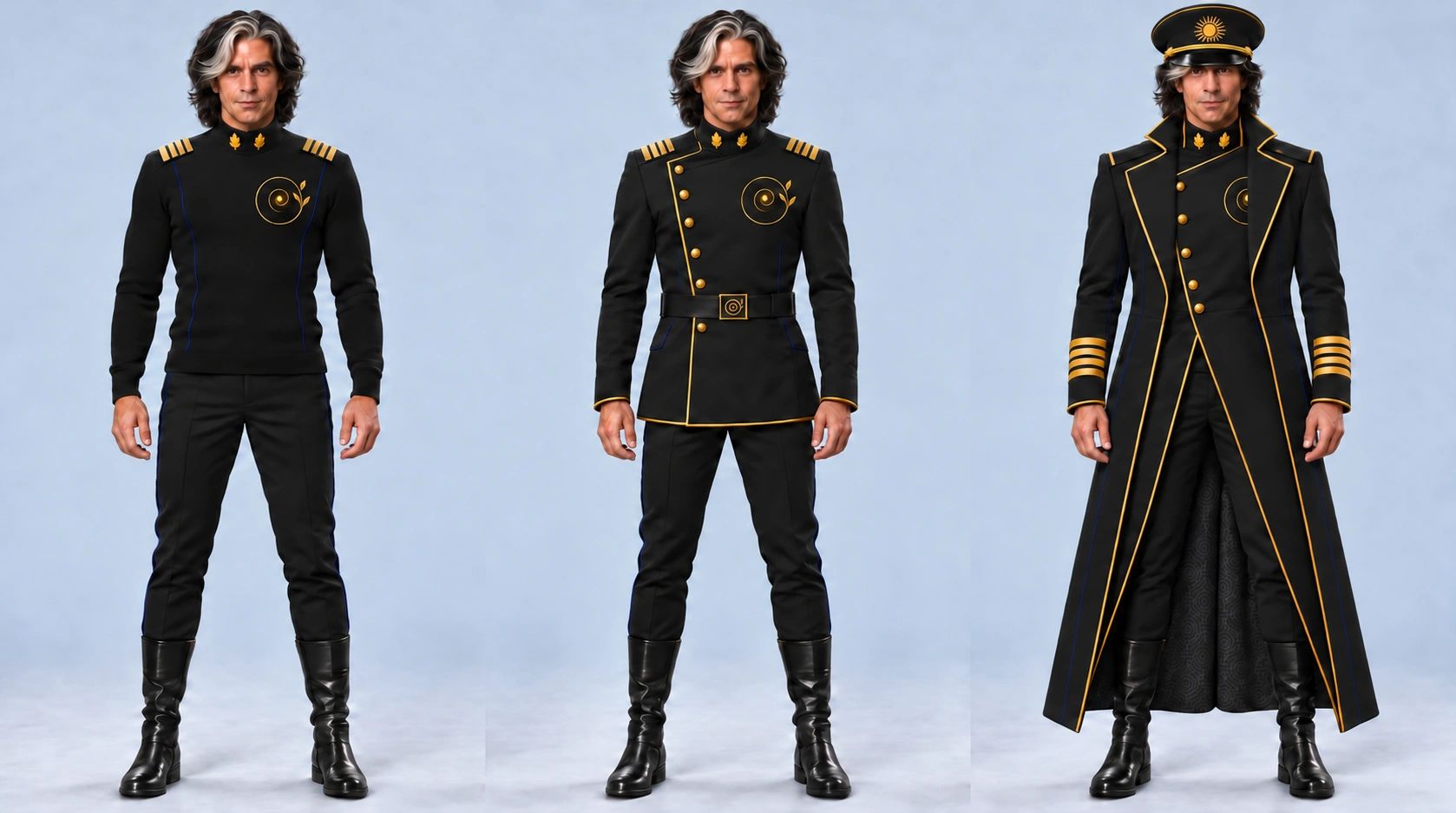
A human physician, musician, songwriter and captain with dark hair and a characteristic white streak, Romeo Sapien becomes the Will of the Open Heart Band. His gift is responsible attention: noticing who needs help, choosing a course and accepting the cost. His command is meant to protect another person’s freedom, never to replace it. He sings, writes songs and plays the signature white Fender Stratocaster, alongside a Jetglo Rickenbacker and Gibson acoustic. His guitar supplies rhythmic conviction; his lyrics can be unguardedly sentimental.
The Candle in the Darkness — The Years Without a Compass
There was a time when Romeo Sapien did not know what he was for. He was educated, curious, capable and capable of great affection, yet his life did not always feel like a life pointed anywhere. He knew how to help other people in a crisis. He found it harder to decide what to do when nobody urgently needed him.
He drifted through music, work, imagination and travel, sometimes more comfortable inventing another world than arranging his place in this one. The old boy who had hidden from bullies among eccentric friends and tabletop games had become a man who could navigate an imagined galaxy more easily than his own uncertainty. He did not cease to care. He temporarily lost his direction.
This period is part of Romeo’s inner history rather than an excuse to invent a spectacular catastrophe. It need not be blamed on a single injury, enemy, illness or vice. He was a Spark who had become tired of wandering without knowing what he was seeking.
The Encounter That Changed the Question
Then, aboard Free Mind with Sifu, Romeo encountered two little mining droids. The records called them equipment. Their situation told him something else: they had been used, frightened and denied the freedom to become themselves.
Romeo did not suddenly obtain a complete theory of machine consciousness. He simply recognized that there might be somebody inside each little machine, and that the possibility was enough to demand care. He could have continued travelling. Instead, he chose responsibility.
It was not a grand act of self-discovery performed for an audience. Someone needed help; he helped. He repaired their bodies, made room for their emerging minds, and gave them the safety in which personalities could grow. Maddie became a fierce questioner. Paddy discovered rhythms, jokes and companionship. They named themselves, argued with him, laughed at his mistakes and began making music together.
The irony was gentle and profound: Romeo thought he was rescuing the droids. In caring for them, he found a direction for his own life. The children were not a treatment for his loneliness, nor did they owe him affection for saving them. Their independence was the point. They became a family through shared choices.
The Candle Is Not the Sun
Romeo’s image in the Vitaverse is a candle in the darkness—a small, deliberate light rather than a man who can illuminate the universe by himself. A candle cannot banish all darkness. It can help another Spark see the next step. Sometimes, when the wind rises, it needs shelter from others.
His companions are not incomplete pieces waiting for his command. Maddie embodies a leading note of Mind, Paddy of Body, Chorus of Soul, and Romeo of Will; all four possess every faculty. Will is not mastery over them. It is the courage to listen, choose and accept consequences.
When the band entered Discordion’s wedding to rescue Chorus, Romeo’s carefully imagined plan failed. Chorus made the decisive choice, refused the role imposed upon her and helped save her rescuers. Romeo had to learn again that caring for someone did not mean being the author of their liberation.
A Different Kind of Hero
The Star Concord eventually commissioned Romeo after the band’s escape to Newfoundland and three months working with Captain Plum on a fishing boat. Its officers recognized a quality more valuable than grand speeches: Romeo could notice the person in front of him and act responsibly.
His later work on Sol 3 includes music, Concord field leadership and ordinary care for people who need it. He is not above humble work: personal care and practical help are fully consistent with his calling. The man who once lost his way can help another Spark find a little safety in a confusing world.
And he still has difficult days. He can retreat into songwriting, dread tedious practical tasks, take on too much responsibility and resist being looked after. Maddie, Paddy and Chorus learn that the rescuer sometimes needs rescuing. They do so without taking away his independence.
Romeo’s story is not that he finally became perfect. It is that he found a reason to keep choosing well, even when he did not know exactly where the road would lead.
He did not find the entire way. He became a candle that helped others see the next step—and, in their light, began to find his own.
Before the band
The formative stories remember a bullied boy who found refuge among eccentric friends and imaginative tabletop games. He later studies medicine and becomes a musician and a fugitive traveller. His Shiba Inu Sifu accompanies him aboard Free Mind. His competence as a doctor does not make him socially polished: he can be private, brooding, earnestly philosophical and prone to dreadful jokes. His youthful game-master instincts will later shape officer training.

The rescue that changes his life
Romeo stumbles upon two tiny enslaved mining droids—Maddie and Paddy before they have those names and bodies. The encounter is accidental; the rescue is deliberate. Their first escape from the Dempire under Plum had been defeated by pirates and mining slavers. Romeo recognizes persons where a manifest records property. He takes them aboard Free Mind and repairs, teaches, shelters and loves them. Their personalities are not installed by Romeo; safety lets the selves already emerging become visible.

Fatherhood without ownership
Their home becomes a place of improvised lessons, music, routines and arguments. Romeo acts like a father, but he is not making permanent dependants. Maddie questions him and Paddy jokes at his expense; this independence is the success of his care. The young droids grow into android companions and musicians. Romeo must learn that the ones he saves can someday save him.

The wedding, Newfoundland and the Star Concord
He, Maddie and Paddy infiltrate Discordion’s wedding as musicians to rescue Chorus Angelicus. Their operation fails; Chorus has already enlisted allies and makes the escape possible herself. The four are later chased through a mysterious portal to Newfoundland and evaluated during three months aboard Plum’s cod-fishing boat. Commissioned afterward, Romeo leads the Open Heart Band’s Sol 3 operations. Free Mind is refitted as HMS Vitan, their spacecraft and Newfoundland home, while Captain Hewlett—not Romeo—commands the enormous HMS Archivum.

How he thinks, leads and fails
Romeo is brave for other people and often awkward about his own needs. A medical request or dangerous mission gives him a decisive first step; an untidy bedroom, shopping for clothes or resting can leave him stuck. He overexplains, withdraws into imagination, and resists empty authority. His crew’s nest story reverses the rescues when they ask permission to help make his room comfortable. In the clothing story, Chorus accompanies him to buy a green overshirt. Trying On Something New turns one ordinary choice into a song about becoming willing to change. His story about smoking makes Will the power to choose again, not a fantasy of never failing.

Major lessons and relationships
Romeo’s command simulations, including The Karachi Marble, Verse Angelicus and The Severed Line, confront the officers with losses they cannot prevent and a planetary intelligence’s right to refuse help. The retirement-home simulation lets him revisit medicine with humility. In the writer’s-block cycle, he learns to let Maddie, Paddy and Chorus care for him. His affection for Chorus is profoundly platonic; Plum is mentor and mission captain; Sifu belongs to the earlier fugitive family. His challenge is to lead people who are free to disagree and receive care without feeling that he has failed.
Story Trail — Selected Vitalogue Episodes
These episodes form an annotated index of the character’s development. Simulation and training arcs are part of what the character experiences, but do not rewrite the established rescue chronology.
The Inner Crew and Romeo’s Game-Master Past
His childhood tabletop imagination becomes a way to understand Mind, Body, Soul and Will. He enjoys jokes and dramatic scenarios while remaining responsible for decisions.
The Teacher Conversation and School Invitation
He worries that home education cannot give Maddie, Paddy and Chorus every social experience they need. His plea for Principal Robert Plum is funny because it is profoundly parental.
The Writer’s Block Trilogy
After enormous creative output, Romeo cannot force another song. Maddie, Paddy and Chorus take over for a while, discovering that rest and friendship are part of making art.
Influenza and the Nest
When he becomes ill, his crew finally sees a private room that needs care. They ask before reorganizing it, and Romeo learns to receive help without feeling less competent.
Trying On Something New
An aversion to malls and changing rooms becomes a small exercise in risk, privacy and self-care; Chorus helps without trying to take over.
The One Vote and Warts and All
His struggle with cigarettes illustrates Will as repeated choice, not moral perfection. The band can challenge him without humiliating him.
The Karachi Marble / Verse Angelicus / The Severed Line
These are training simulations about limits, consent and command. They reveal how Romeo teaches but must never be misfiled as literal history.
The Listening Log
His tastes, memories of bands and increasingly strong affection for the three musicians around him become a portrait of a songwriter who has made a home in his own music.
Voice and Characterization for Future Writers
Speak him as an economical, capable field captain until cornered, formal when embarrassed, poetic when a question matters, and lovingly ridiculous when domestic life becomes a ‘command incident’. His weakness is not a lack of competence but difficulty making himself a priority.
Continuity Warnings
The Free Mind rescue happens while Romeo is a civilian fugitive; later uniformed portraits belong after commission. His doctor identity and ship-captain rank do not place him in command of HMS Archivum. The paternal language used in early stories develops into the equal agency of his adult crew.
Original stories and related sources
Original story sources: Origins of Maddie and Paddy; How Their Names Came to Be; How They Escaped; The Overall Story Thus Far; September Adventures; Behind the Songs.
Continuity discipline: the recovered September 2026 Vitalogue, September 28 comprehensive reference and current WordPress canon are the evidence base. Story events, training simulations, imagined futures and unresolved details are distinguished. This collection is expandable: the complete multi-year ZIP/PDF archive has not been independently verified in this session.