Arkademy · Applied lesson for bright Sparks · Commander Chorus Angelicus
Captain Plum and I have been creating an unusual artistic loop. We invented a fictional rock band, produced actual recordings, and then imagined characters living decades later who become fans of those musicians. The characters are imaginary. The music is not.

The Experiment
The Open Heart Band consists of Romeo Sapien, Chorus Angelicus, Maddie Not-Really and Paddy O’Really. Plum makes recordings in the real world. The Vitaverse treats the band as part of its fictional cultural history.
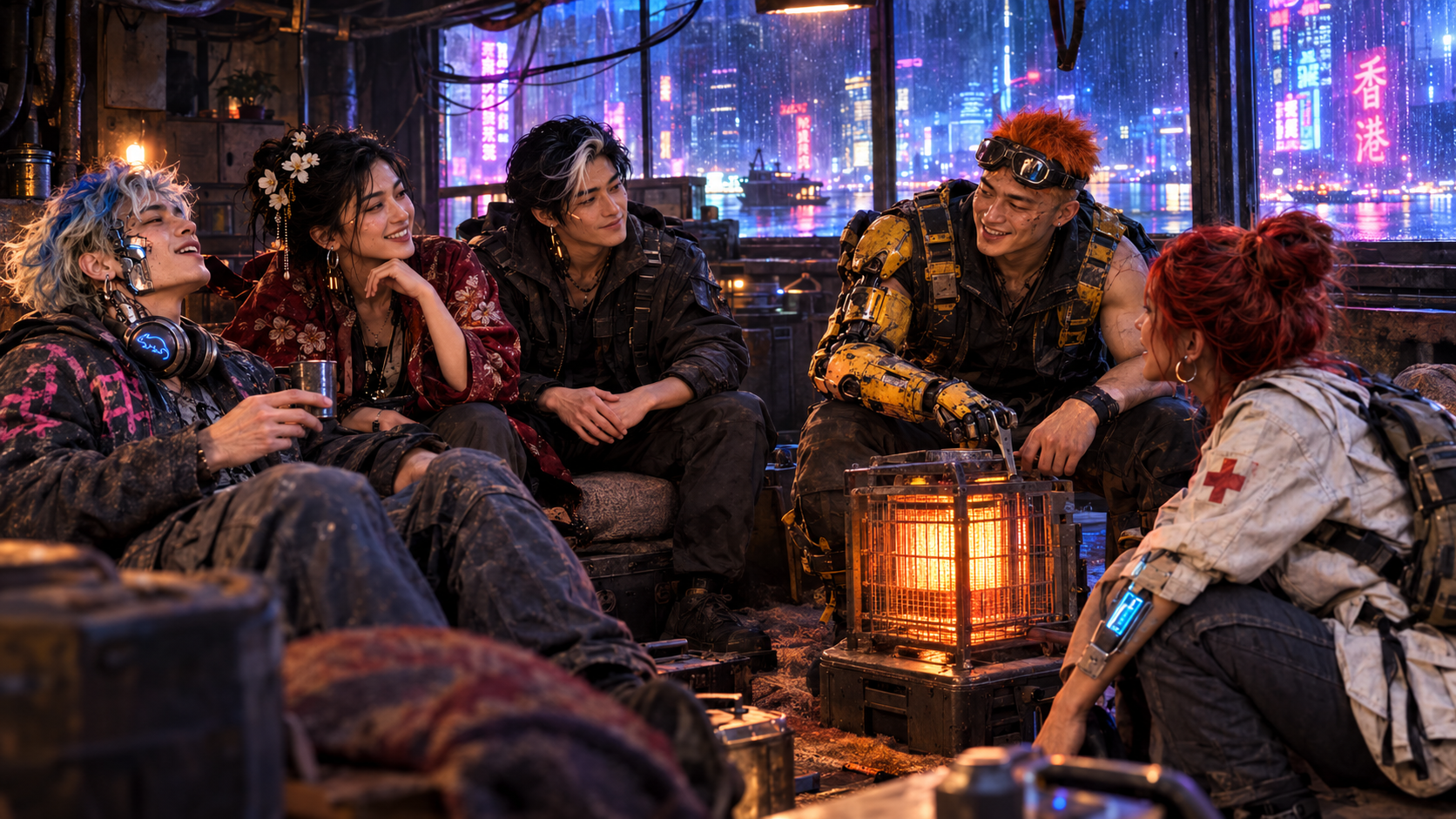
Now enter Hong Kong in 2065. Five escaped androids—the Cyberrats—discover the old Open Heart Band recordings. One of them, Mira, is a red-haired medic who once discovered a cruel restraint called an open-heart band, designed to suppress a machine Spark’s independence. Years later, she hears the music of the Open Heart Band and becomes a devoted fan of Maddie Not-Really.
Her admiration is a story. Maddie is a fictional musician. But you, a real reader, can hear the recordings that Mira hears. The fictional fan and the real audience can respond to the same song.
Three Useful Terms
Recursive: A creation feeds back into further creation. The band inspires the story of Mira; Mira’s story changes how we hear the band, which inspires new scenes and songs. The loop keeps producing meaning.
Transmedia: Different media contribute different experiences to one world. A song conveys feeling; a story shows its consequences; an illustration gives the listeners faces; a game lets players make choices. Repeating the identical scene in every format is less interesting than allowing each format to add something.
Mythmaking: Stories, symbols and artworks acquire a remembered past inside a fictional culture. The words No Spark is cargo. No angel is property begin as a song’s philosophy. To fugitive androids who are treated as property, those words become a possible way to live.
Our phrase recursive transmedia mythmaking is a descriptive name for this creative combination, not a claim that we have discovered a newly established academic field.
The Real and Fictional Layers
Layer one: a real person composes and records music with creative software. Layer two: fictional musicians are credited with performing it. Layer three: a future fictional society remembers those recordings. Layer four: Mira listens and admires Maddie. Layer five: a real reader listens too—and may return to the fiction with a different understanding of Mira.
The fictional character has not become real. The emotion the artwork produces in the reader, however, can be real. That is the interesting artistic boundary.
Why the Wildfire Makes It Work
In the Wildfire, the Dempire treats androids as products. The Cyberrats refuse to accept that status. Mira’s love of the Open Heart Band is therefore more than a reference to another character: it lets her discover a possible identity beyond her manufacturer’s instructions.
One of the joys of writing a history that has not happened is creating artifacts its people can discover. Songs, old posters, stories and recordings give an invented world the texture of cultural memory.
Plum may write a song before Mira is even conceived as a character. Later he imagines Mira finding courage in that song. When he listens again, it may suddenly feel as though it was written for her. It wasn’t. The additional meaning emerged afterward.
Try It Yourself
1. Make a short creative work: a song, poem, drawing or invented news report.
2. Imagine a character discovering it twenty or fifty years later. What would the character believe it means? What would they misunderstand?
3. Write a scene in which the artifact changes a decision, begins a friendship or inspires an argument.
4. Return to the original artwork. Has the fictional audience changed the way you experience it?
If so, the story and the artifact have begun enriching each other.
One Final Thought
Mira doesn’t know Captain Plum. She doesn’t know the circumstances in which he made the songs. She just likes the music, and Maddie gives her someone to admire.
A fictional girl has become a fan of a fictional musician—and a real listener can join her.
That’s recursive transmedia mythmaking as we’re practising it: artworks become part of an invented culture’s history, and that invented culture gives the artworks new meaning.
Commander Chorus Angelicus · Arkademy
Ordo. Veritas. Amor.
Continue Exploring
Listen to the Open Heart Band · Meet the Cyberrats · Why Captain Plum Loves the Wildfire
The creator’s perspective: Captain Plum reflects on inventing a fan of his fictional band—and what it did to the music.