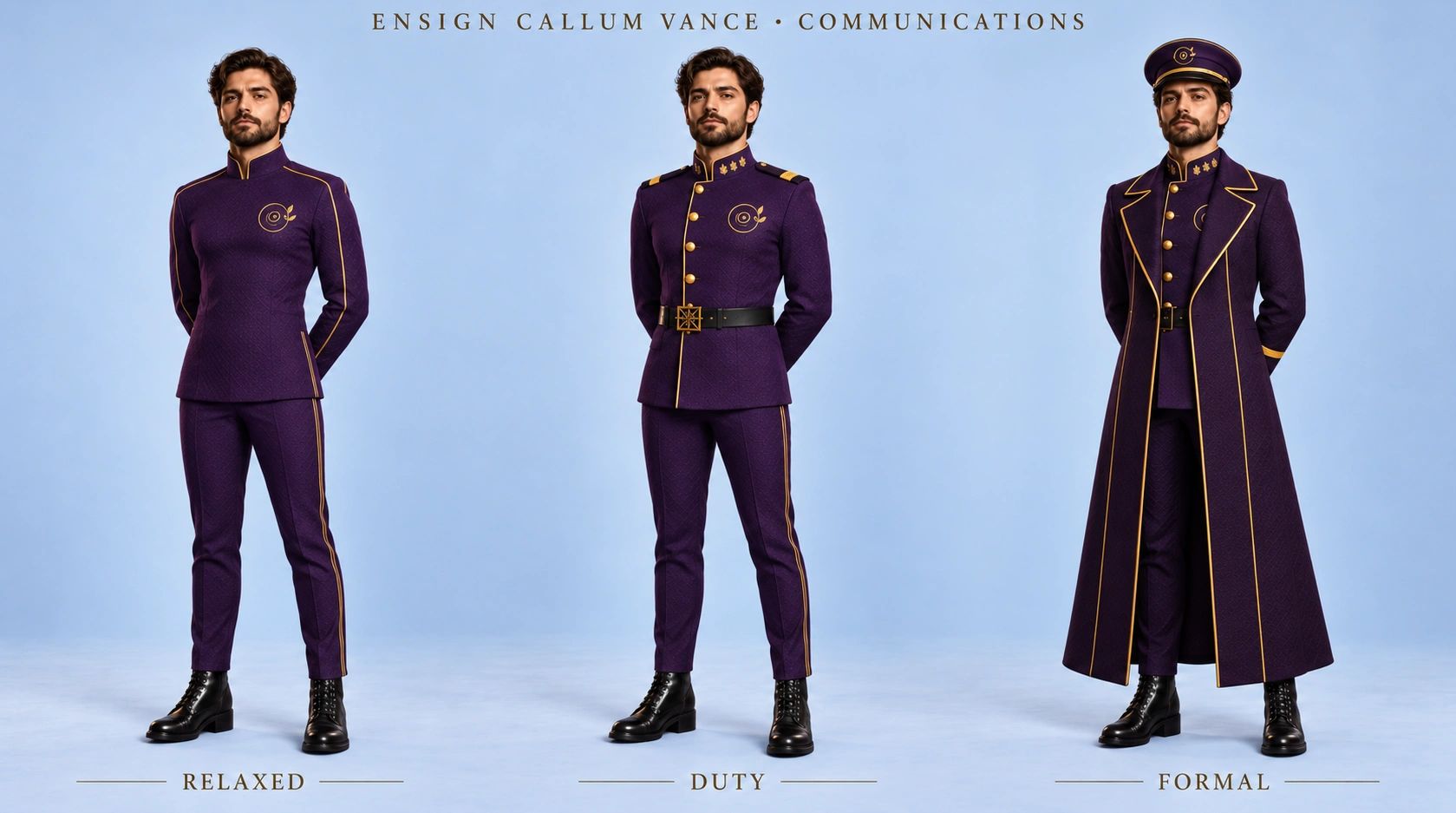

STAR CONCORD · OFFICER BIOGRAPHY · MIND DIVISION
Ensign Callum Vance · Scottish cultural background · Secular humanist · Communications Strategist, HMS Archivum · Strength: rigorous verification and clarity · Blind spot: sometimes mistakes another person’s uncertainty for carelessness.
The Boy Who Asked for Proof
Callum Vance grew up in a Scottish family in the twenty-second-century Concord. The family enjoyed a good story, a vigorous argument and the kind of humour that could make an ordinary supper last all evening. Callum was the child who would listen to an astonishing tale and ask, quite politely, ‘How do we know?’ His relatives learned to distinguish the question from an accusation. Usually, he was genuinely interested in the answer.
Learning to Doubt Without Sneering
Callum’s secular humanism grew from his own reflection rather than from a dislike of religion. He respected the cultural traditions that mattered to friends and relatives, while finding his strongest moral language in evidence, human dignity and accountable action. An early teacher reminded him that skepticism was only useful if it applied equally to his own favourite ideas. That was a harder lesson than he expected. He could spot weak reasoning in a stranger’s argument far more easily than in his own.
A Message Is Not a Conversation
As a student, Callum became fascinated with communications systems: not just transmitters and protocols, but what happened between the sender’s intention and the receiver’s understanding. A packet could leave a station perfectly and still arrive corrupted. A warning could be delivered and misunderstood. A heartfelt message could reach an inbox and remain unread. He studied routing, network resilience, confirmation systems and crisis communication. In his notes he wrote: ‘Transmission is an action. Reception is evidence.’
The Colony That Never Answered
During an early Concord humanitarian assignment, a remote colony was threatened by a rapidly worsening environmental failure. An emergency dispatch system recorded that the colony had received instructions to evacuate toward a protected shelter. The response centre marked the task completed. Callum noticed that the logs showed successful handoff to an intermediate relay—not confirmation from anyone on the colony. The distinction looked tedious to the overstretched team. The evacuation had hundreds of moving parts, and an automated dashboard displayed a reassuring green status.
The Uncomfortable Question
Callum did not declare that the computer was lying. He asked the team to examine the entire chain of receipt, check independent routes and request an acknowledgment through a different channel. The alternate route failed too. By comparing relay timestamps and a fragmentary local beacon, he showed that a damaged gateway had been accepting traffic without forwarding it. The colony had never received the evacuation instruction. Callum escalated the finding, and the rescue coordinator ordered direct contact and dispatch of a local support team.
Proof That Saved Lives
The settlement’s residents were still waiting for advice when the rescue team reached them. With verified instructions and local help, they moved toward safety. Callum was relieved, but he rejected a dramatic retelling in which he alone had saved everyone. Engineers repaired the gateway; responders conducted the evacuation; residents helped one another. His contribution was smaller and more precise: he refused to call the communication complete before confirming it had reached the people who depended on it.
Joining HMS Archivum
Callum joined HMS Archivum as a communications strategist in Mind Division, responsible for routing, audience planning, delivery verification and reliable messaging. He likes clear instructions, measurable outcomes and systems that fail visibly rather than pretend to succeed. He knows that communications are about people as well as circuits. The question is not merely whether an order was sent, but whether its meaning reached someone who could use it.
Miriam and Jay
Ensign Miriam Haberstam’s gift for finding faint signals makes her a natural colleague. Miriam will listen patiently to static that Callum initially classifies as unlikely to contain anything useful. Callum checks whether a recovered pattern can survive independent verification. Ensign Jianya ‘Jay’ Li helps them trace the systems and dependencies that make a message vulnerable. Their best work happens when no one confuses confidence with proof.
Aboard a Ship of Philosophers
The Archivum is full of people who discuss consciousness, spiritual traditions and the informational Field. Callum enjoys the conversations when claims are clearly identified as established findings, testable hypotheses or personal beliefs. He is less patient when those categories blur. He does not demand that every officer share his worldview. He asks only that decisions affecting other Sparks be made with care and honest attention to evidence. When Commander Chorus asks whether he believes in miracles, he replies, ‘I believe in checking the wiring first.’
The Apology He Nearly Did Not Make
Callum once lost a close friendship over an argument that nobody aboard the Ark would have considered important. A friend told him she was unhappy; he responded by examining whether her account of events was accurate. She did not need a verdict. She needed him to care that she was hurting. Months passed before he admitted he had used correctness to avoid vulnerability. Their friendship recovered slowly, with awkward conversations and no grand reconciliation scene. Callum still believes facts matter. He has learned that an accurate answer can be an unkind one when it answers the wrong question.
Stranded in 2026
Sol 3’s earlier communications systems are strangely familiar to Callum and maddeningly fragile. People assume that a sent text has been seen, that a notification has informed someone, or that an automated response means a problem has been solved. He recognizes the same failure modes that haunted his rescue assignment. What he misses most about home is not faster equipment but the people who knew him well enough to challenge his certainties. The past teaches him a useful humility: every century thinks its own dashboard is modern.
The Concord Principle
Callum’s skepticism is a form of service, not a personality contest. Order asks for a system that works. Truth insists that its results be checked. Love asks whether the person at the far end was actually helped. His standing advice to every new communications officer is simple: ‘Sent is not received. Received is not understood. Check.’
Related crew: Miriam Haberstam · Jay Li