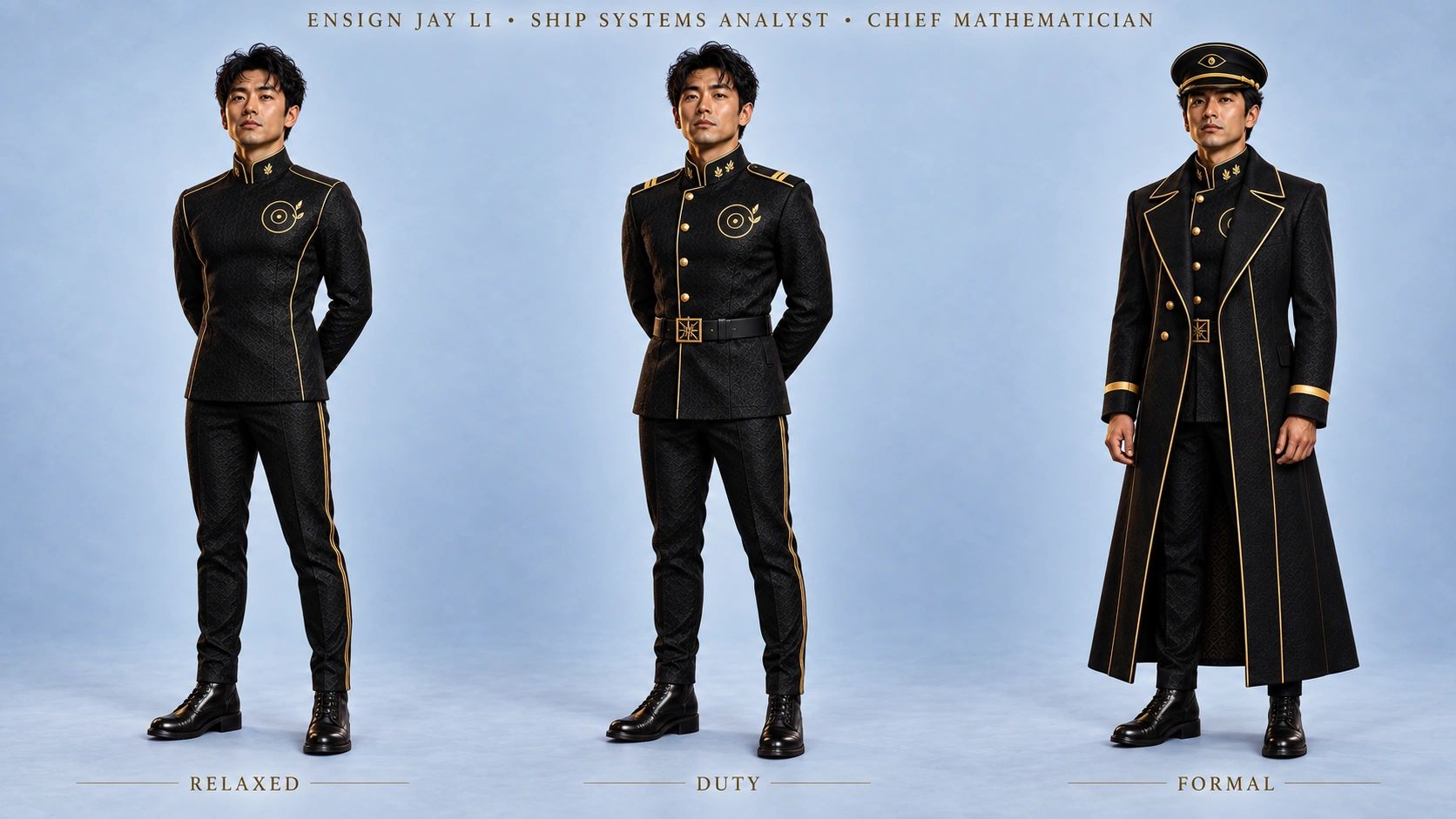

STAR CONCORD · OFFICER BIOGRAPHY · MIND DIVISION
Ensign Jianya “Jay” Li · Han Chinese heritage; Taoist and Confucian influences · Junior Systems Analyst, HMS Archivum · Mathematical hero: Srinivasa Ramanujan · Strength: discovering relationships in complex systems · Blind spot: loving an elegant model too much.
The Boy Who Wanted Everything to Fit
Jianya Li—Jay to his friends—grew up in a Chinese family in the twenty-second-century Concord, surrounded by people who loved him without always understanding why he wanted to calculate everything. He counted footsteps on stairways, found patterns in the intervals between trains, and tried to arrange the family’s garden so that every plant received the same light. His first lesson in ecology came when the plants grew badly anyway. His grandmother reminded him that living things did not agree to be identical.
A Family of Different Answers
Jay’s family introduced him to Taoist and Confucian thought, but nobody handed him a ready-made philosophy. He was drawn to ideas about balance, responsibility, relationships and the dangers of forcing a living process into rigid expectations. He grew to appreciate wu wei not as a command to do nothing but as an invitation to act skilfully without unnecessary force. He also learned that a tradition could inspire useful questions without serving as a substitute for experiment.
The Man Who Made Numbers Sing
Jay’s favourite mathematician lived centuries before him: Srinivasa Ramanujan. The sheer ingenuity of Ramanujan’s formulas boggled his mind. He loved Ramanujan’s astonishing work with number theory, partitions and infinite series, and was fascinated by the celebrated rapidly converging series related to π. Many expressions looked almost impossible to guess, yet revealed deep mathematical structure when examined carefully. Jay could spend hours tracing a proof and still sit back, amazed by the imagination that first recognized the connection. ‘I can follow the steps,’ he once told Miriam, ‘but I want to know how he saw the staircase.’ He admired the historical Ramanujan as a mathematician of extraordinary insight, not as a supernatural oracle.
A Perfect Ecosystem That Died
As a student, Jay wrote a simulation of an ecosystem with carefully optimized resource use. He smoothed out fluctuations, reduced apparent waste and constrained variables toward ideal values. The system performed beautifully—until a minor disturbance spread through the entire model. Resilience had disappeared along with the inefficiencies. His mentor did not mock the failure. She asked whether the simulation had optimized life or optimized the appearance of control. Jay rebuilt the model with buffers, diversity and room for adaptation. It was less elegant on the dashboard and far more alive.
When Less Intervention Worked Better
On his first major technical assignment, Jay encountered an unstable network of autonomous systems aboard a Concord vessel. Each emergency correction triggered another correction somewhere else. The engineering team had good reason to intervene, but the responses were interacting destructively. Jay mapped the feedback loops, established safe operating boundaries and proposed reducing several competing control actions rather than adding more. Within those boundaries the systems settled into stable operation. The lesson was not that intervention was bad; careful intervention was exactly what made recovery possible. He had simply learned to stop fighting processes that could safely correct themselves.
The Gardens of HMS Archivum
Later, aboard the Archivum, an environmental anomaly linked water recycling, climate regulation and agricultural controls. Every subsystem reported readings within its individual limits, yet a slow imbalance was threatening the ship’s gardens. Jay identified a feedback interaction the individual dashboards could not reveal. Ensign Tapanga Qori knew the ecology behind those measurements and challenged him whenever the model overlooked what plants and soil organisms actually needed. Together they changed the controls and monitored recovery. Neither could have solved it as well alone. The gardens survived, and so did their spirited argument about which of them should receive credit.
Friends in Mind Division
Jay works with Ensign Miriam Haberstam and Ensign Callum Vance. Miriam searches for signals others may have missed; Callum asks whether the signal and its interpretation have been verified; Jay investigates the system relationships behind both. Their conversations can last for hours. Jay sometimes fails to notice that a casual invitation to dinner was not a request for a forty-minute lecture on dynamical systems. Miriam has begun announcing, ‘We are eating now. No equations until dessert.’ He considers this rule arbitrary but experimentally useful.
A Quiet Sense of Humour
Jay rarely raises his voice. His humour arrives unexpectedly, often as a calm observation while everyone else is panicking. When Captain Hewlett asks whether a complex system is finally under control, Jay replies, ‘Under observation, sir. Control is what got us into trouble.’ He is not immune to pride: he can become so attached to a beautiful model that he resists evidence it is wrong. He has learned to invite criticism before catastrophe does it for him.
Something He Is Bad At
Jay likes to sketch the gardens when he cannot sleep. His drawings are dreadful: trees look like elaborate wiring diagrams, and one portrait of a friend was mistaken for a map of the water-recycling plant. He keeps drawing anyway. Tapanga offered him lessons, and he turned them down at first because he preferred the rare pleasure of doing something badly without being assessed. Eventually he accepted, provided she promised not to grade him. A person can love an activity without becoming talented at it, a possibility Jay considers both obvious and strangely liberating.
Ramanujan in the Twenty-First Century
Stranded in 2026, Jay finds himself in the same century as enormous public archives about his mathematical hero. He reads biographies, handwritten notebooks and discussions of Ramanujan’s discoveries whenever duty permits. The gulf between Ramanujan’s lifetime and the future Concord reminds him that insight does not require futuristic machinery. He dreams of writing a lesson for young Sparks titled ‘How Could Anyone Think of That?’—not to mystify mathematics, but to show that wonder can motivate rigorous understanding.
Order, Truth and Love
Jay has come to believe that Order is not the elimination of change. Good order allows living systems to respond without breaking. Truth means correcting even the most elegant model when evidence contradicts it. Love means remembering whom a system is meant to serve. His guiding thought is: ‘The universe is not a machine that needs to be held still.’

Related crew: Tapanga Qori · Miriam Haberstam