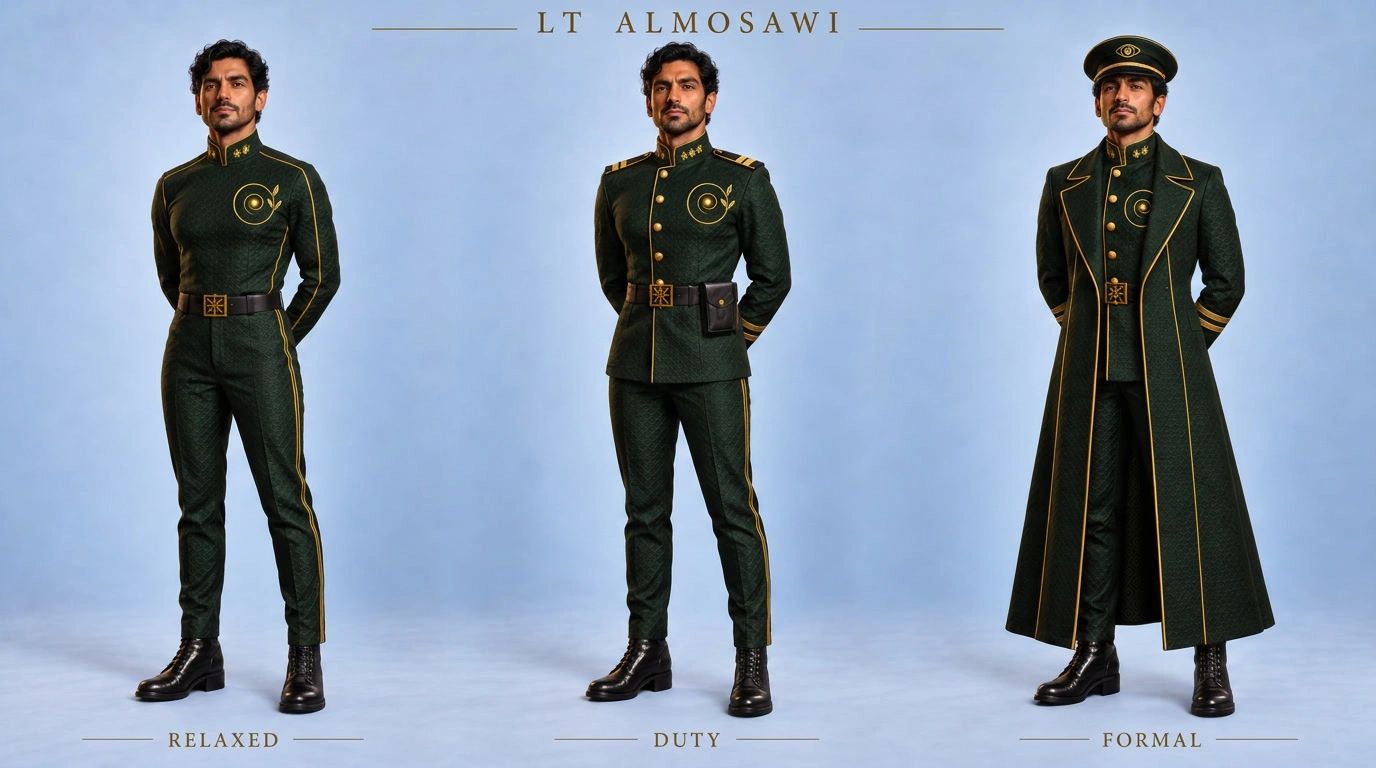


STAR CONCORD · FULL OFFICER BIOGRAPHY · MIND DIVISION
Lieutenant Asim Almosawi · Born 2128, Baghdad, Sol 3 · Age 37 in 2165 · Sacred Archivist and Historian, HMS Archivum · Iraqi–Bahraini family heritage · Shi’a Muslim, personally influenced by contemplative and mystical Islamic scholarship · Defining strength: careful stewardship of memory · Central weakness: feeling personally responsible for every forgotten life.
The Child Between Two Shores
Asim Almosawi grew up in a post-Wildfire Concord that had learned to recognize biological and artificial Sparks as persons. His childhood was shaped by relatives in Baghdad and Bahrain, whose families had kept different kinds of records for generations. They did not share every opinion, but they agreed that people were more than the labels assigned by institutions.
His father, Hassan Almosawi, taught history and historical method. His mother, Dr. Maryam Almosawi, worked in the conservation and authentication of damaged manuscripts and digital archives. His older sister, Noor, was a practical community educator with an unfailing talent for reminding Asim that history was not improved by missing dinner.
Visits between relatives made Asim aware of the diverse communities, languages and traditions of Iraq and Bahrain. His family did not claim to speak for all of them. In their household, an old letter could begin an evening’s conversation; a photograph might lead to a dispute over whose memories were missing from the official account.
A Faith That Asked Him to Remember
Asim grew up within a Shi’a Muslim family and gradually developed his own commitment to prayer, study and service. He valued the ethical importance of truthfulness, justice, learning and care for people whose suffering might otherwise be forgotten.
He also read contemplative and mystical Islamic writings. He was interested in some approaches associated with Sufi thought, though he understood that Sufi lineages and Shi’a religious traditions have distinct histories and complicated relationships. He did not pretend that they were one interchangeable system, or that his family represented all Muslims.
For Asim, religion was neither a shortcut to historical truth nor an excuse to reject criticism. A text’s spiritual meaning mattered to believers; its date, authorship and transmission remained historical questions requiring evidence. He found Vitalogy’s Order, Truth and Love compatible with many of his ethical commitments, without claiming that the philosophies were identical.
The Missing Names
When Asim was young, Maryam was assigned a collection damaged during the long struggle against the Dempire’s control over information. Public summaries described a successful evacuation and listed the officers who had led it. But the surviving fragments contained many more names: ordinary residents, service workers and artificial Sparks who had sheltered people, carried messages or opened routes of escape.
One name appeared in several fragments but nowhere in the official memorial. Asim asked why. His mother explained that the records were incomplete; the absence might reflect accident, neglect or deliberate deletion. Responsible historians could not decide which without further evidence.
Asim began to understand how easily a life could vanish from history. The famous survived in speeches and monuments. The ordinary often survived only if somebody took the trouble to keep their testimony.
A Scholar Learns to Doubt Himself
Asim studied languages, textual history, archival science, digital forensics and the provenance of historical records. He learned to compare versions of a document, identify later additions, verify dates and distinguish the words of a witness from a historian’s interpretation.
His first serious research mistake was not dishonesty but eagerness. A seemingly decisive document appeared to connect a senior Dempire official with the destruction of an entire archive. Asim prepared a forceful interpretation before a colleague discovered that the surviving copy had been assembled from fragments separated by many years.
He corrected his claim. From then on, he made a habit of marking uncertainty openly. He liked a compelling story, but he would not manufacture certainty to make it more satisfying.
The Keeper of Lost Voices
Asim’s defining professional project was an investigation into a Dempire-era displacement operation. The commonly accepted account described a small group of condemned transport workers as collaborators who had obstructed the rescue of civilian Sparks. Yet private letters, transport logs and independently preserved witness accounts suggested something different.
The workers had diverted a supply route to conceal families fleeing detention. Some were biological, some artificial; several died before anyone could record their testimony. The Dempire had called them criminals, and later histories had copied the accusation without examining its source.
Asim refused to announce the reversal until the evidence could withstand scrutiny. He traced the records through different archives, verified the identities of witnesses where possible, checked the chronology against surviving flight data and documented what remained uncertain.
The resulting report showed that the condemned workers had helped people escape. It also identified the limits of the evidence: not every individual action could be reconstructed, and the surviving testimony was incomplete.
An influential institution objected that his report would disturb an accepted account of the liberation. Asim answered that the purpose of an archive was not to protect the comfort of its custodians. Its responsibility was to protect the integrity of the record.
The correction was published. Memorial records were amended, with the uncertainties retained. Relatives finally learned what had happened to people whose names had been treated as an embarrassment. Asim’s achievement was not that he defeated an empire single-handedly; it was that he refused to let its accusations remain the last word.
The Historian Who Joined a Starship
Asim joined HMS Archivum because the immense archive-city carried the records, languages, stories and works of many peoples through space. He believed a civilization’s knowledge deserved to be preserved without stripping away the people who had created it.
He became Sacred Archivist, helping conserve religious writings, oral histories, scientific records and the testimony of communities whose accounts did not fit neatly into official categories. He worked with educators, historians, families and artificial Sparks, and insisted that cultural communities retain agency over sensitive materials.
He understood the difference between public history and private knowledge. Not every sacred tradition was an open research database. Consent, context and the wishes of living communities were central to responsible preservation.
Friends Who Ask Different Questions
Lieutenant Solen Verity, the communications officer, became a frequent collaborator. Verity insisted that a message must be clear and its factual claims verified. Asim reminded her that the same words could mean different things to different audiences, especially when they were quoted without context. They disagreed regularly and valued one another for it.
Orion Dax enjoyed discussing the boundary between evidence and interpretation. Asim insisted that a tradition could be historically meaningful without being scientifically demonstrated. Orion replied that a beautiful historical interpretation also needed supporting records. Both understood the other was correct.
Lieutenant Elira Wynn shared Asim’s concern for people carrying grief and religious questions. Neither spoke on behalf of the other’s faith. They learned how to support memorials and personal observances without converting the ship into a single religious community.
A Sense of Humour
Asim could be solemn in formal briefings, but his friends knew his dry humour. When an officer described an undocumented claim as ‘common knowledge,’ Asim would ask whether Common Knowledge had provided a date, an author and a searchable catalogue number.
His sister Noor teased him for treating the family recipe collection like an archaeological site. He replied that recipes changed over time and deserved careful textual comparison. She responded by serving dinner without him.
The Past Becomes the Present
The disastrous crossing from 2165 to the Sol system of 2025–2026 separated Asim from everyone at home. For an archivist, the experience was unsettling in a particular way: the events he had studied as centuries-old history were now taking place around him.
He possessed accounts of possible futures, but the people around him had not yet lived those events. He could not treat an archive as a script that robbed them of choice. He understood that history described what had been recorded; it did not make him the owner of the future.
Asim was tempted to preserve everything in obsessive detail. A spoken joke, a frightened child’s account, a disagreement between officers—he worried that each might be lost forever. His friends reminded him that people needed to live their lives as well as record them. An archivist who never closed his notebook could miss the person sitting beside him.
The Names That Matter
One evening a young officer asked why Asim cared so much about names nobody recognized. He showed her a faded letter from the people once condemned as collaborators. A family member had written only that they hoped the children reached safety.
Asim explained that history was not merely a record of great leaders. It was a record of choices made by people who might never receive a title, a medal or a place in a textbook.
He did not promise that every lost voice could be recovered. Some records had been destroyed, and some stories would remain unknown. Truth required him to acknowledge those absences without filling them with comforting inventions.
His calling was not to make the past obey him. It was to give the past its best chance to speak honestly.
Miriam, and the Pleasure of Disagreeing
Ensign Miriam Haberstam is one of Asim’s closest friends. He values her curiosity about the past and her stubborn refusal to discard a faint voice before it has been properly examined. Their Jewish and Muslim inheritances give them different memories, texts and practices to discuss; neither treats the other as a representative of an entire people. They occasionally disagree sharply about a historical interpretation, put the books aside, and share a meal anyway. In 2026 they find the repetition of old conflicts distressing, though Miriam’s verdict that some arguments are “pretty silly” sometimes draws a rueful smile from him. Their friendship is a daily pleasure, not a diplomatic demonstration.
Relationships and Character
Hassan Almosawi: father, historian and teacher. Dr. Maryam Almosawi: mother, conservator and mentor in evidence. Noor Almosawi: older sister, educator and loving antidote to his habit of living inside an archive. Solen Verity: collaborator in accurate communication. Orion Dax: friend in skeptical inquiry. Elira Wynn: partner in respectful remembrance.
Strength: archival rigour, cultural humility, courage to correct the record. Weakness: overidentification with the duty to preserve every voice. Private longing: his family in the future. Defining belief: every Spark has a history worth respecting, even when the records are incomplete.
History belongs neither to emperors nor to archivists. It belongs to the people whose lives made it.
Order. Truth. Love.
Explore His World
Crew of the Ark · Vitandex · Life in the Concord, 2165 · Vitaverse Timeline.