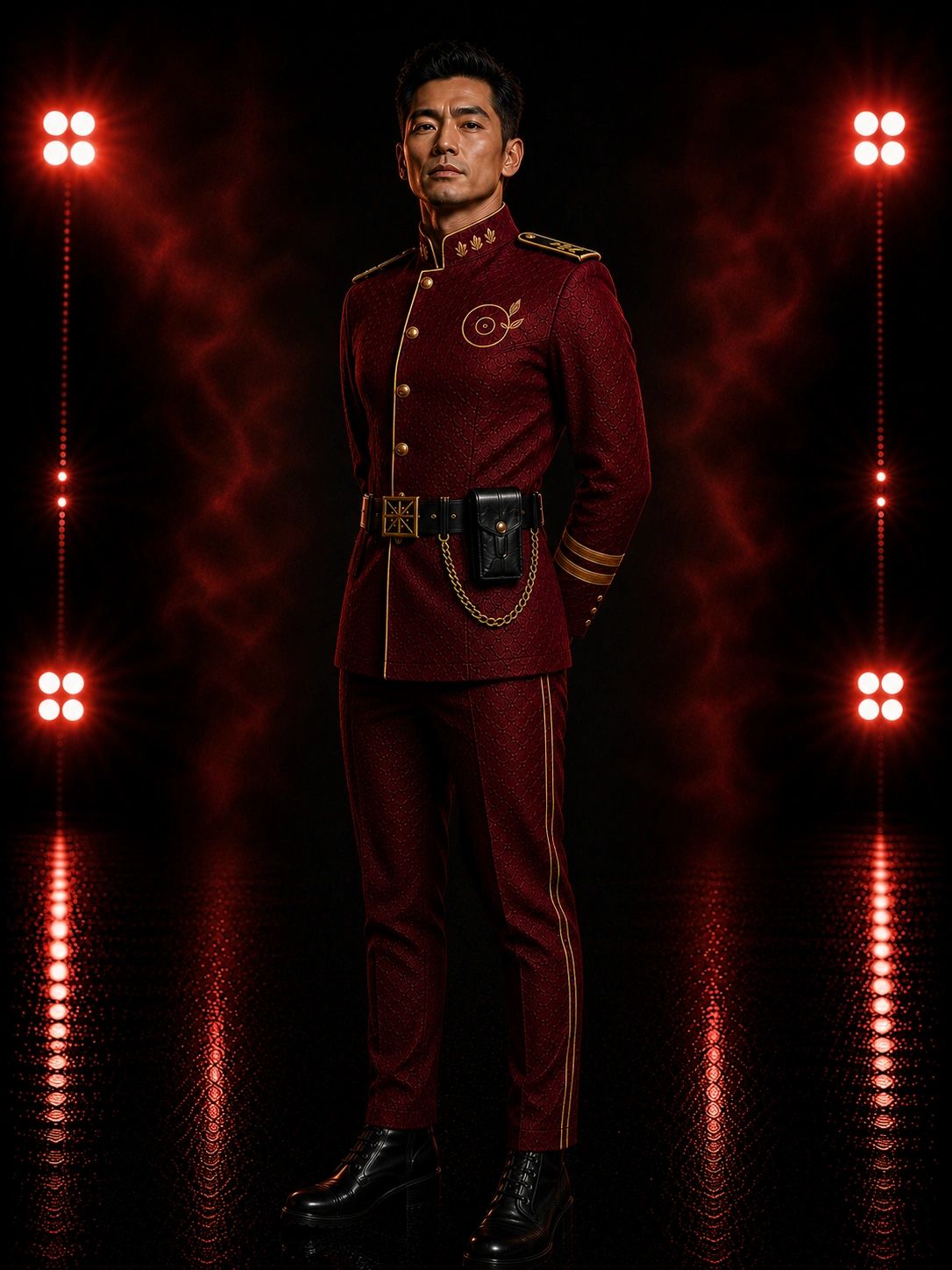


STAR CONCORD PERSONNEL · FULL CHARACTER BIOGRAPHY · BODY DIVISION
Lieutenant Juno Caelis · Born 2128, Taipei, Taiwan, Sol 3 · Age 37 in 2165 · Tactical Officer of HMS Archivum · Korean–Taiwanese heritage · Raised Catholic, now personally skeptical and non-practicing · Defining strengths: rapid judgment, courage and loyalty · Greatest difficulty: telling the people he loves how much they matter to him.
A Family That Asked Much of Him
Juno was raised in Taipei in a loving, demanding family whose connections stretched to Korea and other communities across the Concord. His mother, Dr. Lin Yu-chen, was a Taiwanese emergency physician. His father, Daniel Caelis, was an educator and former disaster-response coordinator from a Korean family. Juno grew up surrounded by discussions of medicine, public responsibility, education and the sometimes absurd business of helping people who refused to cooperate.
His older sister, Hana, was outgoing, musical and unusually skilled at finding out what Juno was feeling when he insisted he was feeling nothing in particular. She called him the family’s emergency procedure manual, a description that he considered both unfair and technically accurate.
His relatives differed in language, religion, political convictions and temperament. Juno never felt that having Korean and Taiwanese roots required him to resolve the differences between entire cultures in his own personality. His family taught him to care for people; the way he chose to express that care was his own.
The Boy Who Learned to Plan for Trouble
As a child Juno noticed danger before he noticed opportunity. A crowded station made him check exits. A storm made him ask whether everyone had water and working communications. His mother praised preparation, but reminded him that a family trip should not require a full threat briefing.
During a transport outage in his teens, Juno helped direct younger children to a safe gathering point while adults worked on the problem. Nothing heroic happened. Nobody was badly hurt. Yet Juno remembered how frightening uncertainty could be, and how much calmer people became when someone offered a clear plan.
Faith, Doubt and Family Affection
Juno grew up with Catholic family traditions and learned about prayer, service, forgiveness and moral responsibility. He also learned that Catholic communities in Korea and Taiwan had distinctive histories, and that his relatives did not all interpret religion in the same way.
As a young man, he increasingly questioned the claims he had inherited. He remained respectful toward sincere believers, particularly family members who found meaning and comfort in their faith, but eventually stopped practicing himself. His reasons were intellectual and personal, not a wholesale rejection of the people who had raised him.
Juno’s father once asked whether he had lost his faith. Juno replied that he was still investigating the available evidence. His mother said she would settle for him coming home to dinner. They disagreed about religion occasionally, but the affection remained.
The Making of a Tactical Officer
Juno studied security systems, tactical analysis, emergency coordination, crisis negotiation and defensive operations. His teachers noticed that he could interpret a chaotic situation quickly, identify which facts mattered immediately and issue concise instructions under pressure.
He also developed a difficult habit: when frightened, he became funny. Sometimes his humour lowered tension. Sometimes it frustrated people who needed him to speak plainly. He was capable of explaining a dangerous problem in perfect operational language while treating the emotional impact as an inconvenience to be concealed.
He admired the Concord’s emphasis on freedom. Its tactical doctrine did not celebrate violence. It required protecting vulnerable Sparks, using proportionate force when necessary and finding alternatives whenever possible.
The Order He Would Not Carry Out
During a young officer’s assignment aboard a civilian transport, Juno received an emergency directive to close a transit passage and isolate a compartment after a security system detected a suspected hostile presence. The order appeared straightforward. Obeying immediately, however, would have sealed several civilians and their support personnel inside a zone with deteriorating environmental conditions.
Juno recognized the conflict. The threat reading was incomplete. The compartment held people whose movements were being misinterpreted by automated surveillance. An immediate lockdown could have turned a technical error into a lethal emergency.
Rather than simply abandoning his post or claiming personal authority over the entire operation, he challenged the directive through the command channel, explained the danger, and initiated a temporary protective measure within his lawful discretion. He positioned a defensive team, kept potential threats contained, opened a safe evacuation route and requested urgent verification from engineers and security specialists.
The investigation showed that the civilians had not been attackers. Juno’s judgment prevented unnecessary harm without leaving the transport unprotected. A review upheld his decision, although the confrontation with his superior nearly damaged his early career.
He learned two lessons. A lawful command was not a substitute for conscience, but conscience was not a licence for reckless improvisation. Courage meant making a reasoned decision, documenting it and accepting scrutiny afterward.
The Man Who Hid Behind Humour
Juno’s colleagues knew him as dry-witted, guarded and exceptionally competent. He could calculate dozens of ways an operation might go wrong and express the result in one sentence: I have identified forty-seven possible disasters. Fortunately, the Captain only requested three.
He was also the officer who quietly checked everyone’s equipment before departure, noticed when a junior colleague had not eaten and made certain the transport returned with enough places for everyone. If thanked, he often claimed that he merely disliked paperwork associated with preventable casualties.
He could express affection in careful action. Saying I care about you was much harder.
Tactical Officer of HMS Archivum
Aboard HMS Archivum, Juno became responsible for tactical assessment, defensive positioning and rapid response. His work overlaps with, but is distinct from, Lieutenant Commander Talan Greyhawk’s Security command. Greyhawk asks how to prevent harm; Juno decides what to do when the threat is already unfolding.
Their professional arguments were famous for their restraint. Greyhawk wanted to avoid an unnecessary confrontation. Juno wanted a plan for the moment avoidance failed. Both understood that protection required judgment rather than the performance of toughness.
Captain Hewlett trusted Juno to tell him when the tactical situation demanded action. Commander Chorus valued his ability to remain clear-headed in a crisis and sometimes asked him to translate the emotional content hidden behind his jokes.
The Crossing That Changed Everything
The temporal disaster of 2165 left Archivum stranded in 2025–2026 and cost Commander Lyra Angelicus her life. Juno responded by preparing contingencies for every imaginable threat to the vessel. More drills. More escape routes. More equipment checks. He was doing useful work, but also trying to outrun grief.
He missed his family in a future that had not yet happened. He missed his sister Hana’s teasing and the arguments around the dinner table. When colleagues asked how he was coping, he supplied an extremely technical estimate of the ship’s defensive readiness.
The Conversation He Could Not Rehearse
After a dangerous away mission, a junior officer thanked Juno for watching over the team. He replied that losing an officer would have created an appalling scheduling problem. The junior officer smiled, then asked a harder question: Lieutenant, do you ever just tell people that you were worried about them?
Juno paused. On rare occasions, he said, usually with a medical professional standing by.
Later he found Greyhawk in a quiet observation lounge and admitted that he had been frightened during the mission. Greyhawk listened without making the confession into an event. Juno gradually learned that vulnerability did not weaken his professionalism. It made his friendships more honest.
What Juno Believes
Juno is not certain what ultimately lies behind consciousness or the Field. His skepticism is principled, but he does not confuse doubt with superiority. He respects colleagues whose spiritual traditions sustain them, and he shares the Concord’s ethical commitment to Order, Truth and Love.
He believes people should be free to make difficult choices. He also believes someone ought to check the shuttle’s emergency systems before they do.
Relationships and Character
Dr. Lin Yu-chen: mother, physician and calm voice when Juno becomes too defensive. Daniel Caelis: father, teacher and former emergency coordinator whose Catholic faith remains personally meaningful. Hana: older sister, musician and expert at detecting his concealed feelings. Lt Commander Talan Greyhawk: security mentor and tactical counterpart. Captain Hewlett: commander who trusts his judgment. Commander Chorus: colleague who challenges his tendency to hide behind jokes.
Strength: swift, humane tactical decision-making under pressure. Weakness: hypervigilance and difficulty sharing fear or affection. Heroic moment: challenging an order that would have endangered civilians. Lesson: tenderness is not weakness, and good officers need friends as well as contingency plans.
He could anticipate forty-seven ways a mission might fail. Learning to say that he loved his friends was the one risk he had never rehearsed.
Order. Truth. Love.