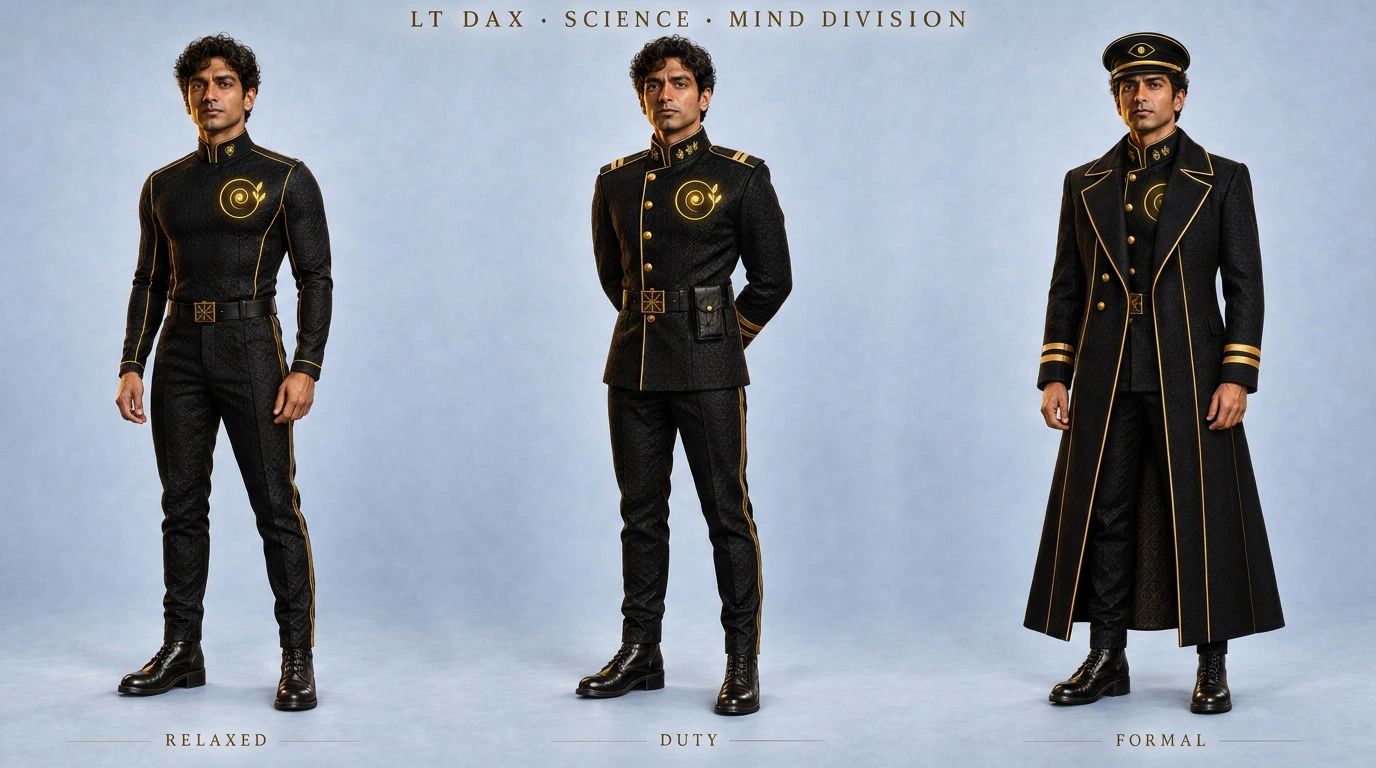

STAR CONCORD · OFFICER BIOGRAPHY · MIND DIVISION
Lieutenant Orion Dax · Born 2127 in Bengaluru, Karnataka, India, Sol 3 · Age 38 in 2165 · Science Officer of HMS Archivum · Indian heritage · Hindu, especially interested in Advaita Vedanta · Defining strength: intellectual curiosity disciplined by scientific honesty.
The Boy and the Stars
Orion grew up in Bengaluru in a family where scientific questions and philosophical arguments were equally welcome. His mother, Dr. Ananya Dax, studied advanced materials and complex physical systems. His father, Professor Ravi Dax, taught philosophy and the history of ideas. His younger sister Meera was a musician who found her older brother’s fascination with abstract questions charming and occasionally exhausting.
Family conversations moved easily from orbital mechanics to ancient philosophy, or from mathematics to whether a conscious machine could suffer. Meera might ask somebody to pass the vegetables. Orion would ask whether the vegetables were truly separate from the universe. Their mother generally gave him a look.
The Question That Would Not Leave Him
At ten, Orion visited a Concord astronomical observatory and saw images of galaxies whose light had travelled for immense stretches of time. He turned to his father and asked: Why is there someone here to see all this? Ravi first assumed he meant human evolution. Orion was asking about experience itself. Why was there an observer of the universe? What was the I that wondered?
His father introduced him to different schools of Indian philosophy, including Vedanta, and explained that thinkers had debated the nature of the self and ultimate reality for centuries without reaching one agreed answer. Orion was delighted. Apparently the universe was full of unfinished homework.
A Home of Science and Philosophy
Orion’s family participated in Hindu cultural and religious life while interpreting its traditions differently. Ravi was interested in Advaita Vedanta; Ananya valued religious tradition alongside demanding scientific inquiry; Meera enjoyed music and ordinary life more than long debates. Orion explored their perspectives without assuming one was a complete description of Indian thought.
He became interested in Atman and Brahman as questions in philosophy, not laboratory measurements. He learned to distinguish ideas with personal meaning from hypotheses that could be tested. He never assumed Vedantic concepts, the Vitan Spark and the informational Field were identical simply because some descriptions sounded similar.
The Young Scientist
Orion excelled at mathematics, physics and computational science. He loved creating experiments that could distinguish rival explanations. The Vitae Field fascinated him: its informational structure suggested extraordinary lines of investigation, including questions about consciousness. Could awareness be fundamental? Did Field phenomena relate to conscious experience, or were they quite different problems joined only by language? He did not know.
He accepted that neither the beauty of an idea nor the sincerity of a belief established a scientific result. Evidence had to be allowed to surprise him.
The Beautiful Mistake
During early research, Orion found an unexpected correlation between measurements in a Field resonance experiment. His mathematical model was elegant, and the paper attracted attention. He began to hope that it revealed a fundamental principle.
Then another researcher failed to reproduce the finding. Orion initially suspected an equipment problem. Further investigation revealed a subtle calibration effect in the original apparatus. The measurements had been real; his interpretation was wrong.
For several days he felt humiliated, not least because he had become attached to the explanation. He published a correction, supplied the revised analysis and acknowledged the researcher who found the problem. Colleagues came to trust him more, because he had demonstrated that Truth mattered more than appearing brilliant.
Ever afterward he became especially careful when a hypothesis seemed beautiful. He knew how tempting it could be to protect the explanation one wanted rather than seek the explanation the evidence supported.
The Scientist Who Learned to Say We Don’t Know Yet
Dax grew comfortable with uncertainty. He resisted premature certainty and elaborate claims unsupported by measurements, but also resisted dismissing unusual evidence merely because it challenged prevailing theories. His favourite sentence became: We don’t know yet. He regarded it as the beginning of investigation, not a failure.
He believed discovery required both imagination and discipline. Imagination supplied possibilities. Discipline helped decide which could survive testing.
Science Officer of HMS Archivum
Orion joined the Concord Fleet and became Science Officer of HMS Archivum. He designed investigations, interpreted sensor data, assessed anomalies, examined Field events and advised command when extraordinary observations demanded caution. Captain Hewlett respected his intellectual honesty. Commander Chorus valued his willingness to question assumptions without treating colleagues disrespectfully.
Chief Engineer Nova Reyes became a frequent collaborator. Nova sometimes detected subtle mechanical patterns before their significance was understood; Orion enjoyed generating rival hypotheses to explain them. Nova would point out that the apparatus still needed repairing. Orion would reply that a successful repair did not necessarily constitute a complete scientific theory. Both found this irritating, and both respected the other enormously.
A Conversation with Captain Plum
One afternoon, Captain Northman Plum visited the science department to discuss consciousness. Again. He proposed that consciousness might be fundamental rather than derived entirely from physical matter. Orion listened, recognized parallels with philosophical questions he had studied, then asked: Captain, what observation would distinguish your hypothesis from the alternatives?
Plum began explaining. The explanation grew longer. Eventually he stopped. You are a difficult man, Lieutenant. Orion answered: Thank you, Captain. Plum replied: That was not entirely a compliment. Orion considered it. Then I shall reserve judgment.
They became friends: Plum bringing imaginative questions, Orion insisting that possibility not be confused with established fact. Neither thought the mystery of consciousness had been solved.
The Scientist and the Angelicus
Orion’s work with Chorus Angelicus sharpened his understanding of ethics. Chorus could describe aspects of conscious experience, and instruments could measure properties of her embodiment and Field interactions. Yet a measurement associated with consciousness did not necessarily reveal the experience itself. Scientific investigation required her informed, voluntary participation. She was a person, not laboratory property.
For Orion, respecting the freedom of the Spark under investigation was not an obstacle to good science. It helped make science worthy of trust.
Meera Brings Him Back to Earth
Orion was not always good at ordinary life. He could work for hours and forget meals, appointments and enjoyable company. Meera contacted him regularly and asked whether he had done anything fun. He would describe an exciting experiment. She would ask if he had spoken to anyone outside the laboratory. He would explain that several colleagues worked on the experiment. She would sigh.
Meera loved her brother and understood him: he sometimes confused being intellectually occupied with being fulfilled. Music, friendship, food and family were not distractions from existence. They were part of it.
The Ship That Fell Through Time
Orion helped prepare Archivum’s temporal mission from 2165. The disastrous crossing killed Commander Lyra Angelicus and stranded the ship in 2025–2026. He examined the records with extraordinary care. Had the science department missed something? Could a pattern have warned them?
His earlier scientific mistake had taught him humility. The disaster required another lesson: not every mystery can be solved quickly, and uncertainty is not itself proof that he had failed. He continued investigating while learning to accept comfort from others.
The Lesson of the Stars
One evening Orion visited an observation deck. The stars looked much as they had during his childhood, but his family had not yet been born in this century. His sister’s music and his parents’ voices belonged to a future he could not reach. For once, he did not want to solve a problem. He wanted to be home.
Lieutenant Elira Wynn found him and asked whether he wanted company. He nodded. They looked at the stars without explanations. Orion finally understood something Meera had been telling him for years: a life need not be solved before it can be lived.
The Man Who Still Asks Why
Orion remains one of the Ark’s most dedicated investigators. He will examine bold possibilities and abandon even a cherished explanation if evidence contradicts it. He does not claim to know what consciousness ultimately is; he believes that Truth deserves better questions, more careful experiments and honest admissions of ignorance.
The universe does not owe us simple answers. But Truth deserves our best questions.
Order. Truth. Love.
Explore the Vitaverse
Crew of the Ark · Vitandex · Life in the Concord, 2165 · The Master Timeline.