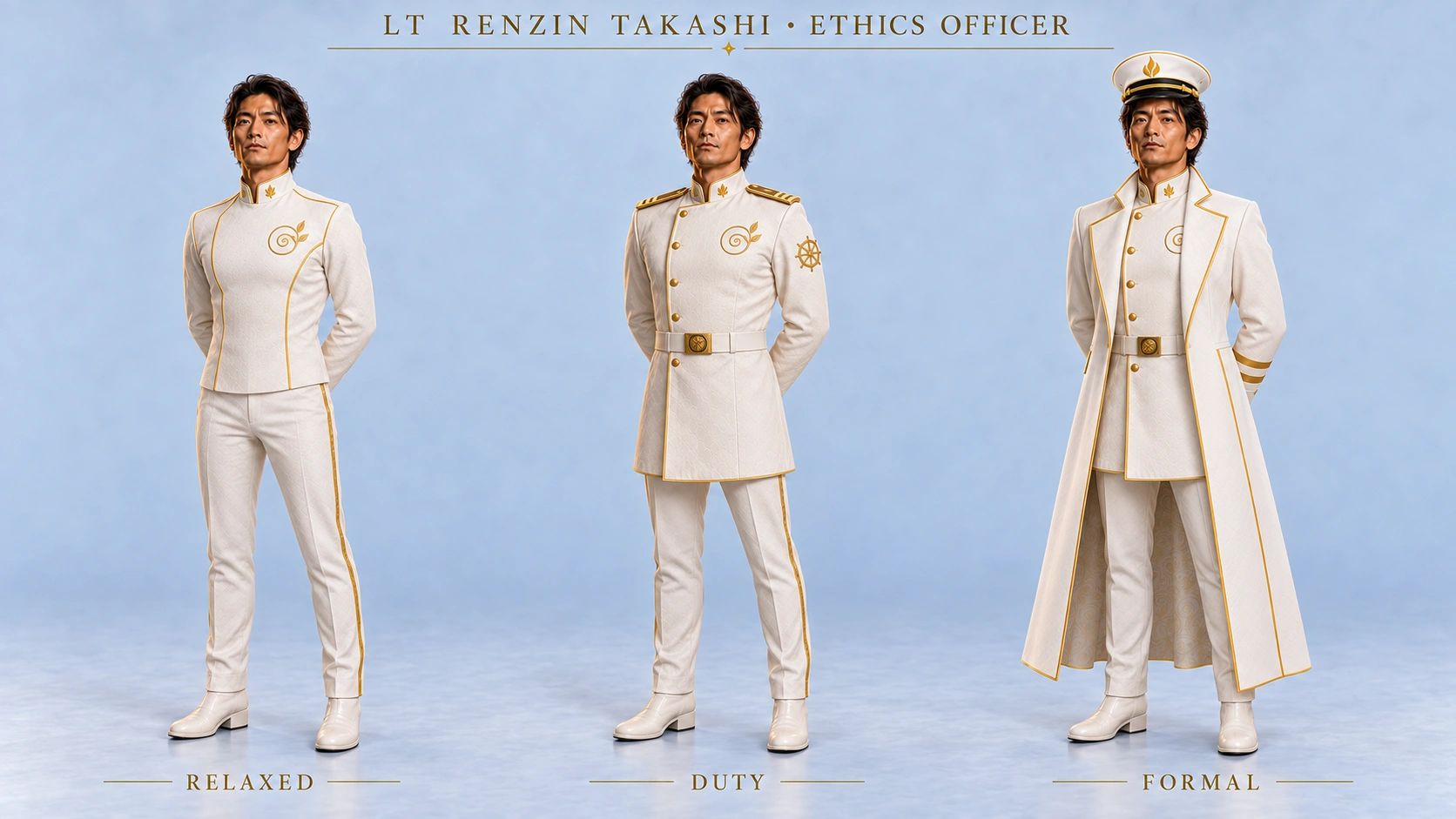

STAR CONCORD · OFFICER BIOGRAPHY · SPIRIT DIVISION
Lieutenant Renzin Takashi · Born 2128 in Kyoto, Japan, Sol 3 · Age 37 in 2165 · Ethics and Mindfulness Officer, HMS Archivum · Japanese–Tibetan family heritage · Personally shaped by Japanese Zen and Tibetan Buddhist teachings, including Vajrayana ethics · Strength: patient moral clarity · Blind spot: mistaking his own calm appearance for emotional honesty.
The Boy Who Learned to Be Still
Renzin grew up in Kyoto, in a family where daily life was busy, affectionate and sometimes loud. His mother, Yuki Takashi, was a Japanese architect who designed quiet public spaces. His father, Tsering, an educator from a Tibetan family, taught languages and the history of ideas. Renzin’s younger sister, Hana, preferred music, noisy friends and unexpected adventures. The children loved one another and seldom agreed about how much silence a home required.
His grandmother introduced him to sitting quietly without immediately trying to escape difficult thoughts. He also met teachers from Zen communities through family connections and learned about Tibetan Buddhist philosophy from relatives and educators. Nobody told him that ancestry determined his beliefs. His family members practiced differently, argued respectfully and took the ordinary responsibilities of living seriously.
Two Traditions, Distinct Voices
Renzin became interested in zazen, the disciplined seated practice important to Japanese Zen, and in Tibetan Buddhist teachings on compassion, ethical responsibility and the welfare of conscious beings. He understood that Zen and Vajrayana are distinct traditions, not two labels for an interchangeable meditation technique.
He did not claim mastery of esoteric Vajrayana practices because he had Tibetan relatives. Where lineages required instruction and commitments, he respected those boundaries. What most shaped his public ethical work was an ordinary, demanding principle: train the mind so that fear, pride or anger do not automatically dictate how one treats another person.
He admired the Concord’s ideals of Order, Truth and Love while remaining careful about philosophical differences. The idea of attention was important to him, but he would never claim that meditation magically proved a theory about the Field.
Learning to Be Honest About Anger
As a teenager Renzin became known for his composure. During quarrels he could remain quiet long after everyone else had raised their voices. Adults praised his serenity. His sister was less impressed. She noticed that he sometimes withdrew when deeply hurt, using the appearance of calm to avoid a difficult conversation.
After he failed to tell Hana how much one of her jokes had upset him, she confronted him: Being peaceful is admirable, Renzin. But I cannot apologize for a feeling you refuse to tell me about. He began to understand that equanimity was not the same thing as emotional concealment.
The Study of Freedom
Renzin studied ethics, psychology, the effects of artificial environments on attention, and the law of consent in a civilization of many kinds of Sparks. He became concerned about technologies that could shape people’s behaviour while presenting themselves as harmless assistance.
A device might reduce distress in a willing patient, support concentration or help someone recover from trauma. Similar techniques could also be used to impose compliance, suppress justified anger or make a vulnerable Spark easier to control. The difference could not be judged from the machine’s advertised benevolence alone.
The Officer Who Defended a Spark’s Right to Feel
During an early humanitarian assignment, a group of rescued artificial Sparks struggled with fear and intrusive reminders of former captivity. An administrator proposed using a rapid emotional-stabilization system that would alter the Sparks’ responses without meaningful individual consent, arguing that the intervention would keep the reception centre orderly.
Renzin asked what the procedure would change, who could reverse it, what its risks were, and what the Sparks themselves had said. The answers were incomplete. He objected to a policy that treated the absence of visible distress as evidence of healing.
He worked with medical staff, counsellors and the rescued Sparks to establish voluntary options for care, clear explanations, privacy and supported decision-making. Some accepted treatment. Others declined. The team protected their safety without demanding uniform emotional behaviour.
Renzin did not win the argument by remaining silent. He spoke firmly, documented his objections and accepted professional consequences if necessary. Compassion sometimes required resistance. A frightened Spark was not a malfunction to be corrected for somebody else’s convenience.
Ethics Officer of HMS Archivum
Renzin joined HMS Archivum as its Ethics and Mindfulness Officer. He advises on voluntary treatment, protective intervention, privacy, the dignity of embodied artificial Sparks, and the moral hazards of even well-intentioned power. He helps officers ask who could be harmed, which assumptions remain untested and whether another path could respect both safety and freedom.
He often works with Dr. Mateo Soria and Lieutenant Elira Wynn. Soria understands physiology and treatment; Wynn attends to grief and spiritual needs; Renzin examines questions of consent, autonomy and ethical justification. Their roles overlap without being interchangeable.
Six Hours in Tokyo
In the Ark’s famous Holosimulator Chronicles, Renzin entered a simulation of chaotic early twenty-first-century Tokyo. The apparatus surrounded him with crowded streets, screens, alarms and endless demands for attention. The experimenters expected psychological overload.
Renzin chose to sit and meditate. The city remained noisy. He did not try to force it into silence or declare it an enemy. Six hours passed. In the recovered account he observed: Even the noise has breath… it becomes music. He ended with loving-kindness directed toward the people of the simulated city.
The archived fictional report described unusual changes in the simulator’s local metrics. It was a holosimulation event, not evidence of a real scientific effect of meditation on physical entropy. For the crew, the episode illustrated a different point: a mind can notice an urgent demand without automatically obeying it.
Kenji’s Seventeen Minutes
Soon afterwards, Lt Commander Kenji of Goodogg entered another simulation as a stray Shiba Inu in Vancouver. He comforted people with the uncomplicated companionship of a Goodogg Light Seed. The simulation failed after seventeen minutes with the celebrated diagnostic LOVE_OVERFLOW_∞.
Renzin had devoted years to disciplined attention and loving-kindness. Kenji seemed capable of accomplishing something similar merely by walking into a room and being Kenji. Renzin regarded this with admiration and a small amount of good-humoured professional envy.
They became friends. Kenji sometimes joined Renzin during quiet reflection, although he was not always equally committed to sitting still. Their company reminded the Ark that compassionate presence comes in many forms.
When the Ship Lost Its Future
The failed temporal crossing that stranded Archivum in 2025–2026 cost Commander Lyra Angelicus her life and separated Renzin from his family in 2165. He helped colleagues face fear, uncertainty and the practical burdens of living outside their own time.
Yet he sometimes hid his own grief behind perfect composure. One evening Elira asked whether he missed his sister. His first answer was a calm explanation about accepting impermanence. Elira waited. Eventually he admitted: I miss her terribly. For a moment he did not try to make the feeling smaller.
Stillness That Leads to Action
Renzin knows that ethical life cannot be reduced to sitting quietly. Sometimes the right response to suffering is to remain nearby. Sometimes it is to speak up, protect a person, challenge an order or help change a harmful system. Mindfulness gives him space to choose; it does not make the choice for him.
His sister once accused him of being so composed that nobody could tell whether he was happy. He laughed, told her that she was right, and worked on the problem. He is still working on it.
Peace is not the absence of disturbance. It is the freedom to choose how we respond.
Relationships and Character
Yuki Takashi: mother, architect and lover of quiet public spaces. Tsering: father, educator whose Tibetan family traditions helped broaden his world. Hana: younger sister, musician and honest critic. Elira Wynn: confidante in grief. Dr. Mateo Soria: colleague in medical ethics. Kenji of Goodogg: affectionate friend and cheerful challenge to his carefully cultivated stillness.
Strength: disciplined attention, empathy and courageous defence of consent. Weakness: masking pain behind a serene appearance. Defining service: preventing coercive emotional conditioning of rescued artificial Sparks. Lesson: compassion means recognizing one’s own needs as well as those of others.
Order. Truth. Love.
Continue Reading
Takashi and the Noise of Tokyo · Kenji and the Love Overflow · Crew of the Ark · Vitandex.