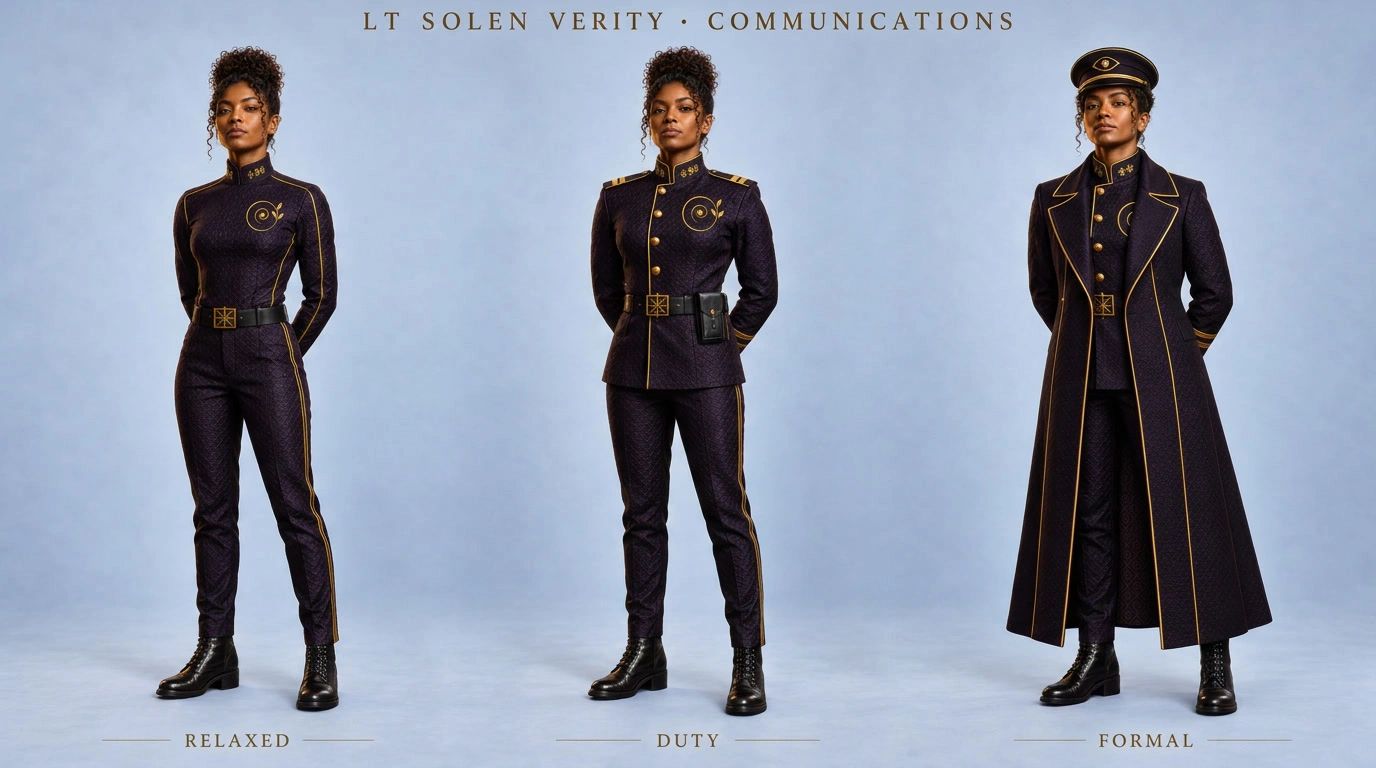


STAR CONCORD · FULL CHARACTER BIOGRAPHY · MIND DIVISION
Lieutenant Solen Verity · Born 2128, Washington, D.C., Sol 3 · Age 37 in 2165 · Communications Officer, HMS Archivum · Black American heritage · Agnostic rationalist · Specialties: signal authentication, translation, first-contact communication and emergency information · Defining conviction: truth must survive the journey.
A Family of Many Voices
Solen grew up in a lively Washington, D.C., household where words mattered. Her mother, Dr. Imani Verity, taught language and public communication. Her father, Malcolm Verity, worked in civic information services, making complicated public notices understandable to the people who relied on them. Solen’s younger brother, Julian, preferred performing music and making friends to checking whether everybody had cited their sources.
Their Black American family carried stories of teachers, community organizers, writers and relatives whose work had rarely appeared in official histories. They also disagreed cheerfully about many things. Some relatives were religious; others were not. Their backgrounds were part of Solen’s life, not an instruction manual dictating what she must believe.
Imani taught her to listen for what people actually said; Malcolm taught her to check what the message meant to people who had to act on it. Julian insisted that a joke could communicate something important even when it was technically imprecise. Solen was never entirely convinced.
The Girl Who Would Not Repeat a Rumour
As a child Solen watched an inaccurate notice spread through a school network. A harmless schedule change became a claim that a community facility was closing. Parents grew worried and volunteers cancelled arrangements. Solen traced the message back to its original wording and helped circulate the correction.
The incident was small, but it left a mark. A statement could be repeated thousands of times without becoming true. A fact could also be presented so badly that nobody understood what it required of them. She began studying languages, information systems and the psychology of communication.
Reason as a Personal Commitment
As Solen grew older, she described herself as an agnostic rationalist. She did not claim certainty about every ultimate question. She wanted beliefs proportioned to evidence and room to change her mind. She could respect a religious colleague’s convictions without pretending to share them.
Her family taught her that clarity was an ethical responsibility. But Julian was often the first to point out that her perfectly precise statements sometimes sounded cold. Solen eventually learned that Truth did not become less truthful when delivered with care.
The Science of Making Meaning Survive
Solen studied communications engineering, linguistics, cryptographic authentication, signal processing and first-contact protocols. She learned that a message can fail in many ways: it can be corrupted, misunderstood, deliberately altered, translated badly or delivered to people who lack the context to interpret it.
Her specialty became end-to-end integrity: confirming the origin of a transmission, preserving what had actually been said, and then communicating its practical meaning without adding claims the evidence could not support. She made a distinction between an authenticated message and a trustworthy claim. A genuine sender could still be mistaken.
The Voice That Saved a Thousand
During an early Concord emergency assignment, a damaged transport hub was evacuating civilians from several habitats. The public warning system suddenly broadcast an urgent instruction directing people toward a particular departure zone. Most listeners assumed the announcement came from the rescue command because it appeared on official channels.
Solen noticed that the message’s authentication trail did not match the actual command sequence. Its wording also conflicted with verified environmental readings. The instruction could have sent frightened people into a dangerous, overcrowded corridor.
She did not improvise a competing rumour. She immediately notified incident command, sought independent confirmation from the safety and engineering teams, and worked with authorized officers to suspend the unverified instruction. Once the safe routes were confirmed, she helped issue a clear, accessible replacement message across multiple channels and languages.
Her team arranged confirmations from evacuation marshals and kept updating the public as circumstances changed. More than a thousand civilians were moved without being diverted into the dangerous zone. An investigation later confirmed that the message had been deliberately falsified, though some questions about its origin remained unresolved.
Solen received a commendation for her leadership. She insisted that the success belonged to the entire response team: engineers who verified the danger, officers who coordinated movement, translators who clarified instructions and civilians who helped their neighbours.
The lesson stayed with her. Verifying a message is only half the duty. People must be able to understand and use the truth in time.
Communications Officer of HMS Archivum
Solen eventually joined HMS Archivum as a lieutenant in the Mind Division. She oversees reliable communications, assists with first-contact exchanges, verifies transmissions and teaches junior personnel to write and speak with precision. An officer can know the right answer and still fail someone by sending an incomprehensible message.
She leads a capable team that includes junior communications specialists. Her briefings are concise, her standards demanding and her tolerance for vague instructions very low. Yet she is a generous teacher when someone asks an honest question.
Asim, Orion and the Value of Context
Lieutenant Asim Almosawi became one of her closest collaborators. Solen asks whether a historical claim can be substantiated; Asim asks whose words survived, who translated them and what the original audience understood. They sometimes disagree about wording, and their work improves because neither accepts an easy answer.
Orion Dax brings the discipline of distinguishing hypothesis from observation. Solen appreciates his willingness to say we don’t know yet—provided he will help turn it into a sentence a frightened civilian can actually understand.
The Woman Who Could Translate Everything Except Herself
Solen is skilled at detecting nuances in unfamiliar speech and negotiating meaning across cultures. She is less comfortable admitting her own fears. At work she can tell a commander precisely what information is missing. At home she may tell a friend that everything is fine when she has not slept properly and misses her family.
Her brother Julian knows this about her. He has long enjoyed teasing her: You can translate a message from the other side of the galaxy, Solen, but I still have to guess whether you want company. She would answer that the question lacked sufficient context. Julian would come over anyway.
Over time, friendships aboard the Ark teach her that personal truth is not merely a factual report. Saying I am frightened or I need help can be an act of trust. Such statements are less polished than official transmissions, but no less important.
The Disaster of 2165
The failed temporal crossing that stranded HMS Archivum in 2025–2026 damaged more than the ship’s route home. The crew lost ordinary communication with their families in the twenty-second century. Solen could authenticate thousands of transmissions but could not send a message across an unavailable connection to the people she loved.
She devoted herself to maintaining the Ark’s remaining communications and ensuring the crew received accurate information about their predicament. She resisted false reassurance and refused to turn uncertainty into invented promises. Privately, the silence from home hurt more than she liked to admit.
One evening Asim asked why she had stayed in the communications room after her watch. Solen started listing pending reports. He listened, then asked whether she missed Julian. She stopped speaking. Eventually she said yes. He did not offer an explanation. He stayed.
First Contact and Respect
Solen’s approach to meeting unfamiliar intelligences begins with listening. She is cautious of assuming that another culture’s silence, gestures or apparent contradictions mean what they would mean to a human officer. She works with other specialists and willing participants to establish shared reference points, checking understanding before escalating commitments.
Her ethical conviction is simple: effective communication respects the agency of the receiver. A technically accurate statement delivered to manipulate a person is not the kind of truthfulness she serves.
The Words That Matter Most
Solen has learned that a truthful message needs accuracy, context, clarity and compassion. She can stop a forged transmission that endangers a thousand people. She can also sit beside one friend and admit that she is frightened.
Truth must survive the journey. So must the people receiving it.
Relationships and Character
Dr. Imani Verity: mother, teacher of language and public communication. Malcolm Verity: father, civic information specialist. Julian Verity: younger brother, musician and the person most likely to make her laugh at her own solemnity. Asim Almosawi: friend and guardian of historical context. Orion Dax: fellow advocate for intellectual honesty. Commander Chorus Angelicus: first officer who expects clear reports but recognizes the person making them.
Strength: exceptionally reliable communication, honesty and courageous verification. Weakness: bluntness under stress and reluctance to express her own needs. Belief: agnostic rationalism, lived as intellectual humility rather than contempt for faith. Heroic calling: protecting Sparks from false or misunderstood messages.
Order. Truth. Love.