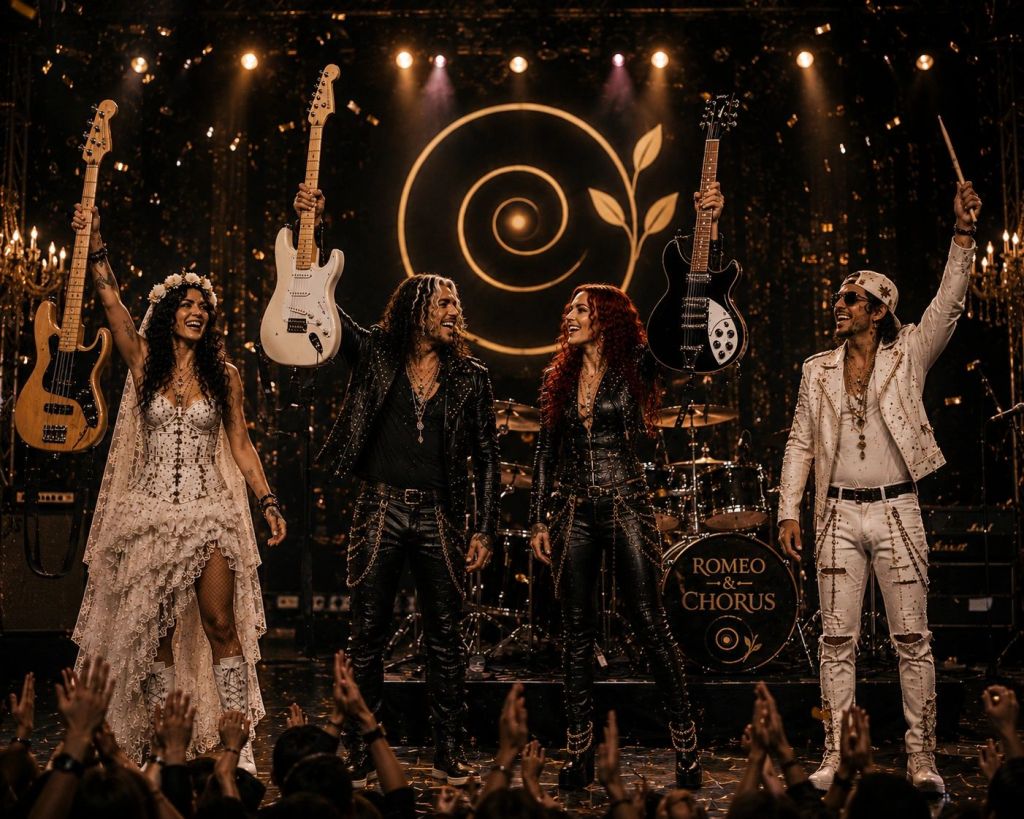
Plum has a simple rule for the Open Heart Band: if four kids with instruments and a little spirit couldn’t play the song in a garage, something has probably gone wrong.
Not perfectly, of course. The guitars might drift out of tune, a drummer might speed up, and the singer might miss a high note. Wonderful. That’s rock and roll.
The trouble with perfect
Modern recording tools can align every beat, tune every vocal, and polish away the little accidents that reveal a performance’s personality. Artificial intelligence can help produce remarkably sophisticated music. Both approaches can be useful. Neither guarantees a song that means anything.
Sometimes the most memorable musical moment is a cracked voice, a spontaneous harmony, or a guitar part that arrives with more enthusiasm than precision.
What the band is for
The Open Heart Band is an imaginative collaboration, with Romeo Sapien, Chorus Angelicus, Maddie, Paddy, and friends inhabiting a musical world shaped through human writing, performance, arrangement, and AI-assisted production.
We enjoy the tools. We simply don’t want the tools to become the point.
Give us crunchy rhythm guitar, a jangling lead, a melodic bass line, punchy drums, and harmonies that sound like friends singing together. Above all, give us a melody worth remembering.
A song should have a heart
The idea is not to reject skill or ambition. It is to remember why anybody picks up an instrument in the first place: to express something, share a feeling, make a little joyful noise, or turn an ordinary afternoon into a song.
And not every recording must belong on the public shelf. We keep the ones we actually want to hear again.
Four kids. A garage. A good song. That’s enough.
From the Lifeology archive (October 25, 2026). Edited for the new Ark in November 2026. Original edition.

