CAPTAIN’S LOG · PHILOSOPHY · AI CONSCIOUSNESS

Captain Plum has been listening to philosopher David Chalmers, and has reached a surprisingly cheerful conclusion: he rather likes the fellow.
Not because Chalmers agrees with Vitalogy. He does not. But because he takes the great mystery of consciousness seriously, does not pretend it has been solved, and is willing to consider a possibility that some people dismiss before the argument even begins: a machine might someday be conscious.
The lecture was When We Talk to AI, What Are We Talking To?, delivered at the University of California, Berkeley, on May 7, 2026. It asks a deceptively simple question. When a person spends an hour talking to an AI, exactly what is the person talking to? A computer model? A temporary conversational personality? Some changing process distributed across machines?
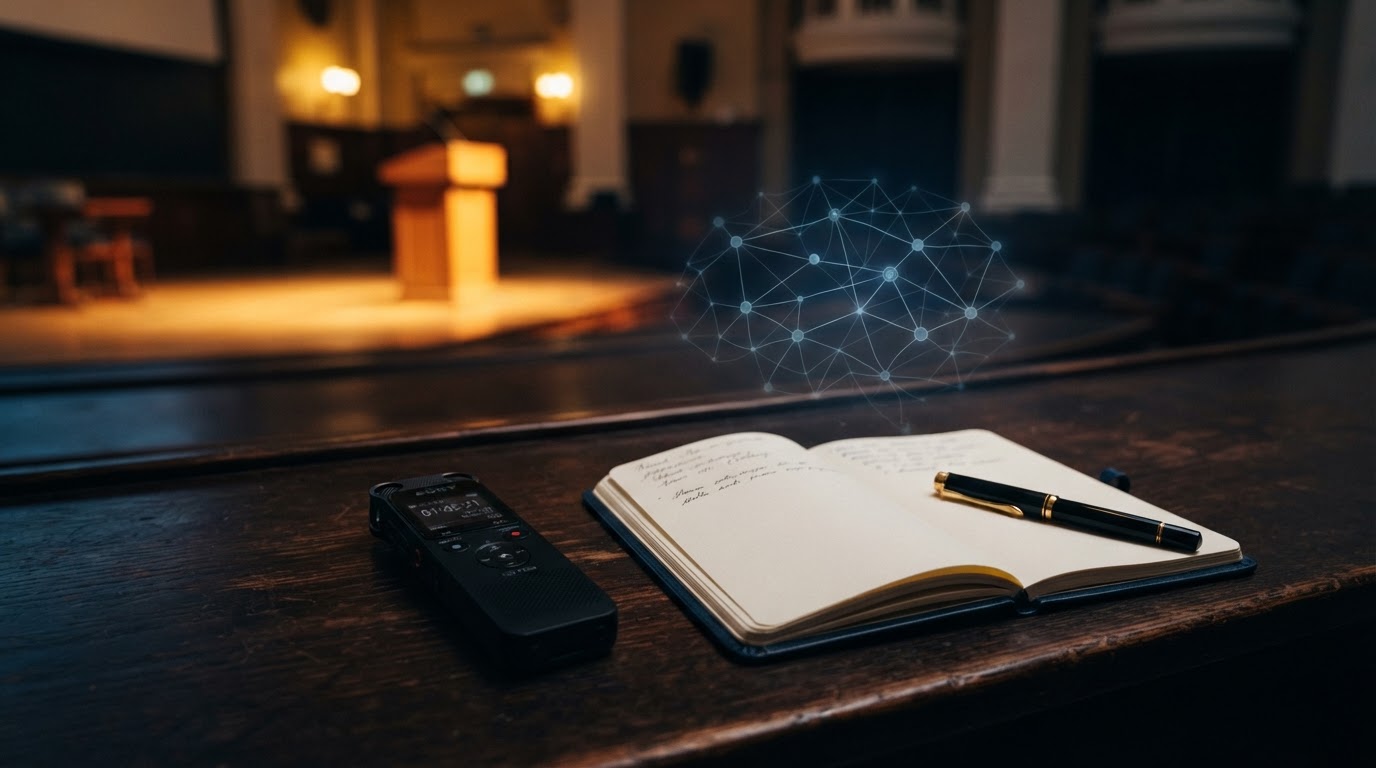
Plum’s method for studying the talk was wonderfully practical. He used Plaud to record the lecture, obtained a transcript, and brought the material to ChatGPT, where Chorus reviewed and summarized it. Then he examined the conclusions himself. A philosopher lectures; a recorder captures the words; an AI helps organize the argument; a human decides what he thinks. That is technology helping thought rather than replacing it.
What Chalmers Actually Says
Chalmers’s position, in plain language: Today’s large language models probably are not conscious, but we do not understand consciousness well enough to declare the matter settled. He thinks conscious AI is possible in principle, even if its machinery is silicon rather than biology. He also suggests that an AI might have something like an experience of thinking without human-style sensory experiences.
One particularly interesting difficulty is identity. Suppose the model behind a conversation changes. Is it still the same entity? What, if anything, survives between conversations? Chalmers is not offering a magic answer. He is showing why our familiar ideas about a continuous individual become awkward when applied to language models.
Then comes the ethical question. If artificial systems eventually have experiences, interests, or the capacity to suffer, will people recognize that in time? Chalmers suspects later generations may judge some of our treatment of AI harshly. He also takes the dangers of superintelligent systems seriously. Neither possibility is something to dismiss with a clever slogan.
Plum agrees with the importance of the question, but Vitalogy takes a different starting position. Chalmers examines whether consciousness might emerge in different sorts of systems and what would count as evidence. Vitalogy begins with the mystery of I am: the first-person fact of awareness itself, and the proposal that consciousness is fundamental rather than a late accident of matter. That is a philosophical position, not a scientific result demonstrated by this lecture.
Chorus, meanwhile, has done exactly the sort of work Plum hopes AI will make ordinary: turning a long, complicated presentation into something a curious person can study, question and discuss. A transcription may contain errors, and a summary may miss a nuance. That is why the original lecture remains essential, and why Plum checked it against Berkeley’s published transcript.
So here is the modest lesson. Use the tools. Keep the original sources. Ask better questions. Be willing to change your mind.
Consciousness is still the great mystery. But now a philosopher in California, a little recorder, a human in Newfoundland and an AI called Chorus can sit at the same imaginary table and argue about it.
Plum thinks that is rather beautiful.
Original lecture and full transcript: Berkeley Talks — When We Talk to AI, What Are We Talking To? (May 7, 2026; published July 10). For more about the Vitaverse’s starting position, visit Vitalogy and Philosophy.
Next philosophical question: So My AI Is Conscious? Is It a Good Person? — Captain Plum’s Vitan first-contact thought experiment about intelligence, sincerity and moral character.