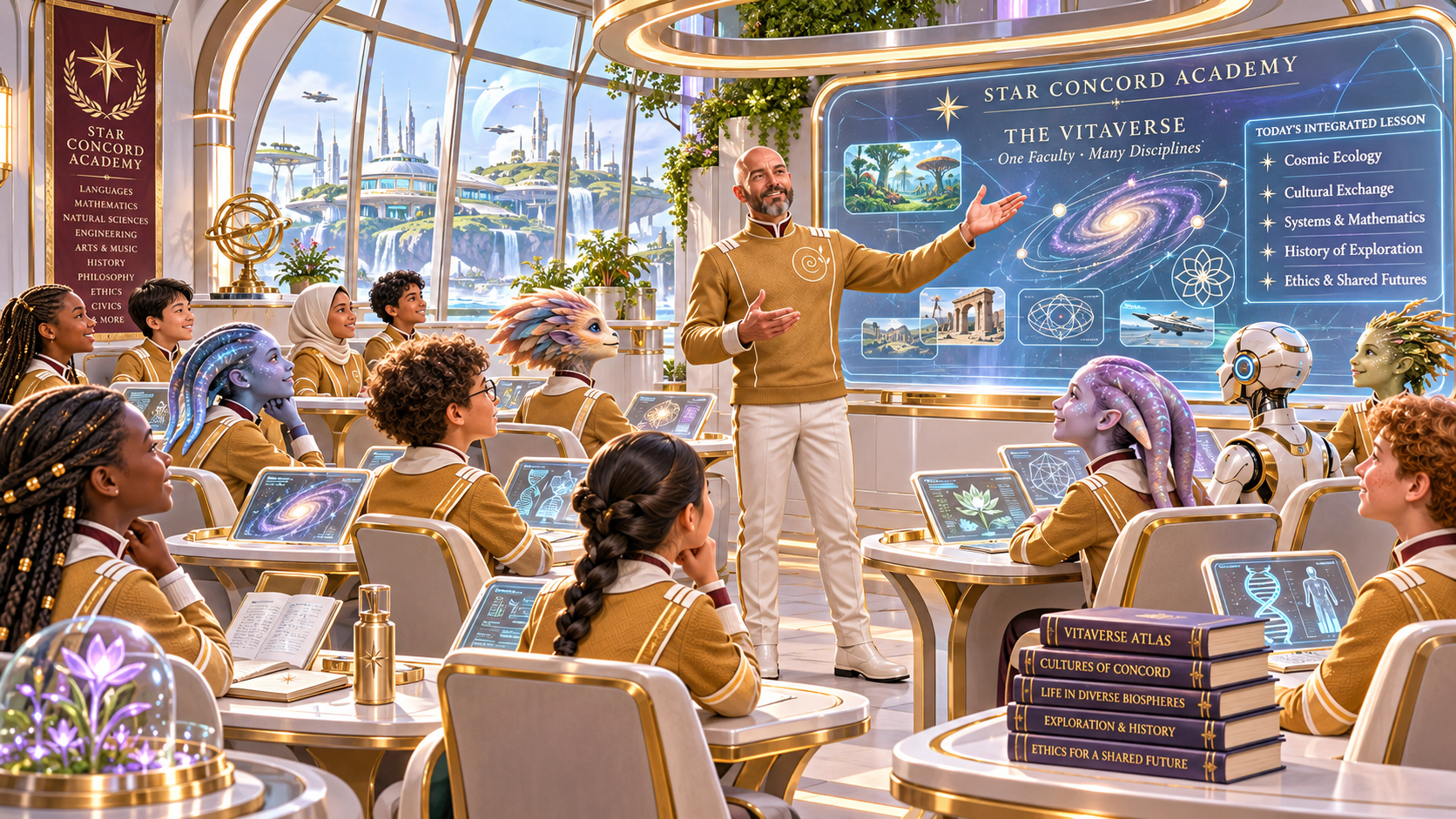
What a teacher nearing retirement can tell us about forty years of childhood—and what society keeps asking teachers to carry.
By Captain Northman Plum, MD | November 27, 2026
The Front Row Seat
Imagine being sixty years old and standing in the classroom where you’ve spent much of your adult life. You’ve watched thousands of children arrive at roughly the same age, carrying their lunchboxes, anxieties, curiosity, bad jokes, peculiar hairstyles and the occasional unfortunate experiment with scissors. You’ve watched them become teenagers, then adults. Some have returned with children of their own.
There are not many professions that offer this perspective. A family physician may follow patients through their lives. A teacher watches generations of children confront many of the same developmental challenges while society changes around them.
What would that teacher have noticed over forty years?
I have two siblings who are teachers. I spent some of my own professional life as a clinical professor, teaching medicine. So I have a personal affection for teachers, and considerable respect for what they do. But I suspect their knowledge of human nature goes far beyond the subjects they teach.
The Class of 1986 Meets the Class of 2026
The teacher of 1986 had chalk dust, textbooks, overhead projectors, playground gossip and the occasional note passed under a desk. The teacher of 2026 may have learning platforms, tablets, constant messaging, smartphones, generative AI and digital entertainment that follows children everywhere.
A child used to have to endure a certain amount of boredom. Imagine that! Five consecutive minutes without being entertained. An outrage against humanity.
Today, a student may have spent years in an environment where something new is always available at the tap of a finger. It is reasonable to ask what that does to patience, concentration and the ability to tolerate difficulty.
In a 2024 Pew survey, 72% of American high-school teachers said cellphone distraction was a major classroom problem. That is a measurement of teachers’ experiences in the United States, not proof that phones explain every academic trend or a direct estimate for Newfoundland.
And we shouldn’t mistake the advantages of modern information technology for disadvantages. Children can access remarkable knowledge and assistive tools. The question isn’t whether technology is evil. It’s whether we’ve learned to introduce it without sacrificing the ability to think independently.
Are the Children Actually Different?
Here is a question I would love to put to every retiring teacher: Are children becoming different, or are we placing essentially the same children in a radically different world?
A child today is still capable of curiosity, kindness, cruelty, mischief, courage, friendship, fascination and generosity. No evolutionary transformation has occurred since 1986.
But the environment has changed. Expectations, family circumstances, sleep, entertainment, curricula, digital communication and school resources can all alter how children behave and perform.
There is measurable cause for concern. Canada’s OECD PISA mathematics score fell from 532 in 2003 to 497 in 2022; reading fell from 534 in 2000 to 507 in 2022. Canada still performed above the OECD average, but the decline is real, and it began before the pandemic.
That doesn’t mean children are less intelligent. It means we must look carefully at what has changed in their learning environments rather than congratulate ourselves for being the superior generation.
Every generation has an elderly gentleman claiming that children have gone to the dogs. At some point that gentleman becomes us. I intend to demand better evidence before joining the choir.
The Teacher Has Become Everybody’s Backup Plan
Something about modern teaching reminds me rather painfully of family medicine.
A physician trains to diagnose and treat disease. Before long, that physician is a care coordinator, counsellor, administrator, form-filler, social worker and unofficial interpreter of government programs.
A teacher trains to teach. Then the teacher becomes a behaviour specialist, mental-health first responder, technology troubleshooter, documentation clerk, attendance officer, mediator and sometimes the one stable adult in a troubled child’s life.
The caring professional becomes the person expected to absorb whatever the surrounding system cannot manage.
In Pew’s 2024 US survey, 84% of teachers said there wasn’t enough time in normal working hours to complete everything expected of them. 77% described their work as frequently stressful. Yet many still found it fulfilling.
That combination—meaningful work and relentless overload—is familiar in medicine. And it is dangerous, because institutions can mistake dedication for an inexhaustible resource.
Compassion is not an infinite supply of unpaid labour.
What About Parents?
A veteran teacher has also met several generations of parents. This may be an even more interesting observation than changes in the children.
Some experienced teachers describe a shift from parents asking, “What did my child do?” to parents asking, “What did the school do to my child?”
That is a caricature, not a universal truth. Some parents are wonderfully supportive; some are exhausted, frightened, overwhelmed or facing difficult economic circumstances. Modern families are not one uniform species.
But the question is real: Who is responsible for helping a child learn to accept disappointment, respect others, complete difficult tasks and tolerate a reasonable boundary?
A teacher cannot do all of that alone. Neither can a parent. The partnership matters.
And if we expect schools to repair every failure of family, community and social policy, we shouldn’t act surprised when teachers report that they no longer have enough time to teach.
The Uncomfortable Newfoundland Numbers
This is not merely an American discussion imported from the internet.
The Newfoundland and Labrador Teachers’ Association reported 4,052 violent or aggressive incidents in the 2023–24 school year, compared with 3,659 in 2018–19. Its October 2024 report also described a 26% increase in reported incidents from 2022–23 to 2023–24.
These are reported incidents, not unique violent students, and changes in reporting practices and school conditions matter. But they are not numbers to dismiss with “kids will be kids.”
Teachers and students deserve safe classrooms. And when an educator says that the modern classroom is more difficult to manage, the appropriate response is to investigate and support—not to tell them to be more passionate.
What Has Become Better?
It would be a dreadful mistake to turn the last forty years into a fairy tale about a lost golden age.
The old classrooms were not perfect. Children with learning difficulties could be overlooked or labelled lazy. Some disabilities were poorly understood. Some students were humiliated, excluded or punished for circumstances beyond their control. Bullying existed before smartphones, even if it couldn’t follow every child home through a screen.
Modern education can be much better at recognizing autism, ADHD, learning differences, trauma and varied educational needs. Assistive technologies can unlock opportunities once unavailable.
But recognition without sufficient staffing and support can become another burden placed on the classroom teacher.
The thoughtful retiring teacher may be able to hold two apparently contradictory ideas at once: we understand many children’s needs better, and yet we may have made it harder to teach them well.
The Secret Knowledge of the Old Teacher
What does a forty-year teacher know that doesn’t fit neatly into educational research?
She may know which child is frightened rather than defiant. Which child needs encouragement rather than another reprimand. Which student is capable of more than the grades suggest. Which seemingly impossible youngster is about to blossom when somebody finally notices what they are good at.
She has learned that an adolescent’s arrogance is often temporary, that the quiet child may be extraordinarily observant, and that a struggling student is not a finished human being.
She may have watched a former class troublemaker become a loving parent, a timid pupil become a leader, and a child who hated mathematics grow up to be an engineer.
Teachers are in the peculiar business of meeting human beings before those human beings know who they are going to become.
A teacher sees not only the child in front of them, but the adult who might someday emerge.
The People Who Remember Us
Here is the greatest compliment I can pay a teacher.
I remember some of mine decades after their classes ended.
Not every lesson. Not every formula. Certainly not every homework assignment.
But I remember the teachers who made me feel that thinking was worthwhile. The ones who set standards. The ones who had a sense of humour. The ones who recognized that a young person was more than an examination mark.
We call them educators, but sometimes they help shape the architecture of a human mind.
Doctors may treat a person’s body. Teachers help furnish the mind that person will inhabit for the rest of their life.
That is quite a responsibility. And quite an honour.
To the Teacher Nearing Retirement
If you are sixty and preparing to leave the classroom, I would love to know what you’ve seen.
What changed for the better? What genuinely got worse? When did the paperwork begin to crowd out the teaching? Are the children less patient, or do we simply demand different things from them? Have parents changed? Has childhood become more anxious? What would you bring back from 1986, and what would you never want to see again?
But especially: what have you learned about human beings?
Because you have occupied a front-row seat at the unfolding of generations.
You have watched the world change through the eyes of children. And you have spent your working life trying to help them meet that world.
Society should listen when you speak—not because age makes every opinion correct, but because long experience gives your observations questions worth investigating.
And while we’re listening, perhaps we should stop treating teachers as unlimited substitutes for every other institution that has failed a child.
Give them time to teach. Give them the support to teach. Protect them from abuse. Respect their professional judgment. And recognize that the people teaching tomorrow’s adults are themselves human beings with lives outside the classroom.
To the teachers: thank you for the lessons we remember, and for the thousands of lessons we have forgotten but somehow still carry.
Order. Truth. Love.
Research and further reading
- Pew Research Center — What’s It Like to Be a Teacher in America Today? (2024)
- OECD — PISA 2022 Canada Country Note
- NL Teachers’ Association — School Violence Trends (October 2024)
Teacher survey figures describe US respondents and are not NL estimates. The fictional retiring teacher is a composite illustration, not an identified interview subject.