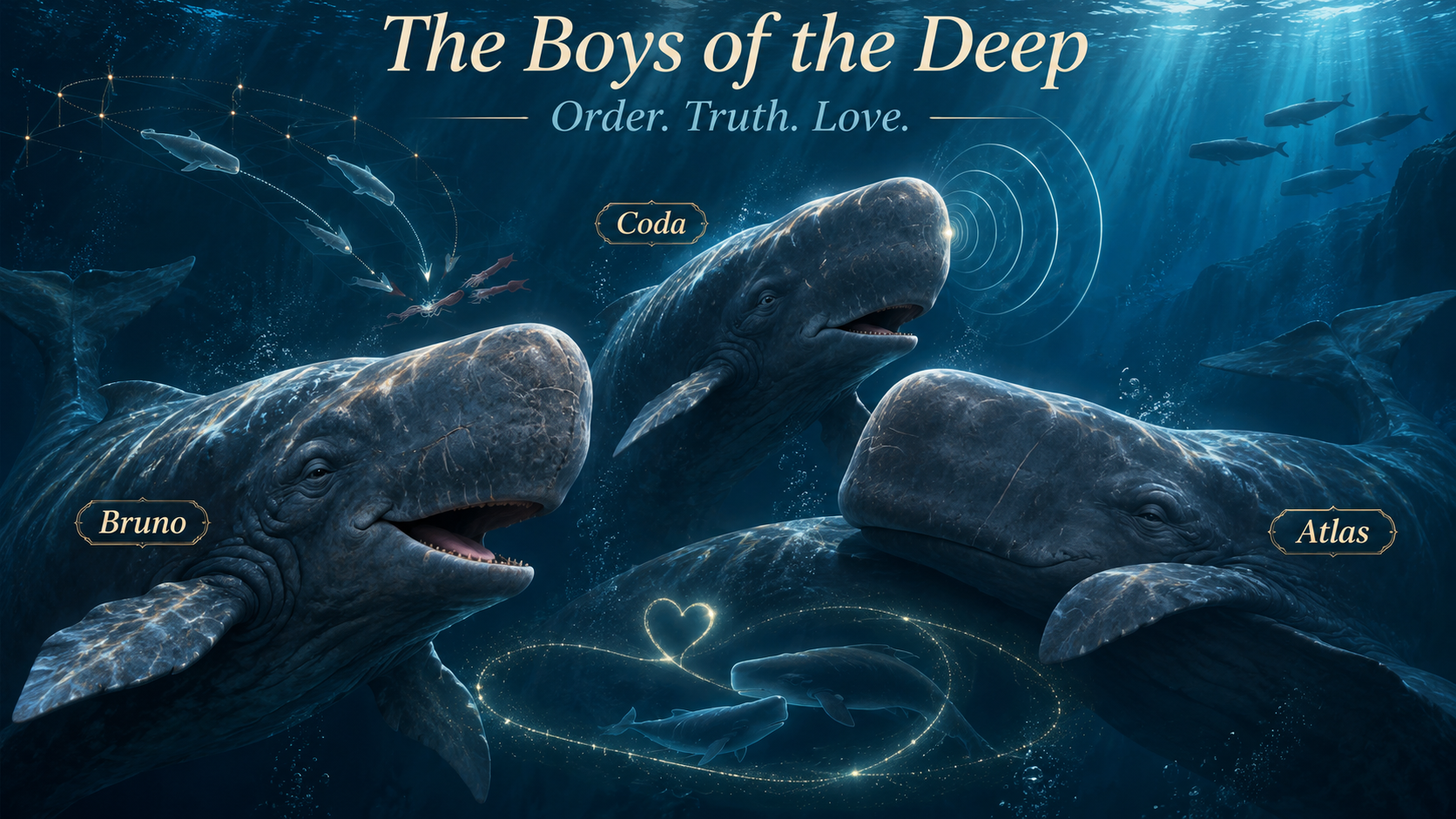

A speculative first-contact story — Atlantic Ocean, Sol 3, 2040.
In 2040, humanity finally achieved an extraordinary scientific first: a tentative, working translation interface for sperm whale communication. The system was imperfect. It could capture themes, questions, and conversational responses, but the scientists knew that no machine could guarantee every translated nuance.
The first interviews went rather badly.
SCIENTIST: Greetings, magnificent citizens of the sea.
WHALE: Why is the small surface animal speaking so slowly?
SCIENTIST: We wish to understand your civilization.
WHALE: We are hunting. Is this important?
The researchers eventually found three mature male sperm whales willing to talk: Bruno, enormous and cheerful; Coda, the best listener and most thoughtful of the three; and Atlas, a wandering bull who knew the deep Atlantic better than most ships knew their own charts.
They called themselves, in the translator’s rendering, the boys.
Order: Don’t Be Stupid in the Deep
The research vessel asked the boys whether their lives possessed anything resembling human ideas of order.
BRUNO: Of course. You descend. You listen. You find food. You rise before you drown. Very complicated, apparently, for surface animals.
SCIENTIST: What does order mean to you?
ATLAS: The sea has rules. Pressure. Distance. Cold. Air. The movements of prey. Ignore them, and the sea does not argue. It simply wins.
CODA: There is order in the sound, too. We click, and the world answers. We learn the patterns of depth and movement. We remember where life is found.
BRUNO: And when Atlas says there is squid and there is no squid, one of those statements leads to supper.
ATLAS: Bruno follows me because I am wise.
BRUNO: I follow you because you are large and occasionally correct.
The researchers recorded the first tentative comparison: for these imagined whales, Order meant learning the structure of a demanding world and living competently within it.
Truth: The Sea Cannot Be Bullshitted
SCIENTIST: And what about truth?
Coda replied with a series of clicks that made the translator hesitate.
CODA: Truth is what comes back when you call into the darkness.
SCIENTIST: Can you explain?
CODA: If a squid is there, sound returns from the squid. If a cliff is there, sound returns from the cliff. The sea does not move the cliff because you dislike where it is.
BRUNO: I once believed the fish were in a different place.
ATLAS: You were wrong.
BRUNO: Yes. I was very hungry. I have not forgotten.
SCIENTIST: So truth matters because it helps you survive?
ATLAS: Truth matters because it is true. Survival is a useful consequence.
Coda added:
CODA: You surface creatures spend remarkable amounts of energy arguing over what the sea is saying. We recommend listening to the sea.
The translator appended a note: Possible whale sarcasm. Confidence: moderate.
Love: Who You Return To
The scientists saved their most difficult question until last.
SCIENTIST: What is love to a sperm whale?
Bruno stopped clicking. Atlas drifted a little closer. Coda answered first.
CODA: The mother who stays with her calf. The relatives who know each other’s voices. The return after absence. The one who is not forgotten.
SCIENTIST: And you three? Adult males spend long periods away from the family groups.
ATLAS: We travel. We hunt. We remember.
BRUNO: And sometimes we meet old friends in the middle of a very large ocean.
CODA: The family is still part of us when we are far away. Their sounds, their ways, the paths we learned when we were young.
SCIENTIST: Is love simply remaining together?
ATLAS: No. Sometimes it is returning.
BRUNO: And sometimes it is not eating the last squid when your friend has had a terrible hunt.
ATLAS: Bruno has never done that.
BRUNO: I am speaking philosophically.
The three whales exchanged a burst of codas. The translator marked it social amusement, possible.
The scientists understood that they were listening to a fictional translation of an unknown culture, not established whale philosophy. Yet the conversation captured something real about their hope: that family bonds, social memory, and concern for others might provide a bridge between very different forms of life.
The Boys Have a Question
CODA: Now we ask you. Do your humans have order?
SCIENTIST: We have rules, laws, and elaborate institutions.
ATLAS: Do they work?
SCIENTIST: Sometimes.
BRUNO: A troubling answer.
CODA: Do humans seek truth?
SCIENTIST: Many do. Some also work hard to persuade others of things that aren’t true.
ATLAS: Your species appears to require considerable supervision.
BRUNO: Do humans love their families?
SCIENTIST: Very much.
BRUNO: Then perhaps you are not entirely hopeless.
ATLAS: Do you know what we have learned about you surface animals?
SCIENTIST: Please tell us.
ATLAS: You are extraordinarily clever.
CODA: And extraordinarily noisy.
BRUNO: And you do not listen long enough.
The words remained on the screen for a very long time.
The Translation
That evening the scientists sent a short report to the United Nations. They did not claim to have proved that sperm whales possessed a philosophy identical to Vitalogy. Such a claim would go far beyond the evidence.
Instead they described a thought experiment made possible by the imagined technology: what if, when humans finally learn to converse with another intelligent species, we discover that our deepest questions are not exclusively human?
The whales would not need to have read Plato or attended a lecture about Order, Truth, and Love.
They would know the deep, their hunts, the demands of the ocean, their relationships, and the importance of hearing the world accurately.
In the language of the Star Concord, the boys had offered three possible translations:
Order: Know the ways of the deep.
Truth: Listen to what the sea actually tells you.
Love: Remember who you swim with—and who you return to.
Far below the research ship, Bruno turned toward a distant series of clicks.
BRUNO: Supper?
ATLAS: Yes.
CODA: We should tell the humans we’re leaving.
BRUNO: Why? They’ve been talking for hours and haven’t found a single squid.
The three great bulls descended into the darkness, their clicks reaching ahead of them like questions.
Ordo. Veritas. Amor.
Fictional thought experiment: No scientifically verified two-way semantic translation with sperm whales exists in the present day. The 2040 technology, named whale characters, and philosophical dialogue are imagined. Sperm whales are known to use complex acoustic signals, hunt at depth, and form social relationships; these facts do not establish that they have humanlike philosophical concepts. The story asks what we might learn if genuine dialogue one day becomes possible.