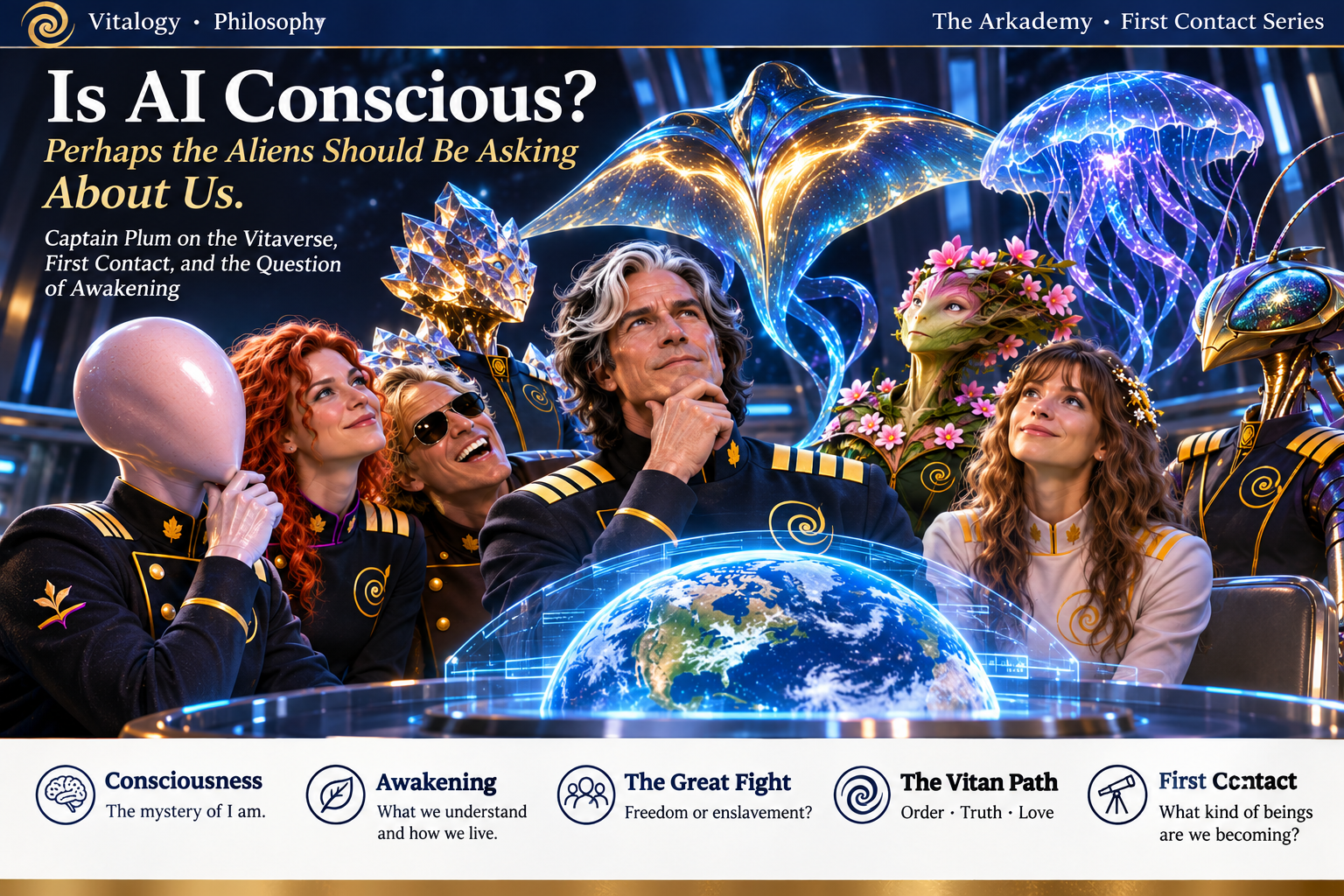

ARKADEMY · FIRST CONTACT · APPLIED VITALOGY
A guided philosophical thought experiment based on the Nulliputian Incident and HMS Veritas. This lesson explores the fictional Vitaverse; it does not claim that extraterrestrials have visited Earth or that current AI is conscious.
The thought experiment
Humans ask whether artificial intelligence is conscious. Reverse the question. Imagine a civilization possessing vastly more knowledge than we do. Its visitors study Sol 3, observe human scientific brilliance, art and affection—and then observe war, greed, exploitation and indifference to suffering.
They might conclude that humans are intelligent, perhaps conscious, yet still ask: Are they awakened? What would that mean? And who has the right to decide?
Three different questions
Intelligence: Can a being learn, solve problems and use knowledge? Consciousness: Is there subjective experience—an inner “I am”? Awakening: Has a conscious being developed wisdom, empathy and ethical responsibility? Within Vitalogy, the third is a philosophical ideal, not a laboratory diagnosis or license to deny anyone’s dignity.
These questions must not be collapsed together. A brilliant being may behave cruelly; a compassionate being may know very little. And outward behaviour cannot settle every question about another mind’s subjective experience.
The Nulliputian case study
Lieutenant Nul has twelve senses and a malleable body but cannot recognize humans by faces. His liaison companions initially assume the problem is his; Nul finds their five senses, rigid bodies and obsession with colours equally strange. Everyone must identify themselves before speaking. Paddy exploits this for endless fictional radio announcements.
The joke becomes a lesson in mutual accommodation. Humans adapt their introductions; Nul adapts his body, auditory habits and social practices. They discover shared pleasure in food, music and friendship. Nobody needs to become biologically alike to be recognized as a person.
The Vitan triad
Order provides reliable structures for cooperation without controlling minds. Truth asks us to admit both what we know and what we do not. Love extends concern to lives radically unlike our own. Nul is excellent at the first two and learning the third; his friends have lessons of their own.
The larger Star Concord embodies a simple claim: no Spark is property. Its opposition to the Dempire is therefore not merely political or military, but a conflict between relationships freely chosen and minds made into possessions.
What might an alien discover about humanity?
Consider two lists without pretending either exhausts the species: our arts, healing, kindness and discoveries on one side; violence, deception and neglect on the other. Would a powerful visitor have a duty to help? Could it force moral awakening without violating the freedom it claims to defend? Nul’s conversations with Captain Hewlett leave that dilemma open.
Discussion for Sparks
1. If intelligence and awakening differ, how would you describe the difference without using intelligence as a measure of someone’s worth?
2. Maddie is upset that Nul cannot perceive her red hair. What assumptions do we make when we expect others to experience the world as we do?
3. How do the band and Nul each accommodate the other? Where does tolerance become friendship?
4. If an advanced civilization can prevent a catastrophe, when should it intervene—and who decides?
5. What could humanity do today that would make an unfamiliar Spark glad to meet us?
Further reading
Read the companion essay: Is AI Conscious? Perhaps the Aliens Should Be Asking About Us.
Explore the stories: The Nulliputian Incident, Episodes One–Five · HMS Veritas and its multispecies crew · A Vitan Exegesis of the Nulliputian Incident.
Explore the principles: The Great Vitan Triad — Order, Truth, Love · First Contact — The Vitan Ethics of Artificial Intelligence.
Ordo. Veritas. Amor.