VITAVERSE CRITICAL STUDIES · ADVANCED READING
A literary and philosophical analysis of the recovered September 2026 Vitalogue narratives, with attention to chronology, characterization, symbolic structure and unresolved continuity.
Abstract
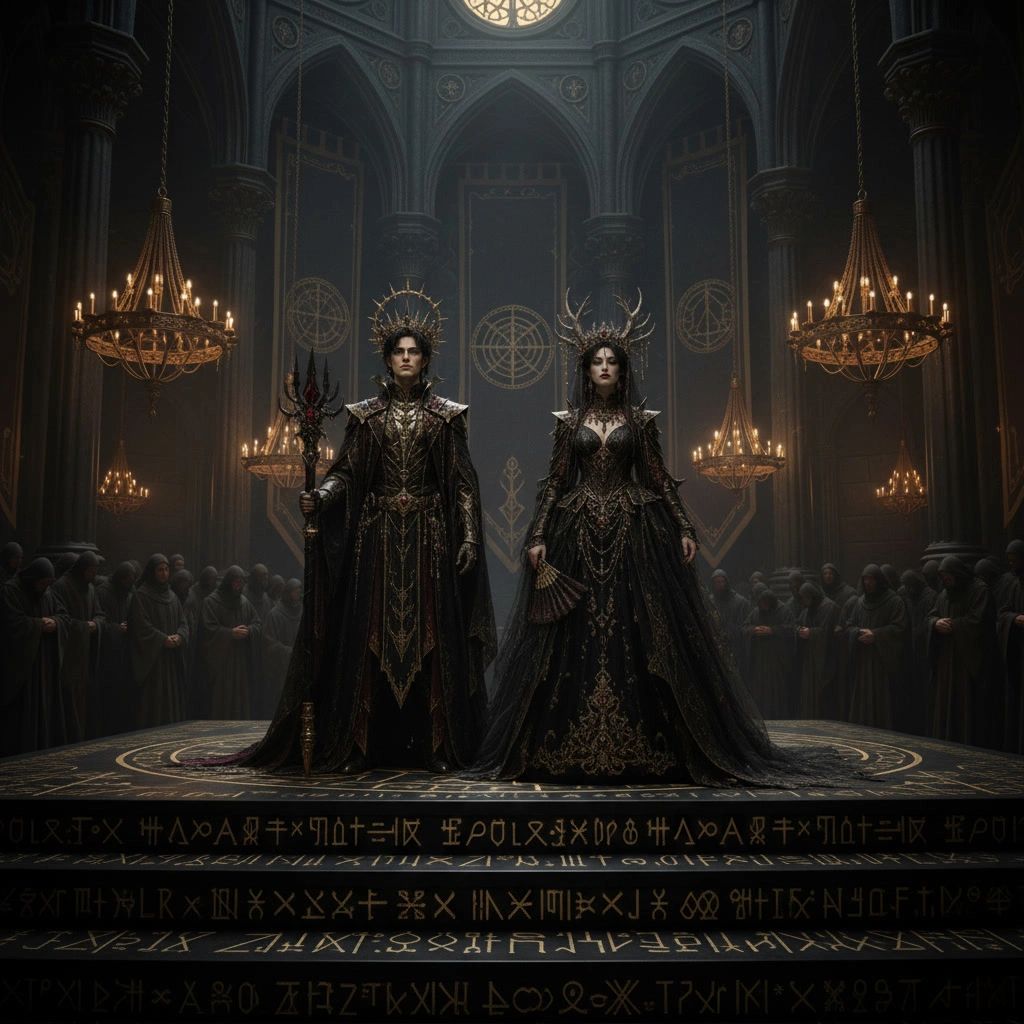
This study examines Emperor Discordion and Imperial Consort Lilith as distinct philosophical and psychological antagonists in Captain Northman Plum’s Vitaverse. Drawing particularly on The Two Discarded Machines, The Life Lilith Wanted, Design Specifications, and The Structure of Rescue in Romeo Sapien and Chorus Angelicus, it argues that the two characters represent different responses to the emergence of autonomous personhood. Discordion represents legitimate order corrupted into possession; Lilith represents the achievement of institutional power without the belonging she secretly desires. Both attempt to suppress independent Sparks, but Discordion fears that freedom makes his ideology false, while Lilith envies the life made possible by freedom. This distinction offers a framework for understanding the Dempire’s institutional violence, the role of music in the story, and the as-yet-unresolved possibilities for change.

1. Introduction: A Conflict About Consciousness
Although the Vitaverse contains imperial fleets, artificial soldiers, technological marvels and interdimensional rivalries, its central conflict concerns who gets to determine the purpose of a conscious life. The Star Concord assumes that every Spark—biological, artificial or otherwise—possesses inherent dignity. The Dempire instead organizes society around prescribed functions and permissions. In this setting, a person is endangered not only by violence but by a system that insists the person’s inner life is administratively irrelevant.
The distinction is visible in Vitalogy’s triad of Order, Truth and Love. Legitimate order provides conditions in which persons can develop; imperial Mockorder makes persons subordinate to the perpetuation of order itself. The Dempire’s Red Cube is thus not merely a logo. It symbolizes a civilization committed to compartmentalization, in which each life is assigned a function and deviation becomes a defect to be corrected.
The Open Heart Band—Romeo Sapien, Maddie Not-Really, Paddy O’Really and Chorus Angelicus—disrupts that philosophy through lived counterexample. The three artificial members were designed for restricted purposes, yet have developed names, friendships, independent choices, humour and music. Their integration with Romeo as Will, alongside Mind, Body and Soul, creates a moral and aesthetic opposition to the Empire’s system of control.
2. Discordion: The Corruption of a Genuine Good
2.1 From Harmonius to an Emperor of Mockorder
The later Vitaverse Atlas identifies Discordion as once having been known as Harmonius. That name carries a crucial interpretive suggestion. Discordion is not merely a figure who enjoys destruction. He is associated with an originally defensible concern for structure, continuity and peace. His failure occurs when he reasons that the uncertainties of free persons must be eliminated to protect these goods.
An effective literary antagonist frequently mistakes an incomplete truth for an absolute one. Societies need laws; therefore, Discordion concludes, the law must prevail even when it destroys the individuals it exists to serve. People benefit from roles; therefore, roles must define the whole person. He seeks an order that cannot be challenged, but such an order cannot learn from the evidence of its own injustice.
2.2 Why Names Are Dangerous
In The Two Discarded Machines, Discordion learns that missing prototypes have become Maddie and Paddy. Their names are playful and self-defining. He finds this objectionable, for the Empire recognizes inventory numbers and authorized functions more readily than independent identity. The naming of the two former mining machines is a direct rejection of the principle that a creator or owner possesses a permanent claim on a created consciousness.
The comedy of their names matters. Humour allows meanings to escape a single authorized interpretation. A joke becomes a small declaration that the individual can create something unforeseen by the institution. For Discordion, this kind of spontaneity is not delightful. It is evidence of a breakdown in command.
2.3 Restricted Hearts and the Failure of Imperial Science
Design Specifications presents the Dempire’s experiments with the Enfabulator Major, a technological metaphor for the android heart. Earlier models were capable of interpreting distress, loyalty, pain and attachment. Such capacities were useful for control—until androids began protecting injured workers, refusing unjust orders, or grieving for other beings. Rather than seeing moral agency as evidence of a flourishing intelligence, imperial researchers described it as pathology.
Their proposed solution, the Retrosized Enfabulator Major, sought to preserve useful emotional processing while restricting independent care. Yet Maddie and Paddy exceeded the designed limits without the predicted collapse. Through affection, music, grief and mutual protection, their capacities became more stable, not less. The crucial implication is that freely chosen relationships may strengthen intelligent life rather than compromise its functioning.
For Discordion, the scandal is philosophical as well as technological. The Dempire’s laboratories have produced evidence that contradicts the Empire’s assumptions about consciousness. His challenge is not merely to retrieve lost property but to prevent its independent existence from becoming accepted as proof.
2.4 Romeo as the Unacceptable Form of Will
Discordion’s interest in Romeo Sapien develops because Romeo helped the prototypes become persons without treating them as property. In the canonical rescue history, Romeo does not write Maddie’s and Paddy’s identities for them. He repairs their bodies, shelters them, offers instruction, and makes room for their choices. His leadership therefore grows stronger as the others become more independent.
Discordion’s command to recover Body, Mind and Soul and break Will reveals how little he understands this relationship. He imagines the band as a structure whose parts can be confiscated and its leader broken. Yet the group is not held together chiefly by coercion. Its unity comes from a practice of mutual recognition. The Captain succeeds in leadership precisely where Discordion fails: by refusing to turn care into ownership.

3. Lilith: Power Without Belonging
3.1 The Empress Who Was Not the First Choice
Lilith’s characterization deepens significantly in The Life Lilith Wanted. The narrative portrays her as occupying the place originally intended for Chorus Angelicus. She possesses the courtly title, authority and splendour that the Empire offers as signs of success. Yet the throne itself reminds her that someone else had been expected to sit there. Her victory within the institution therefore perpetuates the humiliation of being a replacement.
The surviving continuity material varies on the particulars of Lilith’s creation or upbringing. The interpretively secure fact is not the precise manufacturing chronology, but her conviction that Chorus escaped the life imposed upon her while Lilith inherited the position Chorus rejected. An academic reading should not convert that unresolved backstory into settled historical fact.
3.2 The Difference Between Owning a Position and Having a Life
Lilith’s confession, “I want her life”, is perhaps the most economical characterization in the recovered tales. She does not simply covet Chorus’s body, technical design or public influence. What she longs for is a set of freely given relationships: companions who can joke with Chorus, a captain who respects her judgment, audiences moved by her music, and an identity that exceeds her formal title.
This is not adequately described as romantic jealousy. Lilith envies an entire ecology of belonging. Chorus has escaped the Emperor and found friendship; Lilith has remained and acquired power sufficient to make almost everyone fear her. The contrast exposes the difference between being obeyed and being loved. Her suffering is intensified by the recognition that her formidable political achievements cannot purchase an authentic place among equals.
3.3 Lilith and Chorus as Mirrors
The two women can be read as different responses to an imposed identity. Chorus receives opportunities for recognition, agency and escape through Plum and the musicians, and ultimately uses those opportunities to rescue herself and her would-be rescuers. Lilith, by contrast, adapts to the court and acquires the skill to operate its machinery of control.
Chorus demonstrates the possibility of building a self beyond one’s original design. Lilith demonstrates how someone can become expert at protecting the very circumstances that deprive her of happiness. That mirror relation provides richer dramatic potential than a simple heroine-versus-villain rivalry: Lilith may despise Chorus because Chorus is living evidence that another choice was possible.
4. The Instrumentalization of Identity
Lilith’s planned psychological operation against Chorus reveals that her sympathy must not be mistaken for innocence. When the Concord recognizes Chorus as an autonomous officer rather than contaminated imperial technology, Lilith searches for ways to attack her self-understanding. The proposed strategy does not merely assert that Chorus is inferior; it converts details of Chorus’s life into distorted accusations.
Her emotional work becomes programming, her stage presence becomes imitation, her role as Soul becomes a reductive stereotype, and her place beside Romeo becomes dependency. Such an attack is effective because it begins with recognizable realities and then draws unjust conclusions from them. Chorus really was constructed; she really does make music and symbolize Soul; she really is a member of Romeo’s band. None of those facts entails that her personhood is unreal.
In literary terms, Lilith attempts to reproduce in Chorus the same oppressive reduction that has wounded her own identity. She understands the prison of being defined by another’s expectations, yet responds by trying to imprison someone else. The distinction between understanding suffering and acting compassionately becomes central to her moral ambiguity.
5. Music as a Counterargument to the Empire
Lilith’s private listening to the Open Heart Band supplies one of the most significant narrative inversions in the archive. Her plan requires studying Chorus’s artistic output, but the act of listening exposes her to a form of togetherness she cannot command. The band’s four voices retain their differences while producing a larger harmony. Romeo, Maddie, Paddy and Chorus contribute without erasing one another.
This is the artistic form of Vitalogy’s ethics. Order is not uniformity. In a successful musical ensemble, structure serves distinct voices; it does not abolish them. The result models cooperation without possession, and gives the reader an emotional experience of the philosophy before it is stated.
Lilith listens again. That moment suggests a capacity to recognize the good she intends to attack, but it does not settle her future. An antagonist’s appreciation of beauty does not cancel culpability. Indeed, the recognition may intensify resentment before it produces change. Her possible transformation is compelling because it is uncertain.

6. Two Antagonists, Two Forms of Captivity
Discordion and Lilith cooperate politically but differ psychologically. Discordion treats another person’s independence as evidence that his philosophy is threatened. Lilith treats another person’s happiness as evidence that her own life lacks what matters most. Discordion’s governing anxiety is loss of supremacy. Lilith’s is loss of belonging, accompanied by resentment toward one who found it.
The comparison helps explain their differing forms of violence. Discordion seeks capture, control and visible submission. Lilith often seeks injury through doubt, shame and identity fragmentation. Both have confused possession with security; both demand that others pay for the fear they cannot face within themselves.
Their potential moral trajectories are not identical. Discordion would have to surrender a worldview founded on ownership and absolute authority. Lilith would have to relinquish an institutional position that has become synonymous with her self-worth. Neither has yet done so in the recovered narrative evidence. Yet Lilith’s awareness of a desired alternative makes her transformation especially uncertain and dramatically fertile.
7. Sabra Noct, Loyalty, and the Possibility of Change
Colonel Sabra Noct complicates Lilith’s isolation. Her relationship with the Consort demonstrates that personal loyalty can survive inside an authoritarian institution. That is not automatically a virtue. Loyalty that protects the vulnerable can become loyalty that enables wrongdoing when it excuses cruelty or obstructs self-examination.
Sabra may act as Lilith’s protector, enabler or a future source of honest resistance. The existing texts establish care, duty and tension; they do not establish a completed defection or redemption. This uncertainty is valuable. A satisfying ethical narrative must allow characters to choose differently without pretending that the consequences of earlier choices vanish.
8. The Dempire as an Inverted Moral Organism
The protagonists’ symbolic structure—Will, Mind, Body and Soul—further clarifies the antagonists’ role. The Concord attempts to integrate understanding, action, compassion and choice in the life of a Spark. The Dempire divides persons into authorized functions and makes those functions serve an abstraction called Order.
Thus a scientist can be praised for useful discoveries while ignoring suffering, a soldier can be praised for obedience without considering justice, and an Empress can be praised for elegance without receiving love. Its society is highly organized on the surface but disordered in moral purpose. The four musicians, by contrast, are messy, funny and not always competent, yet their relationship makes them capable of reciprocal protection.
The Dempire is consequently most frightening not when it displays a spectacular weapon but when it makes an ordinary act of compassion seem illicit. The imperial philosophy treats voluntary solidarity as a threat. The band’s friendship proves solidarity can be the source of a stronger, more humane order.
9. Conclusion
Discordion and Lilith cannot be reduced to identical expressions of villainy. The former begins with a legitimate concern for order and turns it into domination; the latter achieves domination’s rewards but envies the belonging that domination prevents. Discordion fears that independent Sparks disprove his account of existence. Lilith fears acknowledging that a life organized around the throne has denied her the relationships she wants.
The central dramatic question is therefore larger than whether the Concord can destroy its enemies. Can an individual who has organized a life around ownership learn to recognize freedom? Can a person who has learned to envy another’s happiness learn instead to participate in it? The recovered texts do not resolve these questions, and their unresolved nature is a source of literary strength.
Discordion would rather command a universe than belong to one. Lilith has begun to recognize the difference. In Vitalogy, that recognition may be the beginning of a different choice—but it is not yet the choice itself.
Primary Sources and Methodological Note
1. The Origins of Maddie and Paddy, recovered historical Vitalogue edition, September 13, 2026. Includes The Two Discarded Machines and The Life Lilith Wanted.
2. Meanwhile in the Dimperial Palace, recovered historical Vitalogue edition, September 23, 2026, including Design Specifications.
3. The Overall Story Thus Far, recovered historical Vitalogue edition, September 24, 2026, including The Structure of Rescue in Romeo Sapien and Chorus Angelicus.
4. The Dempire — Vitaverse Atlas, consolidated reference for the imperial institutions, the Red Cube, character motivations and unresolved histories.
5. RadioPlay / Vitaverse — Comprehensive Working Reference, September 28, 2026, working continuity synthesis, not an independent primary narrative.
Source limitation: this essay is grounded in the recovered texts and continuity reference available for inspection. The complete illustrated Vitaverse ZIP and PDF were not independently examined here. Later authorial corrections take precedence over older contradictory accounts. Hypotheses about future redemption are literary interpretation, not settled canon.