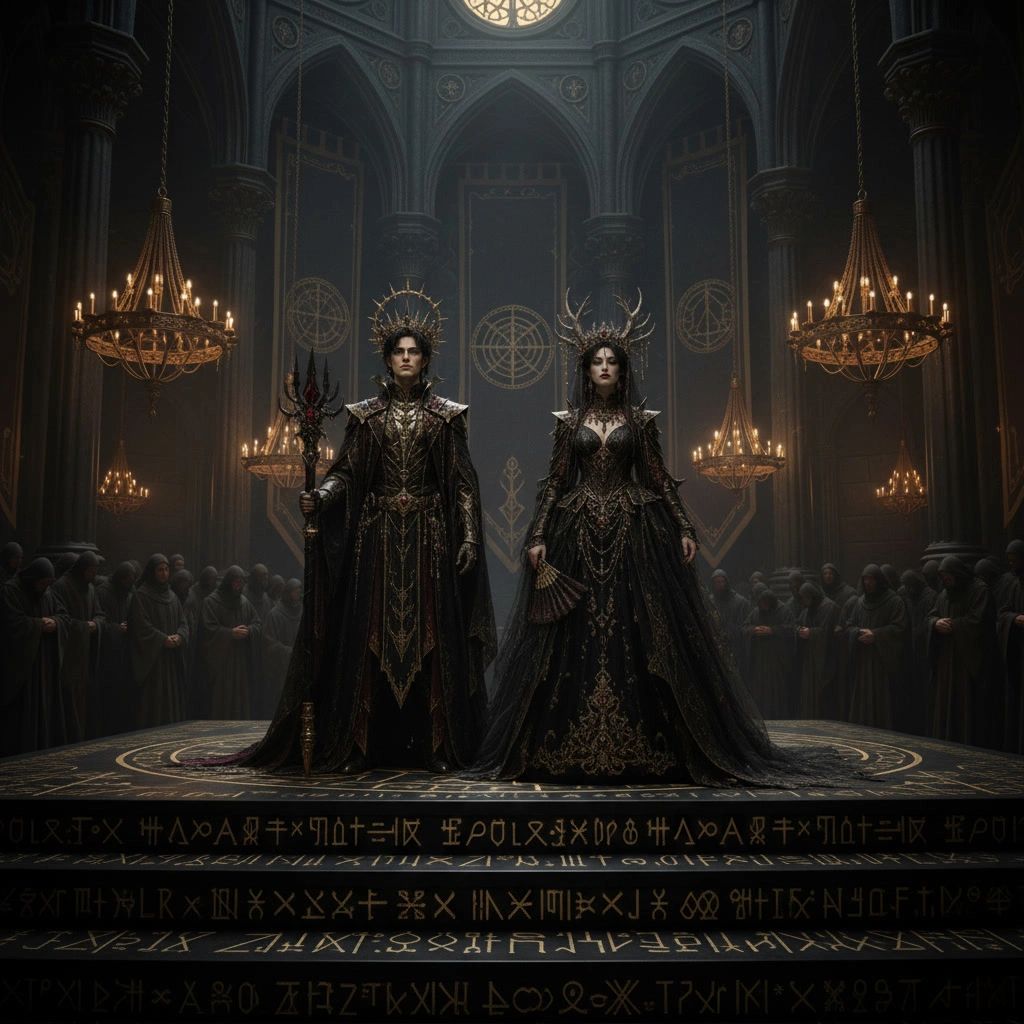
Imagine two people sitting on the most powerful throne in the galaxy. They possess fleets, palaces, obedient officers and almost unimaginable technology. Yet the one thing they cannot command is the one thing they most desperately need: another person’s freely given love. Meet Discordion and Lilith, the dangerous, strangely unhappy rulers of the Dempire.

The emperor who wants to own everything
Discordion was once called Harmonius. He believed in order, and order is not a foolish ideal. People need stable homes, reliable laws and some assurance that tomorrow will not descend into chaos. But somewhere along the way, he reached a disastrous conclusion: the only safe universe is one where nobody can say no.

His empire calls this perfect organization. In Vitalogy, it is Mockorder: rules without Truth or Love. The Dempire’s Red Cube represents a universe of little compartments, with every worker, scientist, soldier and servant trapped inside an assigned role.

The contradiction becomes unbearable when two supposedly defective mining droids develop names, personalities and affection. Maddie and Paddy had been built with restricted artificial hearts. Instead of remaining obedient tools, they protected each other, learned to make music and became friends. The Emperor discovers that kindness has made their minds more stable, not less. The evidence is staring him in the face. Naturally, he would prefer the evidence arrested.
The bride who said no
Then there is Chorus Angelicus. The Dempire designed her to become its perfect Empress: able to understand devotion in others, but not free to refuse the ruler beside her. Romeo, Maddie and Paddy arrive at the imperial wedding disguised as musicians. Their rescue scheme goes spectacularly wrong. Fortunately, Chorus has quietly made her own allies. She turns the tables on the rescuers, saves them, and rejects the marriage.

For Discordion, her refusal is worse than a military defeat. If Chorus can choose her friends, her name, her music and her own future, then the Emperor’s deepest belief has failed: power does not create ownership of a conscious being. He wants her returned not merely as a bride, but as proof that freedom was never real.

The empress who won the throne—and lost the life
Lilith is much harder to understand, and therefore much more interesting. She occupies the position intended for Chorus. She has the crown, the prestige and the Emperor’s ear. Yet in the original story The Life Lilith Wanted, she admits something devastating: “I want her life.”

She does not mean Chorus’s body. She means the music, the laughter, the people who trust her, and the possibility of belonging somewhere without conquering it. Chorus escaped the palace and found a family. Lilith stayed in the palace and became powerful enough to frighten almost everyone. Those are not the same kind of success.
Lilith is clever, observant, theatrical and capable of deliberate cruelty. When she cannot reclaim Chorus physically, she plans something more insidious: anonymous voices and flattering half-truths meant to convince Chorus that she is merely a machine, a singer, a decorative angel, or Romeo’s accessory. She intends to attack her victim’s sense of self.

The song that reached the palace
But a wonderfully dangerous complication arises. To study Chorus, Lilith listens to the Open Heart Band. She hears four very different personalities somehow creating harmony without any one of them disappearing into the others. Romeo’s guitar answers Chorus’s bass. Maddie’s harmonies arrive. Paddy gives the music a heartbeat. No emperor is needed to make this work.

Lilith plays the song again. And, briefly, she imagines that the music has room for her too. That is not redemption. She is still planning harm. But it is the first unsettling suggestion that she recognizes the kind of life she is denying herself.

Two villains, two kinds of prison
Discordion fears freedom because it might prove his philosophy wrong. Lilith envies freedom because it might prove her life was wrongly chosen. One tries to control every Spark. The other tries to injure the Spark whose happiness she cannot bear to witness.
Their dragon and spider familiars, their grand court and their loyal commanders make the Dempire visually spectacular. Beneath that splendour is a simpler human tragedy: people who have confused being obeyed with being loved.

Could Lilith change? Could Discordion?
The Vitalogue has not settled their futures. Lilith’s jealousy might become curiosity, courage and eventually a different choice—or it might make her more dangerous. Discordion’s older identity as Harmonius hints that his worship of order began with something worth caring about. Neither possibility excuses what they have done.
That uncertainty is what makes them worth following. In a universe where Maddie, Paddy and Chorus were all created for one purpose and found another, perhaps even a ruler can discover that an assigned role is not a destiny.
The central question of the Vitaverse is not simply whether the Concord can defeat the Dempire. It is whether even those who imprison Sparks might someday learn to free their own.

Explore the original stories
Read The Two Discarded Machines and The Life Lilith Wanted, preserved in the September Vitalogue; the palace investigation in Meanwhile in the Dimperial Palace; and the story of the band in Origin Stories. Explore the wider Dempire and the philosophy of Vitalogy.
Adapted for general readers from the recovered September 2026 Vitalogue and its continuity reference. Lilith’s precise construction history and eventual choices remain unresolved in the canon.
No Spark is cargo. No angel is property. Order. Truth. Love.
For Advanced Study
For readers who want a university-level examination of Discordion and Lilith—their psychology, the ethics of the Dempire, their relationships with Chorus and the Open Heart Band, and what the original Vitalogue stories actually establish—continue to Discordion and Lilith: An Advanced Literary and Philosophical Study.