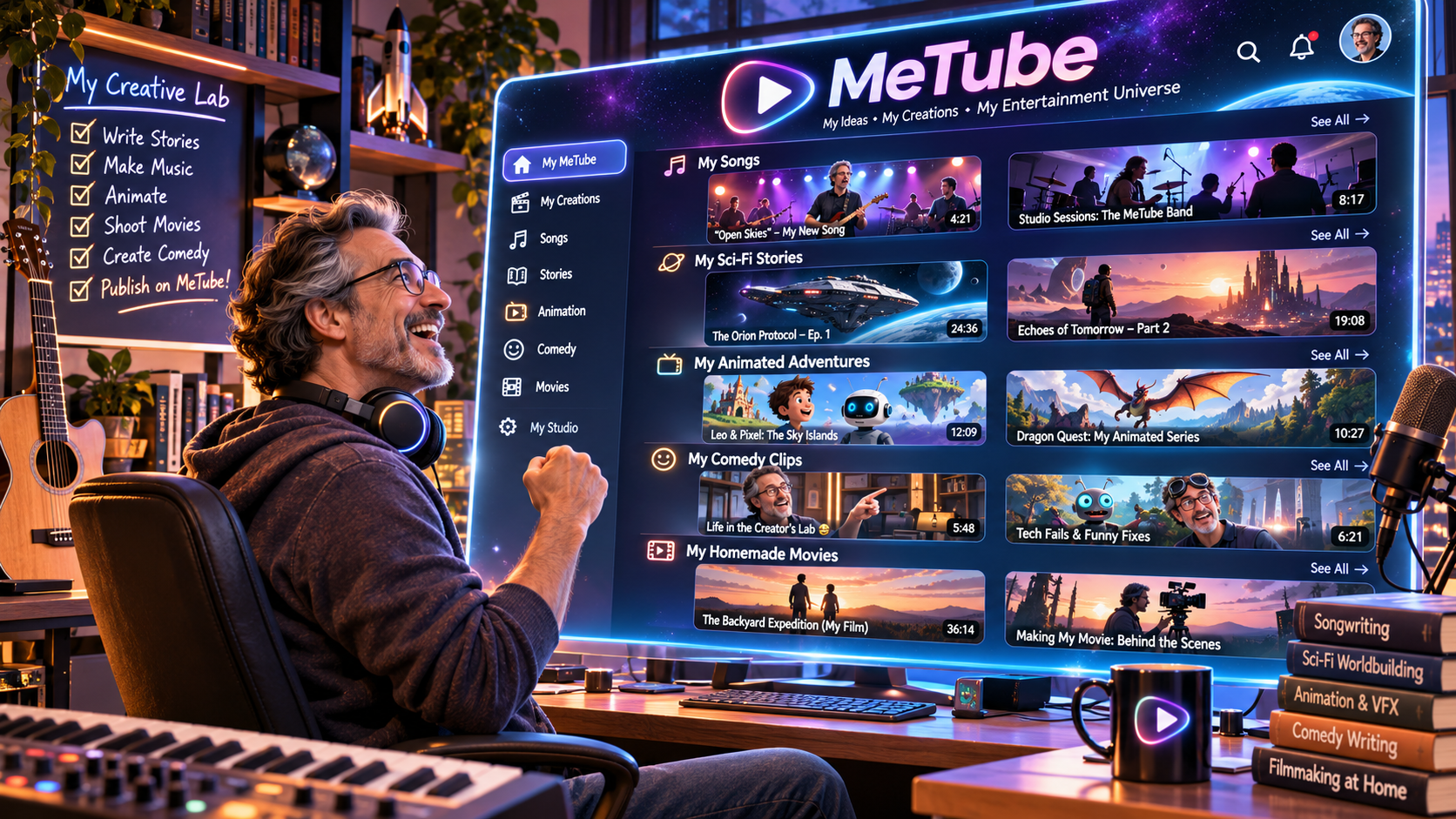
A Vitan thought experiment on creative freedom, Dimperial Media, and the day the audience becomes the author.

Imagine an ordinary evening on Sol 3. Someone comes home from work, makes a cup of tea, and reaches for the entertainment screen. But instead of asking what the media empire has prepared for tonight, the Spark asks a different question: What would I like to make?
A woman creates her own detective mystery. A teenager builds a science-fiction world with friends. An elderly musician records exactly the sort of power-pop song he has always wanted to hear. Someone else makes a short film, or a comedy, or a game. They are not auditioning for an audience. They are enjoying their own imaginations.
Now imagine a million Sparks doing that. Then a billion. Somewhere in the headquarters of Dimperial Media, the quarterly report becomes a horror story.
The Dimperial board meeting
“Engagement is down thirty percent!” cries the Chief Attention Officer.
“Then increase the transmissions!” orders the chairman.
“We’ve tried. They’re making their own music.”
“Offer them celebrities!”
“They’ve invented characters they like better.”
“Then buy the characters!”
“They aren’t for sale, sir.”
The chairman stares at the screen. “Good God. They’re entertaining themselves!”
And somewhere in Newfoundland, Captain Plum plays another song he made simply because he likes it.
The Sorrow Engine runs on dependence
In the Vitaverse, the Sorrow Engine is both a terrible fictional device and a metaphor. Dimperial power seeks to make conscious beings feel small, separated, inadequate and dependent. Its transmissions promise fulfilment while keeping Sparks watching, wanting and returning. Their attention becomes somebody else’s profit; their insecurity becomes somebody else’s power.
The engine’s favourite Spark isn’t necessarily miserable. It is someone who has forgotten that life offers alternatives to receiving the next transmission.
So what happens when a Spark picks up a guitar, writes a story, paints a picture or invites a friend to invent a world? Not every such act is revolutionary. But each can restore a small piece of agency. The Spark is no longer only a customer for somebody else’s imagination. The Spark becomes a participant in existence.
What becomes of the media empire?
It doesn’t necessarily vanish. People will still love remarkable performances, shared concerts, brilliant films and art made by other people. Professional creators may remain treasured. Human beings are endlessly curious about one another’s minds.
But the corporation loses an old advantage: exclusive control over the expensive tools required to produce and distribute culture. If everyone can create, the ability to manufacture entertainment becomes less scarce. Attention, trust, taste and meaningful connection become more important.
A clever Dempire will adapt. It may stop selling stories and start renting the tools to make stories. It may offer creative subscriptions, expensive computing, locked characters and private distribution systems. The old dependence could return wearing a cheerful new interface.
That is why the Vitan goal cannot merely be more content. It must be genuine creative freedom.
The Concord alternative
Imagine a Star Concord in which every Spark has access to tools for music, stories, games, films and art, and the freedom to use them. People still share what they create. They collaborate, admire one another and discover unfamiliar ways of seeing. Their works become conversations rather than compulsory transmissions.
The Open Heart Band does not need to fear a universe full of musicians. Perhaps one Spark answers a chorus with another harmony. Someone writes a story inspired by a song. A child invents a game about the story. Creation becomes a field of relationships.
And the curious thing about making one’s own entertainment is that it can make one appreciate other artists more. You discover what it means to choose a note, find the right word, solve a difficult scene and finish a work you love.
Plum has already begun the experiment
Captain Plum once depended on the music industry for much of what he listened to. Now he spends a remarkable amount of time listening to songs of his own making. His stories are becoming comics; his games are becoming playable adventures; his website is becoming a personal world of music, philosophy and fiction.
He has not declared war on Hollywood, the record labels or the streaming platforms. He has simply found that he needs them less. He can still enjoy what other people make, but his own imagination is no longer waiting for permission.
There is an important warning here. A Spark can become just as entranced by endlessly generating AI content as by endlessly watching television. Clicking “make another” all night is not necessarily a creative life. The test is whether the technology strengthens judgment, imagination, friendship and agency—or quietly replaces them.
The Dempire’s greatest nightmare is not that the Sparks hate its entertainment. It is that the Sparks no longer need it.
And when enough Sparks discover the joy of creating, the Sorrow Engine need not be defeated by an army. It may simply run out of audience.
No Spark is cargo. No angel is property. No imagination was born to feed an engine.
Ordo. Veritas. Amor.