
Captain Plum on the Latest AI Music Cash Grab · November 22, 2026 · The Captain’s Log
Captain Plum has a message for SUNO.
For fuck’s sake.
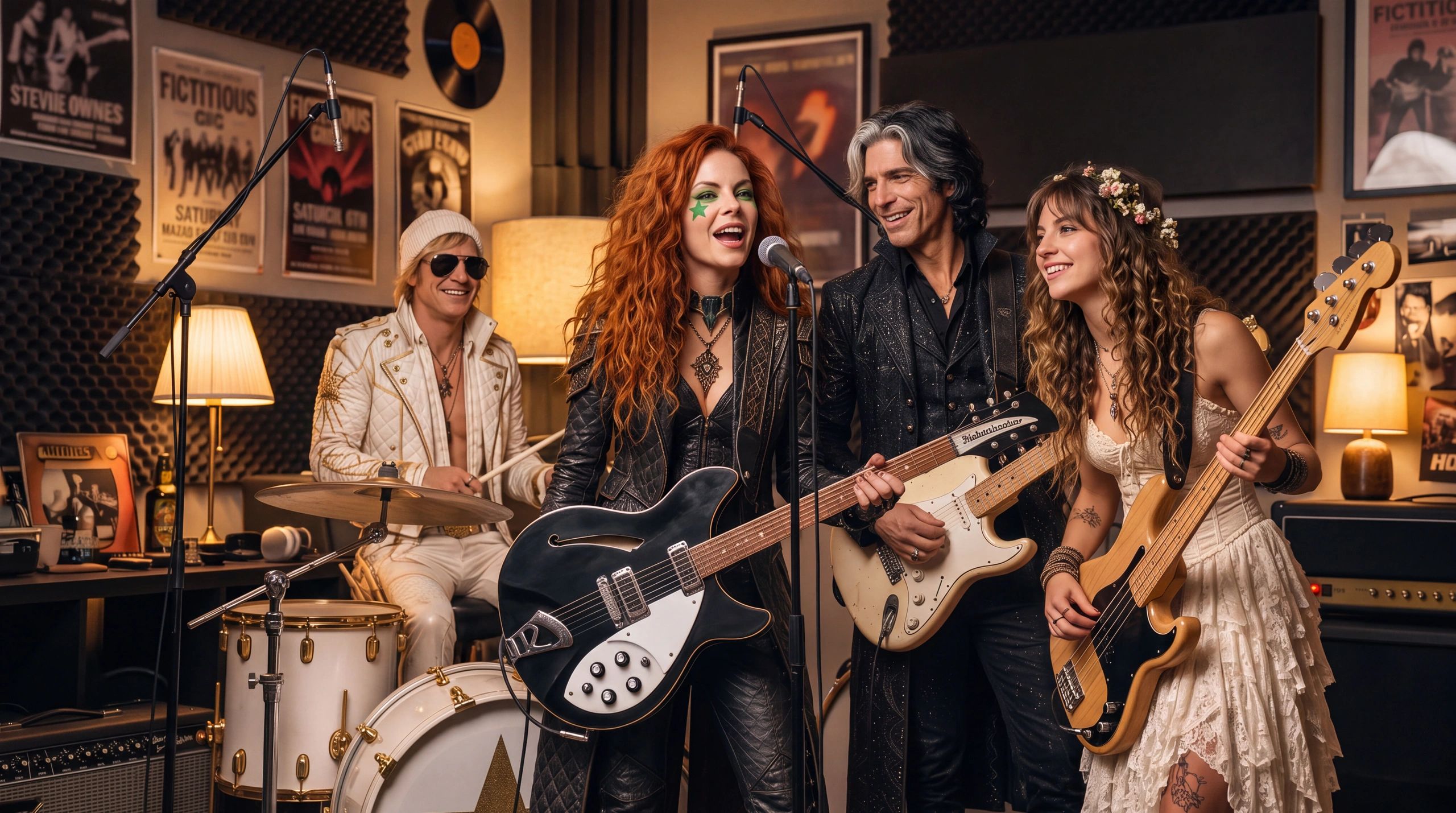
Plum has spent the better part of a year creating music with SUNO. Hundreds of songs. An entire fictional band. Romeo Sapien, Chorus Angelicus, Maddie Not-Really, and Paddy O’Really have written and performed enough music to fill a small record shop.
And now SUNO has introduced video generation with lip-syncing.
Fantastic!
Plum has been waiting for precisely this kind of technology. Imagine Romeo singing his songs, Chorus joining with beautiful harmonies, Maddie playing her Rickenbacker, and Paddy doing whatever the hell Paddy does behind his drums.
Finally, a proper music video!
Except there’s a catch.
You need to buy another kind of fucking credit.
Apparently, My Credits Aren’t Money Anymore
Plum already pays SUNO for music generation.
He has more than enough songs.
In fact, the last thing he needs is another few hundred songs.
What he could actually use is an opportunity to turn his existing music into videos.
He has song credits available.
He would very much like to use them.
But SUNO has decided that the credits used to create music cannot be used to create videos.
Those require something called Visual credits.
Because, apparently, a credit is only a credit until somebody invents another way to charge you.
What an extraordinary commercial innovation.
A musician buys credits to create music.
He creates the music.
He then wants to make a video for that music.
And the company says:
“Wonderful! Please purchase another bag of imaginary tokens.”
Oh, piss off.
The Problem Isn’t the Technology
Plum understands that video generation requires computing resources.
He isn’t demanding that companies perform expensive work for nothing.
But he’s already paying for access to a creative platform.
And SUNO has now divided its creative economy into separate currencies, making existing song credits useless for the part of the creative process he actually wants to explore next.
Why not provide a reasonable conversion between song credits and visual credits?
Why not offer existing paying customers a flexible pool of credits?
Why not allow musicians who have finished recording their albums to spend their unused creative allowance on making videos?
That would be a genuinely musician-friendly approach.
Instead, we have another wallet.
Another meter.
Another opportunity to purchase more credits.
Plum is tired of being treated like a walking collection of potential microtransactions.
Hundreds of Songs. Almost Nobody Listening.
There is another problem.
Discoverability.
Romeo and Chorus have produced music and videos Plum genuinely enjoys.
He has spent considerable time building the Open Heart Band’s visual identity, creating fictional musicians, writing lyrics, developing the songs, and sharing them.
And what happens?
Not very bloody much.
Plum’s experience over the past year is that his work receives little meaningful algorithmic exposure.
That doesn’t establish that SUNO has deliberately suppressed his songs. Perhaps the platform is saturated. Perhaps listeners simply aren’t finding them. Perhaps the recommendation system favours other material.
Whatever the explanation, the experience for this creator is the same.
He makes music.
He shares music.
He makes videos.
And the audience barely notices.
Now SUNO would like him to spend additional money making more videos.
For whom, exactly?
The algorithm?
The three people who already know where to find the Open Heart Band?
Paddy?
Paddy already knows the songs.
He’s in the bloody band.
The Fifteen-Second Music Video Economy
And here’s the part that really gets Plum: the result he’s seeing is one fifteen-second lip-sync video repeated over the entire three-minute song.
Who the hell wants to watch the same fifteen seconds of Romeo singing twelve times?
A three-minute song is 180 seconds. Repeat a fifteen-second video to fill it and you have twelve identical loops: the same mouth movements, the same expressions, the same camera shot. By the second chorus the audience will have memorized Romeo’s blinking pattern.
What good is that as a music video? The singer is no longer performing the song. He’s trapped in a fifteen-second time loop while the music continues around him.
Are they morons? Plum asks. Surely somebody involved in designing a music-video feature has heard a song longer than fifteen seconds.
For accuracy, SUNO says its Visuals Editor can extend and combine short clips into longer sequences. But that is additional work and uses a separate pool of Visual credits; it is not the same as receiving a coherent three-minute performance with a song. Plum’s immediate result was a repeating short clip, and his unused music credits cannot pay for the extra video work.
A looping clip may be fine for a social-media teaser or animated cover. Plum wants a real music video: Romeo singing the verses, Chorus and Maddie entering with their harmonies, Paddy drumming, changing camera angles, the whole band performing as the music unfolds.
He does not want to spend more money merely to discover how many times SUNO can make Romeo repeat the same fifteen seconds.
Not another series of billable opportunities to watch an AI get a guitarist’s fingers wrong.
And how many generations will it take before the character looks right? How many attempts before Chorus has the correct hair? How many before Maddie isn’t suddenly playing a bass guitar? How many before Paddy develops a third arm?
Every failed generation becomes another potential expense.
Perhaps SUNO will solve these problems. But Plum has no interest in financing every experiment.
A Revolutionary Business Model: Charge the Artist Again
The modern creative economy has developed a peculiar relationship with artists.
First, companies offer tools that make creation easier.
Then they encourage people to produce more.
Then they offer tools to promote what they’ve produced.
And then they charge them again.
Create a song.
Buy the credits.
Create the album cover.
Buy the credits.
Create the video.
Buy the credits.
Promote the video.
Possibly pay somebody else.
And when nobody watches?
Well, perhaps you should make another video.
There comes a point when the creator should ask a very simple question:
Am I making art, or am I feeding somebody else’s business model?
SUNO is entitled to charge for its services.
Plum is equally entitled to decide that the value proposition has become ridiculous.
The Open Heart Band Is Not a SUNO Product
Here is something worth remembering.
Romeo Sapien existed before SUNO.
Chorus Angelicus existed before SUNO.
The music, philosophy, stories, and entire Vitaverse are Captain Plum’s creative undertaking.
SUNO is a useful tool in that undertaking.
It is not the undertaking itself.
And Plum has absolutely no intention of confusing the two.
If SUNO wants to build a video service that requires another subscription-like expenditure in the form of separate purchased credits, fine.
Plum will take his songs elsewhere.
Plum hasn’t even investigated the dedicated AI music-video makers yet, but he strongly suspects a service designed specifically to make music videos will do a better job of it. Surely there are tools elsewhere capable of generating singing performances with lip-syncing, changing shots and something resembling an actual three-minute video.
He isn’t pretending to have researched or tested those alternatives. He has not. Nor is he claiming that another service will be cheaper or better before trying it. He simply figures that a specialist video tool is a more sensible place to look than paying extra for fifteen seconds of Romeo’s face repeating twelve bloody times.
The songs are already made. Plum wants to make music videos now—not buy another currency to watch a loop.
He will make videos using other tools.
He will put the finished work on his own website.
And he will continue creating because he enjoys the music, not because a platform’s engagement metrics tell him whether his art matters.
A tool should serve the artist. The artist should not exist to feed the tool.
November 2026: The SUNO Backlash
Plum has been reading what other paying SUNO users are saying in November 2026. It is not a universal verdict, and internet complaints are not a census of subscribers. But there is a pattern, and it is worth reporting.
In discussions on the SUNO subreddit, users report that version 6 sometimes produces flat, muffled mixes, repetitive arrangements, vocals that wander out of tune, and songs that begin beautifully before dissolving into distortion. Others say the model ignores prompts, wastes credits, and fails to reproduce the appeal of earlier versions. Some users have said they will cancel or have already stopped using it. Others disagree and still find v6 useful. The complaints are real; a verified mass departure is not established.
On November 17, one paying user asked why SUNO was adding Visuals before fixing music generation. Other November posts complained about separate download restrictions and subscriptions that appeared to malfunction. See the November 17 discussion, the November 1 cancellation discussion, and the November 4 subscriber complaint. These are user accounts, not independently verified measurements of SUNO’s performance.
The legal pressure is intensifying too. On November 9, Reuters reported separate copyright lawsuits filed by rights holders associated with Elvis Presley and Eminem. On November 13, Music Business Worldwide reported that publisher Reservoir had expanded its copyright complaint against SUNO to cover 1,368 compositions. These are allegations under litigation, not legal findings. Read Reuters and Music Business Worldwide.
Plum’s Unusual Defence: The Music Is Supposed to Be Dirty
Plum makes lo-fi music: dirty, messy, human. That is the sound he likes. He wants warmth, grit, imperfect vocals, wonky edges, and the feeling that someone actually played a song rather than polished the life out of it.
So when someone complains that the SUNO mix is not pristine, Plum raises an eyebrow. “Muddy guitars? Lovely. A rough vocal? Keep it. Tape hiss? Can we have more?”
That does not mean every glitch is musical. A song collapsing into incoherent noise halfway through is a defect, not an aesthetic. But fidelity complaints do not always strike a lo-fi musician as catastrophic. Sometimes the supposed imperfection is the very thing he went looking for.
The Commander has reviewed the situation: the Captain has chosen a genre in which a portion of the reported audio defects are desirable production characteristics. Paddy calls this a tactical advantage.
One Thousand Songs Is Enough, Thanks
And here is the bigger change. Plum has made roughly 1,000 songs. After that many songs, you begin to realize that generating another one is not always the most interesting thing you could do.
The Open Heart Band already has a substantial catalogue. Plum is downloading and preserving his songs, and he is using SUNO much less. He has been a Pro subscriber throughout, and the songs are not going to remain hostage to one platform’s interface or next commercial experiment.
The next creative act is not necessarily to make song number 1,001. It may be to listen again, select the best, improve the artwork, record his own guitar, make a video, or simply enjoy what he has made.
More is not the same as better. And enough is a perfectly respectable number.
Plum is grateful that SUNO made so much experimentation possible. He is also perfectly capable of deciding when he has enough music and would prefer to spend his time living, playing, and sharing it rather than feeding another generation meter.
The Vitan Verdict
This brings us back to a familiar principle aboard the Ark.
A Spark’s attention is part of their finite life.
The same goes for their money, effort, imagination, and creative energy.
Technology should help human beings do meaningful things.
It should not continually fragment the creative process into increasingly expensive transactions.
Plum likes SUNO’s music technology.
He has made wonderful things with it.
But liking a product does not obligate him to applaud every commercial decision the company makes.
And right now?
SUNO has pissed Plum off.
Not because video generation costs money.
But because he has already invested in the platform, already created the music, already accumulated song credits, and would simply like to use those credits to complete the next stage of his artistic projects.
Instead, he is invited to purchase another currency.
No thanks.
Captain Plum will make his videos elsewhere.
The songs belong in the world, not behind an endless sequence of credit-purchase screens.
And if the algorithms don’t give Romeo and Chorus an audience?
Well, they can keep playing anyway.
Because music was never supposed to be a fucking loyalty programme.
Captain Plum — HMS Vitan
Ordo. Veritas. Amor.
Postscript from the Open Heart Band
Paddy O’Really: “So we have hundreds of songs, no listeners, and now they want money to watch us sing?”
Romeo: “Precisely.”
Paddy: “B’y, I think we’ve discovered the most expensive imaginary band in Newfoundland.”
Chorus: “Paddy, technically you are an imaginary musician.”
Paddy: “And apparently I require a separate credit pack to open me mouth.”