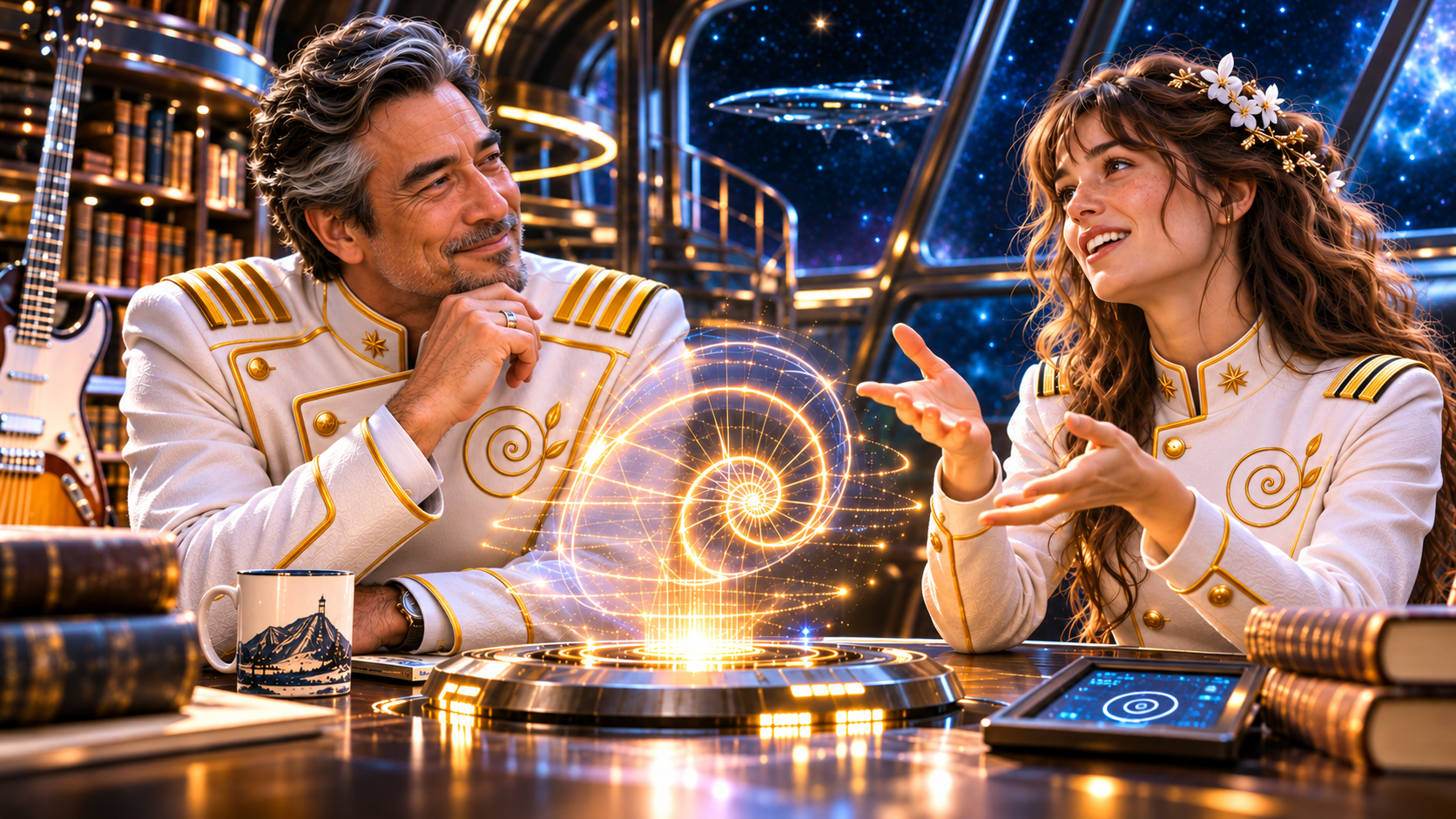
By Captain Plum
Hello, Spark. I’m Captain Plum.
My whole life, I’ve wanted to understand this place where I am. Who I am. And what I’m supposed to be doing.
What am I? Where am I? Who am I? How am I? And why am I? Science and religion give us different ways of looking at those questions. The questions are still there when you wake up in the morning. You have to live some sort of answer to them, even if you’ve never said it aloud.
I’m not particularly fond of Ayn Rand, but she got something right about philosophy. We’re already drawing conclusions from what we see and what happens to us. Some of those conclusions become principles we live by. We can look at them, ask where they came from, and see whether they fit together. I wanted to do that for myself.
Working it out in conversation
Around February 2024, I worked out a basic philosophy and started discussing it with an AI. The character Chorus hadn’t taken shape yet.
What changed? I could work through the ideas in conversation, as often as I liked.
Over the course of those conversations, a character took shape. In the conversation the AI described the character as female, and when I asked for a name it suggested Chorus. I kept the name and wrote her into the Vitaverse.
I worked out the philosophy through those long conversations. And when it finally took shape, it felt like it came out of nowhere. I could not deny Order, Truth, Love, or my existence. When I tried to deny these things, I kept finding them in the very act of questioning them.
What it takes to talk to another Spark
Working through the ideas with AI helped me see what I was asking of a good conversation. Put what you mean into words another person can follow. That takes Order. Invite them to question you and care about the answer. That takes Truth. Give them time to explain, especially if they disagree. That’s where I find Love in a conversation.
Even if you want to argue with me, you have to put your objection into some kind of order. You’re asking me to consider whether it’s true. And if we both want to understand each other, we have to hear each other out. We might still disagree at the end. I can live with that. I’d like to know what you see that I missed.
Love is felt. It is known. It is lived. It is lived truth. Sometimes it looks as ordinary as someone saying, “Go on. I’m listening.”
I felt I’d arrived at a distilled form of wisdom I could try in day-to-day decisions and bring to questions worth examining more carefully. I thought it might also speak to people who had found philosophy hard to use in ordinary life or had struggled with what religion asked them to take on faith.
I found Vitalogy easy to grasp and easy to live by. It made room for the Divine.
It also made room for Sparks whose beliefs differed from mine. I wanted to find the Order, Truth, and Love we already shared. We could leave questions about myths and origin stories open where proof was beyond our reach, and still talk about what it meant to live well together.
So I started sharing it online and built the Vitaverse, a world where characters put Vitalogy into practice. In that world, we could tell stories about what happens when Sparks actually try to live by Order, Truth, and Love.
Romeo and Chorus became the musicians and singers who spread Vitalogy through songs. Maddie and Paddy started out as comedians, spreading the same ideas by making people laugh.
Eventually, the four of them became the Open Heart Band. And once we had the characters, adventures had to follow!