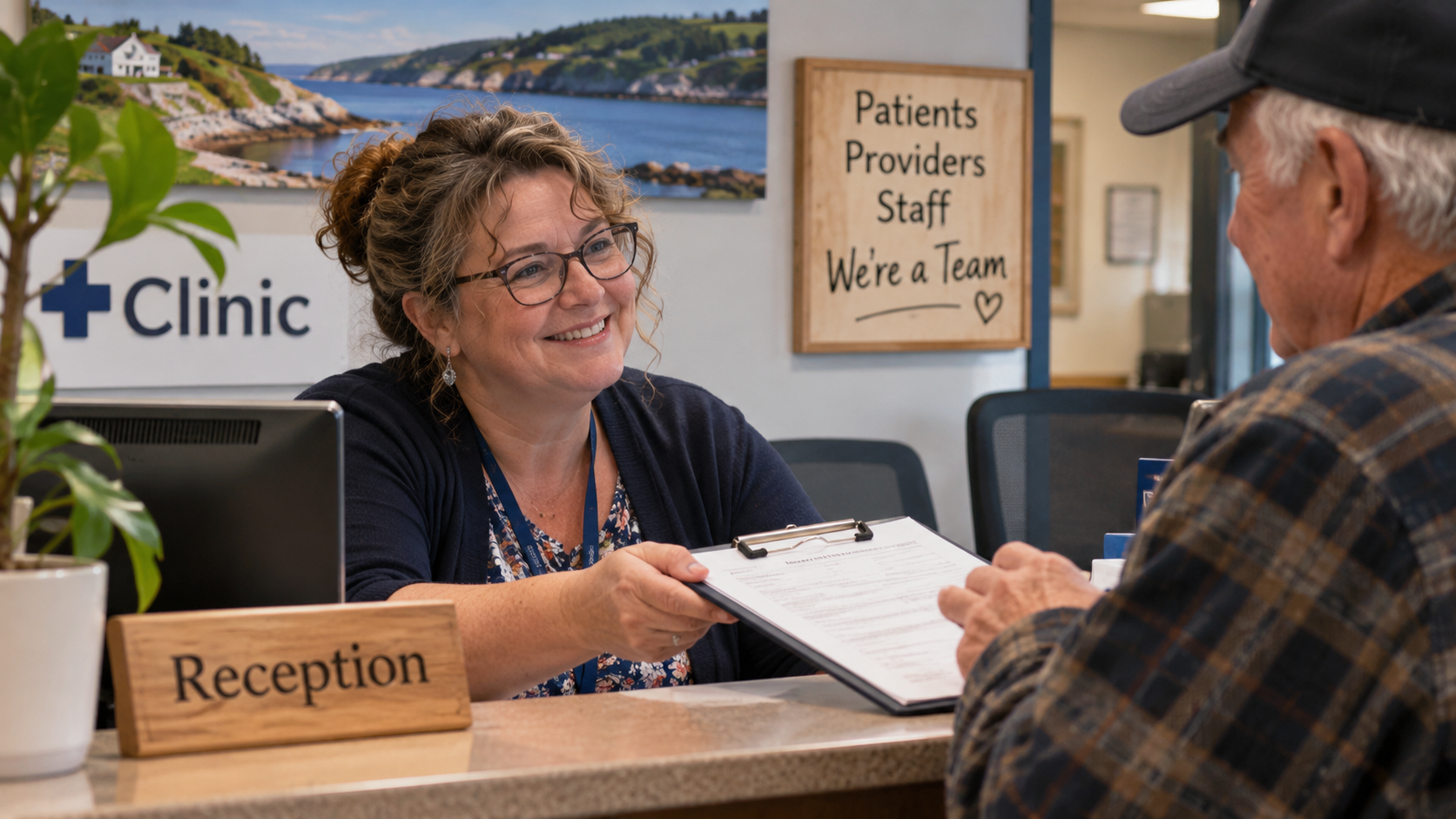
By Captain Northman Plum — Missionary Work Newfoundland. An appreciation of the people at the front desk who absorb the frustration of a struggling healthcare system.
There is a group of healthcare workers Captain Plum believes deserves considerably more recognition than they receive. They do not wear white coats. They do not perform surgery or prescribe medications. They do not receive much public applause. But without them, many medical clinics would descend into chaos before morning coffee.
The receptionists.
Plum has worked with many receptionists over his decades in medicine. He has always tried to treat them with kindness and respect. And he appreciates something patients, physicians and especially administrators may overlook: the receptionist is often the first person to absorb the anger produced by a failing healthcare system. Frequently, they have the least power to change it.
The Voice on the Telephone
The telephone rings. Somebody needs an appointment. Another wants bloodwork results. Another has been waiting for a specialist. Someone needs a prescription. Someone has been told there are no appointments available. And somebody is furious.
The receptionist answers politely. They cannot manufacture an appointment, hire another physician, shorten the surgical waiting list or repair Newfoundland’s healthcare system from behind a desk. But they are expected to absorb the frustration anyway.
The person with the least authority becomes the person who hears the most complaints. Plum finds that deeply unfair.
Plum Hears It Happening
Plum has heard the conversations. He has heard patients venting at reception staff in person and on the telephone. He has watched receptionists remain polite while being treated in ways he would never accept in an ordinary social interaction. And he has seen people leave reception jobs because the experience became too much.
Imagine taking a job answering phones, organizing appointments and helping patients, only to quit because the abuse became unbearable. What a dreadful waste of good people. And what a terrible way to run a healthcare service.
The Receptionist Is Not a Nurse
One of Plum’s greatest concerns is the way receptionists are increasingly expected to perform something resembling medical triage.
A patient calls with chest pain. Another says their child has a fever. Another reports that their mother is confused. The receptionist is expected to decide where the caller goes.
But receptionists are administrative professionals, not clinicians trained to determine whether a symptom represents an emergency. Medical triage is a clinical responsibility and belongs with appropriately trained clinical staff. Receptionists can follow emergency escalation scripts and connect callers to qualified assessment, but they should not be left making clinical decisions—or blamed for dangerous decisions they were never trained to make.
Give busy clinics reliable nursing or other appropriate clinical triage support. Protect the receptionist. Protect the patient.
And Then There Are the Managers
Why is the telephone ringing unanswered? Why is the doctor running late? Why hasn’t this form been completed? Why is the waiting room full? Why hasn’t the appointment list been updated?
The receptionist is caught between frustrated patients, busy physicians and managers concerned about productivity. Everybody wants something immediately. Meanwhile, the receptionist has one telephone, two hands and a finite supply of patience.
Perhaps management should occasionally spend an entire shift answering the phones. Plum suspects it would be educational.
The Quiet Acts of Kindness
The small gestures are easy to overlook: patiently giving directions to an elderly patient, helping someone whose English is limited, reassuring a worried parent, finding a wheelchair, checking why someone has been waiting so long, remembering a familiar face.
These moments rarely appear in productivity statistics. Nobody counts how many frightened people were comforted, how many arguments were avoided through patience, or how many patients felt less alone because the person at the desk was kind.
A good receptionist contributes something essential to healthcare: humanity.
A Message to Patients
Plum understands the frustration of not being able to get an appointment or prescription. He shares it. But the receptionist did not decide how many doctors would work today, determine clinic budgets, or design the provincial healthcare system.
If the clinic is understaffed, ask management why. If primary care is inaccessible, seek answers from those empowered to improve it. But please don’t take your anger out on the person answering the phone. They may be having a worse day than you realize.
Kindness isn’t something patients owe only to doctors. It is something we owe to one another.
A Message to Physicians
Treat reception staff as colleagues. They manage interruptions, appointments, records and messages so that you can concentrate on clinical care. They often absorb frustrations you never even hear about.
Listen when they say the workload is unmanageable. Support them when patients become abusive. Don’t ask them to make clinical judgments outside their training. And remember to thank them. A genuinely good receptionist is worth far more than the job title suggests.
A Message to Administrators
If receptionists are leaving because of abuse or excessive workload, something is wrong with the working environment. Recruit enough people to handle the calls. Establish clear procedures for threats and abusive behaviour. Make clinical escalation available. Provide breaks, training, clear instructions and supportive management.
Most importantly, ask receptionists what would improve their working lives—and listen.
A healthcare system that cannot look after its own receptionists has some serious thinking to do about its commitment to caring for people.
The First Human Face of Healthcare
The receptionist sits at the entrance to the healthcare system: the first voice, the first face, the first person a patient meets. Increasingly, they stand between the public and services that cannot always provide what the public needs.
It is an extraordinarily difficult place to be. They deserve support, respect and recognition. Plum tries to be kind not because he is doing receptionists a favour, but because he respects them and has seen what they endure.
The Forgotten Heroes
To the people answering the phones, organizing appointments, listening patiently to complaints, helping elderly patients, calming frightened families, and staying kind even when kindness is not returned: thank you.
And to those who finally walked away because the job became too much: you deserved better. You were never supposed to be the shock absorbers for an entire healthcare system.
Before raising your voice at the front desk, remember that the person there is another human being. They have a family, worries and a life beyond that desk. They’re probably doing their best.
The receptionist is not your enemy. The receptionist is not the doctor’s servant. The receptionist is our colleague, our neighbour and a fellow Spark.
We are all on the same team. Maybe the healthcare system would become a little more humane if we started treating one another that way.
Captain Northman Plum — Missionary Work Newfoundland
Order. Truth. Love.
No Spark is cargo. No angel is property.
And no receptionist should have to spend their working day being somebody else’s punching bag.