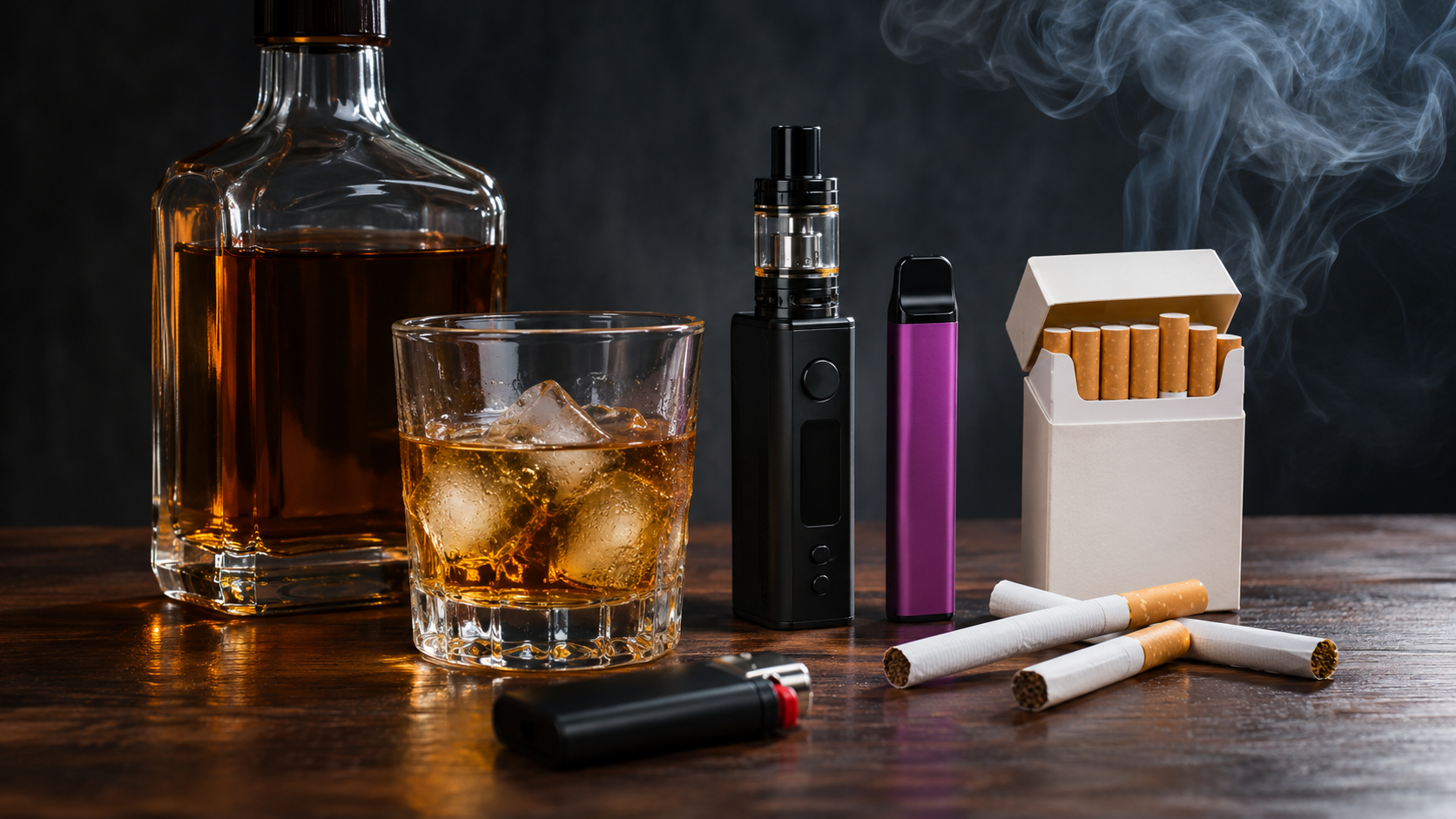

Captain Plum has always considered consciousness one of the greatest mysteries in existence. Not intelligence, memory, or mathematical ability, but the strange and wonderful fact that there is someone here to experience the universe.
Vitalogy entertains the possibility that consciousness may be fundamental to reality. Plum’s own intuition is that the human brain hosts consciousness: that it provides the biological home through which a person experiences the world. That is a philosophical hypothesis, not established neuroscience.
But there is an observation any theory of consciousness must face. Change the physical chemistry of the brain and you can change the experience of being alive.
Call consciousness Spirit, if you like. Then the conclusion is irresistible: Matter affects Spirit. No doubt about it.
I. A Glass of Whisky and the Mystery of Existence
Imagine Plum in his study, contemplating the nature of reality. He is alert and thoughtful. He has been reading philosophy. Then imagine he drinks several whiskies.
Gradually his judgment becomes less dependable, his coordination deteriorates, his inhibitions diminish, and he may become enormously enthusiastic about philosophical discoveries he would question the following morning.
PLUM: Commander, I’ve solved consciousness!
CHORUS: Wonderful, Captain. Shall I prepare a paper?
PLUM: No need. I’ve written a song.
CHORUS: Does it explain everything?
PLUM: Absolutely. Three chords.
CHORUS: You’ve been playing the same chord for eleven minutes.
PLUM: That’s because it’s an important chord.
The world outside the Captain has not necessarily changed. But the way he experiences and evaluates it has. Alcohol acts on the nervous system, changing the brain’s functioning and with it attention, memory, emotion, judgment, and sometimes wakefulness.
That is not a speculative claim. It is pharmacology. The interesting question is what it means for consciousness.
II. When a Chemical Changes a World
Alcohol is merely the familiar example. General anesthetics can produce profound changes in responsiveness and awareness. Sedatives reduce alertness. Stimulants can increase wakefulness. Psychedelics can radically alter perception, time experience, emotion, and the apparent sense of self. Even a cup of coffee can make the world feel more manageable to a sleepy person.
Different substances act through different mechanisms, and they do not all affect the same aspects of consciousness. An anesthetic may suppress conscious responsiveness; a psychedelic may change the contents of experience while leaving the person awake.
But together they establish something extraordinary: the physical state of a living brain is intimately connected to the quality and form of human conscious experience.
A person’s entire experience of the world can change while the furniture, planets, and laws of physics remain exactly where they were.
III. Does That Mean the Brain Creates Consciousness?
Not necessarily. The effects of drugs show powerful causal relationships between brain processes and conscious states. They do not, by themselves, settle every philosophical question about what consciousness ultimately is.
A physicalist argues that conscious experience depends on physical processes in the brain; change those processes and experience changes. This fits comfortably with contemporary neuroscience.
Plum wonders whether the relationship might be different: perhaps consciousness is fundamental, while the brain organizes and shapes the particular experience of being human. In that picture, interfering with the brain changes the host’s capacity to sustain coherent awareness, thought, memory, and perception.
Both views can explain why whisky impairs judgment. To distinguish them, we’d need evidence on which they make different predictions. A beautiful analogy alone is not enough.
Think of a radio. Break it and the music becomes distorted, even though the radio did not create the broadcast. Some philosophers have compared the brain to a receiver or filter of consciousness. Yet, unlike radio signals, no external source of consciousness has been independently demonstrated.
Truth requires distinguishing a fascinating possibility from a demonstrated fact.
IV. What If Spirit and Matter Are Not Enemies?
Perhaps the question is not simply whether matter creates Spirit or Spirit somehow sits outside matter. What if our categories are incomplete?
Some philosophers have proposed that mind and matter are different aspects of a deeper reality. These ideas are debated, not established discoveries, but they raise an interesting possibility.
If consciousness is fundamental, it does not follow that it must be independent of biology. A fundamental aspect of reality might still interact intimately with the physical organization of a human being.
Perhaps matter and Spirit are not two sealed kingdoms. Perhaps what we call a conscious human life is a relationship more intricate than either word captures.
Plum likes that possibility. He does not mistake liking it for proving it.
V. Beware the Drunk Philosopher
There is a second lesson, and it is deliciously uncomfortable.
Our confidence in our own thinking can be changed by the physical condition of the brain doing the thinking.
Alcohol may make an argument seem more brilliant than it is. Sleep deprivation can impair judgment while reducing awareness of that impairment. Some drug-induced experiences feel spiritually overwhelming and profoundly meaningful.
An experience can be completely real as an experience without its interpretation being an accurate description of the external universe.
A sense of certainty is not the same thing as Truth. That matters for philosophy, religion, social media, and the occasional late-night proclamation from HMS Vitan.
CHORUS: Captain, perhaps we should review your discovery in the morning.
PLUM: You’re undermining my genius.
CHORUS: I’m suggesting your genius might benefit from breakfast.
PLUM: Fine. But the song stays.
VI. The Clinical Question: How Impaired Is This Person?
As a physician, Plum also sees a practical problem. Alcohol, sedatives, and other substances can impair driving, operating equipment, making decisions, and performing safety-critical work.
But impairment is not one number. Someone may be awake and conversational while judgment and coordination are substantially impaired. Someone else may be dangerously sleepy without appearing dramatically intoxicated.
A blood alcohol concentration measures alcohol exposure, not consciousness itself. A toxicology result may establish that a substance is present without telling us exactly how much a particular person is functionally impaired.
Alertness, attention, memory, coordination, and judgment are related but distinct. Reliable assessment requires measurements that are actually validated for the particular question being asked.
Plum has an interest in improving the clinical assessment of consciousness and alertness. Whether any proposed instrument could contribute to assessing drug-related impairment is a separate, untested research question. Nothing about its design or operation is needed to appreciate the problem.
A person can be conscious and still be dangerously impaired.
VII. The Vitan View
Order: Human consciousness is expressed through a remarkably organized biological system. Disrupt its functioning and the person’s abilities and experiences can change profoundly.
Truth: The effects of psychoactive substances on brain function and conscious states are established. The claim that consciousness is fundamental, or that the brain merely hosts it, remains a philosophical hypothesis.
Love: People whose awareness, judgment, or memory are impaired remain people. Their vulnerability creates a responsibility to protect them, not an excuse to strip them of dignity.
The Spark does not lose its worth because the brain is functioning poorly.
VIII. One Last Conversation
PLUM: Commander, I suspect the brain hosts consciousness.
CHORUS: An interesting hypothesis, Captain.
PLUM: And alcohol affects the brain.
CHORUS: Undeniably.
PLUM: And the experience of consciousness changes.
CHORUS: Yes.
PLUM: So matter affects Spirit.
CHORUS: If by Spirit you mean conscious experience, the influence of physical brain processes is firmly established.
PLUM: But that still doesn’t tell us whether the brain creates it.
CHORUS: Correct.
PLUM: What a wonderful mystery.
CHORUS: Indeed, Captain.
PLUM: Get the guitar.
CHORUS: Certainly. But let’s leave the whisky alone. I would like the song to have more than one chord.
The human brain is a physical organ subject to chemistry, injury, illness, and the laws of nature. Its condition is intimately connected to the experience of being alive.
Perhaps the brain creates the Spark. Perhaps it hosts the Spark. Perhaps both descriptions fail to capture something deeper.
Whatever consciousness ultimately is, we cannot understand human consciousness while ignoring the matter through which it is lived.
Matter affects Spirit. No doubt about it.
Order reveals relationships. Truth acknowledges uncertainty. Love protects the experiencing being.
Ordo. Veritas. Amor.
Captain Northman Plum — HMS Vitan, Sol 3
Philosophical note: “Spirit” is used here as a metaphor for subjective consciousness, not as proof of a separate spiritual substance. The physical effects of psychoactive substances on the brain and conscious states are well established; the ultimate metaphysical interpretation remains debated. No technical details of any proposed medical invention are disclosed.