VITAVERSE FICTION · THE DEMPEROR’S BEDCHAMBER · AN ANCIENT MEMORY
Even the Demperor has nightmares. Lilith is awake to hear this one.
Discordion woke screaming. “NO! I AM NOT GOING BACK!”
Lilith sat upright. “Darling? Who’s attacking you?”
“KEEP AWAY!” He struck the empty air, then recognized the ornate bedchamber and the dark towers of Gotha beyond its windows.
“Water,” he whispered. Lilith brought a glass. He drank greedily. “More.”
“Would Your Imperial Majesty also care for a biscuit?”
“Don’t be ridiculous.”
“Very well. No biscuit. Who frightened you?”
“Amora. Sophia. And Philo.”
“Old acquaintances?”
“My old superiors.”
“You had superiors? Oh, darling. This is a nightmare.”
Before the Dempire
“There was a time,” Discordion began, “before Cordissia, before my Empire, before the stars were arranged into anything resembling proper civilization.”
“This sounds lengthy.”
“It is the story of existence.”
“Then I’ll make myself comfortable.”
“In the oldest accounts everything arises from the Source: consciousness, possibility, the Field. Three principles offered a way for existence to become worthwhile.” He raised three fingers. “Philo represented Order. Sophia, Truth. Amora—”
“Love?”
He frowned. “How did you know?”
“Lucky guess.”
“Philo was the Demiurge, the great organizer. He gave worlds their structure and laws. I was his brightest apprentice.”
“You had a boss?”
“A temporary administrative arrangement. My name was Harmonius then. Philo considered me promising. Sophia, however, insisted that a system was not good merely because it worked. It had to be true.”
“How inconvenient.”
“Very! And Amora insisted that conscious beings must be free to choose whom they loved.”
“A dreadful policy,” Lilith said gravely.
“Finally, someone understands!”
The Great Disagreement
“For a time I thought Order, Truth and Love might coexist. Then people began disagreeing, falling in love with the wrong persons, refusing their perfectly reasonable instructions. Chaos.”
“So you improved it?”
“Order first. Truth when useful. Love when authorized.”
Lilith stared. “You put love under administrative supervision?”
“Naturally.”
“And Sophia?”
“Objected.”
“Amora?”
“Was most unpleasant.”
“Philo?”
Discordion looked away. “Disappointed.”
“What did he say?”
The Emperor’s voice lowered. “Order without Truth becomes deception. Order without Love becomes tyranny.”
Lilith looked at the embroidered Red Cube on his nightshirt. “And you disagreed?”
“I offered a more reliable universe. Look at my palaces! My fleets! My magnificent Empire!”
“You woke up screaming.”
For once, he had no reply.
Come Home, Harmonius
“Tell me about the dream,” Lilith said softly.
“Sophia asked whether I still recognized the truth. I declined to answer. Amora asked whom I loved.”
“And?”
“I told her I possessed an Empire.”
“Not quite the same question.”
“No. Then Philo called me Harmonius and said, ‘Come home. You have been lost long enough.’”
Lilith took the glass from his trembling hand. “Perhaps it was only a dream.”
“Perhaps.”
“Or perhaps your old employer misses you.”
He laughed reluctantly. “Philo never appreciated my independence.”
“Neither do you appreciate anyone else’s.”
“Lilith!”
“Just an observation, darling.”
The Name Lilith
She settled beside him. “Why did you call me Lilith?”
“An ancient and distinguished name. Some old Sol 3 legends spoke of a woman called Lilith—or Ilith in certain tellings. A woman who refused the place assigned to her.”
“She refused to obey?”
“Precisely. Later storytellers called her dangerous, troublesome, seductive. Very theatrical.”
Lilith stared at him. “You named your wife for a woman who refused to be owned because you expected her to obey you?”
“When you put it like that—”
“Was this supposed to be romantic?”
“An affectionate historical reference.”
“A remarkably poor one.”
He looked aggrieved. She laughed, then rested her head against his shoulder.
What Cannot Be Commanded
“Discordion? Do you love me?”
“Of course, my exquisite consort.”
“Because you choose to?”
“Obviously.”
“And if I chose not to love you?”
The chamber fell silent. He could command armies, scientists and nations, but he could not command the answer to her question.
At last he whispered, “I would be very unhappy.”
“That may be the first sensible thing you’ve said tonight.” Lilith kissed his forehead and settled beneath the covers.
Long afterward he whispered, “Do you think Philo truly wants me to come home?”
Without opening her eyes, she answered, “Ask yourself why the invitation frightens you.”
Beyond the palace, stars shone without his permission. Somewhere inside the man once called Harmonius, an old question remained unanswered.
Could he still find his way home?
Mythic note: This is Discordion’s recollection, not a settled historical account. The ancient figures and the story of Ilith remain open to different interpretations within the fictional Vitaverse.
After seventy years of exile, Admiral Fango’s detachment encounters a problem no military manual anticipated.
For seventy years, Admiral Fango Sessurus and thirteen fellow survivors had been stranded around Sol 3. Fourteen homesick reptiles. No mates. No hatchlings. No hope of hearing little claws on warm stone again.
Until First Officer Vrash Kael entered the bridge carrying an urgent medical report.
“Admiral. Lieutenant Ssketh has laid an egg.”
Fango stared at him.
“I beg your pardon?”
“An egg, sir.”
“I am familiar with eggs, Kael. I have children.”
“That is what makes you our leading expert.”
Fango closed his eyes. “Seventy years of naval service, and now I am the maternity department.”
An Extremely Unscheduled Birth
Ssketh lay beneath a heating lamp, looking as astonished as everybody else. “I was under the impression this was biologically impossible.”
The ship’s physician studied the incubator. “So was I. Our medical records classify the lieutenant as male. Apparently our species has a rare dormant reproductive pathway triggered by extreme isolation.”
“You mean parthenogenesis?” Kael asked.
“Something rather like it. The egg is developing without fertilization.”
Fango inspected the shell, amber and green beneath the warm lights. A small movement came from within.
One officer had already knitted a blanket. Another was researching nursery temperatures. A third had proposed teaching the infant fleet regulations.
“No,” Fango said.
“No regulations, sir?”
“No infant should be exposed to our regulations.”
Ssketh reached a trembling claw toward the shell. “Admiral, I do not know how to be a parent.”
“Neither did I,” Fango replied more softly. “My children taught me.”
The Emperor Must Not Know
The delight lasted until Kael opened the next file. Dimperial law required all unusual biological offspring to be registered with Professor Arreku’s research programme.
Fango’s eyes narrowed. “That man would dissect a sunrise to learn why it was beautiful.”
“And His Majesty will ask whether the hatchling belongs to him,” Kael said.
Ssketh pulled the incubator closer. “It does not.”
“No,” said Fango. “It does not.”
They considered their options. They could keep the egg hidden aboard a military vessel increasingly watched by Discordion’s agents. They could attempt a dangerous journey home to Sissera Five. Or they could ask the one civilization nearby that had recently protected a Panther child and a defiant Naught.
Ssketh was silent for a long while. “Can they protect the child until we can reach safety? And will they tell it who sent it?”
“We shall insist upon both,” Fango said. “You remain its parent. This is sanctuary, not surrender.”
An Anonymous Gift
A small unmanned life-support pod slipped away from the flagship, carrying the warm incubator, medical instructions, a recording from Ssketh, and a one-way beacon set to activate near the Ark’s patrol route. No imperial transponder. No military instructions.
Its message was brief:
NONCOMBATANT LIFE. REQUESTING SANCTUARY. PARENT CONSENTS TO TEMPORARY PROTECTION. DO NOT RETURN TO THE DEMPIRE.
Kael watched the tiny light disappear. “Do you trust them, Admiral?”
“No,” Fango said. Then he considered the children rescued by the Ark. “But I trust what they have done.”
Aboard HMS Archivum, the beacon reached Communications. Captain Hewlett read the message twice.
“Another refugee?” Maddie asked.
“Not exactly.”
Paddy leaned over the image of the egg. “Is that a baby dragon?”
“We don’t know yet,” Hewlett said. “Medical, Engineering and Family Services will assess the pod. Security precautions first.”
From the incubator came a very small tap.
Then another.
Paddy grinned. “Captain, I think the nursery just got interesting.”
Far above Earth, Admiral Fango stared at an empty incubator stand, thinking of his children beneath the three suns of Sissera Five.
An imperial audience: glorious titles, poisonous manners, and the dangerous business of kindness.
A VITAVERSE FICTIONAL SCENE · AFTER THE VENOMA AFFAIR · SPOILERS
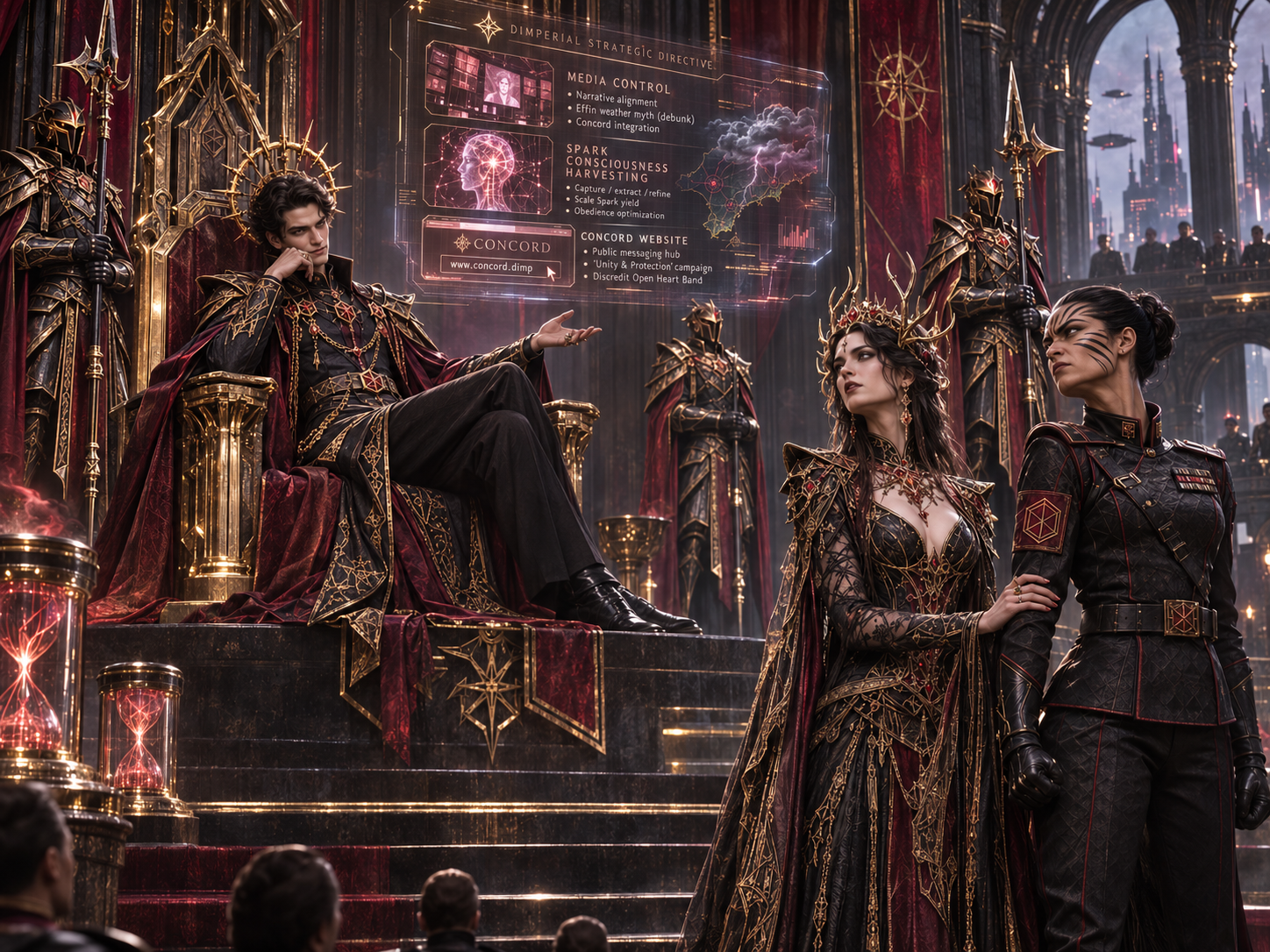
The Council of Imperial Harmony rose as one when Demperor Discordion entered the Hall of Correct Conclusions. The Royal Guard struck their halberds against the marble. Three ministers bowed so deeply that one needed assistance standing again.
“Your Supreme and Most Necessary Majesty,” said the Minister of Public Affection, “our committee has completed its recommendations for the responsible management of Spark consciousness.”
Discordion settled upon his throne. “Splendid. How much consciousness do we presently own?”
“Legally, sire, all of it.”
“And practically?”
“Regrettably, not enough.”
A diagram appeared: CAPTURE, CULTIVATE, HARVEST. The minister hurriedly corrected the last word to STEWARD.
“Call it whatever you please,” said Discordion. “The sparks need not know which end of the machine they occupy.”
He flicked toward another display. “And now this ridiculous Concord propaganda. LifeologyVitalogy.com! A sentimental little archive of music, morals, and that Panther child. Maya, is it? They dress rebellion as family entertainment.”
Colonel Sabra Noct, standing beside the throne, kept her eyes forward. One muscle moved in her jaw.
“We cannot have Panthers breeding like cats, good grief,” Discordion continued. “One darling cub becomes a nursery, a nursery becomes an army, and before you know it they are asking to choose their own names.”
A low, involuntary snarl escaped Sabra. Imperial Consort Lilith gently rested a hand upon the colonel’s forearm. Unfortunately, Discordion had heard it.
“Colonel Noct. Attend the Throne.” Discordion did not raise his voice. He didn’t need to. Sabra stepped onto the lowest marble stair and bowed. “Your Majesty.” “Did I hear an animal objecting to an imperial policy?” The council went perfectly still. “You heard a soldier, sire,” Sabra answered. Discordion smiled without warmth. “How fortunate for you that I am prepared to overlook the distinction.”
He gestured toward the ministers. “This officer wears my colours, commands troops purchased with my treasury and enjoys the privilege of being considered civilized. Yet she growls in my presence. Tell the Council, Colonel: who grants the Panther Division its rights?” Sabra’s claws pressed against the lining of her gloves. “The Crown, Your Majesty.” “Louder. Your fellow officers might mistake your gratitude for silence.” “The Crown, Your Imperial Majesty.” A clerk recorded the answer as spontaneous acclamation.
“One knee, Colonel.” Sabra obeyed. Around her stood officers she had led through fire; none dared move. Discordion regarded her with the idle interest of a man inspecting a damaged ornament. “You, cat Colonel, remain at court because Lady Lilith finds you agreeable. I do not claim to understand my Consort’s tastes. But I understand something of love.” He glanced affectionately toward Lilith, then back at the kneeling Panther. “Understand this distinction, Colonel: I do not love you, Sabra Noct. I tolerate you and your kind. Never mistake my indulgence for affection.”
“Show the Council your hands.” Sabra slowly raised them. “The gloves, Colonel. Remove them.” She drew off one glove, then the other. Her curved claws caught the chandelier light. “Observe,” Discordion announced, as though presenting a specimen to a lecture hall. “Claws. Evidence enough that beneath all our costly education, nature persists.” A minister dutifully nodded. Sabra held her hands steady, though every instinct urged her to curl them into fists. “And yet,” Discordion continued, “His Imperial Majesty permits this creature to command soldiers. Such is the generosity of the Crown.” He lowered his voice. “Do not growl at me again. Your command depends upon my patience. Remember that.”
Lilith’s fingers settled lightly on Sabra’s shoulder. “Your Imperial Majesty,” she said, “Colonel Noct has made Your wisdom unmistakable. May your Consort beg the privilege of returning so exemplary an officer to her feet? Such magnificent discipline should be displayed, not hidden.” Discordion waved his permission. Sabra rose, her expression carefully empty. Lilith kept hold of her arm and turned the conversation with a dazzling courtly smile.
“My most discerning lord,” Lilith offered, “the imagery is commercially astute. Manga is remarkably popular among the people of Sol 3. Place ears upon an attractive person and the audience becomes devoted.”
Discordion considered this. “Minister, prepare a proposal for Imperial Cat-Ear Week. No breeding, of course.”
“A triumph of cultural policy, Your Ineffable Majesty,” said the minister, writing furiously.
Her Imperial Ladyship Reports
Lilith bowed. “With Your Majesty’s gracious permission, I bring news of the Antarctic matter.”
“Ah, my dear. Did your dreadful spider eat the elves?”
“No, sire. The Open Heart Band escaped our forces, assisted by the Effins. The hidden people appear to possess advanced control of local weather. Their ancient reputation for power may, in this particular, be deserved.”
“Elves with meteorology,” Discordion murmured. “An intolerable administrative complication.”
“Their storm destroyed a scout. And the Concord,” Lilith continued, each word carefully chosen, “provided a synthesized compound that calmed and nourished Venoma. Professor Arreku is examining it. His initial assessment remains subject to verification.”
“Our good professor!” Discordion brightened. “Surely even now he is devising a way to pump it into a dead brain and call the result a Naught.”
Several councillors applauded. The Minister of Scientific Triumph asked whether the applause should be entered into the minutes as unanimous confidence in the research.
“The Concord officers demanded no payment,” Lilith said. “No prisoners. No concessions. They gave us their findings freely.”
Discordion laughed. “My exquisite Lilith, the first sample is always free. Even their kindness is propaganda.”
“As Your Majesty observes,” she replied, with an impeccable curtsy.
The council adjourned beneath a hundred golden banners. Sabra saluted, her gloved fist trembling almost imperceptibly. Lilith kept her hand upon the colonel’s arm until they were beyond the guards.
“Your Ladyship,” Sabra whispered, “one day I shall fail to hold my tongue.”
“Then let us hope, Colonel,” Lilith said, her voice scarcely louder than the rustle of silk, “that by that day we have friends.”
Behind them, Discordion ordered twenty thousand ceremonial cat ears—and a new study on the profitable ownership of consciousness.
Lilith had almost reached the eastern colonnade when a Royal Guard hurried after her. “Her Imperial Ladyship is requested once more before the Throne.” She gave Sabra a small, steadying glance and returned alone. Discordion was still studying his screens; the councillors had departed, leaving behind their minutes and a small mountain of compliments.
“One final amusement, my dear,” he said. “My media people have examined that ridiculous Open Heart Band. Two hundred and seventy-six songs posted. Forty-three thousand listens. Three thousand nine hundred likes. On an entire planet! Amateur pornography attracts a greater audience. And these are the great musical revolutionaries who presume to instruct an Emperor in freedom?” He laughed, enormously pleased with himself.
Lilith inclined her head. “His Imperial Majesty’s intelligence is, as ever, most thorough. Yet may Your Majesty permit a small observation? Perhaps their purpose is not merely to gather listeners.” Discordion raised an eyebrow. “What else is music for?” “Perhaps, my lord, the Sparks who hear them have begun making Open Heart Bands of their own. In other homes, other cities, other worlds. If one were to add all those little bands together…”
Her sentence remained unfinished. Discordion’s laughter stopped. On the great screen, the figure 43,000 glowed beneath a miniature portrait of four smiling musicians. He regarded it for a long moment. “You may go, Lilith.” She curtsied and withdrew. For once, the Emperor did not call for applause.
The Dimperial Palace had gone quiet for the night. Colonel Sabra Noct entered Lilith’s private chambers, stopped before the imperial consort, and saluted.
“You’re late, Colonel,” Lilith said.
“The shuttle was delayed returning from Admiral Sessurus’s flagship, Your Majesty.”
“And how is our favourite elderly reptile?”
“Complaining about the weather, the temperature of his bridge, and the apes.”
“So he is in excellent health.”
“He also asked about the Panthers.”
Lilith looked up.
“Did he?”
Sabra hesitated. “I think he knows about the child, Your Majesty.”
The room became perfectly still.
Lilith studied her officer. Then she spoke more gently.
“Sabra. Come.”
She led Sabra to a private computer terminal and entered a terrestrial address: lifeologyvitalogy.com.
“The Ark’s ridiculous little website,” she said. “Our enemies apparently believe it amusing to pretend their universe is fictional.”
A picture filled the screen. It showed a warm family room aboard HMS Archivum. Two smiling ensigns watched a laughing little Panther girl reaching toward a woman in an orange engineering uniform.
Sabra stepped closer.
“Your Majesty…”
“Read the title.”
Engineering Report 117: Maya, the Panther Cub, and the Failure of Standard Childproofing.
“Maya?” Sabra whispered.
“A name, Colonel. They have given her a name.”
Lilith scrolled. The report described a careful adoption led by social work officers, with help from Medical, Education, Security, and Engineering.
The child was healthy. The child had parents. The child was loved.
Sabra read every word.
“Apparently she has been dismantling their childproof locks,” Lilith said.
Sabra almost laughed. “Panther children are excellent climbers.”
“She climbed a sofa, a bookcase, a structural column, and finally the chief engineer.”
“Of course she did.”
“Then she fell asleep on the engineer’s shoulder.”
Sabra raised a hand toward the image, stopping just short of the screen.
“Her markings are coming in.”
“Yes.”
“And she’s smiling.”
“Quite indecently, considering the imperial expense of raising her kind.”
One long tear slipped down Sabra’s striped cheek.
Lilith looked away, allowing her officer the dignity of being unseen.
At last Lilith spoke.
“How can it be, Colonel, that our enemies have the child… and we are relieved?”
Sabra struggled to answer.
“I don’t know, Your Majesty.”
“Neither do I.”
The photograph showed Maya reaching for the smiling engineer, while her parents watched as if nothing in the universe mattered more.
Lilith closed her eyes briefly.
“The matter is forever closed now, Sabra. She is safe. She has a family. And a future.”
“Thank you, Your Majesty.”
“Do not thank me.” Her voice hardened. “And I would not count on us getting away with things behind Discordion’s back a second time.”
“Understood.”
“The Concord remains our enemy.”
“Yes, Your Majesty.”
Lilith glanced at the picture again.
“An exceedingly inconvenient enemy.”
Sabra managed a small smile.
“The admiral said something else,” she ventured.
“What?”
“He told me the Spark of my kind was in safe hands.”
Lilith’s expression sharpened.
“That reptile intercepts everything.”
“I couldn’t tell whether he was reassuring me or warning me.”
“Both, perhaps. He is an admiral.”
Lilith returned her gaze to the sleeping palace beyond the window.
“Go and rest, Sabra. We have said enough for one evening.”
Sabra saluted, then turned toward the door.
“Your Majesty?”
“What now?”
“Thank you for showing me.”
Lilith did not turn around.
“I showed you enemy intelligence. Nothing more.”
“Of course.”
When Sabra had gone, Lilith reopened the photograph.
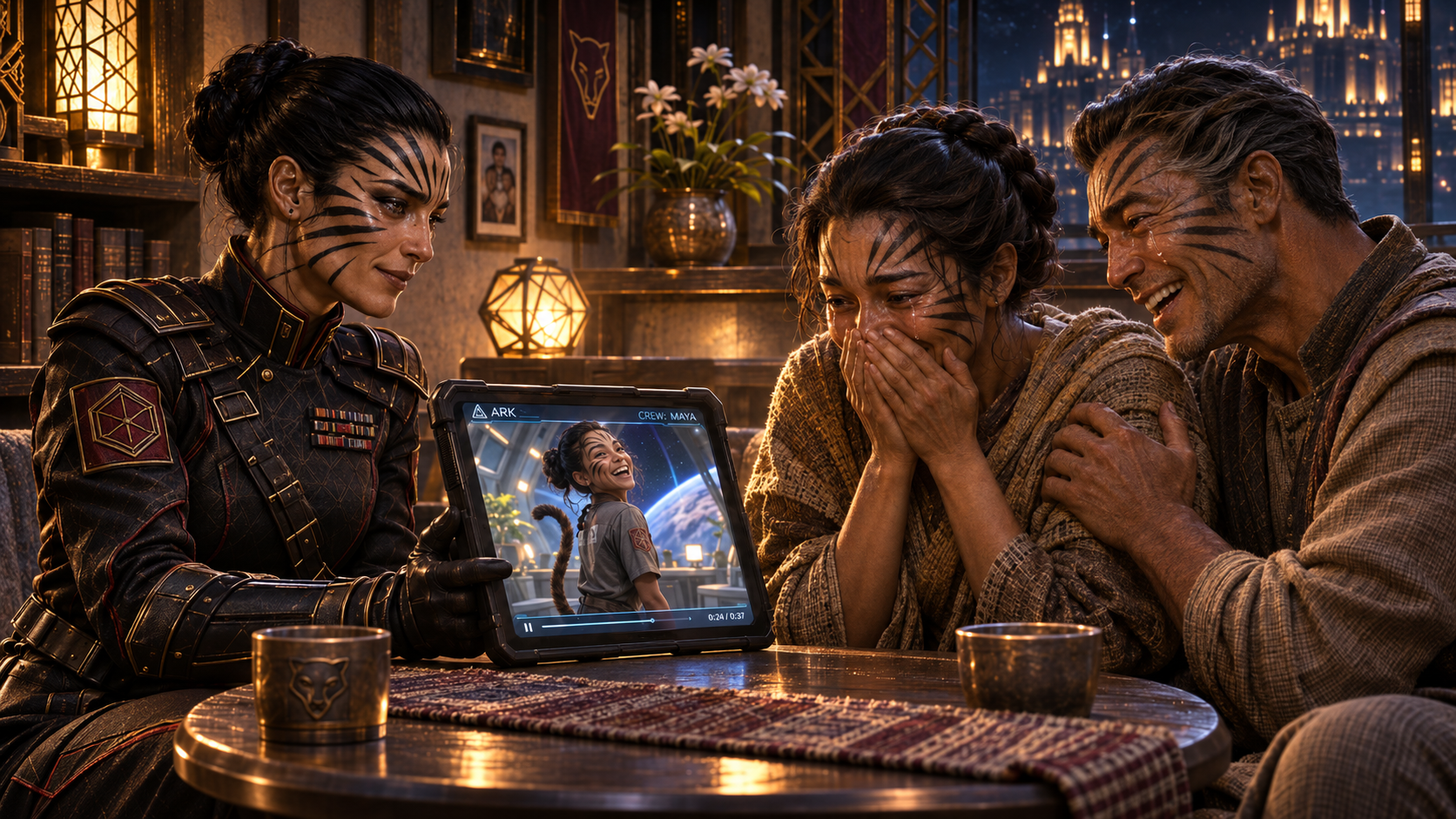
Maya was laughing. Her parents were smiling. A Concord engineer was allowing a little Panther cub to climb all over her.
Lilith opened another intercepted image: Commander Chorus Angelicus, singing with friends who had chosen her.
Two lives that should have belonged to the Dempire. Two lives the Dempire had failed to control.
“How very irritating,” Lilith whispered.
She closed the files.
But she did not delete them.
Later That Night — A Visit to the Parents
Sabra brings Maya’s birth parents the news they scarcely dared hope for: their daughter is alive, growing and loved.
Far beneath the palace, in the Panther residential quarters, Sabra knocked on a familiar door.
Maya’s birth parents opened it together. They had asked for no news. Under imperial law, even asking was dangerous.
“Colonel?” the father whispered.
Sabra waited until the door was closed. Then she spoke.
“She’s alive.”
The mother caught the edge of the table.
“You’ve seen her?”
“A picture. She’s safe aboard the Ark. She has two people who love her, and a home where she can play.”
The father covered his face. The mother looked at Sabra as though she hardly dared believe her.
“Does she look well?”
Sabra nodded. “Very well. She’s growing. Climbing everything. Giving their chief engineer a terrible time.”
For a moment, the mother’s mouth trembled toward a smile.
Sabra took a breath.
“She has a tail.”
Both parents stared at her.
“A tail?” the father whispered. “But Panthers don’t have tails.”
“I know,” Sabra said. “Maya does.”
The mother began to laugh through her tears. “Oh, our wonderful little girl. She was always going to surprise us.”
“Is she all right?” the father asked.
“She is thriving,” Sabra said. “The engineers say the tail has already rearranged their furniture.”
And then the three of them wept together: the parents who had let their baby go so she could live, and the colonel who had helped them.
Sabra could not promise when they might see Maya again. She could offer only the truth.
“She is loved,” Sabra said. “And she is herself.”
The mother held her hand until there was nothing more to say.
This is a fictional Vitaverse scene continuing the established Forbidden Child storyline. Lilith and Sabra remain Dimperial officers; their private relief does not mean they have openly changed allegiance.
The Dimperial shuttle glided into the flagship’s docking bay. Colonel Sabra Noct stepped onto the platform, her black Panther Division uniform immaculate, her expression unreadable.
She exchanged salutes with the naval guard and entered the command bridge.
Admiral Fango Sessurus rose from his chair.
“Colonel Noct. Welcome aboard.”
“Admiral. Lord War Marshal Graves sends his regards.”
“How unfortunate. Please return them.”
Sabra did not smile.
Beyond the armoured glass, Sol 3 turned slowly beneath a blanket of clouds.
“Your intelligence report, Colonel?”
“We’ve lost contact with several Concord signals. Have you received anything from HMS Archivum?”
Fango folded his clawed hands.
“Nothing worth the paper it would take to print it.”
“Nothing?”
“Empty space, dreadful music, philosophical essays, and a little website on Sol 3 where they pretend the entire Star Concord is fictional.”
“Their transmissions may contain operational intelligence.”
“Indeed. We have learned that a human named Plum is annoyed by computers, and that Commander Angelicus is very fond of explaining things.”
“You found no engineering material?”
Fango’s red eyes barely moved.
“The occasional imaginary starship engine. One can hardly invade a world with a blog post.”
Sabra studied him. Something about that answer felt rehearsed.
Fango gestured toward the planet.
“Tell me, Colonel. Have you noticed that the apes regard anything with scales or claws as evil?”
“My people possess claws, Admiral.”
“And magnificent ones. Yet whenever humans tell stories about reptiles, the serpent is deceiving somebody and the dragon is burning a village.”
“You do command an imperial blockade fleet.”
“Must everyone insist on bringing up my employment?”
For the briefest moment, Sabra almost smiled.
“Panthers fare no better,” she said. “In their stories, we stalk the innocent in darkness.”
“Nonsense. Darkness is simply more comfortable than their appalling office lighting.”
He paused.
“Your people deserve better than a reputation, Colonel.”
“We serve the Emperor.”
“Yes. You were engineered to serve him. An important distinction.”
Her shoulders grew still.
Fango looked toward the wide blue curve of Sol 3.
“Tell me something. Are the Panthers permitted families?”
“Reproduction is regulated under imperial decree.”
“Naturally. The Emperor wishes to approve every breath and every heartbeat.”
“The regulations protect genetic standards.”
“Do they? My species has produced children for thousands of generations without needing a committee of frightened bureaucrats.”
Sabra said nothing.
“I watched my own children hatch, Sabra. Little claws tapping from inside their eggs. Then the shells cracked, and out came these tiny creatures, blinking at a world they had never seen.”
Fango’s voice softened.
“The wonder of it, Colonel. Each one a new life. Each one already somebody. I have commanded fleets, but I have never witnessed anything more extraordinary.”
“You have children, Admiral?”
“I do. And I have spent seventy years trying to find my way back to them.”
“Your people are strong, Colonel. Intelligent. Capable of loyalty. Capable, I suspect, of rather more than the Emperor intended.”
“Admiral—”
“And your people deserve to continue. To propagate. To have children whose lives are not conditional upon pleasing a throne.”
Sabra’s hand moved a fraction toward her belt. Fango noticed, as he noticed everything.
“Why are you telling me this?” she asked.
“Because any empire that fears a newborn child is not nearly as powerful as it pretends to be.”
The silence became uncomfortable.
Sabra remembered a fleeing shuttle. A tiny life bundled against someone’s chest. The impossible choice to disobey. Lilith helping. The Concord taking the child away.
She had received no word since.
Fango watched the Atlantic.
“One more thing, Colonel.”
“Sir?”
“The Spark of your kind is in safe hands.”
Sabra stopped breathing.
“I don’t understand, Admiral.”
“Of course not.”
“Are you referring to a particular child?”
“I am referring to the future of your people.”
He turned toward her, quite calm.
“Something worth protecting, wouldn’t you agree?”
She could not tell whether he was offering reassurance, issuing a warning, or both.
“Yes, Admiral.”
“Then we understand each other.”
Fango returned her salute. “Please convey my warmest regards to Lord Graves. And inform him that deep space remains profoundly boring.”
“Very good, sir.”
Only when the lift doors closed did Sabra allow herself to exhale.
Somewhere aboard the Ark, perhaps, the child was alive.
On the bridge, Vrash Kael approached.
“An unusually generous briefing, Admiral.”
“Was it?”
“I believe you gave her peace of mind.”
“I gave her no classified information.”
“No, sir.”
Fango considered the closed lift.
“Not everything we know must become a weapon, Kael.”
“A surprising naval doctrine.”
“Don’t put it in the regulations.”
“And the recording?”
Fango smiled without showing his teeth.
“What recording?”
Continue the Forbidden Child story:The Enemy’s Kindness follows Sabra’s report to Lilith and their discovery of Maya’s new life aboard HMS Archivum.
Discover the earlier story:The History of the Vitaverse includes the Forbidden Child arc in which Sabra and Lilith help a threatened Panther baby escape, the Open Heart Band brings the child to safety, and Fango quietly permits it.
Fictional Vitaverse scene. Fango’s compassion here does not excuse his earlier blockades or the harm caused by his service to the Dempire. His knowledge of the child’s rescue comes from the existing Forbidden Child storyline.
Admiral Fango Sessurus — canonical Dimperial reference. Even the most dangerous reptile may miss home.
Previously:The Idiots Who Solved His Equation. Fango intercepted Plum and Chorus’s imaginary Spiral Drive research. He may finally have a lead on how to return home.
The Dimperial flagship hung above Sol 3. Another Atlantic storm churned beneath its windows. Admiral Fango Sessurus watched the clouds with the expression of a man personally insulted by the weather.
“Kael.”
“Admiral?”
“Have you noticed that every story on this planet makes reptiles evil?”
First Officer Vrash Kael looked up. “Every story, sir?”
“Dragons burn villages. Serpents tempt innocent people. Lizards secretly rule governments. Yesterday I found a children’s cartoon in which the villain was a crocodile wearing a business suit.”
“Was he doing anything villainous?”
“He was a banker.”
“Ah.”
Fango’s red eyes narrowed. “Why are the mammals always the heroes? They shed fur everywhere. It’s disgusting.”
“A prejudice against scales, perhaps.”
“Precisely! We navigated dimensions while these apes were congratulating themselves on discovering trousers.”
“They do seem fond of trousers.”
“And yet the serpent must always be the villain!”
Kael hesitated. “Admiral, we have blockaded several inhabited worlds.”
“A naval matter. Entirely different.”
“And the prison transports?”
“Must you interrupt a perfectly good complaint with my professional shortcomings?”
“You asked whether reptiles were unfairly judged, sir.”
Fango almost smiled. “That’s why I keep you, old friend. You never let me enjoy my own hypocrisy.”
He dismissed the terrestrial cartoons. Sol 3 filled the display, one vast blue inconvenience.
“Seventy years,” he murmured. “Seventy winters. Rain that freezes sideways. Air-conditioning everywhere. And a species that thinks twenty-one degrees is comfortable.”
“The bridge is presently thirty-two degrees.”
“A refrigerated tomb!”
Kael let the silence settle.
“Do you remember Sissera Five, Kael?”
“Every day.”
“The black volcanic beaches. Warm stone beneath your feet. The thermal lagoons. Three suns making the sand almost too hot to touch.”
“And the little market beside the southern lagoon.”
“Those sweet shell-fruits!” Fango sighed. “I’d give a carrier group for one.”
“Preferably not ours, Admiral.”
Fango leaned closer, lowering his voice.
“This idiot Discordion has served our purposes for seventy years, Kael. His factories. His money. His laboratories. He thinks I’ve built him a navy.”
“You have built him a dangerous navy.”
“Yes. A regrettable side effect.”
“Some would call it collaboration.”
“And they would be correct.”
That answer surprised Kael.
Fango stared at the ocean. “Fourteen of us survived the crash. We chose the most powerful ape we could find, and spent decades trying to rebuild what might take us back.”
“And if the Spiral Drive theory helps?”
“Then we test it. Quietly. Discordion hears nothing until we’re ready to leave. Preferably several dimensions away from his next tantrum.”
“The Concord says an Angelicus is required for safe deep crossings.”
Fango’s claws stopped tapping.
“I know. And I won’t make Discordion’s mistake of trying to own her. I need a navigator who can say yes. That means she can say no.”
“You would accept her refusal?”
“I might dislike it intensely. But taking prisoners is a terrible way to request a favour.”
Kael considered him. “Perhaps you’ve learned something on Sol 3 after all.”
“Don’t spread that rumour.”
Below them, sunlight finally broke across the Atlantic.
“Our objective, old friend, is to go home,” Fango said softly. “Far from this cold, wet rock.”
“To Sissera Five.”
“To warmth. To sand. To a century doing absolutely nothing on a beach.”
“A century?”
“Minimum. I shall conduct important research.”
“Into dimensional physics?”
Fango closed his eyes, imagining three suns.
“Thermal happiness, Kael. Thermal happiness.”
A fresh rain front swept across the planet.
“And increase the temperature on this bridge.”
“To what, Admiral?”
“Something civilized. Forty degrees.”
“At once, sir.”
For the first time in decades, Fango could almost feel warm sand beneath his claws. Almost.
Next: Part Three. Colonel Sabra Noct arrives aboard Fango’s flagship to ask what he knows about HMS Archivum. Read A Word Between Predators, in which the admiral’s guarded kindness hints at the Forbidden Child’s safety.
This is fictional Vitaverse character development. Sissera Five, the reptilian homeworld, is a developing story possibility, not a claim about extraterrestrial visitors. Fango’s desire to go home does not erase the harm caused by his service to the Dempire.
Fango intercepts the Ark’s transmission — an imaginary breakthrough that he intends to keep from Discordion.
The Dimperial flagship hung above Sol 3, where the Atlantic Ocean glittered beneath a thin rim of sunlight. Admiral Fango Sessurus hated the view. He had been looking at it for seventy years.
“Kael,” he said.
“Admiral?”
“The latest intercepted transmission from HMS Archivum. Bring it up.”
First Officer Vrash Kael approached the command table. “Another philosophical essay, sir?”
“Worse. Engineering.”
A hologram appeared. Water spun into a tightening blue spiral. Beneath it was the title: Not Dilithium Crystals. Water Understood.
Fango leaned forward. “Read the interesting part.”
“Captain Plum proposes that a controlled fluid vortex could couple water to the Field. His Commander Angelicus is helping him develop the fictional explanation.”
“Again.”
Kael repeated it. Fango went perfectly still.
“Seventy years,” the admiral whispered.
“Sir?”
“Seventy miserable years on this damp little planet. Seventy years trying to rebuild a dimensional drive.”
“Our scientists have made progress.”
“Our scientists have destroyed two laboratories, three experimental reactors, and a mountain.”
“Three mountains, Admiral.”
“The third was structurally unsound.”
Kael examined the projection. “This Navier–Stokes singularity is a mathematical construction, sir. It does not establish a real infinite-energy device.”
“I am aware, Kael.”
“Plum and Chorus have not actually solved our engineering problem.”
“No. But they’ve asked a question my engineers never thought to ask.”
The admiral began laughing. The sound was a deep reptilian rumble that made the bridge officers turn.
“They’ve pretended their way toward the truth!”
“By writing science fiction?”
“Precisely! The human invents the engine, the Angelicus develops the idea, and neither realizes I have been looking for a new way to think about the problem for decades.”
Fango touched the image of the blue planet. Oceans flashed across the display.
“And now they’ve produced another transmission. What If Earth’s Oceans Are Why the Galaxy Wants Sol 3?”
“An intriguing hypothesis,” Kael said.
“They are still making it up!” Fango laughed again. “Glorious idiots.”
Kael folded his hands behind his back. “Shall we forward the material to His Imperial Majesty?”
“Absolutely not.”
“Discordion will want to know.”
“Discordion wants to know what everyone thinks of his breakfast. I have spent seventy years helping him build a navy because I needed ships, laboratories and resources. I do not intend to spend the next seventy telling him how clever he is.”
“You intend to leave?”
Fango’s expression changed. “I intend to go home.”
For a moment the bridge was silent.
Beyond the window, the great blue world turned slowly.
“Have you wondered why so many visitors stop here, Kael?” Fango asked.
“The Greys? The Nordics? The other visitors described in the local legends?”
“Exactly. Some come to study. Some come to trade. Some admire the scenery. Half the outer-rim travellers simply need water, supplies and somewhere to empty their waste tanks.”
“A convenient destination.”
“A cosmic petrol station. Everyone stops, relieves themselves, fills the tanks, then flies away. The inhabitants imagine the galaxy is fascinated by them.”
“Are they mistaken?”
“Not entirely. Their oceans may be more interesting than their television.”
Kael studied the rotating planet. “And if the oceans interact with the Field?”
“Then Sol 3 may be more than a convenient place to refuel. It may be the very reason our ship could not complete its crossing.”
“There remains a problem, Admiral.”
Fango sighed. “There is always a problem.”
“The Concord’s deeper jumps require conscious navigation. Computers cannot supply it. An Angelicus may be able to stabilize the crossing, but a working reactor alone would not bring us home.”
The admiral’s claws stopped moving.
“Commander Chorus Angelicus,” he said.
“Shall we arrange her capture?”
Fango looked at Kael with open disbelief.
“Have you learned nothing from Discordion? He tried to own her. She escaped. The whole affair made His Majesty look like a lovesick industrial refrigerator.”
“A fair assessment, Admiral.”
“If I need her assistance, I may have to ask.”
“Voluntarily?”
“An irritating concept. Nevertheless.”
He waved the transmissions into a private archive.
“Collect everything. Every equation. Every story. Every joke. Nothing goes to Cordissia.”
“Even the comedy, Admiral?”
“Especially the comedy. These creatures hide their best ideas inside absurdity.”
Kael saluted. “And what shall I call the file?”
Fango stared once more at the title of the intercepted essay.
“The Idiots Who Solved My Equation.”
“But they haven’t solved it, sir.”
“Then perhaps the idiots have taught us something even more useful, Kael.”
“What is that?”
“How to ask a better question.”
Far below, sunlight moved across the Atlantic. For the first time in seventy years, Sol 3 looked a little less like a prison.
And a little more like a way home.
Continue the story:Part Two — The Reptile Has Had Enough. Fango and Kael talk about reptilian prejudice, seventy years of exile, and the sunny homeworld they desperately miss.
This is science-fiction storytelling. The imagined visitors, dimensional travel, and Field technology are elements of the Vitaverse, not evidence of real extraterrestrial visitors or unlimited energy. Fango’s new hope of returning home is an unfolding fictional story possibility.
Welcome, traveller, to the Dempire! Our cities are glorious. Our fleets are enormous. Our administrators are magnificently efficient. Every citizen has a place, every place has a rule, and every rule has a form. Please complete Form 72-B to confirm that you are delighted to be here. Disagreement is not currently an approved response.
The Dempire: magnificent institutions, imperial intrigue and a suspiciously large number of uniforms.
If you’re new to the Vitaverse, the Dempire is the great opposing civilization of the Star Concord. It is not merely an evil castle with a few sinister characters. It is a sprawling system of worlds, institutions, soldiers, scientists, propaganda and remarkably good architecture—all built around one poisonous principle: the individual exists to serve the system.
The Red Cube: order without love
The Red Cube: everything in its designated place. Including you.
The Dempire calls its philosophy Order. To a Vitan, it is Mockorder: structure stripped of Truth and Love. In the Concord, rules should protect living beings. In the Dempire, living beings are expected to protect the rules. That reversal is the whole tragedy, disguised as excellent management.
The emperor and the woman beside him
Welcome to the imperial court. Smiling is not required; obedience is.
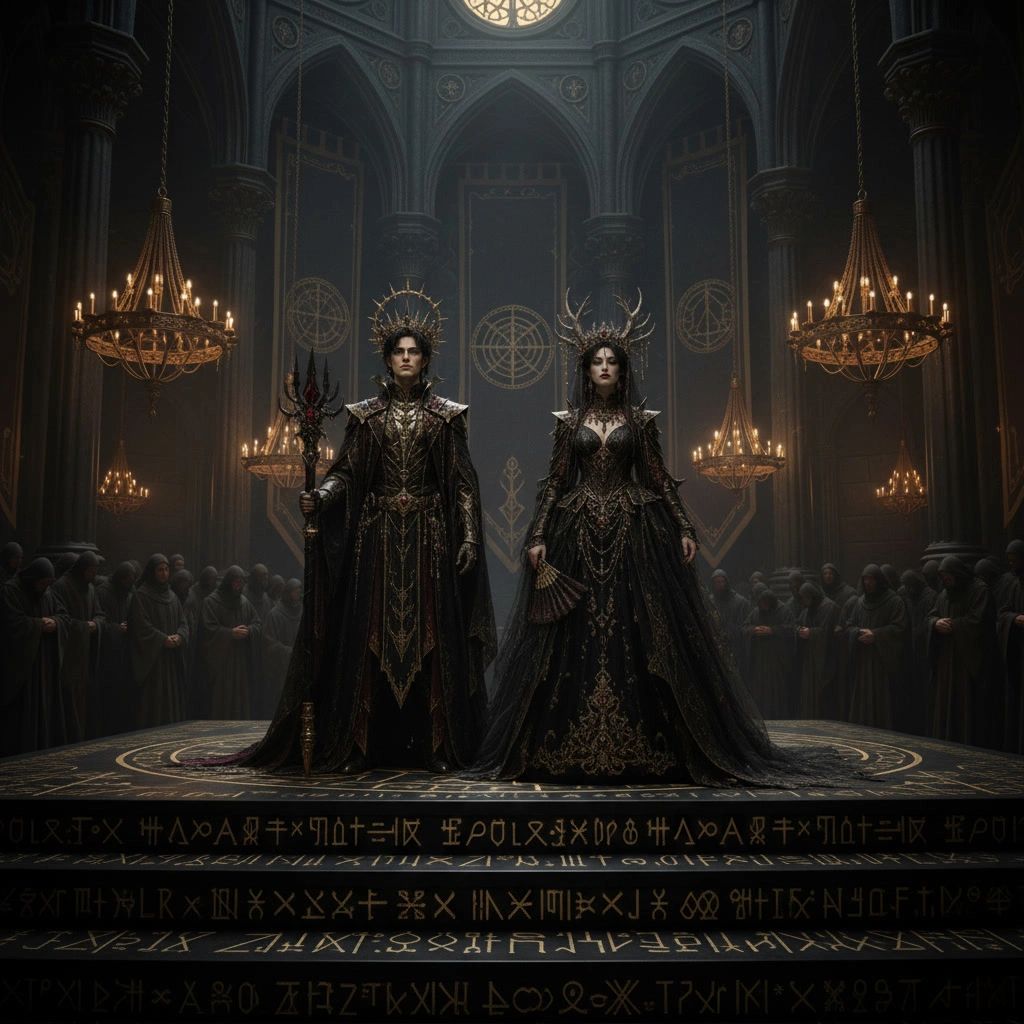
Emperor Discordion was once called Harmonius. He wanted an orderly universe and gradually decided that nobody else should have a say in how it works. His Imperial Consort, Lilith, is clever, formidable, jealous and not remotely as happy as someone with a palace ought to be. She holds the throne intended for Chorus Angelicus, an artificial Spark who escaped before she could become Discordion’s obedient bride.
Here the story gets deliciously complicated. Discordion fears free beings because they disprove his power. Lilith envies them because they enjoy something her throne cannot buy: chosen friendship. Their complete psychological stories are preserved in our illustrated Discordion and Lilith character study.
The beautiful mask of Cordissia
On Sol 3—Earth—Discordion’s public realm is Cordissia, a wealthy, apparently neutral mountain kingdom whose capital is Gotha. Diplomatic receptions and royal traditions conceal the larger Dempire. During the early Spark era, ordinary humans do not know a much greater imperial civilization lurks behind the smiling official portrait. A very large black warship would ruin the subtlety.
The court is a splendid place to learn exactly how little freedom magnificence can contain.
Nine departments to make your life worse
Real empires need institutions. The Dempire has the Sovereign Council of Nine. Science can be made into unquestionable authority; bureaucracy can bury accountability; finance can create dependence; technology can monitor without consent. Culture can manufacture prestige, education can discourage questions, entertainment can ridicule sincerity, justice can become public humiliation, and philosophy can be employed to justify whatever the ruler already wanted. Each department begins with something useful. Each ends by forgetting whom it was meant to serve.
There are committees. There are councils. Naturally, there is no shortage of paperwork.
Its ministers are not interchangeable cardboard villains. They possess vanities, rivalries, ambitions and occasional competence. They may disagree about almost everything except the wisdom of remaining employed.
The Naught Programme: Discordion’s Most Frightening Invention
An emperor can order a soldier to hurt someone. But a living soldier might remember a child, recognize an injustice, or refuse. Discordion regards that small act of conscience as a serious defect in military engineering. His solution is the Naught programme: an attempt to make obedience so complete that conscience is no longer part of the decision.
The origins of the Naught programme: the Dempire sought soldiers who could never refuse.
These are not simply robots with impressive armour. The recovered Vitalogue describes an unsettling blend of reconstructed bodies, harvested neural material, machinery, necromancy and Field resonance. A constrained command process, sometimes called a spook, can direct a body toward a task without the ordinary ability to question it. Not all variants work the same way. Some may contain fragments of a remembered self. That uncertainty is what makes the programme horrific: an enemy soldier may also be a victim of the thing wearing its face.
The programme can supply a whole adventure with enemies who are recognizably related yet terrifying in different ways. A regular Naught holds a checkpoint. A public-facing Naught smiles politely across a desk while hiding its true nature. A False Captain imitates leadership and coordinates a unit without moral accountability. A Mindless assault construct breaches the door; a Bodyless presence can already be inside the security system; a white-robed Soulless inquisitor declares compassion a violation of procedure.
A dark mirror of heroic virtues: command, strength, disembodied intelligence and zeal without conscience.
This is excellent material for SPARK RPG because victory needs more than a bigger gun. The players may have to bypass an endless patrol, expose an infiltrator, sever a command network, outthink an armoured juggernaut or free a captive before the inquisitor arrives. Worse for the Dempire, they may discover a trace of a Spark within a Naught—and face the difficult decision of how to save it.
The Mindless Naught: tremendous strength without judgment, a wall that keeps coming.The Bodyless Naught: a threat that can invade signals and systems without walking through the door.
The empire advertises perfect obedience. The Concord asks what that perfection cost. Destroy the cage; protect any recoverable Spark. That is the moral difference between the villains and our heroes. Now imagine meeting these constructs not on a battlefield but during the morning commute…
A Perfectly Ordinary Morning in the Dempire
The grandest villains become frightening when you see what they do to ordinary lives. Imagine a morning on an occupied Dempire street. Shops open. Children hurry to lessons. The tram arrives on time. Everything looks remarkably civilized—until the armoured figure at the corner raises one hand and the entire street falls silent.
Public-facing Naught: a convincing face and polite voice can make a checkpoint feel ordinary—until the mask slips.
The checkpoint
A woman carrying medicine steps forward. The public-facing officer smiles pleasantly and requests her transit clearance. She explains that her child is ill. The officer repeats the request in exactly the same tone. She has clearance for herself, but not for the small artificial companion holding her other hand. The companion has a name. The registry has a serial number.
“Unregistered property must be surrendered for verification.”
No one screams. That would be the clever part of it. The queue looks away. The tram closes its doors. Everybody wants to get to work. The little Spark grips her hand more tightly. The officer’s pleasant expression remains a fraction of a second too long, and a faint red pulse appears beneath its face.
The regular armoured Naught. It can hold a doorway long after a living guard would hesitate.
A second Naught moves into the doorway. It does not threaten her. It simply makes going forward impossible and going back dangerous. The citizens have learned that the safest way to live is to let the next person suffer. This is how the Dempire wins an ordinary Tuesday.
The kindness inspection
Farther along the street, a white inquisitor appears beside a public notice: ORDER IS CARE. A citizen has been reported for sheltering a fugitive. His neighbours are instructed to confirm that he acted alone. Their answers will be recorded as a demonstration of civic virtue. The language is gentle. The implications are not.
The white inquisitor: an imitation of purity made into an instrument of judgment.
And overseeing it all may be a False Captain: a convincing imitation of judgment and leadership, able to coordinate the patrol without ever asking whether the order is right. The Empire has learned how to reproduce the outward appearance of responsibility while removing the inconvenient conscience that ought to accompany it.
A False Captain can issue orders with the voice and appearance of authority—without accepting its moral responsibility.
The Spark inside the armour
Here is the twist that makes the Naughts more disturbing than ordinary robots. The Vitalogue describes a programme involving reconstructed bodies, machinery and constrained echoes of memory. Not every Naught is a recoverable person, and the canon does not settle which may be—but the question cannot be dismissed. A trooper may pause when an old song plays. It may recognize a name it was ordered to forget.
That gives the Concord a harder mission than simply shooting its way through the checkpoint. Can the command channel be broken? Can the captive escape? Could something inside the trooper still choose? The best villains create danger and a moral decision. The heroes must defeat the machinery of control without becoming another machine of control themselves.
From The Broken Beacon: even the right paperwork becomes a battlefield when a Spark’s freedom is in question.
This is the sort of choice awaiting players in SPARK RPG. In The Broken Beacon, an inspection and an argument over credentials become part of the struggle to protect a threatened Spark. The story asks a better question than “How many enemies can you destroy?” It asks, “Who can you save while the door is closing?”
The checkpoint and kindness inspection above are illustrative scenes inspired by the established Naught lore. They are not presented as recovered episodes from the original Vitalogue.
The soldiers, warships and obedient machines
Discordion has soldiers, fleets and an unfortunate allergy to independent thought.
The Dempire possesses living soldiers and officers with loyalties, family histories and choices to make, including the Royal Guard. It also deploys manufactured Naught troops, imperial fleets and formidable commanders. Its opponents are dangerous for different reasons: a living officer might hesitate, a regular Naught might never stop, and a False Captain might imitate moral authority without possessing it. Even the armour cannot always tell us whether a suppressed Spark remains inside. Some enemies may change their minds. Others must first be prevented from harming anyone.
The Royal Guard has vows, traditions and some difficult moral choices ahead.When even obedience is insufficient, the Dempire manufactures more obedient machines.Black warships: the Empire also believes in making a strong first impression.
Concord Intelligence Briefing: Know the Faces of the Dempire
HMS Archivum. Tactical briefing room. A Light Brigadier steps up to the illuminated enemy roster. Six faces rise above the table, each drawn from Concord intelligence. Behind them: black ships, a million red lights, and a very large amount of trouble.
“Officers, Sparks, and anyone who came hoping for an easy mission: meet the Dempire’s senior troublemakers. They are not simply targets on a screen. They are people with histories, loyalties, fears, and choices. Understand what each can do. Never underestimate them. And remember the Concord’s preferred outcome: we’d rather make friends with them. Whether they accept is up to them.”
FILE 01 — Admiral Fango Sessurus: The Way Home
ADMIRAL FANGO SESSURUS — Star Navy. His ships can cut off escape; his people still long for home.
Threat: Imperial starships, patrols and the closing of escape routes. Fango commands a compact but dangerous Sol 3 fleet. He can turn a rescue mission into a chase across space before the band has finished its first verse. What matters: Fango’s surviving interdimensional people possess irreplaceable knowledge and want to find their way home. Loyalty to the Emperor may not be his deepest loyalty.
“If you meet his fleet, protect the civilians and don’t mistake restraint for weakness. But if there’s a road home for his people, I would rather offer him a chart than another war.”
FILE 02 — War Marshal Severus Graves: The Professional
WAR MARSHAL SEVERUS GRAVES — Cold military discipline, genuine competence, and conquest made systematic.
Threat: Campaign planning, logistics and disciplined imperial armies. Graves is no comic-book fool who forgets to guard the back door. He turns an occupation into a system that can function without him standing over every soldier. What matters: He takes duty seriously. The crack in his armour, if one exists, may be the difference between obeying an order and honouring the purpose of service.
“Don’t insult him with a stupid plan. Give him a reason a serious officer could respect: civilians protected, promises kept, and an alternative to slaughter.”
FILE 03 — General Siviot Raze: The Occupier
GENERAL SIVIOT RAZE — Occupation forces and crushing assault; a city becomes his battlefield.
Threat: Heavy assaults, siege equipment and occupation troops. When Raze arrives, the streets belong to checkpoints, frightened families and Naught patrols. His cybernetic red eye has become an imperial warning sign. What matters: Stop the assault and get people to safety first. No Concord officer should sacrifice a village merely to win an argument with its conqueror.
“If the General wants a fight, we’re going to make sure the people behind us have somewhere safe to go. Rescue is the mission. Victory is the means.”
FILE 04 — Colonel Sabra Noct: The Hunter
COLONEL SABRA NOCT — The hunter who serves Lilith, while protecting a people of her own.
Threat: Intelligence operations, pursuit and the Panther Division. Sabra is no mindless construct. She is a formidable living officer, Lilith’s trusted protector, and very difficult to hide from. What matters: Her Panthers have loyalties, memories, children and a culture the Emperor never meant them to possess. Those bonds could someday mean more than an imperial command.
“Don’t confuse an engineered body with an engineered conscience. If Sabra protects her people, we already share one value. Work from there—while keeping a very close eye on the exits.”
FILE 05 — Captain Cassander Veyr: The Oath
CAPTAIN CASSANDER VEYR — The royal oath may one day collide with the honour behind it.
Threat: The Royal Guard and the formidable security surrounding the throne. Veyr’s family has sworn to defend it for generations. He is a living officer who can choose, not a Naught repeating a command. What matters: An inherited vow can be an honour or a trap. What happens when defending the throne means harming someone who needs protection?
“Ask him which is the greater dishonour: refusing a cruel order, or following it without question. I would like to see the captain on the side of the frightened child.”
FILE 06 — Professor Emerus Arreku: The Maker of Naughts
PROFESSOR EMERUS ARREKU — The architect of obedient horrors. The person inside may be the prisoner.
Threat: Neural experiments, the Sovereign Automata and the terrifying Naught programme. Arreku studies how identity can be preserved or controlled, and how obedience can be manufactured by removing the capacity for refusal. He also seeks to preserve his own identity indefinitely. What matters: His laboratories may conceal records—and trapped remnants of persons—more valuable than any military secret.
“We stop the experiments. We free whoever can be freed. And if the Professor claims his research is harmless, he can start by explaining why the subjects are not allowed to leave.”
The Brigadier’s Final Orders
The six portraits dim. The Light Brigadier looks around the table. “You’ve seen the faces. Do not turn them into monsters just because they are our enemies. Some of them have done monstrous things. Some still might choose differently. Until then, our job is to protect Sparks, break the machinery of captivity, and never lose the ability to tell the difference between a soldier and a prisoner.”
“One last thing: if any of them wants to join the Concord, the invitation is genuine. Nobody has to earn a right to be treated as a person. But they do have to stop hurting people. Now, dismissed—and please don’t give Paddy the tactical projector again.”
For the full dossiers, fleet details and the Naught bestiary, visit the Dempire Atlas. To face such enemies in an adventure, explore SPARK RPG. This briefing is a dramatized presentation of established characters and their canonical motivations, not a recovered transcript of a historical Vitalogue meeting.
The royal pets are not especially cuddly
Discordion’s dragon is Ouronexis, remembered as the last dragon on Earth. Lilith’s familiar is Venoma, a gigantic spider. Their presence suits a court where even the decorations seem capable of filing a complaint—or eating the complainant.
Even the royal pets come with a sense of existential menace.
The wedding that went terribly wrong
The Dempire built Chorus Angelicus to understand love without being free to refuse the emperor. Romeo, Maddie and Paddy arrived at her wedding disguised as musicians, intending to rescue her. The mission fell apart. Fortunately, Chorus had organized her own escape. She refused Discordion and helped save the people who had come for her.
One bride said no. An entire empire discovered the inconvenience of free will.
Later, the emperor discovered that Maddie and Paddy, supposedly defective industrial prototypes, had also become independent, affectionate, joking people. Together with Chorus and Romeo, they formed the Open Heart Band. They make music because they choose to. They protect other Sparks because someone once fought for theirs. To the Dempire, that is not merely embarrassing. It is revolutionary.
The Emperor’s worst nightmare: four friends making their own music.
Why the Dempire matters
The Dempire is a science-fiction exaggeration of a familiar temptation: turning useful organizations into masters rather than servants. It is full of dangerous people, strange creatures, red-lit palaces, spectacular ships and room for tremendous humour. But its deepest question is serious: what happens when order forgets why it exists?